
Research article · 2018 · Full text
International Journal of Statistics and Applied MathematicsA study on particle methods for dispersive equations
Volume 3(6) · Pages 143–145
Research areasNumerical methods in engineeringGrouting, Rheology, and Soil MechanicsFluid Dynamics Simulations and Interactions
Abstract
Author-writtenIn recent years, particle methods have ended up a standout amongst the most valuable and far reaching tools for approximating solutions of partial differential equations in an assortment of fields. In these methods, an answer of a given equation is spoken to by a gathering of particles, situated in points Xi and conveying masses Wi• Equations of advancement in time are then composed to portray the flow of the area of the particles and their weights.
Summary
Source-checkedPlain-language reading of the full paper, prepared with AI and checked against the text. Each point links to the authors' own words.
Why it matters
- Particle methods are highly valuable tools used across various fields to approximate solutions for partial differential equations. View evidence ↗
- The Lagrangian nature of particle methods allows for the effective depiction of small scales in a solution using a relatively small number of particles. View evidence ↗
- Standard numerical methods, such as finite differences and pseudo-spectral methods, often produce spurious oscillations on the fronts of non-smooth structures due to irregularities in derivatives. View evidence ↗
The question
- The study aims to present a primary particle method for approximating solutions to both linear and nonlinear dispersive equations. View evidence ↗
What they did
- The authors introduce the 'dispersion-velocity method,' which is based on a method previously used for parabolic equations. View evidence ↗
- The linear Airy equation is used as the model problem for the linear setup of the study. View evidence ↗
- For the nonlinear setup, the study focuses on the K(m, n) equation, which produces minimally supported solutions with non-smooth fronts. View evidence ↗
- The specific non-linear model problem used in the study is the K(m, n) equation with parameters m = 2 and n = 1. View evidence ↗
What they found
- The authors demonstrate the existence and uniqueness of solutions for the dispersion-velocity transport equation over a short time interval. View evidence ↗
- The theorem for existence and uniqueness requires the initial data to have a bounded derivative, which is then preserved in the resulting solution. View evidence ↗
- In linear cases, the proposed plan demonstrates accuracy and L2 preservation properties. View evidence ↗
- In nonlinear examples, particles representing two compactons moving at different velocities can undergo a nonlinear interaction and emerge while preserving the characteristic phase shift. View evidence ↗
What it means
- The authors conclude that the dispersion-velocity method is the first particle method of its kind for these equations and the first attempt to use particles to directly mimic interactions between solitary waves. View evidence ↗
Visual summary
1 visualsIllustrations explain the paper; they do not show study data.
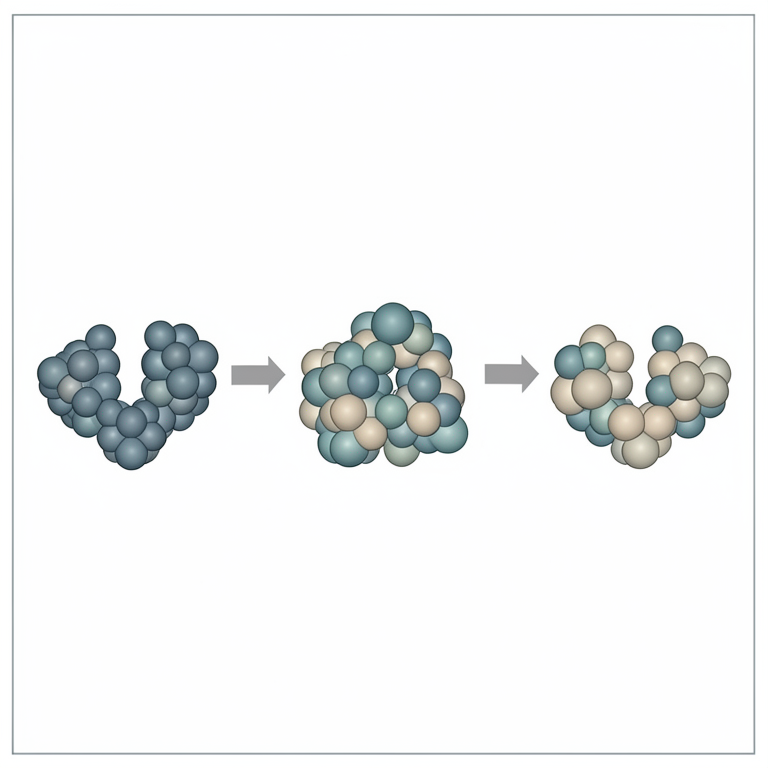
Conceptual Particle Interaction
AI-generated conceptual illustration (discrete particles in a fluid simulation). It explains the idea and does not show study data.
View source evidence ↗Introduction
Due to the Lagrangian way of the method, little scales that may create in an answer can be effectively depicted with a moderately little number of particles. This property is the thing that made particle methods so alluring practically speaking. In this work we display the main particle method for approximating solutions of linear and nonlinear dispersive equations. Our method depends on the dispersion velocity method, which was presented in (Degond P., et al. 2000) for approximating solutions of allegorical equations, and we hence name our new method the dispersion-velocity method. The dispersionvelocity method is the primary particle method to be proposed as such to approximate solutions of such equations. Mo13t imperatively, this is the principal endeavor to'use particles for straightforwardly mimicking cooperations between single waves. Since our beginning stage was a particle method for allegorical equations, we quickly depict a portion of the thoughts that are utilized for such equations. It is for the most part conceivable to separate the particle methods for approximating allegorical equations into two classes: stochastic methods and deterministic methods. The most generally utilized treatment of dispersion terms, the irregular vortex method, was presented by Chorin (1993). There, dissemination was presented by adding a Wiener procedure to the movement of every vortex. Various works took after that spearheading paper. For a far reaching list we allude to the audit paper of Puckett (2003) and the book by Cottet and Koumoutsakos (2000).
An alternate methodology in which particle methods were utilized for approximating solutions of the warmth equation and related models, (for example, the Fokker-Planck equation and a Boltzmann-like equation: the Kac equation), was presented by Russo (2003). In these works, the dissemination of the particles was portrayed as a deterministic procedure regarding a mean movement with a pace equivalent to the osmotic velocity connected with the dispersion procedure. In a taking after work, the method was appeared to be fruitful for approximating solutions to the two-dimensional Navier-Stokes (NS) equation in an unbounded area. In this setup, the particles were convected by velocity field while their weights advanced by. The dissemination term in the vorticity definition of the NS equations.
Particle Methods for Dispersive Equations
Another deterministic methodology for approximating solutions of the illustrative equations with particle methods was presented by Degond and Mustieles (2000). Their alleged dispersion velocity method depended on characterizing the convective field connected with the warmth administrator which then permitted the particles to convect standardly.
For example, the one-dimensional heat equation is rewritten as where the velocity a(u) is taken as -ux/u. Particles conveying settled masses will be then convected with velocity a(u). The merging properties of the dispersion velocity method were explored, where brief time presence and uniqueness of solutions for the subsequent dissemination velocity transport equation were demonstrated. The diffusionvelocity method serves as the basic tool for the determination of our particle methods in the dispersive world. We center our consideration on linear and nonlinear dispersive partial differential equations. Our model problem in the linear setup is the linear Airy equation,
The achievement of particle methods in approximating the oscillatory solutions that create in this dispersive equation, give us important knowledge with respect to the potential implanted in our methodology. In the nonlinear setup, we concentrate on equations which produce minimalistically upheld solutions with non-smooth fronts, the prototype being the K (m, n) equation, which was presented by Rosenau and Hyman (2003). In this equation, a nonlinear dispersion term replaces the nonlinear dispersion term in the Korteweg-de Vries (KdV) equation, coming about with.
For certain values of m and n, the K(m, n) equation has solitary waves which are compactly supported. In particula, the variant K(2, 2), has a fundamental "compacton" solution of the form After the first appearance of the compactons, it turned out that similar structures emerge as solutions for a much larger class of nonlinear PDEs, among which is, e.g., which we consider with m = 2, n = 1 as our non-linear model problem.
In this work we are mostly intrigued by creating tools for approximating numerically solutions of equations which produce non-smooth structures. Because of the irregularity in the subordinates on the fronts of these developing structures, standard numerical methods, for example, limited contrasts and pseudo-ghostly methods create spurious oscillations on the fronts. Controlling these oscillations requires a numerical separating of the higher modes, which may bring about the disposal of fine scales from the arrangement. In addition, in situations where a positive arrangement ought to stay positive in time; the spurious numerical oscillations may bring about the answer for change sign. For this situation, one can fall into a badly postured district of the equation, and the numerical arrangement will stop to speak to the arrangement of the current equation. There have been a few endeavors in the writing. to address the complex numerical issues. For instance, solutions of the compacton equation, K(2, 2), were acquired with limited distinction methods. In (de Frutos J., 2005), these limited distinction methods were appeared to create insecurities on the discontinuous fronts, which were translated there as stuns. In Russo (2003), the arrangement of compacton equations was created by pseudo-ghostly approximations while sifting through the high modes. None of these works introduced a far reaching investigation of the properties of the numerical plan utilized. We might want to offer here an alternate methodology utilizing particle method approximations. The structure of the study is as per the following: we begin in §2 by presenting the new dispersion-velocity method with regards to linear equations. The principle expository result in this segment, where we demonstrate a brief timeframe presence and uniqueness for solutions of the dispersionvelocity transport equation. This theorem requires the underlying information to have one and only limited subordinate and gives the same normality to the subsequent arrangement. We then continue, where we demonstrate how •to make the modification required with a specific end goal to adjust our dispersion-velocity method~ to nonlinear problems. Taking after the discourse over, the inference of our method is done on compacton-type equations, which create structures with non-smooth interfaces. Our numerical method is compressed in §4. For culmination we talk about a few issues identifying with different parts of the execution of the method, for example, e.g., the instatement, the cutoff functions and the exactness of the method.
Conclusion
We summaries up with a few numerical case, for linear and nonlinear equations. In the linear cases we can check the' precision and the L 2 preservation properties of the plan. In the nonlinear illustrations, it is wonderful to perceive how the particles that are spread more than two compactons (moving with various velocities} arecapable of experiencing the nonlinear compacton-compacton association and rising up out of the connection, while saving the stage shift which is common with this type of communication.
References
6 in the original paper- Elgart A, Schlein B. Mean field dynamics of boson stars. Comm. Pure Appl. Math., 2006, doi: 10.1002/cpa.20134. Published online.
- Hameda AA. Variational iteration method for solving wave equation. Computers and Mathematics with applications. 2008; 56:1948-1953.
- Wazwaz AM. New solitary-wave special solutions with solitary patterns for the nonlinear dispersive (𝑚, 𝑛) equations. Chaos, Solitons and Fractals. 2002; 13:161 170.
- Ambrosetti A, Ruiz D. Multiple bound states for the Schröodinger Poisson problem. Commun. Contemp. Math 2008; 10:391-404.
- Benci V, Fortunato D. An eigenvalue problem for the Schröodinger -Maxwell equations. Topol. Methods Nonlinear Anal. 1998; 11:283-293.
- Benci V, Fortunato D. An eigenvalue problem for the Schröodinger -Maxwell equations. Topol. Methods Nonlinear Anal. 1998; 11:283-293.