
Research article · 2018 · Full text
International Journal of Statistics and Applied MathematicsModeling the survival and existence of a resource dependent population: Effects of toxicants emitted from external sources on the resource biomass
Volume 3(5) · Pages 113–121
Research areasEcosystem dynamics and resilience
Abstract
Author-writtenIn this paper, a non-linear mathematical model is proposed and analyzed to study the existence and survival of a resource dependent population when the resource is affected by a toxicant (pollutant), emitted into the environment from external sources. Although the population density is also affected, here in the model we have only considered the adverse effects on resource biomass taking up the consideration of the uptake of toxicants by population.
Summary
Source-checkedPlain-language reading of the full paper, prepared with AI and checked against the text. Each point links to the authors' own words.
Why it matters
- Industrialization leads to the discharge of toxicants into aquatic and terrestrial environments, which negatively impacts both living organisms and the resources they need to survive. View evidence ↗
- Toxicants in the environment can reduce the carrying capacity of a species and directly lower its growth rate. View evidence ↗
The question
- The study aims to use a non-linear mathematical model to analyze how a population that depends on a specific resource survives when that resource is impacted by externally emitted toxicants. View evidence ↗
What they did
- The authors developed a six-dimensional mathematical model to represent the dynamics of the population and its resource. View evidence ↗
- The model assumes that both the biological population and its resource biomass follow generalized logistic equations. View evidence ↗
- The model assumes that toxicants are emitted into the environment from external sources at a constant cumulative rate. View evidence ↗
- The researchers used the stability theory of differential equations to analyze the proposed model. View evidence ↗
What they found
- The analysis demonstrates that an increase in the emission rate of the toxicant leads to a decrease in the density of the resource biomass. View evidence ↗
- Higher toxicant emission rates reduce the equilibrium density of the resource biomass, which subsequently reduces the density of the population depending on that resource. View evidence ↗
What it means
- The authors conclude that continuous increases in environmental toxicant levels may ultimately threaten the survival of the species. View evidence ↗
- The study suggests that very high rates of toxicant emission and transformation can lead to the extinction of the resource biomass and the dependent population. View evidence ↗
Visual summary
1 visualsIllustrations explain the paper; they do not show study data.
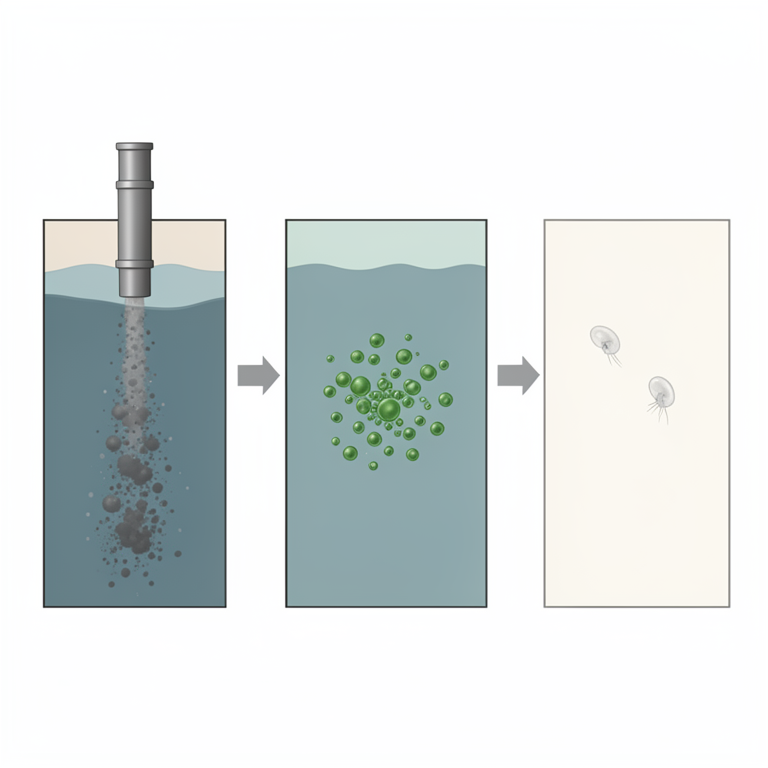
Toxicant Impact Cascade
AI-generated conceptual illustration (zooplankton and phytoplankton in a water column). It explains the idea and does not show study data.
View source evidence ↗Introduction
Due to fast development in the field of industrialization, human population and its activities has been key factor in the disturbance of nature and its resources. From the industries various kinds of toxicants (pollutants) are discharged into both aquatic and terrestrial environments affecting living beings as well as their resources on which they depend for their survival. These toxicants are emitted into the environment from different sources (e.g. chimneys, vehicular traffic, etc). Several investigators have studied effects of toxicants on biological species using mathematical models. In particular, Hallam and collaborators have proposed and analyzed mathematical models to study effects of toxicants on the biological species when these are emitted into the environment from external sources. It may be noted here that in above studies toxicants are emitted from external sources into the environment with constant rates. It may also be noted here that, in these studies, effect of toxicant has been studied by considering that the intrinsic growth rate of species is affected by uptake concentration only but it may happen that environmental concentration of toxicant, apart from affecting carrying capacity, may also directly affect the growth rate of biological species. These considerations have got to be used in the modelling process while studying effects of toxicants on biological species. Here, in the model the uptake of resource as well as population both has been considered. In making of the model the following assumptions are made. 1) The densities of biological population as well as its resource are assumed to be governed by generalized logistic equations with respective intrinsic growth rates and carrying capacities.
2) The toxicant is emitted into the environment at a constant rate (cumulative rate due to emissions from different sources such as industrial chimneys, vehicles, etc.) its concentration is augmented due to various activities of population.
3) The concentration of the toxicant in the environment decreases due to its simultaneous assimilation, (absorption, deposition, uptake), etc. by species population and its resource biomass, the magnitudes being proportional to environmental concentration of toxicant as well as densities of population and its resource. These assimilated amounts affect the densities of population and its resource biomass in the following two ways. i. A fraction of the corresponding assimilated amount becomes part of the uptake phase and this uptaken toxicant interacts with the population and the resource biomass through biophysical processes leading to decrease in the intrinsic growth rate (growth rate per capita of biomass) of it resource biomass density.
ii. The remaining fraction of this assimilated amount of toxicant in each case decreases the respective growth rate of population (resource biomass density) directly. 4) The environmental concentration of the toxicant decreases the carrying capacities of population as well as its resource biomass. 5) The concentrations of toxicant in the environment as well as in its uptake phase decrease due to natural factors by an amount which is proportional to respective concentrations in the two phases. Also due to recycling there may exist a transformation of toxicant from uptake phase to environmental phase.
In the following we propose a general model governing the above mentioned problem and analyze it by using stability theory of differential equations [10] .
Mathematical model
We model here the survival of a resource dependent population (such as human beings) when both population and its resource are affected simultaneously by a toxicant (pollutant) emitted from external sources as well as formed by precursors of population. Keeping in view the above considerations and assumptions, a six dimensional model governing the problem is proposed as follows, is the depletion rate coefficient of B . The constants , and 1 are the depletion rate coefficients of the toxicant in the environment, resource biomass and biological species respectively, The constant is the rates of depletion of pollutant in the environment due to uptake of pollutant by resource biomass respectively. Some of part of the may die out at a rate due to pollutant and a fractions of this may again re-enter in the environment. Here k is a fraction of BT directly effecting population and remaining k 1 of it is up taken by the species, which decreases the intrinsic growth rate.
In model (2.1) the function U s represents the intrinsic growth rate of resource biomass which decrease with U of the toxicant.
denote the maximum densities of resource biomass which the environment can support. It is assumed that these are decreasing functions of T and so we write
represents the intrinsic growth rate of resource biomass which decrease with U of the toxicant. Hence we assume,
In our model, the constants K denotes the carrying capacity of population.
Equilibrium analysis
The given model (2.1) has four non-negative equilibria in
It is noted here that in the second equation of the model, which can be written as
From the (2.6) we note the following:
Thus the condition for unique and positive
,T and * U can be found from above equations. Further, from the 2 nd equation of the model at equilibrium we get,
On differentiation, we have,
and similarly for other variables, we get 0 dQ dB These show that as emission rate of toxicant increases the resource biomass density decreases.
Stability analysis Local stability
To study the local stability behavior, we compute the varitional matrices corresponding to each equilibrium, from which the following is noted. i. 0 E is a saddle point with unstable manifold in B N direction and stable manifold in U T direction.
2
E is a saddle point with unstable manifold in N direction and stable manifold in
The stability behavior of * E is not obvious from the corresponding Jacobian matrix, therefore, by using Liapunov's method, in the following theorem we have found sufficient conditions for * E to be locally asymptotically stable. Theorem 1. Let the following inequalities hold:
Then * E is locally asymptotically stable.
Proof: -Using the following Liapunov's function for the linearlized system (2.1).
For V to be negative definite the following conditions must hold.
Rewriting the above inequality as follows
C is defined above
Keeping the values of the constant we get the same inequalites as mentioned above
It can be checked that the derivative of V with respect to t is negative definite under the above-mentioned conditions. The following theorem characterizes the non-linear stability behavior of the equilibrium point * E . The following lemma, which establishes a of attraction for all solutions of the system initiating in the interior of the positive orthant.
attracts all solutions initiating in the interior of the positive orthant. Proof: From the second equation of the model, we have
From the first equation of the model, we see
Theorem 2. In addition to the assumptions (2.1a) and (2.1b), let the functions
If the following inequalities holds
Then * E is non-linearly asymptotically stable in A .
Proof: -Consider the following positive definite function around
Then by using the above equations and the mean value theorem, we get
On choosing the value of the constant as
The above equation reduces to the following form
For W to be negative definite the following conditions must hold.
Rewriting the above inequality by using the maximum values of The above theorems imply that under some conditions the equilibrium level of resource biomass density decreases as the emission rate of the toxicant into the environment increases leading to decrease in the density of resource dependent population. Further it is pointed out that if the amount of toxicant in the environment goes on increasing, the survival of species may be threatened.
Conclusion
In this paper, a mathematical model have been proposed and analyzed to study the survival and existence of a resource dependent population, considering the uptake phase by population and resource biomass. The cumulative rate of the emission of the toxicant into the environment is assumed to be constant. The existence of non-trivial equilibrium has been proved and its stability behavior is analyzed. It has been shown that with the increase in the emission rate of toxicant the equilibrium level of biological population decreases leading to the decrease in the equilibrium level of the resource dependent population. It has been also noted that for large rates of its emission and transformation, the resource biomass may become extinct and the population depending on it may be threatened to extinction.
References
14 in the original paper- DeLuna JK, Hallam TG. Effect of toxicants on population: a qualitative approach IV. Resource-consumer-toxicant models. Ecol. Modelling. 1987; 35:249-273.
- Freedman HI, Shukla JB. Models for the effect of toxicant in single species and predator-prey systems. J Math. Biol. 1991; 30:15-30.
- Freedman HI, So JWH. Global stability and persistence of simple food chains Math. Biosciences. 1985; 76:69-86.
- Garcia-Montiel DC, Scatena FN. The effect of human activity on the structure and composition of a tropical forest in Puerto Rico. Forest Ecol. Management. 1994; 63:57-78.
- Hallam TG, Clark CE. Nonautonomous logistic equation as models of population in a deteriorating environment. J Theor. Biol. 1982; 93:303-311.
- Hallam TG, De Luna JT. Effects of toxicants on population: A qualitative approach III. Environmental and food chain pathways. J Theor. Biol. 1982; 109:411-429.
- LaSalle J, Lefschetz S. Stability by Liapunov's Direct Method with Applications, Academic Press, New York, London, 1961.
- McLaughlin SB. Effects of air pollution on forests, J. of Air Pollut. Control Assoc. 1985; 35:512-534.
- Padoch C, Vayada AP. Pattern of resource use and human settlement in tropical forest. In: Golley F.B. (ed), Tropical Rain Forest Ecosystems, Elsevier, New York, 1983, 301-313.
- Patin SA. Pollution and the biological resource of the ocean, Butterworth Scientific, London, 1982.
- Schulze ED. Air pollution and forest decline in a Spruce (Picaabies) forest, Science. 1989; 224:776-783.
- Shukla A, Shukla JB, Dubey B. Effect of Environmentally degraded soil on crop yeild: the role of conservation. Ecological Modelling. 1996; 86:235-240.
- Shukla JB, Freedman HI, Pal VN, Misra OP, Agarwal M, Shukla A. Degradation and subsequent regeneration of a forestry resource: A mathematical model. Ecol. Model. 1989; 44:219-229.
- Srinivasu PDN. Control of environmental pollution to conserve a population, Non Linear Analysis, RWA. 2002; 3:397-411