
Research article · 2018 · Full text
International Journal of Statistics and Applied MathematicsImplementation of zero acceptance number single sampling plan on EOQ with permissible delay in payment with extended payment privileges
Volume 3(5) · Pages 97–104
Research areasAdvanced Statistical Process Monitoring
Abstract
Author-writtenTraditionally, all the Economic Ordering Quantity models are developed based on the assumption that the received products are of free of defect. But in reality, the products may contain defects. Acceptance sampling plan helps to discriminate the product with the benefits of less time consuming, economic and very useful when the testing involves destructive. This study implements single sampling plan on the EOQ model with permissible delay in payments. Mathematical models are developed for extended payment privileges. Also numerical examples are provided to validate the results.
Summary
Source-checkedPlain-language reading of the full paper, prepared with AI and checked against the text. Each point links to the authors' own words.
Why it matters
- Standard Economic Ordering Quantity (EOQ) models often assume products are defect-free, which does not reflect real-world conditions where defects occur. View evidence ↗
- Acceptance sampling plans provide an economical and time-efficient way to assess product quality, especially when testing is destructive. View evidence ↗
- A single sampling plan with a zero acceptance number is particularly suitable for safety-related items or when testing is expensive or destructive. View evidence ↗
The question
- The study aims to develop mathematical models that integrate a single sampling plan into an EOQ model featuring permissible payment delays and extended payment privileges. View evidence ↗
What they did
- The model assumes destructive testing without replacement and accounts for ordering, holding, inspection, and acceptance costs. View evidence ↗
- The payment structure allows for a cash discount if paid early, full payment within a permissible delay, or payment with interest if the delay is exceeded. View evidence ↗
- The model is based on several assumptions, including known and invariable demand, no shortages, a non-finite time frame, and a single product with an imperative replenishment cycle. View evidence ↗
- The sampling process accounts for inspection errors, specifically Type I errors (defective classified as non-defective) and Type II errors (non-defective classified as defective). View evidence ↗
- The model was validated using hypothetical numerical examples with specific parameters for costs, demand (D=1000), and payment periods (M1=0.34, M2=0.38, M3=0.4). View evidence ↗
What they found
- Numerical results indicate that increasing inspection errors leads to a decrease in the optimal replenishment cycle time and an increase in total costs. View evidence ↗
- The total cost of the system is minimized when inspection errors are reduced. View evidence ↗
What it means
- The authors conclude that allowing a permissible delay in payments results in a decrease in total annual costs. View evidence ↗
- Payment privileges benefit both parties by allowing customers to choose the best payment option and helping vendors retain their customers. View evidence ↗
- The authors suggest that future research could extend this study to other sampling plans, such as the Quick Switching System or Skip lot sampling plans. View evidence ↗
Visual summary
1 visualsIllustrations explain the paper; they do not show study data.
Payment Timeline
AI-generated conceptual illustration (A digital payment transaction flow on a linear timeline). It explains the idea and does not show study data.
View source evidence ↗Figures & tables
From the original paper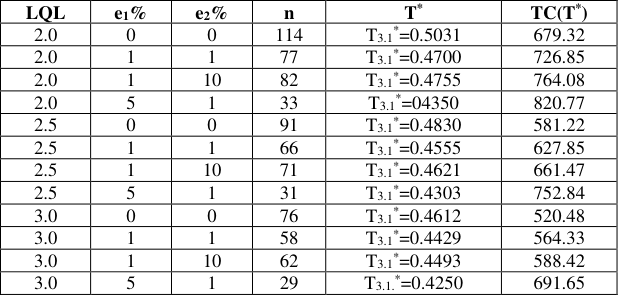 Table 1
Introduction
In the production and assembly industries, testing is one of the crucial instruments in assess the quality of the product. It involves the measurement of quality by compare to the determined standard and specifications. It is a key when there is a call for to create competent decision with the restricted resources. Testing procedures may vary based on the nature of the product. Some products may require destructive testing. Destructive testing is defined as the test which may alters the shape, form or size or structure of the product. The products after destructive testing have no future use. 100% inspection of the product is impossible as the by doing all the products are destructed so nothing will be available for future use. So there is a need for a practical tool. Acceptance sampling plans assent the predicting the overall quality of a product through the testing of a relatively small number of samples thus curtailing the redundant costs. It is mainly applicable when the sole intention of the inspection is to either accept or reject the lot. It is applied in assessing the quality of the raw materials, finished products etc. Acceptance sampling plans are optimal under the following scenarios; when the cost of inspection is huge; when 100% inspection is tedious & exhausting; when inspection requires destructive testing. Sampling plans with expensive or destructive testing it is appropriate to use single sampling plan with zero acceptance number. Schilling (1982) indicated that in the field of compliance testing, and principally for safety-related items, zero acceptance number is principally desirable. Since most of the inspection process involves human inspectors there is possibility oferrors in the inspection. Effect of inspection error on the acceptance sampling plans are studied by different authors for instance, Harris (1968) [6] , Collins (1973) [2] , Bennet (1974) [1] , Hoag (1975) [7] , Kenneth (1975) [8] , Dorris (1978) [3] . Pradeepa Veerakumari and Aruna (2018) developed zero acceptance number single sampling plans with inspection error on EOQ model with permissible delay in payments. Permissible delay in payment was pioneered by Goyal (1985) [5] . J.T. Teng (2002) amended the Goyal's model by considering varying unit price and unit cost. This study extends Pradeepa Veerakumari and Aruna (2018) [9] model when the vendor is offered extended payment privileges. In the study, it is assumed that the buyer applies the single sampling inspection plan to detect the defects.
The sampling is executed without replacement requiring destructive testing. Total costs associated with the model are ordering costs, holding cost, inspection cost, acceptance cost. The model is designed that the items of the rejected lot are sold at the discounted costs. Cash flow timing plays a crucial factor in the investment as soon as the cash is available, there may be possibility of using it for other purposes. Therefore the arrangement of cash flow is a important factor for an organization. In most of the business transactions, the vendor may incorporate the cash models with the permissible delay in payments. The consumer can acquire cash discount if the payment is paid before the discount period; the buyer will make full payment if paid within permissible delay in payments; otherwise the payment should pay with the interest levied by the vendor. In general, the cash discount period is shorter than the permissible delay in payments which in turn shorter than the interest levying period. For instance, the vendor provides a cash discount for r 1 if paid with in cash discount period M 1 ,pays full payment if paid within permissible delay in payments M 2 ; Other pays with interest r 1 if paid after M 2 i.e. M 3 .In short M 1 <M 2 <M 3 . The value of r 1 and r 2 lies between 0 to1. It is noted that just like the grace period of the credit card payment paid before or on the permissible delay in payments does not carry any interest charges.
Model Assumptions
Model Assumptions
Model Formulation
Consider that the buyer places an order of Q to the vendor. The ordering cost is constant and symbolized as C o and Demand rate D. After acquiring the lot, sampling is executed on the sample of size n. Proportion defective in the lot is symbolized as p. It is presumed that single sampling by attributes is implemented with some faulty inspection .e 1 is the probability of committing type I error in that case defective is classified as non-defective. e 2 is the probability of committing type II error i.e. classifying nondefective as defective. The modus operandi of the single sampling plan is followed. If the case involves destructive testing generally zero acceptance number is applied. Then the probability of acceptance becomes,
Since the inspection process involves the errors, the apparent fraction defective p e can be represented as a function of the known true fraction defective p,
Since,process involves zero acceptance sampling plan the sample size n can be obtained by using β and LQL. where β representing consumer risk, LQL representing the probability of accepting reject able quality. It is assumed that the inspection is faulty with inspection error then the LQL=
Costs associated with the model If a lot is accepted then there is a shortage of (DT-n)p e +n in the lot is. Then the cost of accepting the lot is C a ((DT-n)p e +n)/T. Otherwise, if the lot is rejected, then it is sold at discounted rate G per unit. Then the cost associated with the rejection is G (DTn)/T. Then the further, costs related to the model are Since it is assumed that the consumer continues to reorder the lot until, a lot is accepted and sold the rejected lot at discounted lot, the process continues until x times, then the expected total cost, when T>M 1
The series can be rewritten as, The results of this series expansion are converging,
Since the zero acceptance number sampling plan is applied, then P ae =(1-p e ) n , thus reducing the cost function to,
Similarly, total cost of TC 1.2 (T) when T≤M 1 ,is obtained as, The total cost for T>M 3 ,is obtained as, In order to optimize the cost function and to determine the optimal replenishment cycle time, first order and second order derivative function of total cost functions with respect to T are obtained. 2 2
The optimal replenishment cycle time associated with least possible cost is obtained when; the non-negative term of first order derivative is equated to zero. Thus obtaining, )) ) )) )
, then the optimal payment cycle time is minimum of (M 1 , M 2 , M 3 ) with the minimized cost associated with the optimal replenishment cycle time
, then the optimal payment cycle time is minimum of (M 1 , M 2 , M 3 ) with the minimized cost associated with the optimal replenishment cycle time
, then the optimal payment cycle time is minimum of (M 1 , M 2 , M 3 ) with the minimized cost associated with the optimal replenishment cycle time is
, then the optimal payment cycle time is minimum of (M 1 , M 2 , M 3 ) with the minimized cost associated with the optimal replenishment cycle time is
, then the optimal payment cycle time is minimum of (M 1 , M 2 , M 3 ) with the minimized cost associated with the optimal replenishment cycle time is
, then the optimal payment cycle time is minimum of (M 1 , M 2 , M 3 ) with the minimized cost associated with the optimal replenishment cycle time is , then the optimal payment cycle time is minimum of (M 1 , M 2 , M 3 ) with the minimized cost associated with the optimal replenishment cycle time is
Numerical Illustrations
To illustrate the results, proposed method is applied to hypothetical numerical examples where the associated costs and parameters are, c 0 =50, c i =0.1perunit; c d =0.2perunit; c h =0.5;D=1000; G=0.05; W=5 per unit; S=7 per unit; I e =.10; I p =.15; M 1 =0.34; M 2 =0.38; M 3 =0.4; r 1 =0.05; r 2 =0.06; p=0.01 in appropriate units. By applying the theorem, for various values of LQL,e 1 and e 2 : the optimal replenishment cycle interval associated with the least cost is derived. It is noted from the table that with the increase in inspection error leads to the decrease in optimal replenishment cycle time and increase in the total cost. By reducing the inspection error the total cost will be minimized.
Conclusion
As a result of the permissible delay in payments, there is a decrease in the total annual costs. When the customer is offered with the payment privileges, it enables the customer to select better option depend on the situation. On the other hand, it enables the vendor to retain the customer. The study can be extended to other sampling plans for instance, Skip lot sampling plan, Quick Switching System.
Figures and tables from the paper
| LQL | e1% | e2% | n | T* | TC(T*) |
|---|---|---|---|---|---|
| 2.0 | 0 | 0 | 114 | T3.1*=0.5031 | 679.32 |
| 2.0 | 1 | 1 | 77 | T3.1*=0.4700 | 726.85 |
| 2.0 | 1 | 10 | 82 | T3.1*=0.4755 | 764.08 |
| 2.0 | 5 | 1 | 33 | T3.1*=04350 | 820.77 |
| 2.5 | 0 | 0 | 91 | T3.1*=0.4830 | 581.22 |
| 2.5 | 1 | 1 | 66 | T3.1*=0.4555 | 627.85 |
| 2.5 | 1 | 10 | 71 | T3.1*=0.4621 | 661.47 |
| 2.5 | 5 | 1 | 31 | T3.1*=0.4303 | 752.84 |
| 3.0 | 0 | 0 | 76 | T3.1*=0.4612 | 520.48 |
| 3.0 | 1 | 1 | 58 | T3.1*=0.4429 | 564.33 |
| 3.0 | 1 | 10 | 62 | T3.1*=0.4493 | 588.42 |
| 3.0 | 5 | 1 | 29 | T3.1.*=0.4250 | 691.65 |
Table text extracted from the original PDF; superscript letters are shown inline. The original table image is below.
View original table image
References
9 in the original paper- Bennet G, Kenneth E, Schimdt JW. The economic effects of inspector error on attribute sampling plans. Naval Research Logistics. 1974; 21(3):431-443.
- Collins RD, Case KE, Bennett GK.The Effects of Inspection error on Single sampling Inspection Plans, International journal of Production Research. 1973; 11(3):289-298.
- Dorris AL, Footie BL. Inspection errors & Statistical Quality Control -A Survey.AIEE Transactions. 1978; 10(2):184-192.
- Govindaraju K. Inspection Error Adjustment in the design of single sampling attribute plan. Quality Engineering. 2007.19(3):227-233.
- Goyal SK. Economic order quantity under conditions of permissible delay in payments. Journal of operational research society. 1985; 36(4):335-338.
- Harris DH. Effect of Defect Rate on Inspection Accuracy. Journal of Applied psycholog. 1968; 52(5):236-237.
- Hoag LL, Bobbie LF, Clark Mount-campbell. The Effect of Inspector Accuracy on the Type I and Type II Errors of Common Sampling Techniques.Journal of Quality Technology. 1975; 7(4):157-164.
- Kenneth EC, Bennet KG, Schmidt JW. The Effect of Inspection Error on Average Outgoing Quality.Journal of Quality Technology. 1975; 7(1):28-32.
- Pradeepa Veerakumari K, Aruna HM. Determination of Economic Ordering Policies under Trade credit with Application of Zero Acceptance number Single Sampling by Attributes involving Destructive Testing, Inspection Error. International Journal of Scientific Research in Mathematical and Statistical Sciences. 2018; 5(3):79-84.