
Research article · 2017 · Full text
International Journal of Advanced Biochemistry ResearchA study on Multi Site phase catalysts and their characterization
Volume 1(1) · Pages 14–16 · DOI: 10.33545/26174693.2017.v1.i1a.5 ↗
Research areasMicrowave-Assisted Synthesis and Applications
Abstract
Author-writtenA suitable catalyst is required to execute the phase-transfer reaction. There are mainly three factors which are responsible for the phase-transfer reactions. First is that the catalyst should be capable of transferring one reagent from its phase to second reagent’s phase. Second thing is that the reagent once transferred must be available in a highly reactive form. And the final factor is that the catalyst to be used must be recycled.In some chemical reactions, it is observed that co-solvent such as alcohol or methanol is used so as to enhance the rate of agitation resulting in the loss of mechanical or electrical energy. Since, hydrogen bonding is found in alcohol or methanol which leads to the reduction in the rate of a reaction. The current article analyzes the synthesis characterization of multi-site phase catalysts.
Summary
Source-checkedPlain-language reading of the full paper, prepared with AI and checked against the text. Each point links to the authors' own words.
Why it matters
- Phase-transfer reactions require a suitable catalyst to proceed effectively. View evidence ↗
- An effective phase-transfer catalyst must be able to move a reagent between phases, ensure the reagent remains highly reactive, and be recyclable. View evidence ↗
- Using co-solvents like alcohol or methanol to increase agitation can lead to energy loss and reduce reaction rates due to hydrogen bonding. View evidence ↗
The question
- The paper aims to analyze the synthesis and characterization of multi-site phase catalysts. View evidence ↗
What they did
- The analysis distinguishes between homogeneous catalysts (where reactants and products share a phase) and heterogeneous catalysts. View evidence ↗
- The study categorizes phase transfer catalysis into Liquid-Liquid and Solid-Liquid types. View evidence ↗
What they found
- Heterogeneous catalysts are preferred over homogeneous ones because they are easier to handle and separate from products, whereas homogeneous catalysts are sensitive to air and moisture. View evidence ↗
- The addition of 18-crown 6 as a catalyst allows potassium permanganate to dissolve in a benzene medium, enabling the smooth oxidation of olefins. View evidence ↗
- Polyethylene glycols (PEGs) are useful for gas-liquid phase transfer catalysis because they are non-toxic and low-cost, despite having lower efficiency than other catalysts. View evidence ↗
- Using phase transfer catalysis to produce dihalocarbenes under mild conditions is advantageous due to high yields, product purity, and cost-effectiveness. View evidence ↗
- Polar aprotic solvents like DMF and DMSO increase reaction rates by dissolving ionic reactants without forming hydrogen bonds. View evidence ↗
- Polar aprotic solvents are often impractical for industrial use because they are expensive, difficult to extract, environmentally harmful, and require high temperatures. View evidence ↗
What it means
- To improve catalyst efficiency and product purity, the authors highlight the development of immobilized phase transfer catalysts on solid insoluble supports. View evidence ↗
- A limitation of solid-liquid phase transfer catalysis is the high cost associated with complexants such as cryptants or crown ethers. View evidence ↗
Visual summary
1 visualsIllustrations explain the paper; they do not show study data.
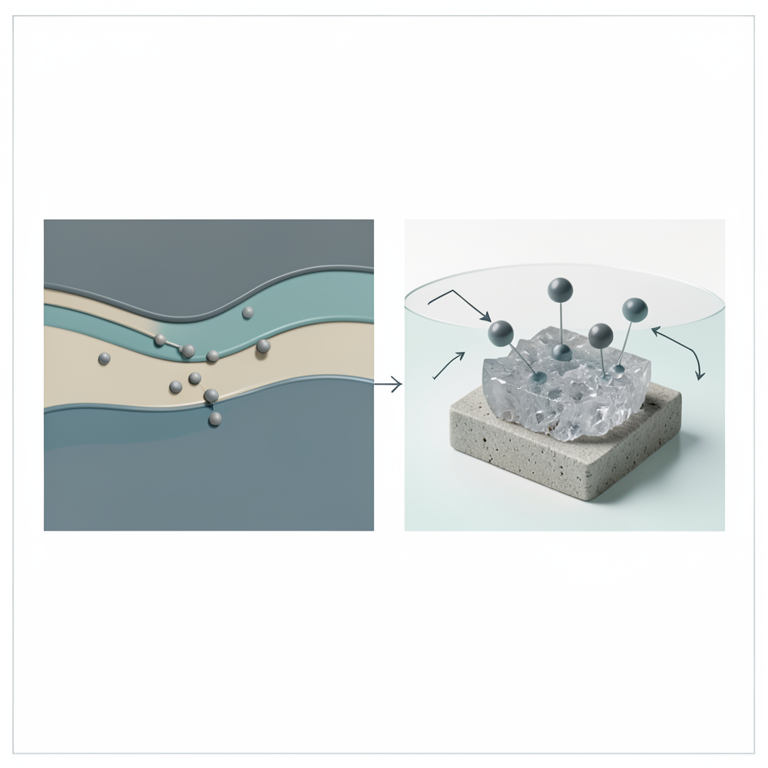
Types of Phase Transfer Catalysis
AI-generated conceptual illustration (phase transfer catalysts in liquid and solid chemical systems). It explains the idea and does not show study data.
View source evidence ↗Introduction
Generally, there are two groups of catalysts, homogeneous and heterogeneous. The type of catalysts to be used depends on the situation that whether the reactant and the product share the same phase or not. It means that if both the reactant and the product have the same phase then the catalyst used is said to be homogeneous otherwise the catalysts used is heterogeneous. In case of homogeneous catalysts, it is observed that they provide selective routes for reactions and these are very difficult to separate from the products as they are very sensitive to air and moisture. To avoid these kinds of problems, heterogeneous catalysts are used which are very easy to handle and can be easily separated from the products. In phase transfer reactions, a system having two phases i.e. an organic phase with liquid reagent and an aqueous phase with nucleo-philic regent M + Y -. Here, ammonium or phosphonium catalyst is divided between two phases. Two cases can be generated depending on the nature of nucleophile: In first case, M + Y -directly dissolves in water. The examples are Na + CN -, K + F - In second case, M + Y -can be yielded with the help of exchanging between the base and a neutral reagent.
There are two types of phase transfer catalysis. First is Liquid-Liquid phase transfer catalysis and second is Solid-Liquid phase transfer catalysis.
In Liquid-Liquid phase transfer catalysis, [Q+R] reacts with alkyl halide substrate R Y to produce the product R-R and the [Q+Y-] thus formed may reenter a next catalytic cycle.
where, liquid reagent (RX) and quaternary onium catalyst (Q+X") In Solid-Liquid phase transfer catalysis, the organic reagent used in the reaction is soluble in a solvent whereas solid substrate M + Y -is not soluble in the solvent.
Synthesis characterization of multi site phase catalysts
Generally, it is well known that in all kinds of chemical reactions, collision is the essential condition for the progress of the reaction in heterogeneous system to get the desired product. However, in the early period, the main problem faced by chemists was to conduct the reactions effectively between water soluble ionic reactants and organic soluble reactants. Normally, these types of immiscible reagents react very slowly due to the intrinsically low solubility of the reagents located in two different phases. This important problem has been solved traditionally by applying high agitation speed or by employing cosolvents. The increase of agitation speed is also involved the electrical and mechanical energy loss. Similarly, the additions of protic cosolvents like alcohols are led to decrease the rate of the reaction due to the formation of hydrogen bond with reactants, and also the work-up procedure becomes intricate. Therefore, its reactivity is very much hindered. In the subsequent developments, the solubility of immiscible substrates had been promoted by employing expensive dipolar aprotic solvents. The most commonly used aprotic solvents are dimethylformamide (DMF), dimethyl sulphoxide (DMSO), hexamethylphosphoramides (HMPA), acetonitrile and nitromethane. They have the property to dissolve ionic reactants without forming hydrogen bond with them and thus ultimately increased rates of the reactions 11. Unfortunately, these polar aprotic solvent techniques also have some inconveniences for industrial process development. Specifically, these solvents are not economical and often not easily extractable after the completion of reaction. Additionally, the products obtained are often accompanied with by-products. Further, the process required very high reaction temperature, need very strict anhydrous conditions and environmentally harmful in industrial scale preparation. Solid-liquid PTC consists of reaction occurring between an organic reagent soluble in a solvent and a solid substrate insoluble in this solvent. Co-extraction of water in liquidliquid PTC has created a negative influence on certain reactions and can even fully suppress them. To cite an example, potassium permanganate is added into a benzene medium containing an olefin. Under these conditions, the crystals of potassium permanganate remain at the bottom of flask, the solvent remains colourless and the reaction does not occur. If a catalytic amount of 18-crown 6 is added to the reaction mixture, then the solvent immediately turns purple which means the permanganate dissolved in the system and the olefin gets smoothly oxidized. The complexants first used were crown ethers prepared which showed high complexing abilities of alkali and alkaline earth cations.
Discussion
Solid-liquid phase transfer catalysis using complexants is still hampered by high cost of catalysts like crown ethers or cryptants. In some cases, the presence of water is strictly avoided when the reactions are conducted with a quaternary onium catalyst under solid-liquid conditions. By using GL-PTC system, a gaseous organic substrate reacts with activated anions in a liquid phase which can be carried out under continuous-flow conditions. In this course of action PTC is immobilized on a solid bed. The solid support may also be a reagent in reaction. Reaction occurs in the immobilized liquid phase with continuous transfer of products and reactants between gas and liquid phases. Crown ethers, cryptants, phosphonium salts and polyethylene glycols (PEG) were used as PTCs because they increase the anion transfer into organic phase and thus enhances the activities. Even though the efficiency of PEGs is lesser than that of other PTCs, they are more pertinent in gas-liquid PTC because they are not toxic and the cost is very less. They form complex with alkaline metal cations and therefore can solubilize the related solid reagents into supported liquid phase, making them more readily available for reactions. Numerous reactions had been carried out by following the GL-PTC technique. Similar to quaternary onium salts, the activity of macrocyclic ethers is high and is dependent on the structure.
The known examples like crown ethers and cryptands (PTC catalysts) were first prepared by Pederson and Lehn et al. These catalysts have a tendency to complex with various ions and molecules and are one of the most important achievements in modern organic chemistry. The steady increasing interest of macrocyclic PTCs can be attributed to their unique properties viz., specific complexation of metal salts, ionic or neutral, organic and inorganic molecules; the ability to transfer ionic reagents from aqueous or solid phases to organic phases. Dihalocyclopropanes are valuable compounds for the synthesis of cyclopropane derivatives and other pharmaceutically valuable products which can be obtained by the addition of dihalocarbenes to the double bond of olefins. Dihalocarbenes are very useful intermediate neutral molecules having divalent carbon atoms with two unshared electrons. Even though, the methods of generation of dihalocarbenes are available in literature, the dihalocarbenes produced by employing phase transfer catalytic method under very mild conditions is more facile due its easy handling, cost effectiveness, high yields and purity of products. The dichlorocarbene, thus generated in situ by the PTC method has been used for a number of synthetic purposes.
Conclusion
One of the major concerns in using phase transfer catalysts (PTCs) in soluble from is its separation from the reaction International Journal of Advanced Biochemistry Research mixture and subsequent reuse or disposal. For efficient use of the catalyst and to meet product purity requirements, synthetic techniques involving PTCs need additional separation techniques for catalyst isolation and product purification. This led to the development of immobilized PTC on solid insoluble support, viz., insoluble PTC.
References
5 in the original paper- Berzelius JJ. Ann. Chim. Phys. 2014; 61:146.
- Blaser HU, Indolese A, Schnyder A. Curr. Sci. 2010; 78:1336.
- Sheldon RA, Ven Bekkum. Fine Chemicals through Heterogeneous Catalysis, Wiley-VCH, Wilhelm, New York, 2011.
- Mikkola JP, Virtanen P, Karhu H, Salmi T, Murzina DY. Green Chem. 2012; 8:197.
- Anderson K, Goodrich P, Hardacre C, Rooney DW. Green Chem. 2013; 5:448.