
Research article · 2018 · Full text
International Journal of Statistics and Applied MathematicsStatistical analysis of outreach and financial sustainability of kifanya Saccos limited in Njombe
Volume 3(6) · Pages 119–123
Research areasMicrofinance and Financial InclusionTaxation and Compliance StudiesUrban and Rural Development Challenges
Abstract
Author-writtenThe main objective of this paper is to review financial performance of Kifanya SACCOS Limited, Tanzania, through its outreach and financial sustainability. Outreach was assessed by analyzing historical data on the number of clients who are offered financial services together with the growth of the working capital for the period starting with the year 2003 up to 2017. While financial sustainability was assessed by investigating the trend of loan borrowing and its repayment. Financial sustainability of the SACCOS through lending, was analysed using yearly data on loan borrowing and its repayment by computing the operational self-sufficiency (OSS) indices for the period starting 2004 through 2017. The results of the study had shown that the performance of the SACCOS is good in terms of breadth outreach as it is reaching many rural dwellers who have no access to formal financial services. Although the sustainability indexes has shown that there has been a positive trend showing that the SACCOS has moved toward gaining sustainability in its role of financial intermediation as the sustainability index grows towards 1.
Summary
Source-checkedPlain-language reading of the full paper, prepared with AI and checked against the text. Each point links to the authors' own words.
Why it matters
- Semi-formal financial institutions are critical in developing countries as they provide savings and loan services to rural poor who cannot access formal banking. View evidence ↗
- Cooperative societies aim to mobilize resources to create funding sources that benefit their members. View evidence ↗
- Financial sustainability is a key area requiring attention for Savings and Credit Cooperative Societies (SACCOS). View evidence ↗
The question
- The study aims to review the financial performance of Kifanya SACCOS Limited in Tanzania by analyzing its outreach and financial sustainability. View evidence ↗
What they did
- Outreach was measured using historical data on the number of clients and the growth of working capital from 2003 to 2017. View evidence ↗
- Financial sustainability was analyzed by calculating operational self-sufficiency (OSS) indices based on yearly loan borrowing and repayment data from 2004 to 2017. View evidence ↗
- The SACCOS operates through three branches in the villages of Kifanya, Ihanga, and Lwangu. View evidence ↗
What they found
- There was an increasing trend in both the number of members and the working capital of the SACCOS. View evidence ↗
- The SACCOS performed well in terms of breadth outreach by reaching many rural residents who lacked formal financial services. View evidence ↗
- Sustainability index values remained below 1, indicating that the amount borrowed exceeded the amount repaid every year. View evidence ↗
- The Sustainability Index (SI) showed a general upward trend, increasing from 0.3804 in 2004 to 0.9933 in 2017. View evidence ↗
- The growth of the sustainability index toward 1 indicates that the SACCOS is moving toward achieving financial sustainability in financial intermediation. View evidence ↗
What it means
- The authors conclude that Kifanya SACCOS Ltd has good breadth outreach due to its growing membership. View evidence ↗
- While the SACCOS is not yet sustainable in financial intermediation, the trend from 2004 to 2017 shows it is moving toward attaining sustainability. View evidence ↗
Visual summary
1 visualsIllustrations explain the paper; they do not show study data.
Sustainability Trend
AI-generated conceptual illustration (A small-scale credit union office building in a rural Tanzanian village setting). It explains the idea and does not show study data.
View source evidence ↗Figures & tables
From the original paper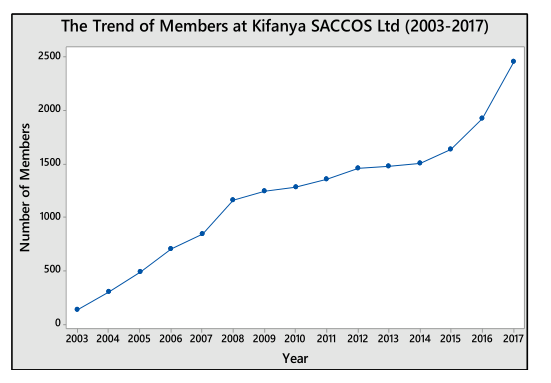 Figure 1
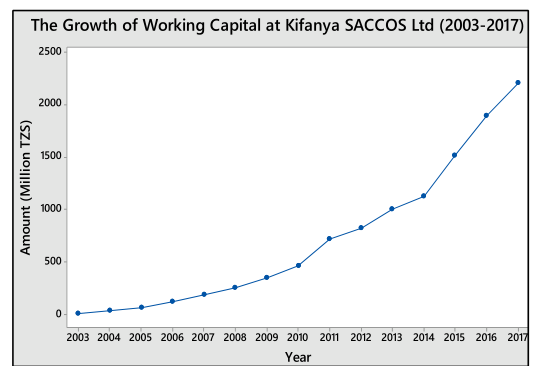 Figure 2
 Table 1
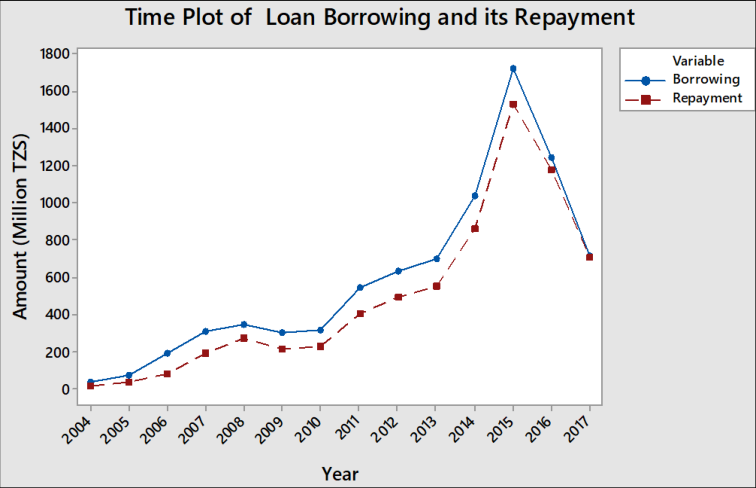 Figure 3
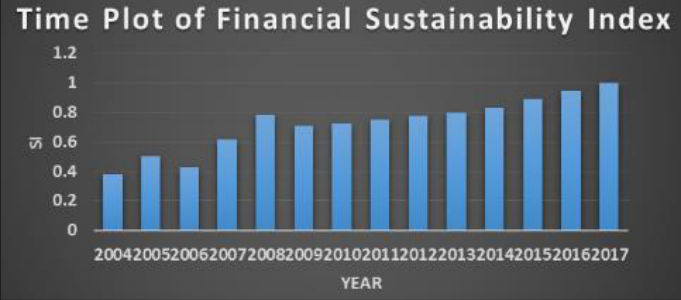 Figure 4
Introduction
A cooperative is a voluntary network of individuals who own or control a business that distributes benefits basing on the use or ownership of the business, with ownership being largely weighted equally across its members (Altman, 2009) [1] . The main objective of cooperative societies is to mobilize resources and create source of funds that can benefit their members (Ndiege, Mataba, Msonganzila, & Nzilano, 2016) [14] . Cooperatives are well known for their provision of financial services by encouraging voluntary savings among cooperators and providing them with cheap credits. In many developing countries, these semi-formal financial institutions are the main source of savings account and loan services for the poor in rural areas, where formal financial institutions are beyond the reach of many (Mwakajumilo, 2011) [13] . Saving and credit cooperatives (SACCOS) which are known as credit unions in some countries are cooperative movements which can equip their members with convenient and secure means of saving money to make cheap credits available (Karimi, 2011) [8] . According to Mumanyi (2014) [12] , SACCOS is a voluntary association which is owned and controlled by its members with the aim of promoting saving, providing cheap credits and other financial services to its members. Therefore, the idea behind establishment of SACCOS is to promote savings and make cheap credits available to its members. There are many studies which have been done pointing out the importance of SACCOS in its role of financial intermediation. Most of these studies have focused on three important areas. The first one is the role of SACCOS in poverty alleviation. It is to mean that whether the provision of financial service mostly of credit and saving has improved the lives of the poor economically and socially. The second area is about the outreach of the services provided by these institutions especially to the poor who are not covered by the formal financial services. In microfinance, outreach refers the provision of financial services to many clients (breadth of outreach) especially those who are very poor (depth of outreach). The third area that needs more attention in SACCOS is the problem of financial sustainability.
This study has been conducted to assess the outreach and evaluate the financial sustainability of Kifanya SACCOS Ltd. Outreach is assessed by considering the breadth of outreach while financial sustainability is assessed by investigating the trend of loan borrowing and its repayment.
Materials and Methods
Materials and Methods
The Concept of Outreach:
According to Conning (1999) [5] , outreach refers to the efforts made by Micro finance Institution (MFI) to extend loans and financial services to many clients (breadth of outreach) and especially to the poorest of the poor (depth of outreach). Some studies have shown that this definition of outreach is vague because it includes quantitative as well as qualitative aspects. The clients who are the subject of assessment are difficult to identify and obtain their status. The difficulty is encountered when one tries to answer the following two questions. 1. Should outreach be assessed in terms of the number of clients accessing financial services in general or only the number of the poor accessing financial services? 2. If only the poor accessing financial services should be considered, how can they be identified?
Therefore, the definition of outreach given by Conning is very restrictive because it specifically refers to the poorest of the poor. In this study we adopt a less restrictive definition of outreach, which defines outreach as the extent to which formal financial services are accessible to low-income groups, measured by the scale of outreach.
Measure of Outreach:
The definition of outreach given by Conning (1999) [5] describes two important aspects of outreach; breadth of outreach and depth of outreach. Basing on these aspects scholars have classified measures of outreach into two categories: I. Scale (or breadth) of outreach: The scale of outreach refers to the number of clients served in a defined period of time. II. Depth of outreach: Depth of outreach refers to the level of poverty of the clients served.
Breadth of outreach is the number of users. In this case outreach is measured in terms of a numeric value such as the number of clients to whom a MFI is providing financial services especially those previously having no access. Depth of outreach which is more nebulous, is also very important because it explains the poverty status of the clients being served.
Scale of outreach is a straightforward measure but less nebulous than the depth of outreach because the former captures the total number of clients served by an MFI without taking into account their poverty status. A more nebulous measure is one that captures the characteristics of the poor clients served. In this study we adopt a less restrictive definition of outreach, which defines outreach as the extent to which formal financial services are accessible to low-income groups, measured by the scale of outreach.
The Concept of Sustainability:
In microfinance industry, sustainability is same as selfsufficiency, financial selfsufficiency, profitability, financial sustainability, viability, financial efficiency (Hulme, 1996; Johnson & Rogaly, 1997; Ledgerwood, 1999; Yaron, 1992) [6,7,9,7] . According to UNESCAP (2006:15), sustainability is defined as the ability of the organization or institution to meet the cost of the operations and build enough reserves for capitalization. Chaves, R. A. and Gonzalez-Vega (1996) [3] , assert that sustainability is the institution's ability to grow and provide financial services on continuous basis by the financial resources that they have or by borrowing from other financial or non-financial institutions based on market interest rate. Conning (1999) [5] argues that "in most discussions sustainability is taken to mean full cost recovery or profit making and is associated with the aim of building microfinance institutions that can last into the future without continued reliance on government subsidies or donor funds". When related to profitability, sustainability refers to an adjusted measure of profitability in an accounting sense, which is the difference between total revenue (TR) an institution generates from its operations and the total costs (TC) incurred in those operations (Okumu, 2007) [15] . While profitability is generally used to assess the financial performance of organizations that does not depend on external subsidies, sustainability is considered more appropriate to assess the financial performance of subsidy-depend organizations (Hulme, 1996) [6] . Specifically the concept of sustainability in microfinance is used to describe the performance of institutions or programmes that at one point or another rely on external support in the form of grants, or subsidies. It is a concept developed to answer the question of whether it is possible for an institution to exist for a long time providing valuable services without subsidies. In this study sustainability of a SACCOS means its ability to earn enough profit through lending that can enable the continuation of financial intermediation without relying on any other source of income.
Measures of financial sustainability
Financial sustainability also known as financial selfsustenance (FSS) and operational self-sustenance (OSS) in microfinance context, is the measure of the ability of MFIs to go on operating indefinitely using their own resources without depending on donations, grants, or subsidized loans from outside individuals, NGOs, or governments (Yeshi, 2015). There are two common methods of measuring financial sustainability; Sustainability Index (SI) method and Subsidy Dependency Index (SDI) method. I. Sustainability Index (SI) method: It is expressed as a percent of total cost covered by the income generated in a given period. This measure describes the extent to which a MFI is able to cover all its operating and financial costs by its operating income (Rao & Fitamo, 2014) [16] . It is well described by operational self-sufficiency (OSS) which measures operating revenue as a percentage of operating and financial expenses, including loan loss provision expense. If this ratio is greater than 100 percent, the MFI is covering all of its costs through own operations and is not relying on contributions or subsidies from donors to survive (Churchill et al. 2006) [4] .
Operational self-sufficiency index measures the extent to which the operating revenue of MFIs cover its operating cost. Revenues mainly come from interest and fees paid by borrowers, but a typical institution also generates income from investment and other services. OSS is the most basic measurement of sustainability showing the extent at which operating revenues are enough to finance financial loan loss provision and operational expense (Barres, I., Norell, D., Porter, B., and Curran, 2005) [2] . According to Okumu (2007) [15] , OSS is calculated as
Where, LY=Total operating financial income FINCO= Financial costs OPCO=Direct and indirect costs incurred by the MFI in the process of lending LLP=Loan loss provisions Note: Total expenses=FINCO+OPCO+LLP OSS is a continuous variable fully defined when (FINCO+OPCO+LLP)≠0. This means that at least one of the variables in the denominator, that is, either FINCO, OPCO or LLP≠0. OSS<0 implies that either LY or total expenses are negative. This cannot occur because negative income or cost is not feasible. OSS=1, it means the MFI is at break-even point. OSS>1, implies that MFI fully covers all costs. 0< OSS<1, means that total expenses are more than the income generated, therefore MFI is making losses.
II. Subsidy Dependency Index (SDI) method
Subsidy Dependency Index measures the extent to which a MFI depend on external support for its operation. This index measures how much the average lending interest rate would have to be increased to compensate for complete and immediate subsidy elimination (Rao & Fitamo, 2014) [16] . The lower the index value, the more sustainable the institution. According to Yaron (1992) [7] , the following formula is used to determine SDI:
In this study we adopt the OSS index because it is the basic measurement of sustainability that can indicate whether revenue from a particular activity is sufficient to cover all costs incurred in that activity or not.
Results and Discussion
Outreach was assessed by analysing historical data on the number of clients for the period starting with the year 2004 up to 2017. More explanations were obtained from the trend of growth of the working capital for the same period. Financial sustainability of the SACCOS through lending, was analysed using yearly data on loan borrowing and its repayment by computing the operational self-sufficiency (OSS) indexes for the period starting 2004 through 2017.
Findings on Outreach
The time series plots in figure1 and 2 show that there is an increasing trend in the number of SACCOS members as well as the working capital. To meet the needs of the increasing number of its members, the SACCOS has been increasing the number of branches as well as the workforce. Currently, the SACCOS operates using its three branches which are located in three villages namely Kifanya, Ihanga and Lwangu covering two wards; Kifanya and Ihanga. The increasing number of members increases the working capital in the SACCOS as it receives more savings from its members. According to Miriti (2014) [11] , increasing the number of members increases the capital base of the SACCOS. Also, Malamsha and Kayunze (2014) [10] asserts that a successful SACCOS is one that has been able to possess large number of members and extends its financial services over a long period. Therefore, when the number of members in the SACCOS increases, saving deposits and shares are increased and this leads to increased SACCOS outreach. The growth of working capital is likely to have been contributed by factors such as government support, increase in number of SACCO's members, Expansion of agriculture and agribusiness and absence of formal financial institution in the area in which the SACCOS operates.
Findings on Financial Sustainability
The figure-3 displays the time plot of loan borrowing and its repayment. The financial sustainability indices on loan operations are shown in table 1 and displayed in figure 4.
From the sustainability index plot, the values are less than 1 showing that in each year the amount borrowed is more than the amount repaid. But the trend shows that the SACCOS has moved toward gaining sustainability in its role of financial intermediation as the sustainability index grows towards 1. This positive trend in OSS is an indication of long term financial sustainability in which the SACCOS can lend more and earn more profit.
Conclusion
From this study it was found that Kifanya SACCOS Ltd is good in breadth outreach because the number of its members has been increasing with time. Also, this has been revealed by the increased workforce and number of branches. Regarding sustainability, it was observed that the SACCOS is not sustainable in terms of financial intermediation. However, the trend of sustainability indexes from 2004-2017 revealed that the SACCOS was moving to attain financial sustainability.
Figures and tables from the paper
References
18 in the original paper- Altman M. History and Theory of Cooperatives. Retrieved, 2009. from https://www.researchgate.net/publi cation/228272144
- Barres I, Norell D, Porter B, Curran L. Measuring Performance of Microfinance Institutions : A Framework for Reporting, Analysis, and Monitoring. USAID, 2005.
- Chaves RA, Gonzalez-Vega C. The Design of Successful Rural Financial Intermediaries : Evidence from Indonesia. World Development. 1996; 24(I):65-78.
- Churchill Craig, Frankiewicz C. Making microfinance work: managing for improved performance. Geneva: International Labor Organization, 2006. Retrieved from http://mmw.itcilo.org.
- Conning J. Outreach, sustainability and leverage in monitored and peer-monitored lending. Journal of Development Economics. 1999; 60:51-77.
- Hulme D PM. Finance against Poverty. London: Routledge, 1996.
- Johnson S, Rogaly B. Microfinance and Poverty Reduction. London: Oxfam and Action Aid, 1997.
- Karimi KC. The role of savings and credit cooperative societies in facilitating rural financing in Kenya (a case study of Embu County). Master's Thesis. The University of Nairobi, 2011. Retrieved from http://erepository.uonbi. ac.ke:8080/handle/123456789/6072
- Ledgerwood J. Microfinance Hand Book: Institutional and financial Perspective. Washington D.C.: The World Bank, 1999. Retrieved from https://issuu.com/world. bank.publications/docs/9780821343067
- Malamsha K, Kayunze K. Success Characteristics of Savings and Credit Co-Operative Societies (SACCOS) in Tanzania. Journal of Co-Operative and Business Studies (JCBS). 2014; 2(1).
- Miriti JM. Factors influencing financial performance of savings and credit cooperative societies. A case of capital sacco, Meru county, Kenya. Master's Thesis. The University of Nairobi, 2014. Retrieved from http://erepo sitory.uonbi.ac.ke/handle/11295/74255
- Mumanyi EAL. Challenges and Opportunities Facing SACCOS in the Current Devolved System of Government of Kenya: A Case Study of Mombasa County. International Journal of Social Sciences and Entrepreneurship. 2014; 1(9):1-26.
- Mwakajumilo SL. The role of Informal Microfinance Institutions in Saving Mobilization, Investment and Poverty Reduction: a Case of Savings and Credit Cooperative Societies (SACCOs) in Tanzania, 2011, 1245. Retrieved from www.stclements.edu
- Ndiege BO, Mataba L, Msonganzila M, Nzilano KL. The link between financial performance and loan repayment management in Tanzanian SACCOS. African Journal of Business Management. 2016; 10(4):89-97.
- Okumu LJ. The Microfinance Industry In UGANDA: sustainability, outreach and regulation. PhD Thesis. University of Stellenbosch, 2007.
- Rao K, Fitamo T. Concepts and Measures of Outreach and Sustainability in Microfinance Institutions : A comprehensive literature review. Research Journal of Finance and Accounting. 2014; 5(21):41-49.
- Yaron J. Successful rural finance institutions; Discussion Paper. Washington DC, 1992.
- Yeshi A. The Relationship between Outreach and Financial Sustainability: An Empirical Study on Ethiopian Microfinance Institutions. Master's Degree Thesis. Addis Ababa University, 2015.
Cited by 2
From OpenAlex, OpenCitations and reference lists read by Scinovex
- Effect of Outreach on Financial Sustainability and Profitability of Saving and Credit Cooperatives in Eastern Ethiopia ↗
Mekonnen Kumlachew Yitayaw · Zeszyty Naukowe SGGW w Warszawie - Problemy Rolnictwa Światowego · 2020
This study scrutinized the effect of outreach on financial sustainability and profitability of SACCOs in Eastern Ethiopia using balanced panel data from 33 SACCOs over the period of 2017-2019. Quantitative approach and explanatory design were employed to realize the stated objective. This study used secondary data sources, mainly audited financial statement of the SACCOs, in the study period. The analysis…
❝ 1PDF - Effect of Outreach on Financial Sustainability and Profitability of Saving and Credit Cooperatives in Eastern Ethiopia ↗
Mekonnen Kumlachew Yitayaw · Research Journal of Finance and Accounting · 2020
This study scrutinized the effect of outreach on financial sustainability and profitability of SACCOs in Eastern Ethiopia using balanced panel data from 33 SACCOs over the period of 2017-2019. Quantitative approach and explanatory design was employed to realize the stated objective. This study used secondary data sources mainly audited financial statements of the SACCOs in the study period. The analysis…
❝ 0PDF