
Research article · 2018 · Full text
International Journal of Statistics and Applied MathematicsAssessment of factors influencing students’ achievement in applied mathematics I: The case of weekend and evening engineering and technology students at Assosa University
Volume 3(6) · Pages 106–109
Research areasEducation, Safety, and Science StudiesEducational Research and Pedagogy
Abstract
Author-writtenThe purpose of this study was to investigate factors influencing students’ achievement in Applied Mathematics I in the case of Weekend and Evening Engineering and Technology students at Assosa University. Based on review of the related literature, basic research questions were formulated. Both quantitative and qualitative research methods were used for data gathering. The quantitative data were obtained by using questionnaire and the qualitative data were gathered by using Focus Group Discussion. A pilot study was conducted to validate the instrument using 20 second year university students and was followed by the main study. The final version of the questionnaire was administered for 108 undergraduate Weekend and Evening Engineering and Technology students at Assosa University. The SPSS 20.0 was used for analysis of the data collected by questionnaire. Statistical techniques such as Percentage, Pearson Correlation and t-test were used in the data analysis. The majority of factors that influence students’ achievement in Applied Mathematics I are Mathematics self-efficacy, attitude towards Applied Mathematics I, poor prior knowledge in Mathematics, Mathematics Self Concept and Mathematics Anxiety. In addition to this the Pearson Correlation yielded that there is a positive correlation between prior knowledge in Mathematics and the achievement in Applied Mathematics I. Moreover, the t-test showed that there is no significant difference between the achievement of male and female students in Applied Mathematics I.
Summary
Source-checkedPlain-language reading of the full paper, prepared with AI and checked against the text. Each point links to the authors' own words.
Why it matters
- Student academic achievement is critical for producing high-quality graduates who drive a country's social and economic development. View evidence ↗
- Mathematics is considered fundamental to all learning, providing the conceptual basis for both arts and sciences. View evidence ↗
- Consistent poor performance in mathematics among Ethiopian students is a concern as it may lead to a loss of economic advantage compared to other nations. View evidence ↗
The question
- The study aimed to assess the factors that influence the achievement of weekend and evening engineering and technology students in Applied Mathematics I at Assosa University. View evidence ↗
What they did
- The researchers used proportional simple random sampling to select 108 students from a target population of 380 weekend and evening engineering and technology students at Assosa University. View evidence ↗
- Data collection involved a mixed-methods approach using questionnaires for quantitative data and Focus Group Discussions for qualitative data. View evidence ↗
- Data analysis was performed using SPSS 20.0, employing percentages, Pearson Correlation, and t-tests. View evidence ↗
What they found
- A high percentage of students identified mathematics anxiety as a contributor to poor achievement in Applied Mathematics I. View evidence ↗
- No significant difference in achievement was found between male and female students (p = .317). View evidence ↗
What it means
- The authors conclude that the most prominent factors influencing achievement are self-efficacy, attitude, self-concept, background knowledge, and anxiety. View evidence ↗
- The study's findings are limited to the specific population of weekend and evening engineering and technology students at Assosa University. View evidence ↗
Visual summary
2 visualsIllustrations explain the paper; charts are replotted from the paper's own table values.
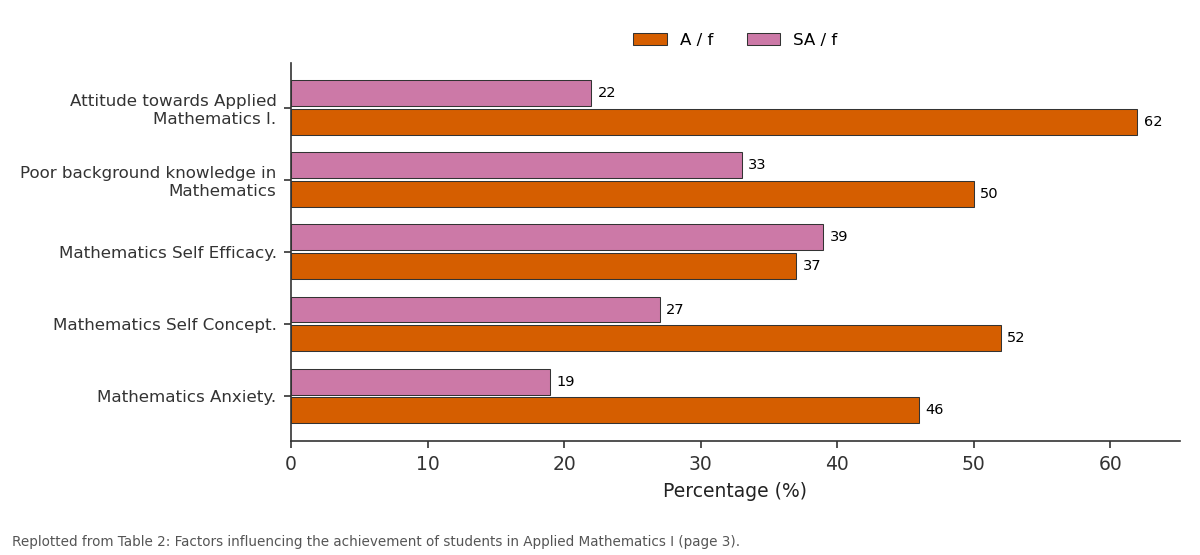
A / f and SA / f: Attitude towards... vs Poor background... vs Mathematics Self... vs Mathematics Self... vs Mathematics Anxiety.
Replotted from Table 2 (page 3) of the original paper. Every bar is the paper's own table value.
View source evidence ↗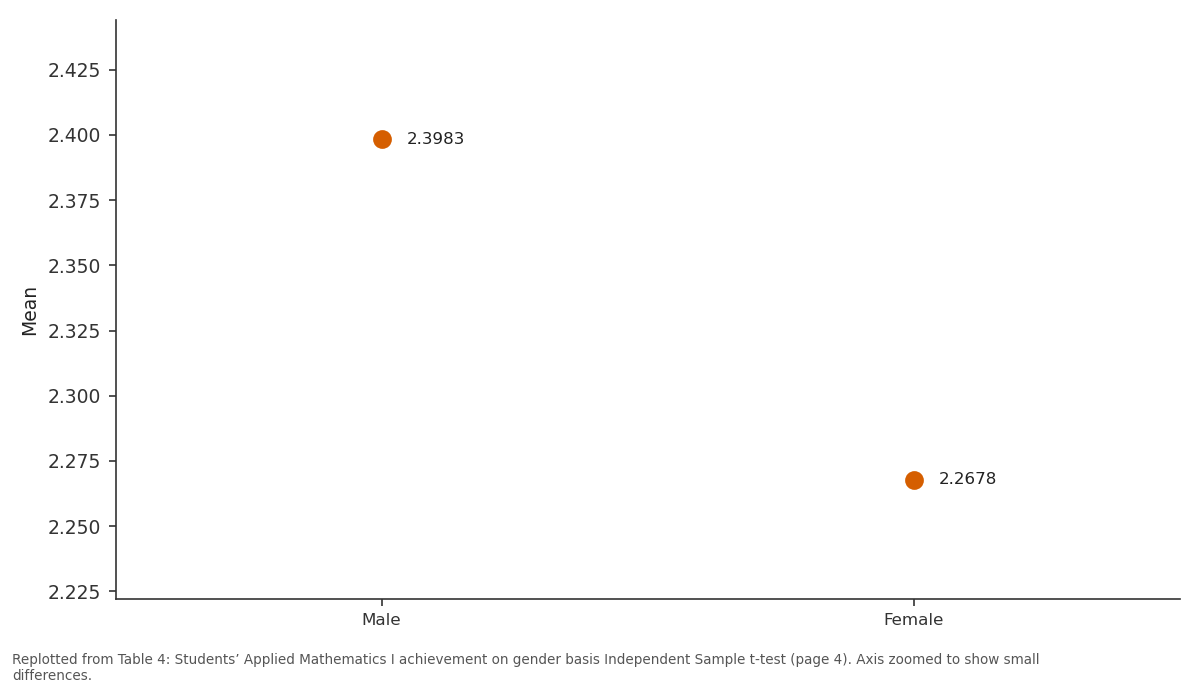
Mean: Male vs Female
Replotted from Table 4 (page 4) of the original paper. Every bar is the paper's own table value.
View source evidence ↗Figures & tables
From the original paper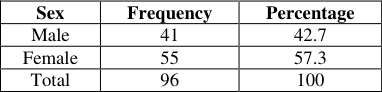 Table 1
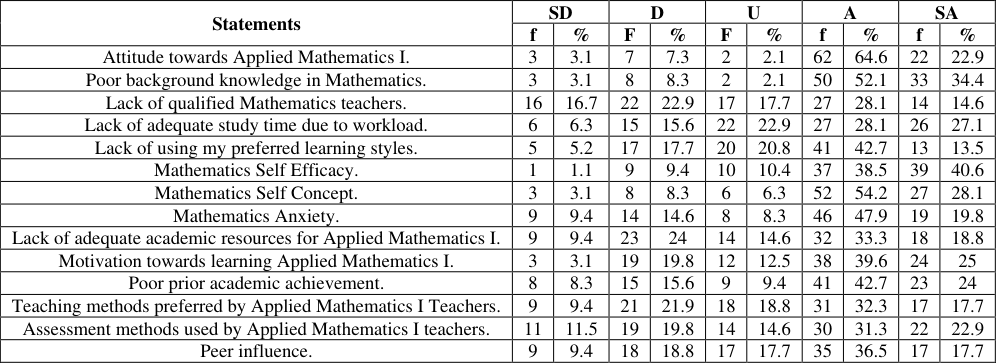 Table 2
 Table 3
 Table 4
Introduction
The social and economic development of the country is directly linked with student academic achievement. The students' academic achievement (performance) plays an important role in producing the best quality graduates who will become great leader and manpower for the country thus responsible for the country's economic and social development (Ali et al., 2009) [1] . Mathematics is the subject which is recognized as the mother of all learning with other subjects deriving their concepts from it, in both arts and sciences. It is also an international language and is essential in almost every field, such as handling money, measurements in fashion and carpentry, technical economics, etc. Mathematics is also regarded as the queen of all sciences, such as chemistry, physics, biology, economics, etc. Mathematics is a way of thinking and organizing a logical proof. It can be used to determine whether or not an idea is true, or at least, whether it is probably true as a way of thinking, as it gives insight into the power of human mind and becomes a challenge to intellectual curiosity. No wonder, any individual who is competent in mathematical sciences, can equally have the ability to do any other courses. Consequently, a good performance in mathematics is important (Oseiwu Ali, 2013) [4] . Furthermore, Ethiopia and the world are talking about sustainable development, where STEM (science, technology, engineering, and mathematics) cannot be set aside, nor separated from the plans to achieve sustainable development. According to Nwafor (2012) [5] , development is a process, in which the people or the beneficiaries are actively involved in deciding what they need and how to provide for them.
As is the case in the past, most people nowadays still think that mathematics is all about computation. However, computation for mathematicians is just a tool for comprehending structures, relationships and patterns of mathematical concepts, and therefore producing solutions for complex real life problems. This perspective of mathematicians has gained more attention and importance with rapid advancements in information and communication technologies. It becomes necessary for people of all ages to reach, analyze and apply the mathematical knowledge effectively and efficiently to be successful citizens in our information age. Particularly, students are expected to be well-equipped with higher-order mathematical knowledge. In this era of globalization and technological revolution, education is considered as a first step for every human activity. It plays a vital role in the development of human capital and is linked with an individual's well-being and opportunities for better living (Battle & Lewis, 2002). It ensures the acquisition of knowledge and skills that enable individuals to increase their productivity and improve their quality of life. This increase in productivity also leads towards new sources of earning which enhances the economic growth of a country (Saxton, 2000) [3] . The quality of students' performance remains at top priority for educators. It is meant for making a difference locally, regionally, nationally and globally. Mathematics is an abstract subject, yet important for scientific and technological development in any society. Tella (2008:16) remarked, "Its usefulness in science, mathematical and technological activities as well as commerce, economics, education and even humanities is almost at par with the importance of education as a whole". In Ethiopia, as in most countries, Mathematics is one of the compulsory core subjects in primary and lower secondary levels of education. This is intended to improve mathematical literacy, and steer the country towards economic growth and development. Despite the wide applicability and importance of Mathematics, students consistently perform poorly in the subject, which makes Ethiopia lose economic advantage over other countries, because its students lag behind their counterparts in Mathematics and Science. Hence, Mathematics achievement has been a great concern for researchers, policymakers, educators, teachers, parents and students themselves. But, the desired level of Mathematics Achievement seems to require a dynamic interplay between student, class/teacher, and school factors. The knowledge of mathematics is an essential tool in our society (Baroody, 1987). It is a tool that can be used in our daily life to overcome the difficulties faced (Bishop, 1996). Due to this mathematics has been considered as one of the most important core subject in a school curriculum. More mathematics lessons are likely to be taught in schools and colleges throughout the world than any other subject (A. Orton, D. Orton, & Frobisher, 2004). Students' mathematics achievement is often associated with the future economic power and competitiveness of a country. Therefore, the desire to understand and identify factors that may have meaningful and consistent relationships with mathematics achievement has been shared among national policy makers and educators around the world.
Statement of the problem
There are many problems that affect academic achievement of the students. In particular, at the University level there are many factors; like students' background knowledge, facilities such as well-organized library, class room conditions, teaching and learning materials, offices and etc. which affect the academic achievement of the students in Applied Mathematics I. Applied Mathematics I is a course delivered to all Engineering Extension students in Assosa University. Over the academic year 2013 to 2016 students' performance in the Applied Mathematics I has been poor. The implication of such low students' achievement in the course means that many students cannot pursue the follow-up Applied Mathematics courses. Poor performance in this area also lowers the Grade Point Average (GPA) of students. This leads one to know about the underperformances in Applied Mathematics related to prior mathematics achievement at the Ethiopian General Secondary School Leaving Examination Certificate (EGSLEC) level or is the underperformance related to other factors. Thus, this research will identify and examine those factors which affect the academic achievement of the students. Among the factors which can be identified as predictors are prior academic achievement, self-efficacy beliefs, Math Anxiety, students' learning styles, academic resources and students' attitude towards mathematics. The question is that what are the factors contributing to the failure in Applied Mathematics? The central of this study is that some factors have a significant effect on academic achievement of students in Applied Mathematics I. Therefore, what are prevailing factors contributing to students' low academic achievement in Applied Mathematics?
Objective of the study
The general objective of the study was to assess factors influencing students' achievement in Applied Mathematics I in the case of weekend and evening engineering and technology students at Assosa University. The specific objectives of this study were: To examine factors which influence the academic achievement of students in Applied Mathematics I. To compare the academic achievement of the students in Applied Mathematics I on gender basis. To identify the relationship between students' prior mathematics performance and the academic achievement in Applied Mathematics I.
Significance of the study
Mathematics achievement has been a great concern for researchers, policy makers, educators, teachers, parents and students themselves. It is expected that identifying factors that influence students' achievement in Applied Mathematics I in the case of Weekend and Evening Engineering and Technology students at Assosa University will provide instructors, learners and the University with a means of designing and implementing intervention strategies that promote improved results. Furthermore, it will add to the body of existing knowledge on the predictors of Applied Mathematics I achievement in higher education since there is no study to date which has investigated factors that influence Applied Mathematics I achievement with the population identified in the study area.
Limitations of the Study
The following limitations were important to this study. The findings of the study were limited to Assosa University and are only applicable for Weekend and Evening Engineering and Technology students. The validity and reliability of the data collected were dependent on the information given by the participant students.
Methodology
In this study a descriptive survey method followed by correlation analysis was employed.
Data Sources
Primary data were used in this research study. The primary data were collected by using questionnaire survey.
Population
The targeted population of this study were 380 Weekend and Evening program Engineering and Technology students of Assosa University. All students of each department in Weekend and Evening program were included as the population of the study.
Sample and Sampling
A sample size of 108 students was selected from the Colleges by using proportional simple random sampling. A sample size has to be representative of population from which it is selected and there should be no considerable difference between the sample and population on any key characteristics.
Procedure
The data collection instrument was organized and pilot-tested to obtain reliability. Class schedules were reviewed to identify the most appropriate date and time of participants. Potential participants were reached through arbitrarily visits to classes at each department. The purpose of the study was explained to students and their voluntary participation was requested. Printed questionnaires were distributed to 108 students and 96 students completed and returned it on the same day. This study was conducted on the bases of descriptive survey method combined with inferential statistics. Therefore, different analysis methods such as percentage, T-test and Pearson's Correlation were used by researchers.
Result and Discussion
A total of number of 108 students were sampled for this study, from which 96 of them filled the Questionnaires correctly and returned it in given period of time so that it was used in the data analysis. As shown in Table 3 above, there is a significant positive relationship between Prior Mathematics Achievement and achievement in applied Mathematics I. This indicates that if students have good prior mathematics knowledge, then their achievement in applied mathematics I will be good. On the other hand, students have poor prior mathematics knowledge, then their achievement in applied mathematics I will be poor. To find if there is any significant difference in mathematics achievement of male and female students; Applied Mathematics I result of 41 male and 55 female students was analyzed using SPSS 20 and the result is shown in table 4. As it can be seen from Table 4 above, there is no significant difference between males (Mean= 2.3983, SD=.66739) and females (Mean=2.2678, SD=.59870; t(94)=1.006 with 𝑝 =.317. Thus, there is no evidence to generalize that significant difference occurred between the achievement of male and female students in Applied Mathematics I since .317 > 0.05.
| Sex of respondents | N | Mean | Std. Deviation | Std. Error Mean | t | df | Sig. (2-tailed) |
|---|---|---|---|---|---|---|---|
| Male | 41 | 2.3983 | 0.66739 | 0.10423 | 1.006 | 94 | 0.317 |
| Female | 55 | 2.2678 | 0.5987 | 0.08073 |
Table text extracted from the original PDF; superscript letters are shown inline. The original table image is below.
View original table image
| — | — | Prior Mathematics Achievement | Applied Math I Achievement |
|---|---|---|---|
| Prior Mathematics Achievement | Pearson Correlation | 1 | .457** |
| Sig. (2-tailed) | 0 | ||
| N | 96 | 96 | |
| Applied Math I Achievement | Pearson Correlation | .457** | 1 |
| Sig. (2-tailed) | 0 | ||
| N | 96 | 96 |
Table text extracted from the original PDF; superscript letters are shown inline. The original table image is below.
View original table image
Characteristics of the Samples
Characteristics of the Samples
Conclusion
The major findings of this study include The study revealed that Mathematics self-efficacy, attitudes towards Applied Mathematics I, Mathematics Self Concept, poor background knowledge in Mathematics and Mathematics Anxiety are among the prominent factors that influence the achievement of students in Applied Mathematics I. Moreover, the result showed that there is no significant difference between Applied Mathematics I achievement of male and female students. Furthermore, the finding indicated that there is a positive correlation between Prior Mathematics Achievement and the achievement in applied Mathematics I.
Recommendation
Based on the findings of the study, the following possible recommendations are forwarded. Any concerned body shall work towards improving the Mathematics self-efficacy, attitude towards Applied Mathematics I, poor background knowledge in Mathematics, Mathematics Self Concept and Mathematics Anxiety. To get a better result, all stakeholders shall focus on building strong prior knowledge in mathematics as there is a positive correlation between Prior Mathematics Achievement and the achievement in applied Mathematics It could be better if some selected topics are taught before this course in order to fill the knowledge gap.
Figures and tables from the paper
| Sex | Frequency | Percentage |
|---|---|---|
| Male | 41 | 42.7 |
| Female | 55 | 57.3 |
| Total | 96 | 100 |
Table text extracted from the original PDF; superscript letters are shown inline. The original table image is below.
View original table image
| Statements | SD | — | D | — | U | — | A | — | SA | — |
|---|---|---|---|---|---|---|---|---|---|---|
| f | % | F | % | F | % | f | % | f | % | |
| Attitude towards Applied Mathematics I. | 3 | 3.1 | 7 | 7.3 | 2 | 2.1 | 62 | 64.6 | 22 | 22.9 |
| Poor background knowledge in Mathematics. | 3 | 3.1 | 8 | 8.3 | 2 | 2.1 | 50 | 52.1 | 33 | 34.4 |
| Lack of qualified Mathematics teachers. | 16 | 16.7 | 22 | 22.9 | 17 | 17.7 | 27 | 28.1 | 14 | 14.6 |
| Lack of adequate study time due to workload. | 6 | 6.3 | 15 | 15.6 | 22 | 22.9 | 27 | 28.1 | 26 | 27.1 |
| Lack of using my preferred learning styles. | 5 | 5.2 | 17 | 17.7 | 20 | 20.8 | 41 | 42.7 | 13 | 13.5 |
| Mathematics Self Efficacy. | 1 | 1.1 | 9 | 9.4 | 10 | 10.4 | 37 | 38.5 | 39 | 40.6 |
| Mathematics Self Concept. | 3 | 3.1 | 8 | 8.3 | 6 | 6.3 | 52 | 54.2 | 27 | 28.1 |
| Mathematics Anxiety. | 9 | 9.4 | 14 | 14.6 | 8 | 8.3 | 46 | 47.9 | 19 | 19.8 |
| Lack of adequate academic resources for Applied Mathematics I. | 9 | 9.4 | 23 | 24 | 14 | 14.6 | 32 | 33.3 | 18 | 18.8 |
| Motivation towards learning Applied Mathematics I. | 3 | 3.1 | 19 | 19.8 | 12 | 12.5 | 38 | 39.6 | 24 | 25 |
| Poor prior academic achievement. | 8 | 8.3 | 15 | 15.6 | 9 | 9.4 | 41 | 42.7 | 23 | 24 |
| Teaching methods preferred by Applied Mathematics I Teachers. | 9 | 9.4 | 21 | 21.9 | 18 | 18.8 | 31 | 32.3 | 17 | 17.7 |
| Assessment methods used by Applied Mathematics I teachers. | 11 | 11.5 | 19 | 19.8 | 14 | 14.6 | 30 | 31.3 | 22 | 22.9 |
| Peer influence. | 9 | 9.4 | 18 | 18.8 | 17 | 17.7 | 35 | 36.5 | 17 | 17.7 |
Table text extracted from the original PDF; superscript letters are shown inline. The original table image is below.
View original table image
References
5 in the original paper- Ali Norhidayah, Jusoff Kamaruzaman, Ali Syukriah, Mokhtar Najah, Salamt Azni Syafena Andin. The Factors Influencing Students Performance at Universiti Teknologi MARA Kedah, Malaysia. Canadian Research & Development Center of Sciences and Cultures. 2009; 3:4.
- Battle J, Lewis M. The increasing significance of class: The relative effects of race and socioeconomic status on academic achievement. Journal of Poverty. 2002; 6(2):21-35.
- Saxton J. Investment in education: Private and public returns, 2000. Retrieved from http://www.house.gov/jec/educ.pdf.
- Oseiwu Ali. Factors Affecting Students Academic Performance in Mathematical Sciences Department in Tertiary Institutions in Nigeria Kogi State University, Anyigba, Nigeria, 2013.
- Nwafor MO. Components of education for sustainable peace. Lead paper presented at Biennial Conference organized by Faculty of Education, Cross River State University of Technology, Calabar in Collaboration with School of Education, and Nwafor Orizu College of Education, Nsugbe, 2012.