
Research article · 2018 · Full text
International Journal of Veterinary Sciences and Animal HusbandryIncidence and aetiology of calf neonatal diarrhoea in Blida Algeria
Research areasAnimal health and immunology
Abstract
Author-writtenNeonatal calf diarrhoea is the most important disease of neonatal calves and results in the greatest economic losses due to disease in this age group in both dairy and beef calves the objectives of the present study ware to estimate the morbidity and the mortality of neonatal diarrhoea in dairy calves also to determine aetiology and risk factors were caused a diarrhoea in dairy veal under 60 days old. A total of 324 claves, housed in 30dairy breeding were followed during two velage season from January to Juan 2013. The total mortality was 5, 9% and was significantly higher in calves had less than 15 days of age. The incidence rate of diarrhoea was 31, 5% and peaked in the first two week after velage. The main causes were breeding controls, defect of passive immunity, old of calf, production season, and nutrient of pregnant cattle, veal’s housing and infectious agents. ELISA test on 22 fecal samples revealed that the 31, 82% of dairy breeding were infected, by cryptosporidium parvum in 13, 6% of study population, E. Coli F5 in 9% and Rotavirus with rate of 4, 5%.
Summary
Source-checkedPlain-language reading of the full paper, prepared with AI and checked against the text. Each point links to the authors' own words.
Why it matters
- Neonatal calf diarrhoea is considered the most significant disease for neonatal calves, causing the highest economic losses in both beef and dairy sectors. View evidence ↗
- The disease negatively impacts the immediate health, long-term herd longevity, and overall productivity of young calves. View evidence ↗
The question
- The study aimed to estimate the morbidity and mortality rates of neonatal diarrhoea in dairy calves under 60 days old, while also identifying the causes (aetiology) and associated risk factors. View evidence ↗
What they did
- The researchers followed 324 dairy calves across 30 dairy farms during two production seasons from January to June 2013. View evidence ↗
- Fecal samples were collected from 22 calves under 60 days old showing clinical signs of diarrhoea who had not previously received antibiotics. View evidence ↗
- The study used a Bio-X Diagnostics ELISA kit to test for Rotavirus, Coronavirus, E. Coli F5, and Cryptosporidium. View evidence ↗
What they found
- The highest incidence (53.33%) and mortality (16.00%) rates occurred in the 8-15 day age group. View evidence ↗
What it means
- The authors conclude that implementing good management practices and vaccination against primary enteropathogens is necessary to limit the impact of the disease. View evidence ↗
- The authors recommend vaccinating pregnant mothers to increase specific antibodies and reinforce passive immunity in calves. View evidence ↗
Visual summary
2 visualsIllustrations explain the paper; charts are replotted from the paper's own table values.
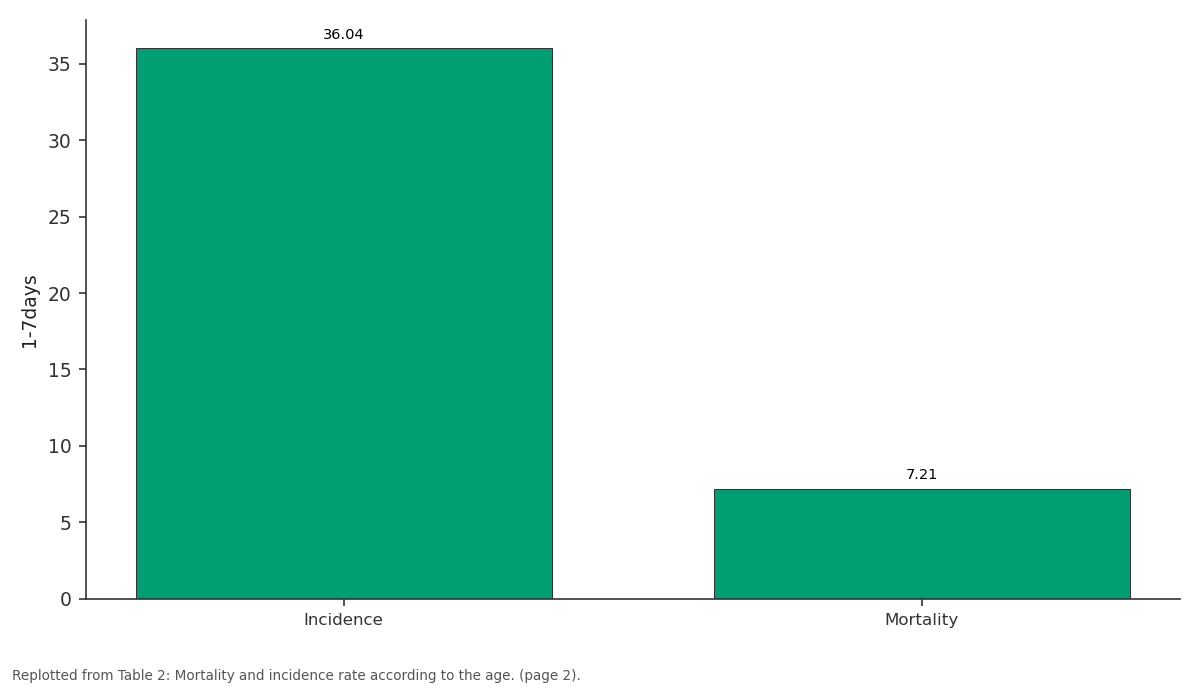
1-7days: Incidence vs Mortality
Replotted from Table 2 (page 2) of the original paper. Every bar is the paper's own table value.
View source evidence ↗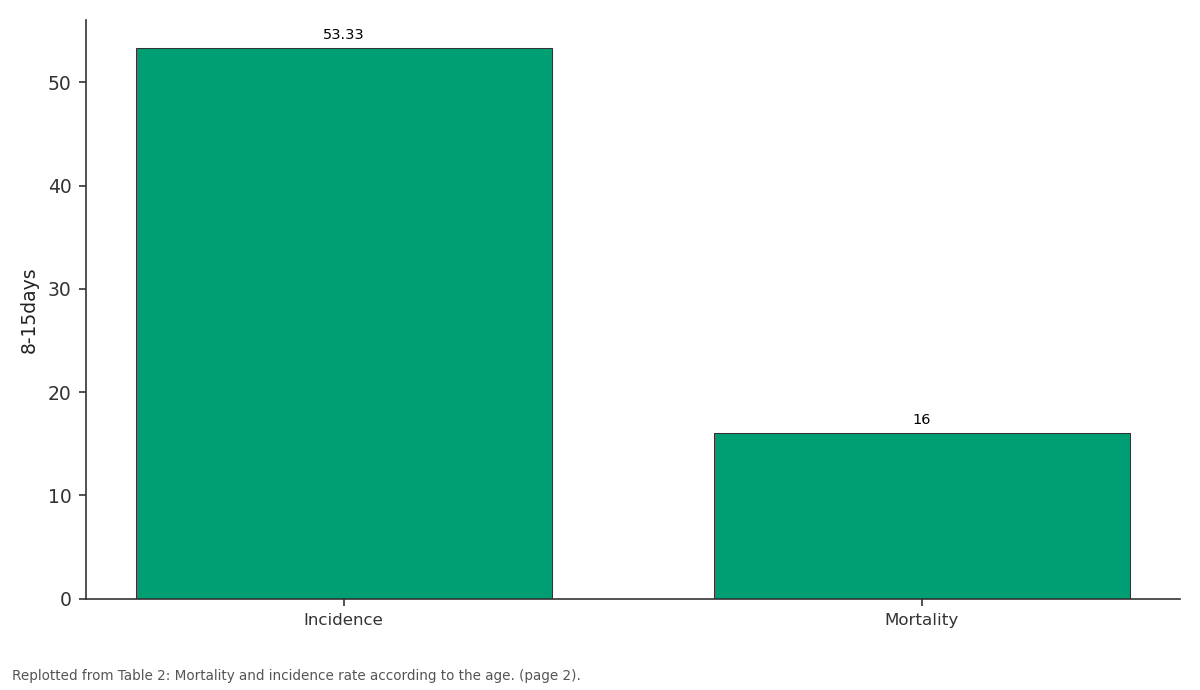
8-15days: Incidence vs Mortality
Replotted from Table 2 (page 2) of the original paper. Every bar is the paper's own table value.
View source evidence ↗Figures & tables
From the original paper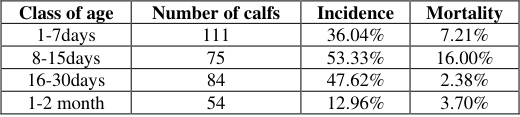 Table 2
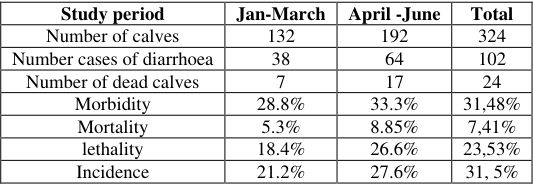 Table 1
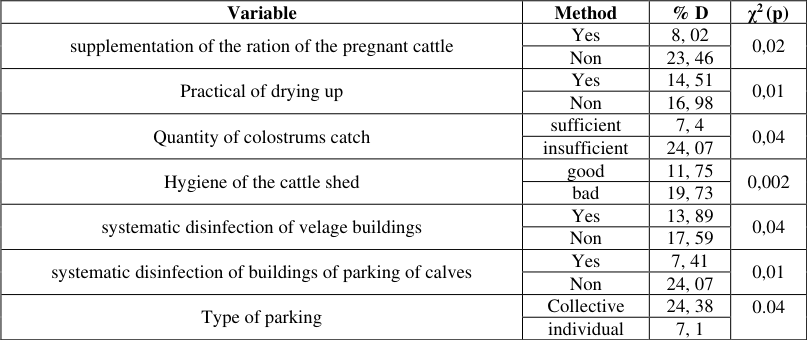 Table 3
 Table 4
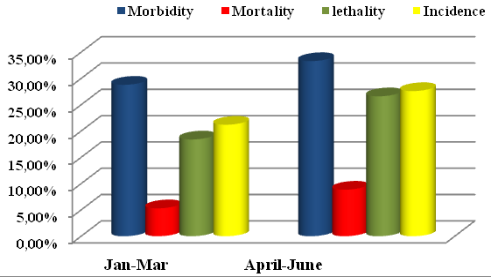 Figure 1
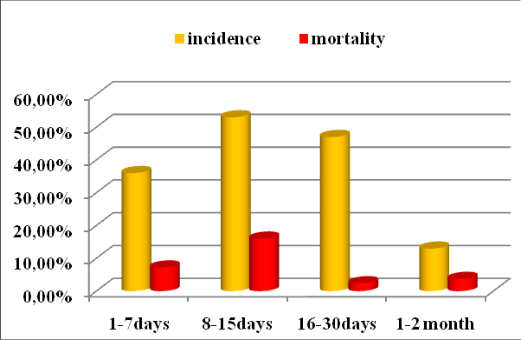 Figure 2
 Table 5
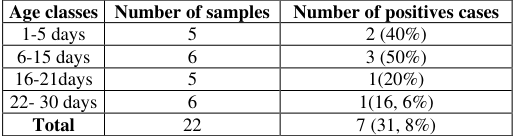 Table 5
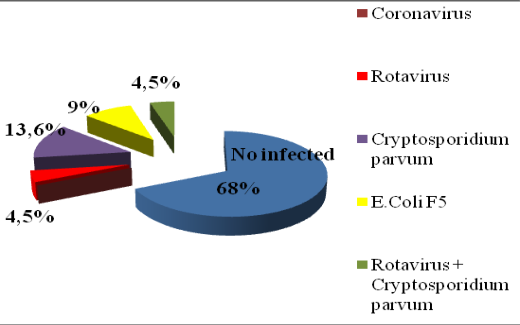 Figure 3
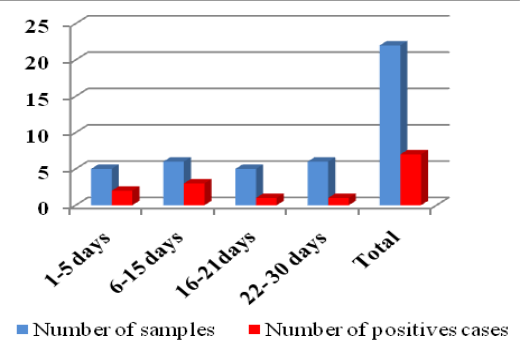 Figure 4
Introduction
Diarrhoea in young pre-weaned calves is one of the most important causes of calves morbidity and mortality [2] . Disease incidence in young calves has Un adverse effect on their immediate health status, longevity in the herd and productivity performance and thus causes great economic loss [3] . In order to increase productivity of area study livestock, it is important to identify the etiological and risk factors involved in calf diarrhoea in order to devise preventive measures and reduce losses during the initial months of life.
Materials and Methods
Materials and Methods
Data collection 2.1.1 Registration of Diarrhoea and Mortality Data:
A case of mortality and morbidity of calf under 60 days of age was determinate by weekly visits to 30 farms in region of Blida. The study population was randomly selected within the lists of all area dairy breeding. The study was carried out by 324 dairy calves less than 60 days of age, with the means of followed cards we recorded the new diarrhoea cases and all the predisposing factors.
Samples
Collect: 22 fecal samples were collected from 22 dairy farms; the calves sampled were under 60 days of age with clinical signs of diarrhoea, provided they had not received prior treatment with antibiotics.
Laboratory Analysis:
it was carried by digestive ELISA kit antigenic provided by (Bio-X Diagnostics) for diagnosis test of Rotavirus, Coronavirus, E. Coli F5 and cryptosporidium for bovines, it's one of direct test for faeces.
Statistical Analysis:
a Statistica06 software analysis used for descriptive analysis and to compare the different average, showed a significant relation of risk factors and diarrhoea by means the chi-square test (χ 2 ),the significance was set at P<0,05.
Results
Results
Descriptive Epidemiology The Incidence
During the investigation period, we recorded the birth of 324 calves with 59,25% in second half of the study(April-June) and 40,75% during the season of (January-March), the presence of diarrhoea were observed during the two season and in all the breeding included, with an incidence monthly combined of 19,6% up to 44%, the mortality consecutive of o diarrhoea episode was observed in 27 breeding studied (90%) with a higher rate in May 21, 3% and the absence in April. Mortality Overall, 324 calves of which 5, 9% died during two season of production and 31, 5% were presented the clinical symptoms of diarrhoea. The mortality rate was significantly higher in calves were 15 days of age during second study period. The diarrhoea symptoms peaked during April to June in calves had two week of age.
Risk factors
The analytical study showed that the nutrient of adult cattle, quality and quantity of colostrums, disinfection of buildings, calf's housing were the important factors associated with calf neonatal diarrhoea.
Laboratory analysis
The antigenic research reveals the presence of three infectious agents in 7 faecal samples or 31,8% of breeding were infected by cryptosporidium parvum with 13,6%, E. Coli F5 in 9% of population included and Rotavirus with 4,5%.
Discussion
Random sampling is the method of choice to obtain a representative sample of the population [4] . the survey results show that the diarrhoea remains a pathology major in dairy breeding in the region of Blida, and a crucial constraint has an important lethality (23,5%) in dairy calves. in the present study, the morbidity risk (31,5%) was higher than those is reported in France by Bendali (14,6%), Schuman (20,5%), Virtala (22%); bordering that given by Wells (24,5%) [4] , it's inferior with those shown by Sfakssi in the east of Algeria (64%) and Fassi in Morocco (60%) [5] . a case-control study was performed to examine the possible involvement of various enteropathogens in diarrhoea by comparing the presence of these agents in the faeces of scoring calves younger than 2 months of age. We have detected just three enteropathogens Rotavirus, E. ColiF5 and Cryptosporidium parvum with an important variation according the age. Other studies reported the presence of 4 enteropathogens Rotavirus, Coronavirus, E. Coli F5 and cryptosporidium parvum in different area in Algeria [6] . The laboratory analysis is in agreement with studies of Khelèf and al in centre of Algeria into 2000, 2002, 2007 and 2009, which showed that cryptosporidium parvum, E. Coli F5, Rotavirus and Coronavirus are the 4 principal infectious agents implied in the calf neonatal diarrhoea with prevalence depend with the age of sick calves [7] .
Conclusion
the diarrhoea is a very frequent diseases in diary calf, which can be caused by various infection agents affect more particularity the calves had 15 days of age, it generate losses economic considerable because of mortality raised at the newborn, it's thus necessary to put good conduits to limit their impact and more to undergo them, such as the good practice of vaccination against principal enteropathogens. It's necessary to reinforce passive immunity in calves by the vaccination of the pregnant mothers in order to increase the rates of the antibody specific to principal enteropathogens.
Figures and tables from the paper
| Class of age | Number of calfs | Incidence | Mortality |
|---|---|---|---|
| 1-7days | 111 | 36.04% | 7.21% |
| 8-15days | 75 | 53.33% | 16.00% |
| 16-30days | 84 | 47.62% | 2.38% |
| 1-2 month | 54 | 12.96% | 3.70% |
Table text extracted from the original PDF; superscript letters are shown inline. The original table image is below.
View original table image
| Study period | Jan-March | April -June | Total |
|---|---|---|---|
| Number of calves | 132 | 192 | 324 |
| Number cases of diarrhoea | 38 | 64 | 102 |
| Number of dead calves | 7 | 17 | 24 |
| Morbidity | 28.8% | 33.3% | 31,48% |
| Mortality | 5.3% | 8.85% | 7,41% |
| lethality | 18.4% | 26.6% | 23,53% |
| Incidence | 21.2% | 27.6% | 31, 5% |
Table text extracted from the original PDF; superscript letters are shown inline. The original table image is below.
View original table image
| Variable | Method | % D | χ2 (p) |
|---|---|---|---|
| supplementation of the ration of the pregnant cattle | Yes | 8, 02 | 0,02 |
| Non | 23, 46 | ||
| Practical of drying up | Yes | 14, 51 | 0,01 |
| Non | 16, 98 | ||
| Quantity of colostrums catch | sufficient | 7, 4 | 0,04 |
| insufficient | 24, 07 | ||
| Hygiene of the cattle shed | good | 11, 75 | 0,002 |
| bad | 19, 73 | ||
| systematic disinfection of velage buildings | Yes | 13, 89 | 0,04 |
| Non | 17, 59 | ||
| systematic disinfection of buildings of parking of calves | Yes | 7, 41 | 0,01 |
| Non | 24, 07 | ||
| Type of parking | Collective | 24, 38 | 0.04 |
| individual | 7, 1 |
Table text extracted from the original PDF; superscript letters are shown inline. The original table image is below.
View original table image
| Entomopathogens Agents detected | calves (n = 22) | — |
|---|---|---|
| Number | % | |
| No agent | 15 | 68,18 |
| Coronavirus | 00 | -- |
Table text extracted from the original PDF; superscript letters are shown inline. The original table image is below.
View original table image
| Rotavirus | 1 | 4,54 |
|---|---|---|
| Cryptosporidium parvum | 3 | 13,63 |
| E. Coli F5 | 2 | 9,09 |
| Rotavirus + Cryptosporidium parvum | 1 | 4,54 |
Table text extracted from the original PDF; superscript letters are shown inline. The original table image is below.
View original table image
| Age classes | Number of samples | Number of positives cases |
|---|---|---|
| 1-5 days | 5 | 2 (40%) |
| 6-15 days | 6 | 3 (50%) |
| 16-21days | 5 | 1(20%) |
| 22- 30 days | 6 | 1(16, 6%) |
| Total | 22 | 7 (31, 8%) |
Table text extracted from the original PDF; superscript letters are shown inline. The original table image is below.
View original table image
References
0 in the original paperCited by 1
From OpenAlex, OpenCitations and reference lists read by Scinovex
- SEROTYPING AND ANTIMICROBIAL RESISTANCE OF ESCHERICHIA COLI ISOLATED FROM DIARRHEIC CALVES IN THE PROVINCE OF TIZI-OUZOU, ALGERIA ↗
Madjid Akkou, Madjid Sadi, Lamia Bentayeb, Yacine Titouche · Archives of Veterinary Medicine · 2024
Calf diarrhea is still a problematic disease in the dairy industry worldwide. Several enterpathogens are associated with diarrhea in calves including Escherichia coli. This latter is one of the most common causes of diarrhea and septicemia in calves. The primary goal of antimicrobial therapy in calves with diarrhea is to prevent bacteremia and decrease the number of coliform bacteria in…
❝ 0PDF