
Research article · 2017 · Full text
International Journal of Statistics and Applied MathematicsNew special homogeneous Bianchi type I Massive string cosmological models with anisotropic dark energy
Volume 2(6) · Pages 131–134
Research areasCosmology and Gravitation TheoriesGeophysics and Gravity MeasurementsBlack Holes and Theoretical Physics
Abstract
Author-writtenA special law of variation for Hubble’s parameter is presented in a spatially homogeneous Bianchi type-I massive string cosmological models with space-time that yields a constant value of deceleration parameter. Using the law of variation for Hubble’s parameter, exact solutions of Einstein’s field equations are obtained for Bianchi-I space-time filled with perfect fluid in two different cases where the universe exhibits power-law and exponential expansion. It is found that the solutions are consistent with the recent observations of type Ia supernovae. A detailed study of physical and kinematical properties of the models is carried out.
Summary
Source-checkedPlain-language reading of the full paper, prepared with AI and checked against the text. Each point links to the authors' own words.
Why it matters
- Cosmic strings are of interest to cosmologists because they are believed to cause the density perturbations that led to galaxy formation. View evidence ↗
- Dark energy, acting as a repulsive pressure, is considered the most likely explanation for observations that the universe is currently accelerating in its expansion. View evidence ↗
The question
- The authors aim to develop a new spatially homogeneous Bianchi type-I cosmological model that incorporates massive strings, bulk viscosity, and vacuum energy density. View evidence ↗
What they did
- The model employs a special law of variation for the Hubble parameter to ensure the deceleration parameter remains constant. View evidence ↗
- The study derives exact solutions by applying Einstein's field equations to a system of strings with vacuum energy density. View evidence ↗
- The researchers use a spatially homogeneous Bianchi type-I line element as the geometric basis for their model. View evidence ↗
What they found
- The authors obtained exact solutions for the Bianchi-I space-time that describe two distinct expansion scenarios: power-law and exponential expansion. View evidence ↗
- The resulting model describes a universe that begins its evolution from a finite big-bang singularity. View evidence ↗
- Anisotropy is a persistent feature of the model, remaining present throughout the entire evolution of the universe. View evidence ↗
- The model indicates that while strings are the dominant feature in the early universe, they eventually vanish over a sufficiently long period. View evidence ↗
- Because the model utilizes a negative deceleration parameter, it successfully represents an accelerating phase of the universe. View evidence ↗
- The theoretical results of the model are consistent with astronomical observations of type Ia supernovae. View evidence ↗
What it means
- The authors conclude that their model is physically meaningful because its associated parameters exhibit reasonable behavior. View evidence ↗
Visual summary
1 visualsIllustrations explain the paper; they do not show study data.
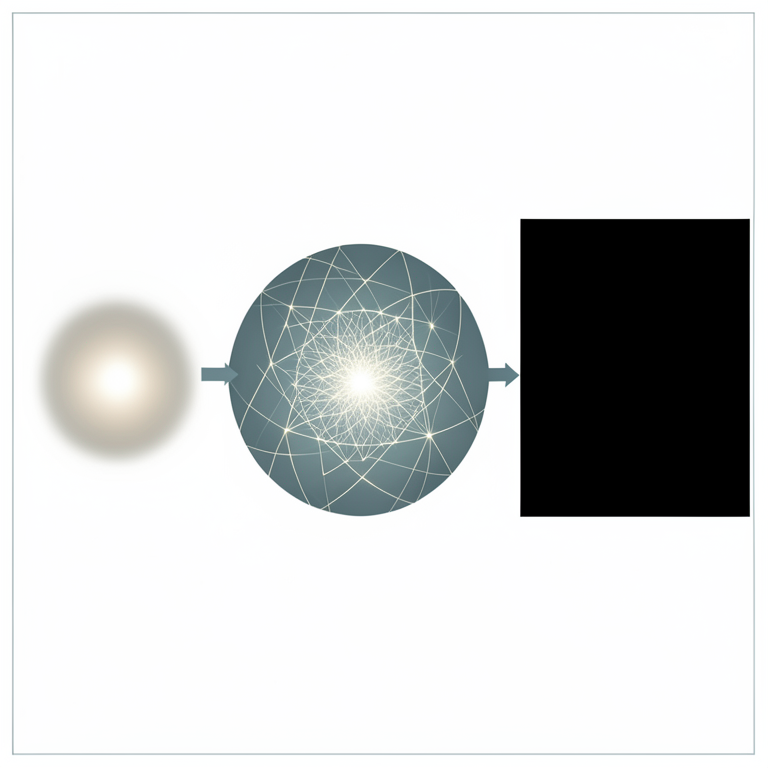
Timeline of Model Evolution
AI-generated conceptual illustration (The evolution of a Bianchi type I universe from a singularity to an empty space-time). It explains the idea and does not show study data.
View source evidence ↗Introduction
The study of cosmic strings has been a subject of much interest for cosmologists. It is believed that these strings give rise to density perturbations leading to the formation of galaxies (Zel'dovich [1980]). String theory is a hypothetical framework in which the point-like particles are replaced by one-dimensional objects called strings. On distance scales larger than the string scale, a string in believed to work just like an ordinary particle. In the early universe (strings dominated era), the strings produce fluctuations in the density of particles. We may speculate that as strings vanish and particles become important, then the fluctuations grow in such a way that finally we shall end up with galaxies. The presence of string in the early universe can be explained using grand unified theories (GUT) as already discussed by Kibble (1976), Everet (1981), Vilenkin (1982). These strings have stress energy and are classified as geometric and massive strings. Letelier (1979Letelier ( , 1981) ) studied a gauge onvariant model of a cloud formed by geometric strings and used the model as a source of gravitational field. Stachel (1980) has developed the classical theory of geometric strings as a theory of simple surface forming time-like bivector field in an arbitrary background space-time. Letelier (1979) has formulated the energymomentum tensor for massive strings and explained that the massive strings are formed by geometric strings with particles attached its extension. Further, Letelier (1983) used this idea for deriving cosmological models of Bianchi type-I and Kantowski-Sachs space-times in the presence of massive strings. Matraverse (1988) has presented a class of exact solutions of Einstein's field equations with a two-parameter family of classical strings. Krori et al. (1990) have obtained some exact solutions in string cosmology for homogenous spaces for Bianchi type II, VI, VIII and IX. Banerjee et al. (1990) have studied Bianchi type-I string cosmological models with and without the source-free magnetic field. Tikekar and Patel (1992) have obtained some Bianchi type III cosmological solutions of massive strings in the presence of a magnetic field. Shri Ram and Singh (1995) have presented some spatially homogenous type I Bianchi massive string models with and without source free magnetic field. Chakraborty (1991) has discussed string cosmology in Bianchi type VI o space-time. Bali et al. (2003Bali et al. ( , 2008) ) In general relativity, cosmological models are usually constructed under the assumption that the matter content is an idealized prefect fluid. This assumption may be a good approximation to the actual matter content of the universe at present time. The evolution of isotropic cosmological models filled with perfect fluids has been extensively studied by many workers. It is certainly of considerable interest to study cosmologies with richer structure both geometrically and physically than the standard prefect fluid FRW models. It is of interest to take into account dissipative process such as viscosity and heat conduction in cosmological models. Misner (1968) has studied the effect of viscosity on the evolution of cosmological models. Several authors viz. Belinski and Khalatnikov (1976), Banerjee and Santos (1984) Perlmutter (1998) have led to the belief that a cosmological constant in a kind of repulsive pressure, dubbed as dark energy, and is most suitable candidate to explain the recent observations that the universe is not only expanding but also accelerating. The cosmological term is also interpreted as the vacuum energy density. Cosmological models with timedependent term have been investigated so far by many authors. Recently, Bali and Swati (2016) have investigated a Bianchi type-I massive string cosmological model with bulk viscosity and vacuum energy density. In this paper, we obtain a new spatially homogenous Bianchi type-I massive string cosmological models with bulk viscosity and vacuum energy density. The plan of the paper is as follows. In Sect. 2, we present the metric and field equations by assuming a special law of variation of Hubble parameter. We discuss the physical and kinematical properties of the model is Sect. 4. In Sect. 5 we outline some concluding remarks.
Metric and field equations
We consider the spatially homogenous Bianchi type-I line element given by
where the metric potentials A, B and C are functions of cosmic time t. The energy-momentum tensor for a cloud of massive string dust with a bulk viscous fluid of string in given by Letelier (1983) and Landau and Lifshitz (1963) as
Here is the proper energy density for a could of strings with particles attached to them, is the string tension density, is the four-velocity of the particles,
x is a unit spacelike vector representing the direction of string, is the coefficient of bulk viscosity and is the expansion scalar. If the particle density of the configuration is denoted by p , then we have
Einstein's field equations for a system of strings with vacuum energy density are given by
where R is the Ricci tensor and R is the scalar curvature in the gravitational unit
We assume that the string's direction is along the x-axis,
the field equations (5) together with ( 2) and (3) lead to the following system of equations.
where an overdot denotes ordinary derivative with respect to t. For the model (1), the spatial volume (V) and average scale factor a are given by .
3 ABC a V (10) The expansion scalar , shear scalar , the anisotropy parameter (Am) and, Hubble parameter H are given by An important observational quantity in cosmology is the deceleration parameter (q) defined by
The sign of q indicates whether the model inflates or not. The positive value of q corresponds to the standard decelerating universe and the negative value indicates inflation.
Solutions of the field equations
We now obtain exact solutions of ( 6)-( 9) which are four equations in seven unknowns A, B, C, , , and .
Therefore to obtain a deterministic model, we need extra conditions depending upon the physical nature of the problem. Subtracting ( 8) from ( 7), we get
Equation ( 16), on integration, provides
where k is an arbitrary constant. To treat (17) we consider the following relation
(18) as suggested by Goswami et al. (2016). Future, we set
where D(t) is an arbitrary function. Substituting (19) in (17) and integrating of the resulting equation we get 10) and (18), we find that
We can determine the function D(t) from (20) if the average scale factor a is a known function of time. Hence to obtain an expression for the average scale factor a, we can apply the special law of variation of Hubble parameter proposed by Berman (1983) that yields constant value of the deceleration parameter. It may be noted that here most-of the well known models in general relativity and alternative theories including inflationary models are model with constant deceleration parameter. For an accelerating models of the universe, we take the constant negative. Then (15) gives the solution
where 0 c and d are integration constants. This equation implies that the condition of expansion is . 0 1 q Substituting (22) in (20) and integrating, we obtain
where N is integration constant. Without loss of generality we can take N=1. Therefore from ( 19), ( 21), ( 22) and ( 23), the solutions for the scale factor A, B and C are obtained as
To get a deterministic model of universe, we assume that
where is a constant. Then, from ( 22) and ( 27), the vacuum energy density has the value given by
Physical feature of cosmological model
For the present model, we obtain
The expansion scalar, shear scalar and anisotropy parameter are obtained as
The energy density, string tensor density, particle density and bulk viscosity coefficient are given by , are all infinite. Thus, the model starts evolving with a big-bang singularity at t=t o . As t tends to infinity, the spatial becomes infinite and the physical and kinematical parameter all tend to zero. Therefore, the model essentially gives an empty space-time for large time. The anisotropy parameters , being infinite initially, tends to a constant as t . This means that the anisotropy of the model is maintained throughout the passage of time. Since the deceleration parameter is negative, the present model represents an accelerating phase of the universe. The strings eventually disappear from the universe for sufficiently large time. The model is compatible with the results of recent observations on present-day universe from type Ia supernova (Riess, et al. 1998;Perlmutter et al. 1998.)
Conclusions
In this paper, a spatially homogenous Bianchi type I model representing massive strings with bulk viscosity and vacuum energy density has been studied. The exact solutions of the field equations have been obtained by applying a special law of variation of Hubble parameter which yields a constant value of the deceleration parameter. By assuming the negative constant deceleration parameter and a time-decaying form energy density, an accelerating model of the universe has been presented. The model starts evolving from a finite big-bang singularity. The anisotropy in the model is maintained throughout its evolution. The strings dominate in the early universe and eventually disappear from the universe for sufficiently large time. For sufficiently large time, the model would essentially gives an empty space-time as , and p all tend to zero as t . The model presented here is physically meaningful as the associated parameters behave reasonably.
References
17 in the original paper- Zeldovich, YaB.: Mon. Not. Roy. Astron. Society 192, 663 (1980)
- Matraverse, D.R.: Gen. Relativ. Gravit. 20, 279 (1988)
- Krori, K.D., et al.: Gen Relativ. Gravit. 22, 123 (1990)
- Tikekar, R., Patel, L.K.: Gen. Relativ. Gravit. 24, 397 (1992)
- Shri Ram and Singh, J.K.: Gen. Relativ. Gravit. 27, 1207 (1995)
- Chakrabotry, S.: Ind. J. Pune Appl. Phys. 29, 31 (1991)
- Bali R., Upadhyay, R.D.: Astrophys. Space Sec. 238, 97 (2003)
- Bali, et al.: Astrophy. space Sci. 317, 21 (2008)
- Pradhan, A.: Commun. Theor. Phys. 55, 931 (2011) 18.
- Belinski, V.A., Khalatnikov, I.M.: Sov. Phys. JETP 42, 205 (1973)
- Banerjee, A., Santos, N.O.: Gen Reltiv. Gravit. 16, 217 (1984)
- Bali, R. Singh, J.P.: Int. J. Theor. Phys. 47, 3288 (2008)
- Saha, B., Visinescu, M: Int. J. Theor. Phys. 49, 1411 (2010)
- Saha, B. et al.: Cent Eur. J. Phys. 8, 113 (2010)
- Bali, R. Swati: Int. J. Appl. Sci and Maths 3 no. 6 (2016)
- Perlmutter, S, et al.: Nature 391, 51 (1998)
- Goswami, G.K.: Astrophys. Space Sci. 361, 118 (2016)