
Research article · 2017 · Full text
International Journal of Veterinary Sciences and Animal HusbandryMyositis in German shepherd dog and its management
Volume 2(6) · Pages 01–02
Research areasMuscle and Compartmental DisordersVeterinary Orthopedics and NeurologyInflammatory Myopathies and Dermatomyositis
Abstract
Author-writtenA German shepherd dog of 7 years age was presented with a local swelling on the right arm region near scapula, edematous swollen right limb and lameness. On physical examination swollen area has crepitating sound with fluid filled inside it. Fine needle aspiration shows presence of serosangineous fluid with foul smell in it. Laboratory investigation revel normal blood profile with increased total leucocytes count, Creatinine kinase enzymes and Neutrophillia. Microscopical examination of fluid smear shows presence of Gram positive rods and gram negative Cocci. Culture results shows antibiotic sensitivity to Amoxicillin and streptomycin. Dog was treated with Cefpodoxime+ Clavunic acid along with supportive therapy and modified Robert Jones bandage for 3 days with insignificant results. Addition of Meteronidazole and Amoxicillin+ Clavunic acid from 4th day significantly improve the wound healing and lameness in dog. The clinical and microscopical findings and treatment responsive to Amoxicillin + Metronidazole suggestive of myositis and myonecrosis caused by anaerobic gram positive gas producing long Rods- Clostridium Sp.
Summary
Source-checkedPlain-language reading of the full paper, prepared with AI and checked against the text. Each point links to the authors' own words.
Why it matters
- Clostridial myonecrosis, also known as gas gangrene, is a dangerous muscle infection that can spread from a trauma site or through the bloodstream from the gastrointestinal tract. View evidence ↗
- Myositis and myonecrosis in animals are primarily caused by anaerobic, gas-producing Gram-positive long rods, specifically Clostridium species. View evidence ↗
- The destruction of muscle fibers during these infections results in elevated levels of Creatinine kinase enzymes in serum biochemistry tests. View evidence ↗
The question
- The study aims to manage a case of a 7-year-old German shepherd presenting with lameness and edematous swelling on the right limb near the scapula. View evidence ↗
What they did
- Fine needle aspiration was used to examine the swelling, revealing a foul-smelling serosanguineous fluid. View evidence ↗
- Blood profiles were analyzed, specifically monitoring total leukocyte counts, Creatinine kinase enzymes, and neutrophil levels. View evidence ↗
- Fluid smears were examined microscopically for bacteria, and cultures were performed to determine antibiotic sensitivity. View evidence ↗
- Management included draining the abscess via a stab incision and washing the wound with a 2% Povidone iodine solution. View evidence ↗
What they found
- The dog's blood profile showed a total leukocyte count of 23,000/ul, Creatinine kinase at 204 u/l, and 92% neutrophilia. View evidence ↗
- Initial treatment with Cefpodoxime and Clavunic acid, combined with a modified Robert Jones bandage for 3 days, yielded insignificant results. View evidence ↗
- Switching to intravenous Amoxicillin+Clavunic acid (600mg B.D) and Metronidazole (100ml B.D) for 3 days led to a marked reduction in swelling and wound improvement. View evidence ↗
- Significant healing of the wound and improvement in the dog's limping gait were observed within 3 days of the revised treatment. View evidence ↗
- The wound achieved complete healing following a subsequent course of oral medications. View evidence ↗
What it means
- The authors conclude that the case was myositis and myonecrosis caused by Clostridium sp., based on clinical findings and the positive response to Amoxicillin and Metronidazole. View evidence ↗
- The authors emphasize that early recognition and aggressive treatment are essential for managing clostridial myonecrosis. View evidence ↗
Visual summary
1 visualsIllustrations explain the paper; they do not show study data.
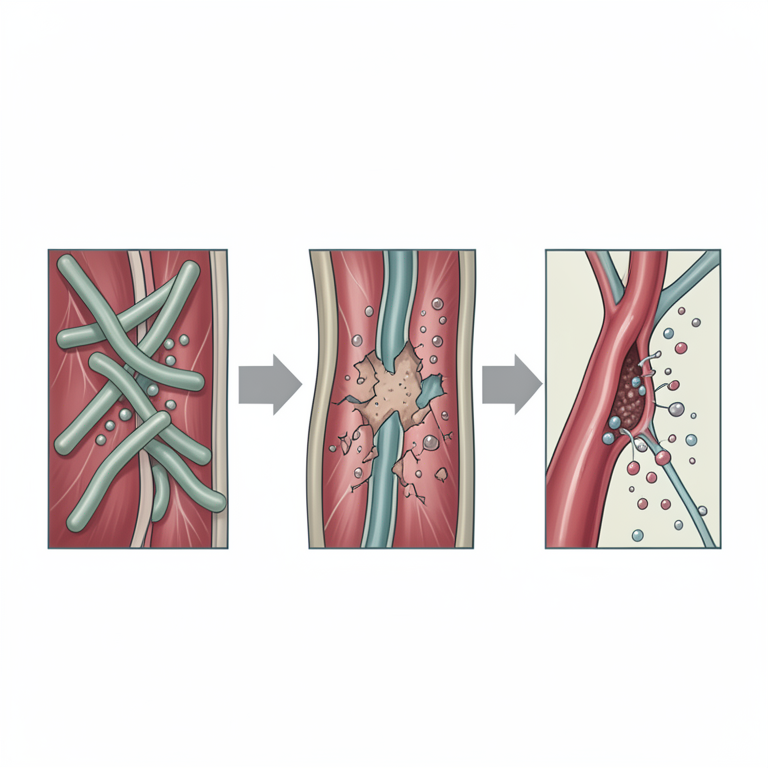
Pathophysiology of Clostridial Myonecrosis
AI-generated conceptual illustration (German shepherd dog muscle tissue and bloodstream). It explains the idea and does not show study data.
View source evidence ↗Introduction
A German shepherd dog of age 7 year was presented with a swelling on right leg below scapula. The dog is reluctant to move and has difficulty in sitting. The corresponding leg has edematous swelling downwards the swollen area till paws. The swollen area appears fluid filled with crepitating sound on external examination.
However only a mild pain is present on palpation. External examination reveals a fluid filled pocket on the right arm below scapula. History and Clinical findings On presentation the dog was having rectal temperature of !02.40F. lameness and reluctant towards motion. History reveals that lameness and edematous swelling appears 1 days back.
The dog has partial loss of appetite and dark color urination. On palpation a hard but fluid filled pocket was observed with crepitating sound. Fine needle aspiration of swollen pocket show presence of serosangivenous foul smelling fluid in the pocket. The fluid was collected by sterile tube and sent to culture and antibiotic sensitivity test.
A thin smear of fluid was made and the sent to laboratory for further investigation. 5ml of blood was collected and sent to laboratory for complete blood profile investigation. Laboratory findings and Diagnosis The examination of smear stained with gram stains shows presence of bacteria mainly Gram positive Rods species and few gram negative Cocci. Antibiotic sensitivity test shows positive sensitivity for Meteronidazole, Amoxicillin and Streptomycin. The blood profile shows elevated total leukocyte count to 23000/ul, Creatnine kinase to 204 u/l, and Neutrophillia 92 %, however liver function test and kidney function test were normal.
Elevated level of Creatnine kinase and total leukocyte count revels Myositis leading to myonecrosis caused by gas producing gram positive anaerobic bacteria. Dog has persistent rectal temperature of 102- 1030F, dullness and partial loss of appetite. Treatment & Management At the time of presentation dog was treated by giving RL (ringer lactate) 400ml intravenously (i.v), Ceftriaxone+ Salbectum @ 20mg per kg body weight (per/kg bw.), Inj. Melonex 1.5ml Neutrophillia also suggestive of Bacterial infection and local inflammatory reactions.
Meteronidazole is drug of choice in anerobic gas producing bacterial infection. Amoxicillin has good affinity towards Gram positive bacteria. Anti-inflammatory drugs should be used in as supportive therapy. Draining of wound is essential to remove the infiltrated serosangivenous fluid for effective healing of wound.
Clostridial myonecrosis (gas gangrene) is a life-threatening muscle infection that develops either contiguously from an area of trauma or hematogenously from the gastrointestinal tract with muscle seeding. Early recognition and aggressive treatment are essential.
Discussion
The main causative agents of wounds in muscular area which leads to myositis and myonecrosis (gas gangrene) in animals are Gram Positive gas producing anerobic bacteria- long Rods mainly Clostridium sp. These bacterial affects the G.I tract and large muscles leads to gastroenteritis myositis and myonecrosis that occurs as local swelling with crepitating sound. The same is reflected in serum biochemistry test as elevated level of Creatnine kinase enzymes that occurs due to destruction of muscle fibers. Increased total leukocyte count and
References
5 in the original paper- Mane MC, Vives MA, Barrera R et al. A putative clostridial myositis in a dog. J Small Anim Pract. 1992; 33:345-348.
- Cagienard B. Suspected clostridial myositis in a domestic cat. N Z Vet J. 1982; 30:87
- Slappendel RJ, Ferrer I. Leishmaniasis. In: Greene CE, ed. Infectious Diseases of the Dog and Cat. Philadelphia: WB Saunders Co. 1998; 450-458.
- Weller RO, Cumming WJK, Mahon M. Diseases of i.v, Meteronidazole 100ml and Tribivet 2ml iv. Modified Robert Jones Bandage was done on affected legs to reduced edematous swelling and sent home with advised oral medication with Cefpedoxime+clavunic acid (325mg) tablet B.D, Melonex oral suspension 3-4 drops B.D for 3 days. On 4thday the dog was presented with no considerable improvement in condition. Considering the laboratory culture report, blood profile and antibiotic sensitivity treatment was planned accordingly. The local swelling (abscess) was drained by giving stab incision. Serosangivenous fluid was drained out and wound was washed with Povidone iodine 2% solution. A 15 cm long and 3cm wide gauge piece soaked in lixen powder (Ceflexine powder) was placed inside the wound and whole leg was bandaged by modified RobertJones bandage covering wound. Dog was kept on intravenous medication as Amoxicillin+ Clavunic acid (600mg) B.D, Meteronidazole 100ml B.D, Melonex 1ml B.D, Pentaprazole 20mg B.D and Tribivet 2ml B.D for 3 days. In three days of treatment there is marked reduction in swelling and overall condition of wound. Marked healing of wound and improvement in limping gait occurred in 3 days. The dog was kept on oral medication with Amoxicillin+clavunic acid 325mg TID, Meteronidazole 400mg B.D and Verol Syrup (Multivitamins syrup) 10 ml B.D for next 5 days. Complete healing of wound occurred after oral medication. muscle. In: Graham DI, Lantos PL, eds. Greenfield's Neuropathology. 6th ed. London: Arnold. 1997; 489-581.
- Blood DC, Henderson JA, Radostits, OM; VETERINARY MEDICINE, 10thedition. Philadelphia, Lea & Febiger