
Research article · 2018 · Full text
International Journal of Statistics and Applied MathematicsA mathematical model for the slip condition of the blood flow through a stenosed artery using casson-fluid flow
Volume 3(1) · Pages 31–38
Research areasCardiovascular Health and Disease PreventionRheology and Fluid Dynamics StudiesBlood properties and coagulation
Abstract
Author-writtenThe mathematical model is developed by considering blood as Casson fluid through the asymmetric artery with the stenosis. The non-Newtonian fluid behaviour is characterized by using Casson-fluid flow model. The analytic expression for flow rate, resistance to flow and skin friction are derived by using this model. We observed that the flow rate decreases when the yield stress and viscosity coefficient increases, the skin-friction increases with the increase of yield stress in presence of slip velocity for velocity coefficient parameter. The results are derived in detail with the help of graphs for the variation of different flow parameter. Flow rate, resistance to flow, and skin-friction and impedance analysis of the casson fluid have been shown graphically by varying the yield stress.
Summary
Source-checkedPlain-language reading of the full paper, prepared with AI and checked against the text. Each point links to the authors' own words.
Why it matters
- Arteriosclerosis involves the buildup of plaque, composed of fatty substances, cholesterol, and calcium, in the inner lining of arteries, which is known as the hardening of the arteries. View evidence ↗
- The accumulation of plaque is dangerous because it can obstruct blood flow or detach, potentially leading to severe conditions such as strokes or heart attacks. View evidence ↗
- Stenosis, which is the narrowing of an artery, is categorized as a serious cardiovascular disease. View evidence ↗
The question
- The study aims to develop a mathematical model that treats blood as a Casson fluid flowing through an asymmetric artery affected by stenosis. View evidence ↗
- The research seeks to derive analytic expressions for three key parameters: flow rate, resistance to flow, and skin friction. View evidence ↗
What they did
- The model assumes steady blood flow within an artery that is axially symmetric but radially non-symmetric due to constriction. View evidence ↗
- MATLAB software was used to plot the results and visualize the variations of the flow parameters. View evidence ↗
What they found
- The flow rate of the blood decreases as the viscosity coefficient and yield stress increase. View evidence ↗
- Resistance to flow increases when both slip velocity and yield stress are increased. View evidence ↗
- With a fixed velocity coefficient (g), skin friction increases as both slip velocity and yield stress increase. View evidence ↗
What it means
- The authors conclude that their mathematical model will be useful for predicting flow characteristics in arteries affected by stenosis. View evidence ↗
- The authors suggest that this model could be further developed to account for the deformation of stenosis in human arteries. View evidence ↗
Visual summary
2 visualsIllustrations explain the paper; they do not show study data.
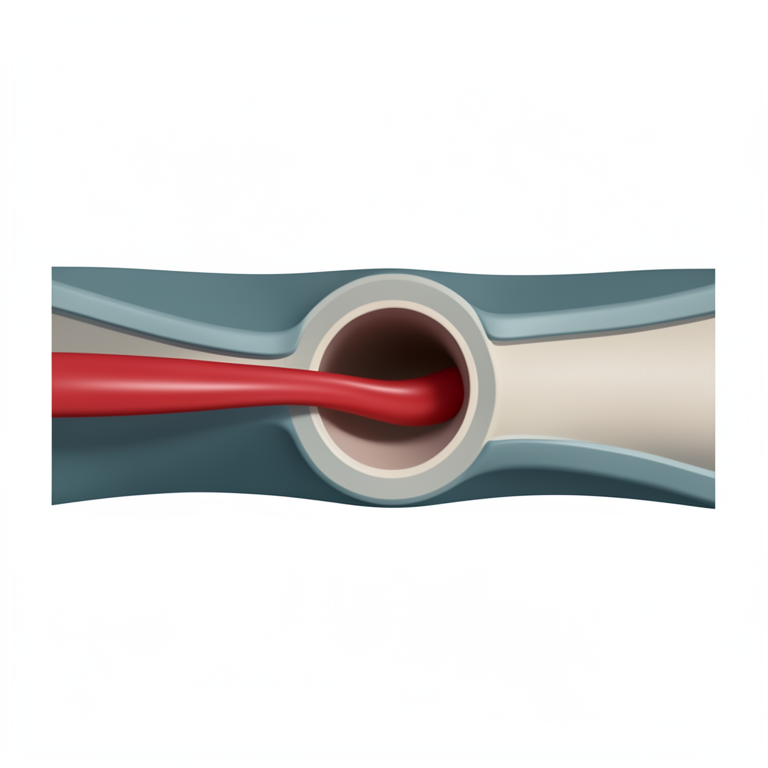
Stenosed Artery Geometry
AI-generated conceptual illustration (a human coronary artery with a localized stenosis). It explains the idea and does not show study data.
View source evidence ↗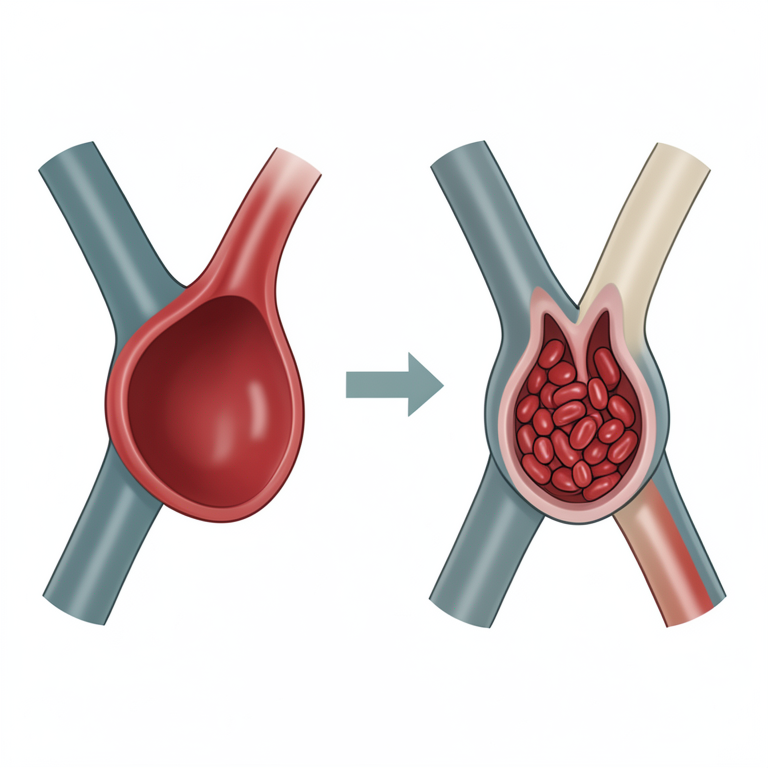
Flow Rate Dynamics
AI-generated conceptual illustration (blood flow through a stenosed human artery). It explains the idea and does not show study data.
View source evidence ↗Figures & tables
From the original paper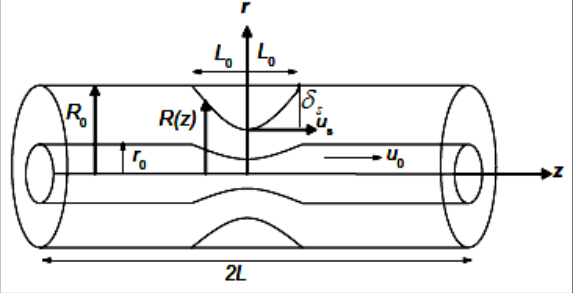 Figure 1
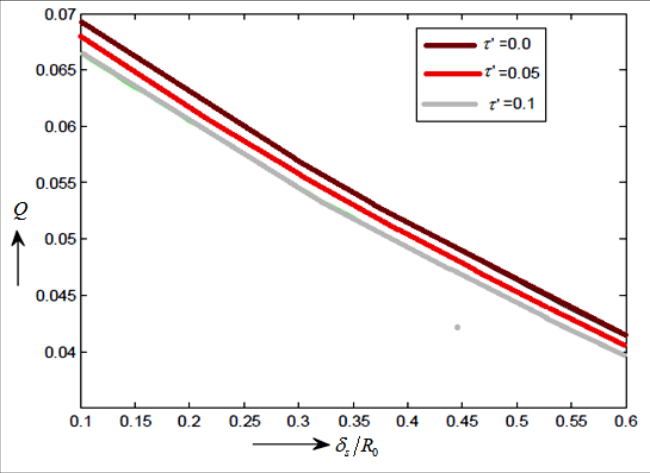 Figure 2
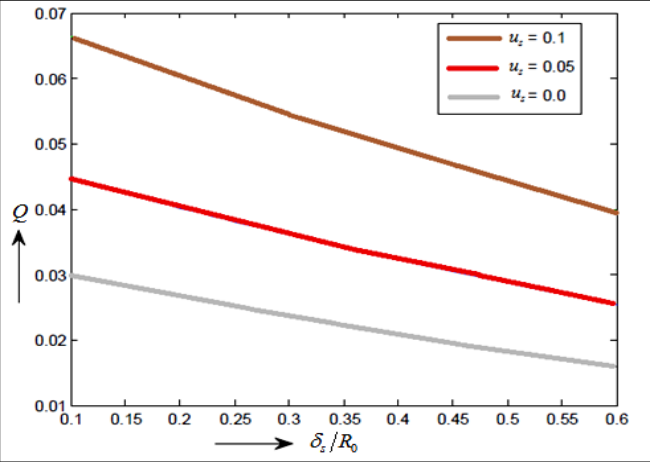 Figure 3
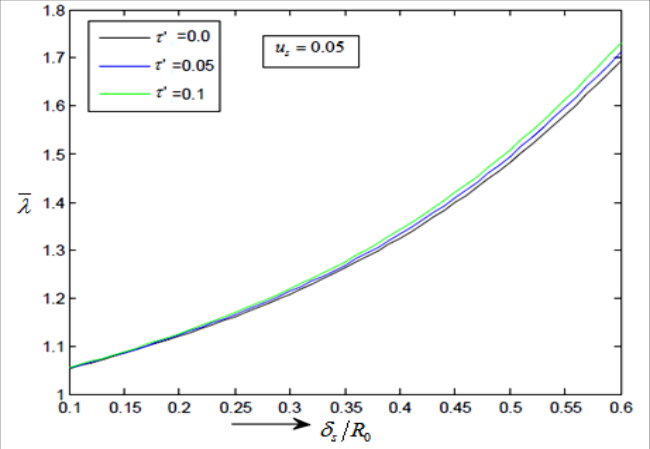 Figure 4
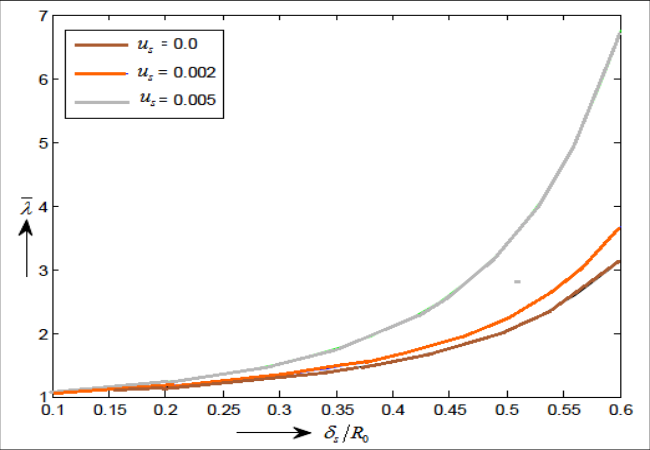 Figure 5
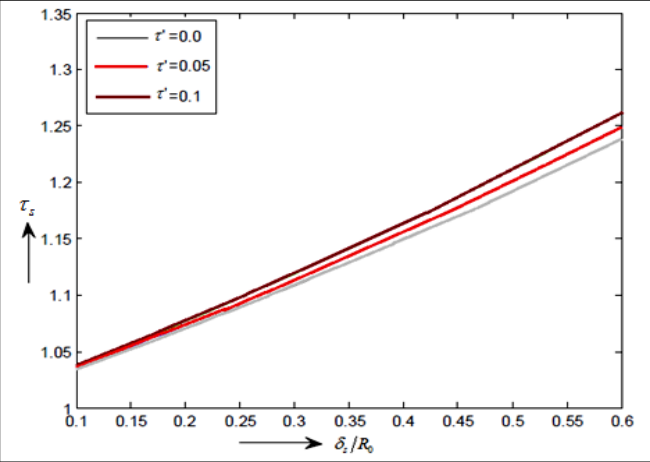 Figure 6
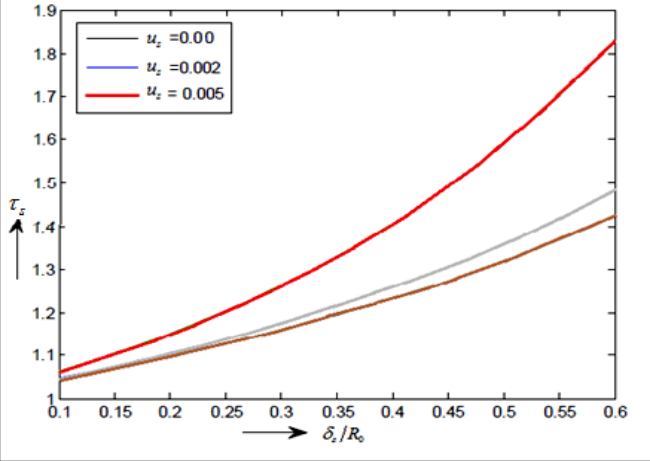 Figure 7
Introduction
Arteriosclerosis is often referred to as "hardening of the arteries." The word comes from the Greek words athero (meaning paste or gruel) and sclerosis (hardness). It's the process in which deposits of fatty substances, cellular waste, cholesterol, calcium and other substances build up in the inner lining of an artery. This buildup is called plaque. Plaques can block blood flow or break off. It causes a heart attack, stroke and another severe disease. There are many pieces of evidence that mathematical modeling in fluid dynamics plays a significant role in the development of blood vessel structure. Stenosis (narrowing the artery) is one of the serious cardiovascular diseases. Some researchers derived that Herschel-Bulkley fluid model and Casson fluid model are the fluid models with the yield stress, flow rate, and wall shear stress. Merrill et al. [16] developed a Casson-fluid model holds satisfactorily for blood flowing in tubes of diameter 130-1300, whereas Herschel-Bulkley fluid model may be employed in tubes of diameter 20-100. Several researchers have been studying on this diseases like Younge [29] , Biswas, et al [2] , chaturani et al [6] , Shukla et al. [23] and many more. An analysis on the effect of stenosis on the non-Newtonian flow of the blood in an artery by Shukla et al [23] . A mathematical model for the study of blood flow through a channel with permeable walls is given by Mishra et al [17] . The steady flow of blood through a stenosed artery is developed by Biswas et al [2] . The effect of time-dependent stenosis on flow through a tube is investigated by Young [29] . A mathematical model for the blood flow through narrow vessels with the mild stenosis is developed by Jain et al [11] . Two-layered poiseuille flow model for blood flow through arteries of small diameter and arterioles is developed by Chaturani et al [7] . The study of the effects of couple stresses on the blood flow through the thin artery with mild stenosis has been developed by Sinha and Singh [25] . A mathematical model for different shapes of stenosis and slip velocity at the wall through mild stenosis artery studies by Kumar et al [15] . The two-phase model of blood flow through stenosed tubes in the presence of a peripheral layer: Applications is derived by Srivastava [27] . The effect of peripheral layer viscosity on blood flow through an artery mild stenosis is studied by Shukla et al [24] . The effect of the Magnetic field on the peristaltic transport of couple stress fluid in a channel with wall properties is proposed by Sankad et al [22] .
Effect of stenosis on the non-Newtonian flow of the blood in an artery is derived by Rao [21] . The effect of elastic property of the wall on flow characteristics through an arterial stenosis is developed by Moayeri et al. [18] . A nonlinear Mathematical model of blood flow in a constricted artery experiencing body acceleration is derived by Chakravarty et al. [5] . The steady flow of blood treated as a Bingham plastic fluid in a circular cylindrical tube studied by Fung [10] . A technique for solving the approximate equations that the steady flow in tubes having axisymmetric mild stenosis is studied by MacDonald [15] . He derived an observation that the approximate equations are also valid if the stenosis is severe. The study of blood flow is very useful to cure atherosclerosis problem.
Mathematical Analysis
Let us consider the steady blood flow through an axially symmetric but radially non-symmetric constricted artery. The geometry of equation of stenosis is derived by: The constitutive equation of Herschel-Bulkley equation is given by:
where u is the axial velocity of blood, g is the velocity coefficient of Casson-fluid, is the shear stress and ' is the yield stress. We consider the flow equation in the form:
here p is the pressure at any point and is the shear stress of blood considered as Casson fluid.
Boundary Conditions:
The boundary conditions are:
The velocity boundary condition on the arterial wall is the slip condition, given by:
The regularity condition is given by:
is finite at 0 r (6) using the equation. ( 4) into (6), we have the skin friction:
) from the equation (7) the skin friction at ) ( z R R can be written as:
from equation ( 7) and ( 8), we have: Flow Rate: The volumetric flow rate is given by:
Integration (11) and using equation ( 5), we have:
using equation (4), we have:
using equation( 9) and (10), we get:
from equation ( 12 Resistance Parameter: The resistance to flow is given by:
The resistance to flow in the dimensionless form is given by:
is resistance to flow in the absence of stenosis, using eq.( 16), we get:
using eq. ( 16) and ( 18) into (17), we get,
using equation ( 2), the Equation ( 19) can reduced to:
Results and Discussion
The analytic expressions have been derived for the resistance to flow, yield stress and wall shear stress. The expression for the resistance to flow is given by equation ( 20) and for the yield stress is given by equation (13).These results are plotted with using MATLAB software. In fig. 2
Conclusion
In this paper, we developed the flow characteristics of a Casson fluid model for blood flow with velocity slip conditions in presence of the magnetic effect in the stenosed arteries. In this paper, we studied of the mathematical modeling of blood flow in narrow arteries stenosis. We observed that the flow rate decreases when the yield stress and viscosity coefficient increases, the skin-friction increases with the increase of yield stress and slip velocity for velocity coefficient parameter g . The results are compared with the results of Chaturani et al. [7] for blood flow in cosine curve-shaped stenosed arteries treating blood as Hershel-Bulkley fluid and Misra et al. [17] . This type of model can be developed for the deformation of stenosis with delivery models in human artery. This study will be useful in prediction of flow characteristics in stenosed arteries.
Figures and tables from the paper
References
29 in the original paper- Bhatt BS, sachet NC. On the analogy in slip flows. Indian Journal of Pure and Applied Mathematics. 1979; 10:303-306.
- Biswas D, Chakraborty US. Steady flow through a stenosed artery: A non-Newtonian fluid model", Assam University journal of Science and Tech. 2010; 7(11):144-153.
- Bulugliarello G, Hyden JW. Detailed characteristics of the flow of blood in vitro", Trans. Soc. Rheol. 1963; 7.
- Moayeri MS, Zendehboodi GR. Effect of elastic property of the wall on flow characteristics through arterial stenosis", Journal of Biomechanics. 2003; 36:525-535.
- Chakravarty S, Sannigrahi. A nonlinear Mathematical model of blood flow in a constricted artery experiencing body acceleration, Mathematical and Computer Modelling. 1999; 29:9-25.
- Chakravarty S, Datta A, Mandal AK. Effect of stenosis on the flow behaviour of blood in an artery", IJES. 1987; 25:10031018.
- Chaturani P, Kaloni PN. Two-layered poiseuille flow model for blood flow through arteries of small diameter and arterioles", Biorheology. 1976; 13:242-250.
- Chaturani P, Upadhyay. Two phase model for blood flow through small diameter tubes, Biorheology. 1979; 16:109-118.
- Enderle J, Susan B, Bronzino B. Introduction to Biomedical Enginnering, Academic Press, Londaon, 2000.
- Fung YC, Lee JS. Flow in Locally constricted tubes at low Reynolds numbers, J Appl. Mech., Trans. ASME. 1970; 37:9.
- Jain M, Sharma GC, Kumar S. A mathematical model for the blood flow through narrow vessels with mild stenosis, IJE. 2009; 1:99-106.
- Kapur JN. Mathematical Models in Biology and Medicine", Affiliated East-Wes press, New Delhi, 1985.
- Kumar H, Chandel RS, Kumar S, Kumar S. A mathematical model for different shapes of stenosis and slip velocity at the wall through mild stenosis artery", Advances in Applied Mathematical Biosciences. 2014; 5(1):9-18.
- Mac Donald DA. Blood flow in Arteries, Edward Arnold, Londan, 1974.
- MacDonald DA. On steady flow through modeled vascular stenosis. J Biomechanics. 1979; 12:13-30.
- Merrial EW, Benis AM, Gilliland ER, Sherwood TK, salzman EW. Pressure-flow relations of human blood in hollow fibers at low flow rates. Journal of Applied Physiology. 1965; 20(5):954-967.
- Mishra JC, Ghosh SK. A mathematical model for the study of blood flow through a channel with permeable walls", Acta. Mechanica. 1997; 12:137-153.
- Moayeri MS, Zendehbudi. The effect of elastic property of the wall on flow characteristics through an arterial stenosis", Journal of Biomechanics. 2003; 36:525-535.
- Naeem RK, Younus S, Dania. Inverse solutions for unsteady in-compressible couple fluid flow, IJAMM. 2010; 6:1-17.
- Radhakrishnamacharya G, Shrinivasa Rao P. Flow of a magnetic fluid through a non-uniform wavy tube, PNASI. 2007; 76:241-245.
- Rao BRP. Effect of stenosis on non-Newtonian flow of the blood in an artery, Bull. Math. 1980; 42:283-294.
- Sankad GC, Radhakrishnamacharya G. Effect of the Magnetic field on the peristaltic transport of couple stress fluid in a channel with wall properties. Int. J Biomath. 2011; 4:365-378
- Shukla JB, Parihar RS, Rao BRP. Effect of peripheral layer viscosity on blood flow through an artery mild stenosis", Bull Math. Bio. 1980; 17:403-410.
- Sinha P, Singh C. Effect of couple stresses on the blood flow through an artery with mild stenosis, Biorheology. 1984; 15:3-4.
- Srinivasacharya D, Shrikanth D. Effect of couple stresses on the pulsatile flow through a constricted annulus", Comtes Rendus Mecanique. 2008; 336:820-827.
- Srivastava VP. Two-phase model of blood flow through stenosed tubes in the presence of a peripheral layer: Applications", Journal of Biomechanics. 1996; 29(10):1377-1382.
- Stokes VK. Couple stresses in fluids, Fluid. 1966; 9:1710.
- Younge DF. Effects of time-dependent stenosis on flow through a tube. J Engrg. Ind. Trans. ASME. 1968; 90:248-254.
- Zendehbudi GR, Moayeri MS. Comparison of physiological and simple pulsatile flow through stenosed arteries. Journal of Biomechanical. 1999; 32:959-965.