
Research article · 2018 · Full text
International Journal of Veterinary Sciences and Animal HusbandryMorpho histological study of the spleen of broiler chickens during post-haching age
Volume 3(4) · Pages 22–23
Research areasAnimal Ecology and Behavior StudiesRabbits: Nutrition, Reproduction, HealthAnimal Virus Infections Studies
Abstract
Author-writtenThe study of morphometric and histologic evolutions of the Thymus during 28 weeks of posthashing age, realized on 86 subjects of broiler chicken they permitted to collect information about the morpho-histological aspect according to their post-hashing age; showed the size and the weight of the Thymus which reach their maximum at the 2nd week of age and the physiologic involution phenomena. These variations are in close relationship to the sexual maturity. These results can be used in the diagnosis of viral disease such as the Gumboro disease, Marek disease, Mycotoxicose.
Summary
Source-checkedPlain-language reading of the full paper, prepared with AI and checked against the text. Each point links to the authors' own words.
Why it matters
- The avian lymphoid system, similar to mammals, is categorized into primary and secondary lymphoid organs. View evidence ↗
- In birds, the spleen is one of the secondary lymphoid organs, alongside bone marrow and mucosa-associated lymphoid tissue (MALT), though birds lack lymph nodes. View evidence ↗
The question
- The study aims to examine the morphometric and histological changes in the spleen of broiler chickens as they age after hatching. View evidence ↗
What they did
- The study used 88 clinically healthy Hubbard F15 broiler chickens, with 8 subjects randomly sampled weekly from a larger group of 2,000. View evidence ↗
- Spleen tissues were fixed in 10% formalin for 24 hours, dehydrated with ethanol, cleared in xylene, and embedded in paraffin for histological preparation. View evidence ↗
- Optical microscopy at both low and high magnifications was used to observe the histological structures of the lymphoid tissues. View evidence ↗
What they found
- Between the first and seventh weeks post-hatching, the spleen experienced rapid growth, increasing in average weight from 0.1 g to 3.7 g. View evidence ↗
- Starting from the eighth week post-hatching, the spleen entered a stationary phase, maintaining an average weight of 3.7 g. View evidence ↗
- The histological changes observed in the spleen are not closely related to sexual maturity, unlike the changes seen in the thymus and bursa of Fabricius. View evidence ↗
- Unlike mammals, the fibro-elastic outer capsule of the avian spleen does not have short connective trabeculae extending into the parenchyma. View evidence ↗
- Histological analysis revealed that the white pulp (referred to as weight pulp in the text) and red pulp are intermingled without a distinct boundary between them. View evidence ↗
What it means
- The authors suggest that these morphometric and histological findings can be applied to the diagnosis of diseases such as Marek disease and Gumboro disease. View evidence ↗
- The authors conclude that the spleen's average weight peaks around the 6th week and remains relatively stable through the 8th week post-hatching. View evidence ↗
Visual summary
1 visualsIllustrations explain the paper; they do not show study data.
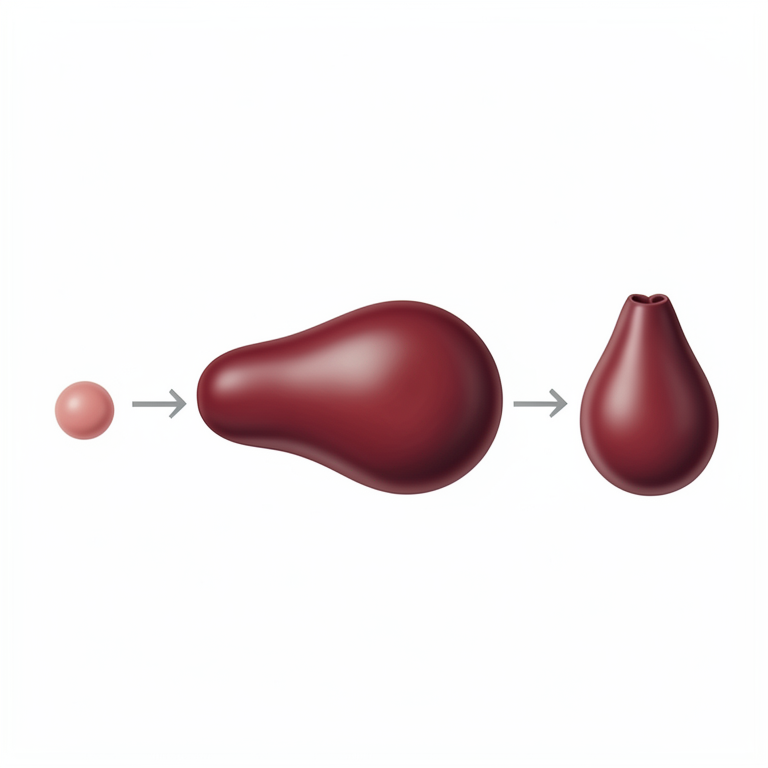
Spleen Weight Growth Curve
AI-generated conceptual illustration (broiler chicken spleen). It explains the idea and does not show study data.
View source evidence ↗Figures & tables
From the original paper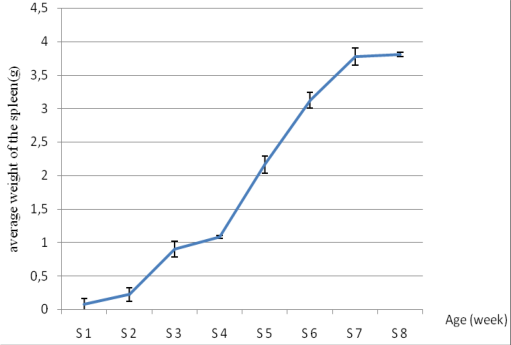 Figure 1
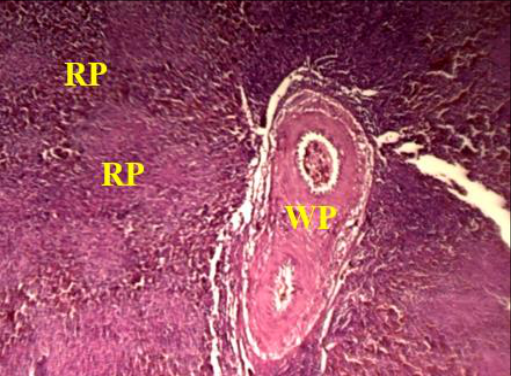 Figure 2
Introduction
Like mammals, birds lymphoid system is divided into two parts morphologically and functionally distinct: the primary lymphoid organs and secondary lymphoid organs [2]. The immune system (lymphoid) in birds mainly differs from that of mammals by the presence of the bursa of Fabricius (equivalent to bone marrow in mammals) and the thymus. The secondary lymphoid organs include the bone marrow, mucosa-associated lymphoid tissue (MALT) and spleen without lymph nodes [1]. The aim of our work is to study the morpho histological evolutions of the spleen of broiler chickens during post-haching age.
Materiel and methods The experimental study was carried out on 88 subject of broiler chickens clinically healthy, a sample of 8 subjects were taken weekly randomly on a strip of 2000 subjects of broiler chickens (Hubbard F15). The study was performed in the histology laboratory, agro-veterinary institute, University of Souk Ahras. The lymphoid organs collected have been a macroscopic and histological examination. The realization of blades for histological examination was made using the technique described: Tissues obtained from chickens were fixed in 10% formalin for 24 hours and then underwent successive passes through various compartments; dehydrated in increasing concentration of ethanol, cleared in xylene and finally soaked in paraffin.
The histological structures of lymphoid tissues were observed using an optical microscope (low and high magnification) [4].
Results And Discussion
Morphometric Study of The Spleen The evolution of the average weight of the spleen during post-hatching age is shown in fig. 1, we note the existence of two phases: during the first phase, which runs from the first week to 7th weeks of post-hatching age. The spleen growth quick and fast (pass 0.1 g to 3.7 g), but from the eighth week, spleen enters a stationary phase characterized by keeping its weight to 3.7g.
Conclusion
The morphometric and histological evolution of the spleen during post-haching age showed that spleen average weight peeked development at 6th week of age and remains in a relative stability until 8th weeks of post-hatching age. The weight pulp and red pulp are intermingled and there is no limit between two pulp.
Figures and tables from the paper
References
8 in the original paper- Brugère-Picoux J, Silim A. Manuel de pathologie aviaire. ed. Ed. france, 1992.
- Toivanen P, Naukkarinene HH, Vannino O. Avian Immunology. 1987; 1:79-92.
- Luna L. Manuel of Histology, Staining methods of armed forces, Institute of lymphoid tissue. Toxicol Pathol. 1968, 34:599-608.
- Khenenou T, Melizi M, Bennoune O, Benzaoui H. Morpho-histological study of the Thymus of Broiler chicken during post-hashing age. Int. J Poult. Sc. 2012; 11(1):78-80.
- Imre O, Bruce G. Splenic white pulp and associated vascular channels in chicken spleen. An J Anat. 1982, 165:445-480.
- Chen LT. Microcirculation of the spleen: and open or closed circulation. Poultry Science. 1978; 201:157-159.
- Alamorgot J. Manuel d’anatomie et d’autopsie aviaire, 2005. http:// www.Point-vet.fr.
- Bacha WJ, Bacha LM. Color Atlas of veterinary histology. 2nd edition Lymphatic system. Lippineatt Williams and Wilkins, U.S.A, 2000. Fig 1: Average weight of spleen during post-haching age According to some authors, a quick growth of spleen weight in the first weeks of age may be due to the histological maturation phenomena in the splenic parenchyma [5]. It has been found in chickens, that the spleen reaches its maximum size in the first 6 weeks of postnatal age [6]. [7, 8] report a similar evolution characterized by a progressive development of spleen weight during the first week of postnatal life, followed by stable phase. This is due to the increase in the number of germinal centers during the first weeks (4th and 7th week) and the no antigenic stimulation during the last weeks. Histological Study of the Spleen Fig. 2 shows the normal histological aspect of spleen. We note that the white pulp (BP) consists of lymphoid aggregates and the red pulp (RP), which represents the bulk of the body, has a richly vascularized network. The spleen is covered with a thin outer capsule fibro-elastic from which connective short trabeculae extend into the parenchyma in all mammals but not in birds. Our results showed that the weight pulp and red pulp are intermingled and there is no limit between two pulp. Fig 2: Histological aspect of spleen in 8th week of age WP: Weight pulp, RP: red pulp
Cited by 2
From OpenAlex, OpenCitations and reference lists read by Scinovex
- Heat stress and poultry production: a comprehensive review ↗
E. M. Oluwagbenga, Gregory Scott Fraley · Poultry Science · 2023
The impact of global warming on poultry production has gained significant attention over the years. However, our current knowledge and understanding of the mechanisms through which heat stress (HS) resulting from global warming affects the welfare, behavior, immune response, production performance, and even transgenerational effects in poultry are still incomplete. Further research is needed to delve deeper into these mechanisms…
❝ 146PDF - Effects of Sunset Yellow FCF on immune system organs during different chicken embryonic periods ↗
Fatma Filiz Colakoglu, Muhammet Lütfi Selçuk · Journal of Veterinary Research · 2020
Abstract Introduction Sunset Yellow FCF (SY), used frequently in ready-made foods, cosmetics, and the pharmaceutical industry, may cause many health problems. This study is intended to evaluate the morphological and cellular effects of SY on the embryonic chicken immune system throughout incubation. Material and Methods Babcock white leghorn eggs were randomly divided into four groups. Besides a control group, there…
❝ 9PDF