
Research article · 2017 · Full text
International Journal of Statistics and Applied MathematicsApplications of manpower levels for business using six and eight point state space in the stochastic models
Volume 2(6) · Pages 56–60
Research areasOptimization and Mathematical Programming
Abstract
Author-writtenThe present study aim is to compare the steady rate of crisis and steady state of probabilities under varying conditions which are manpower, under irregular conditions of full availability and nil availability in the case of business and manpower. Six and eight point state space has been compared under the different assumption that the transition from one state to another in both business and manpower occur in exponential time with different parameters.
Summary
Source-checkedPlain-language reading of the full paper, prepared with AI and checked against the text. Each point links to the authors' own words.
Why it matters
- Businesses aim to maintain an optimum level of resources, including manpower, to meet their responsibilities without maintaining more than is necessary. View evidence ↗
- The loss of trained and technically capable personnel can severely impact a company, forcing it to pay higher costs or overtime. View evidence ↗
The question
- The study aims to compare steady-state probabilities and the steady rate of crisis under varying conditions of manpower and business availability. View evidence ↗
What they did
- The researchers compared six-point and eight-point state spaces, assuming transitions between states occur in exponential time. View evidence ↗
- The model assumes two levels for both manpower (full or nil) and business (fully available or nil). View evidence ↗
- The system is designed such that if manpower reaches zero, the business also vanishes and becomes nil. View evidence ↗
What they found
- In the six-point model, as the parameter 'a' decreased from 65 to 7, the crisis rate (C-infinity) decreased from 8.97949 to 2.76085. View evidence ↗
- In the eight-point model, increasing the parameter λ from 7 to 29 resulted in a decrease in the crisis rate (C-infinity) from 143.5 to 55.05. View evidence ↗
What it means
- The authors conclude that an increase in the value of λ leads to a decrease in the crisis rate for both the six and eight point state space models. View evidence ↗
- The authors state that even when manpower is full, the business can enter a crisis state if experienced experts leave the company. View evidence ↗
Visual summary
1 visualsIllustrations explain the paper; they do not show study data.
Relationship between λ and Crisis Rate
AI-generated conceptual illustration (A conceptual business office environment with varying densities of office workers). It explains the idea and does not show study data.
View source evidence ↗Figures & tables
From the original paper Table 1
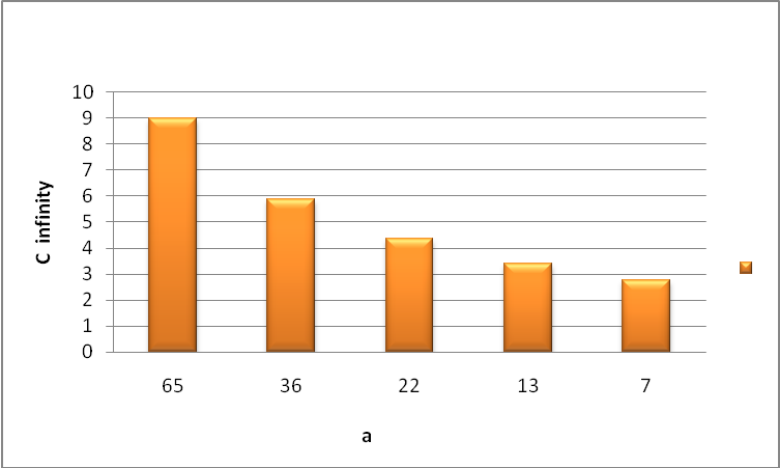 Figure 1
 Table 2
 Table 3
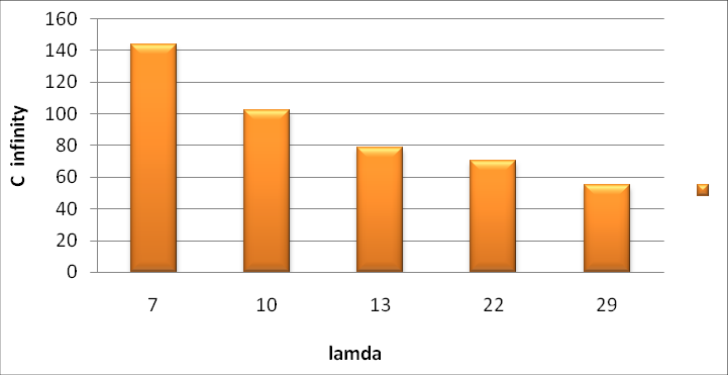 Figure 2
Introduction
Nowadays we start that labor has turn into a buyers' market as well as sellers' market. Any business which generally runs on commercial base wishes to keep only the optimum level of all resources necessary to meet company's responsibility at any time during the course of the business and manpower is not an exemption. This is spelt in the sense that a company may not want to maintain manpower more than what is needed. Therefore, retrenchment and recruitment are general and persistent in most of the companies now. If trained laborers and technically capable persons leave the business the seriousness is most awfully felt and the company has to assign paying deep price or pay overtime to employees. Approach to manpower problems have been dealt in many different ways as early as 1947 by Vajda [11] and others. Manpower planning models have been dealt in depth in Grinold & Marshal [3] , Barthlomew [1] and Vajda [11] . The methods to compute wastages (Dismissal, resignation and death) and promotion intensities which make the proportions corresponding to some selected planning proposals have been dealt by Lesson [4] . Markov model are designed for wastages and promotion in manpower system by Vassilou [12] . Subramaniam [11] . For an application of Markov chains in a manpower system with efficiency and seniority and Stochastic structures of graded size in manpower planning systems one may refer to Setlhare [9] . A two unit stand by system has been studied by Chandrasekar and Natrajan [2] with confidence limits under steady state. For n unit standby system may refer to Ramanarayanan and Usha [8] . Yadhavalli and Botha [13] have observed the same for two unit system with an introduction of preparation time for the service facility and the confidence limits for stationary rate of disappointment of an intermittently used system. For three characteristics system involving machine, manpower and money one may refer to C. Mohan and R. Ramanarayanan [6] . The study of Semi Markov Models for Manpower planning one may refer to the paper by Sally Meclean [5] . Stochastic Analysis of a Business with Varying Levels in Manpower and Business has been studied by C. Mohan and P. Selvaraju [7] . Applications of manpower with various stages in Business using stochastic models R. Arumugam and M. Rajathi [14] .
Markov chain model with four and six point state space
In this paper we consider two characteristics namely business and manpower. We compare steady state probabilities and steady state rate of crisis in both six and eight point state space. The situations may be that the manpower may be fully available or hardly available and business may fluctuate between complete availability to nil availability. It goes off when the manpower becomes nil. This is so because the experts may take the business along with them or those who have brought good will to the concern may bring the client's off the concern. The business depends on steady state probabilities and the availability of manpower. The steady state probabilities of the continuous Markov chain connecting the transitions in different states are identified for presenting the cost analysis. Numerical illustrations are also given.
Assumptions
1. There are two levels of manpower namely manpower is full and manpower is nil. 2. There are two levels of business namely, (a) business is fully available (b) business is nil.
The time T-during which the manpower remains continuously filled and becomes nil has exponential distribution with parameter 10
and the time R-required to stop full recruitment from zero stage is exponentially distributed with parameter 01 .
4. The fully available and zero periods of the business are exponentially distributed with parameters 'λ' and 'μ' respectively. 5. The time T during which the business is continuously full becomes moderate has an exponential distribution with parameter 21 and the time R-required to stop full recruitment from moderate level is exponentially distributed with parameter 12 . The time T-during which the business is moderately.
6. While manpower becomes zero, the business is vanished and becomes nil. 7. T-and R-are independently distributed random variables.
System Analysis 4.1 Six Point state space
The time for which the manpower remains continuously full and enters a state of reduced strength follows exponential distribution with parameter α1. The other two phases have exponential distribution with means 1/β1 and 1/γ1. The overall time for the process of recruitment time is then hypo-exponential. Since the sojourn time is in the down state is two -stage hypo-exponentially distributed, the system being modeled in a semi Markov process. The busy and lean periods of the business are exponentially distributed with parameters a and b. The Stochastic Process X(t) describing the state of the system is Markov chain continuous time with six points state space as given below in the order of manpower and business
The steady state probabilities of Manpower are, ;
Eight Point state space
The Stochastic Process X(t) describing the state of the system is Markov chain continuous time with four points state space as given below in the order of manpower and business
Where, 1. Refers to shortage/non availability of manpower and business. The system is in state (1, j).
When the manpower is in state 1 and business is in state for (1, j) = (1, 1) or (1 0) or (0 0) and there is not the state (0 1) as the business is misplaced while the manpower goes off.
2. Refers to moderate availability of business and it refers to full availability of manpower in the case of business.
3. Refers to full availability in the case of business.
The continuous time markov chain of the state space is given below which is a matrix of order eight.
The occurrences of transition in both business and manpower are independent, the individual infinitesimal generator of them are given by Let
be the steady state probability vector of the matrix Q, then
Using (5), we get the steady state probabilities:
(i) The infinitesimal generator of manpower of order two is as follows
The infinitesimal generator of business is given by the matrix of order three.
The steady state probabilities of manpower are While manpower is available business is fully available or nil. Manpower is inadequate or nil will lead to crisis state. The only crisis states are {(1 1), (1 2), (2 1)} and the crisis arise when there is full business or moderate business also the manpower is moderate or full. Now the rate of crisis in the steady state is given by
Using steady state probabilities, we obtain
Numerical illustration and steady state cost calculation 5.1 Six Point state space
The steady state probabilities and the rate of crises are measured by using the formulas (2) and ( 3
Eight Point state space
Now taking the values of the parameters in the model as below, we can find the steady state probabilities and the rate of crisis using ( 7) and ( 8). We calculate the corresponding rate of crisis and it is tabulated below:
Conclusion
From the above concept it is found that the value of λ increases and the corresponding crisis rate decreases in both six and eight point state space. Also it is observed that if there is full business but there is no manpower, under such situations labour has to be paid a lot. When the manpower is full, there is a chance of the business getting into crisis state if manpower leaves particularly experts and experienced people leave the concern. The same holds in the case of business are moderate while the manpower may be full or inadequate.
Figures and tables from the paper
References
14 in the original paper- Barthlomew DJ. Statistical technique for manpower planning, John Wiley, Chichester, 1979.
- Chandraswkar, Natrajan. Two unit stand by system with confidence limits under steady state, 1997.
- Grinold RC, Marshall KT. Manpower planning models, North Holl, New York, 1977.
- Lesson GW. Wastage and promotion in desired manpower structures, J Opl. Res. Soc. 1982; 33:433-442.
- McClean, Semi Markovian models in continuous time, J Appl. Prob. 1980; 16:416-422.
- Mohan C, Ramanarayanan R. An analysis of manpower, Money and Business with Random Environments, International Journal of Applied Mathematics. 2010; 23(5):927-940.
- Mohan C, Selvaraju P. Stochastic Analysis of a Business with Varying Levels in Manpower and Business, International Journal of Applied Engineering Research, 2015, 10(53). ISSN 0973-4562.
- Ramanarayanan R, Usha K. Unit warm stand by system with Erlang failure and general repairand its dual, IEEE Trans. on Reliability. 1979; R-28(2):173-174.
- Setlhare K. Modeling of an intermittently busy manpower system, In: Proceedings at the Conference held in Sept, 2006 at Gabarone, Botswana, 2007.
- Subramanian V. Optimum promotion rate in a manpower models. International Journal of Management and Systems. 1996; 12(2):179-184.
- Vajda. The stratified semi stationary population, Bio-Metrika. 1947; 34:243-254.
- Vassiliou PCG. A higher order markovian model for prediction of wastage in manpower system, Operat. Res. Quart, 1976, 27.
- Yadavalli; Botha, Asympotic confidence limits for the steady state availability of two unit parallel system with preparation time for the repaired facility, Asia-Pacific Journal of Operational Research, 2002.
- Arumugam R, Rajathi M. Applications of manpower with various stages in Business using stochastic models, International Journal of Recent Trends in Engineering and Research. 2017; 3(1):95-100.
Cited by 1
From OpenAlex, OpenCitations and reference lists read by Scinovex
- An Analysis on the Markovian Model for Production Management and Establishment of New Pharmacies Using Hyper Graph ↗
Anitha Florence F. Vinola, G. Padma, Prabu Velusamy · Journal of Mathematics · 2022
Stochastic models are mainly used to rectify the real‐life problems in different areas of the busy world such as marketing, trading, networking, communicating media, and challenging biomedical inventions, for the survival of mankind. Any business which runs on the basis of getting more profit with less investment includes all the resources for production and the man power too, during the…
❝ 0PDF