
Research article · 2018 · Full text
International Journal of Statistics and Applied MathematicsMore about edge domination in hyper graph
Volume 3(5) · Pages 01–06 · DOI: 10.22271/maths.2018.v3.i5a.01 ↗
Research areasAdvanced Graph Theory ResearchNuclear Receptors and Signaling
Abstract
Author-writtenIn this paper we further prove more results about edge domination in hypergraphs. In particular we prove necessary & sufficient conditions under which the edge domination number of a hypergraph increases or decreases when a vertex is removed from the hypergraph. We have proved that a subset F of E (G) is an edge dominating set of G iff it is a dominating set in G* (Where G* is dual hypergraph of G) also we have proved that if gE (G-v) > gE (G) & if F is a minimum edge dominating set of G then there is an edge e containing v ' e Î F & Prn [e, F] contains two distinct edges.
Summary
Source-checkedPlain-language reading of the full paper, prepared with AI and checked against the text. Each point links to the authors' own words.
Why it matters
- Edge domination is a concept based on the adjacency of edges, which is applicable to both standard graphs and hypergraphs. View evidence ↗
- Understanding how the edge domination number changes when a vertex is removed from a hypergraph is a key area of study in this research. View evidence ↗
The question
- The authors aim to establish the necessary and sufficient conditions that cause the edge domination number of a hypergraph to either increase or decrease upon the removal of a vertex. View evidence ↗
What they did
- The study utilizes the concepts of subhypergraphs and partial subhypergraphs created by removing a vertex to analyze changes in domination. View evidence ↗
- The authors use the dual hypergraph (G*) to relate edge dominating sets in the original hypergraph to dominating sets in the dual. View evidence ↗
What they found
- The authors demonstrate via example that removing a vertex can increase the edge domination number, such as when it increases from 1 to 2. View evidence ↗
- The authors demonstrate via example that removing a vertex can decrease the edge domination number, such as when it decreases from 2 to 1. View evidence ↗
- The edge domination number decreases after vertex removal if and only if a minimum edge dominating set of the original hypergraph consists of a minimum edge dominating set of the reduced hypergraph plus one edge containing the removed vertex. View evidence ↗
- If the edge domination number decreases upon removing a vertex, the decrease is exactly by 1. View evidence ↗
- The edge domination number increases after vertex removal if every minimum edge dominating set contains the vertex and no subset of edges of size less than or equal to the original domination number can dominate the reduced hypergraph while leaving an edge incident to the removed vertex. View evidence ↗
- A decrease in the edge domination number occurs if there is a minimum edge dominating set containing an edge 'e' (which contains vertex 'v') such that 'e' is in its own private neighbourhood and its private neighbourhood is a subset of the edges incident to 'v'. View evidence ↗
- For hypergraphs without isolated vertices, a subset of edges is an edge dominating set if and only if it is a dominating set in the dual hypergraph. View evidence ↗
- If the edge domination number increases after removing vertex 'v', then any minimum edge dominating set must contain an edge 'e' incident to 'v' whose private neighbourhood contains at least two distinct edges. View evidence ↗
What it means
- The authors conclude that they have successfully analyzed the effects of vertex and edge removal on edge domination in hypergraphs. View evidence ↗
- The authors suggest that future work could introduce and study the concept of 'total edge domination' and how vertex/edge removal affects it. View evidence ↗
Visual summary
1 visualsIllustrations explain the paper; they do not show study data.
Vertex Removal Effects
AI-generated conceptual illustration (A mathematical hypergraph consisting of small spheres as vertices and translucent colored overlapping loops as hyper-ege). It explains the idea and does not show study data.
View source evidence ↗Figures & tables
From the original paper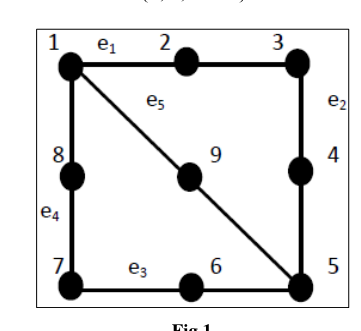 Figure 1
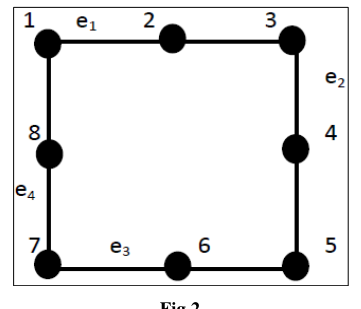 Figure 2
Introduction
Edge dominating set & edge domination number have been explored by several authors [5,6] . The concept of edge domination requires the adjacency relation among the edges of a graph. The same relation is also available in hypergraphs and therefore we have considered edge domination in hypergraphs [7] . The change in the edge domination number when a vertex is removed from the hypergraph has been studied here. For this purpose we have considered the subhypergraph & the partial subhypergraph obtain by removing a vertex from the hypergraph.
Preliminaries Definition 2.1 Hypergraph [4]
A hypergraph 𝐺 is an ordered pair (𝑉(𝐺), 𝐸(𝐺)) where 𝑉(𝐺) is a non-empty finite set & 𝐸(𝐺) is a family of non-empty subsets of 𝑉(𝐺) their union = 𝑉(𝐺). The elements of 𝑉(𝐺) are called vertices & the members of 𝐸(𝐺) are called edges of the hypergraph 𝐺. We make the following assumption about the hypergraph.
(1) Any two distinct edges intersect in at most one vertex. [4] : Let G be a hypergraph & v V (G) then the edge degree of v = d E (v) = the number of edges containing the vertex v. The minimum edge degree among all the vertices of G is denoted as E (G) and the maximum edge degree is denoted as E (G). [4] : Let G be a hypergraph. For every v V (G) define 𝑣̅ as [1] : Let G be a hypergraph & 𝑆 𝑉(𝐺) then S is said to be a dominating set of G if for every 𝑣 𝑉(𝐺) -𝑆 t here is 𝑢 𝑆 u and v are adjacent vertices. A dominating set with minimum cardinality is called minimum dominating set and cardinality of such a set is called domination number of G and it is denoted as (𝐺). Definition 2.5 Edge Dominating Set [7] : Let G be a hypergraph & 𝑆 𝐸(𝐺) then S is said to be an edge dominating set of G if for every 𝑒 𝐸(𝐺) -𝑆 there is some f in S e and f are adjacent edges.
Definition 2.2 Edge Degree
Definition 2.2 Edge Degree
Definition 2.3 Dual Hypergraph
Definition 2.3 Dual Hypergraph
Definition 2.4 Dominating Set in Hypergraph
An edge dominating set with minimum cardinality is called a minimum edge dominating set and cardinality of such a set is called edge domination number of G and it is denoted as E (G). Definition 2.6 Minimal Edge Dominating Set [7] : Let G be a hypergraph & 𝐹 𝐸(𝐺) then F is said to be a minimal edge dominating set if 1. F is an edge dominating set 2. No proper subset of F is an edge dominating set of G. [3] : Let G be a hypergraph & 𝑣 𝑉(𝐺). Consider the subset 𝑉(𝐺) -{𝑣} 𝑜𝑓 𝑉(𝐺). this set will induce two types of hypergraphs from G.
Definition 2.7 Subhypergraph and Partial Subhypergraph
Since F 1 is an edge dominating set of Gv, there is some g F 1 h is adjacent to g, then g F also. Thus h is adjacent to some member of F also. Suppose v h then h e because v h. Therefore, h is adjacent to e & e F. Thus, F is an edge dominating set of G. Obviously F is a minimum edge dominating set of G.
Conversely, suppose the condition is satisfied.
Let F be a minimum edge dominating set of G such that F = F 1 {e} for some minimum edge dominating set F 1 of Gv & for some edge e containing v. Then
From the proof of the above theorem it is clear that every minimum edge dominating set F 1 of Gv & every edge e containing v give rise to a minimum edge dominating set of G namely F 1 = F {v}. Suppose there are k distinct minimum edge dominating set of Gv & suppose the edge degree of v = j, then in the above manner they will generate kj minimum edge dominating set of G. It follows that the number of minimum edge dominating set of G the number of minimum edge dominating set of Gv. Now, we stat & prove a set of necessary and sufficient conditions under which the edge domination number of a hypergraph increases when a vertex v is removed from the hypergraph.
1. Suppose there is a minimum edge dominating set F of G v V(F) then F is a set of edges of Gv. Let h be any edge of G v then h is also an edge of G & therefore h g for some g F. Thus F is an edge dominating set of Gv.
2. Suppose the set F mentioned in statement (2) of the theorem exists.
Which is again a contradiction. Thus condition (2) also holds.
Let F be a minimum edge dominating set of Gv, then v V (F). Suppose F is an edge dominating set of G also. Then F is a minimum edge dominating set of G. Thus, F is a minimum edge dominating set of G v V (F). This is a contradiction to (1). Therefore, let's assume that F is not an edge dominating set of G. Therefore there is an edge h v h & h is not adjacent with any First suppose that E (Gv) = E (G). Let F be a minimum edge dominating set of Gv. First suppose that F is an edge dominating set of G. Then F is a minimum edge dominating set of G not containing any edge containing v. This is a contradiction to (1). Suppose F is not an edge dominating set of G -v. Therefore, no edge containing v can be a member of F. Thus, F N E (v) =, |F| E (G) & F is an edge dominating set of Gv. This is a contradiction to (2). Therefore,
Let F be a minimum edge dominating set of Gv then F cannot be an edge dominating set of G. Therefore, no edge containing v can be a member of F. Thus, F For some j in 1, 2… k Prn [e j , F] contains atleast two distinct edges.
Concluding Remarks
In this paper we have studied edge domination in hypergraphs and the operations of vertex removal and edge removal. Further a new concept like total edge domination can be introduced in hypergraphs and the effect of above operations can be studied for total edge domination in hypergraphs.
Figures and tables from the paper
References
7 in the original paper- Acharya B, Domination in Hypergraphs, AKCE J. Graphs. Combin. 2007; 4(2):111-126.
- Behr A, Camarinopoulos L. On the domination of hypergraphs by their edges, Discrete Mathematics. 1998; 187:31-38.
- Berge Graphs C. Hypergraphs, North-Holland, Amsterdam, 1973.
- Berge C. Hypergraphs, North-Holland Mathematical Library, New York, 1989, 45.
- Haynes T, Hedetniemi S, Slater P. Domination in Graphs Advanced Topics, Marcel Dekker, Inc. New York, 1998.
- Haynes T, Hedetniemi S, Slater P. Fundamental of Domination in Graphs, Marcel Dekker, Inc. New York, 1998.
- Thakkar D, Dave V. Edge Domination in Hypergraph, International Journal of Mathematics & Statistics Invention. 2017; 5(9):13-17.
Cited by 4
From OpenAlex, OpenCitations and reference lists read by Scinovex
- Edge Stable Sets and Secured Edge Stable Sets in Hypergraphs ↗
D. K. Thakkar, V. R. Dave · International Journal of Mathematical Sciences and Computing · 2019
In this paper, we have proved several results regarding edge stable sets and maximal edge stable sets in hypergraphs.We have also proved various results regarding edge stable sets and maximal edge stable sets in partial subhypergraphs.We have introduced the concept of secured edge stable set, maximum secured edge stable set and 𝑖 𝑠 1 -Set in this paper and proved…
❝ 3PDF - A sharp upper bound for the edge dominating number of hypergraphs with minimum degree ↗
Zhongzheng Tang, Zhuo Diao · Journal of Combinatorial Optimization · 2025
❝ 0 - Edge Stable Sets and Edge Independent Sets in Hypergraphs ↗
D. K. Thakkar, V.R. Dave · Journal of Mathematics and Informatics · 2018
In this paper we have introduce two new concepts namely edge stable sets& edge independent sets in hypergraphs.We have proved a necessary and sufficient condition under which an edge stable set is a maximal edge stable set.We have also proved an important result that an edge stable set of a hypergraph is a maximal edge stable set of it if…
❝ 0PDF - About Edge Independent Sets in Hypergraphs ↗
D. K. Thakkar, V. R. Dave · International Journal of Scientific Research in Mathematical and Statistical Sciences · 2018
The International Scientific Research Organization for Science, Engineering and Technology (ISROSET) is a Non-Profit Organization; The ISROSET is dedicated to improvement in academic sectors of Science (Chemistry, Bio-chemistry, Zoology, Botany, Biotechnology, Pharmaceutical Science, Bioscience, Bioinformatics, Biometrics, Biostatistics, Microbiology, Environmental Management, Medical Science, Forensic Science, Home Science, Library Science, Material Science Military Science, Physical Science, Physical Education Science, Educational Science, Fisheries,…
❝ 0PDF