
Research article · 2017 · Full text
International Journal of Statistics and Applied MathematicsProblem and solution for finding shortest traffic routes
Volume 2(6) · Pages 39–42
Research areasAdvanced Database Systems and QueriesData Management and AlgorithmsTransportation Planning and Optimization
Abstract
Author-writtenThis paper provides a Problem and Solution execution of the transportation systems coordinated with Traffic Routes innovation and creates basic leadership systems for deciding the ideal flight times, and ideal routing policies under time-fluctuating traffic flows. The approach that hypothetically yields the framework ideal traffic pattern may victimize a few clients for others. Proposed exchange models, in any case, don't straight forwardly address the framework point of view and may bring about second rate execution. We propose a paper model and comparing algorithms to resolve the Traffic Problem and Solution. We introduce computational outcomes on certifiable occasions and contrast the new approach and the settled traffic assignment demonstrates. The quintessence of this paper is that framework ideal directing of traffic flow with unequivocal coordination of client requirements prompts a superior execution than the client balance, while all the while ensuring better decency thought about than the unadulterated system optimum.
Summary
Source-checkedPlain-language reading of the full paper, prepared with AI and checked against the text. Each point links to the authors' own words.
Why it matters
- Route guidance systems are designed to assist drivers in making better routing decisions to potentially alleviate road traffic blockages. View evidence ↗
The question
- The research aims to explore how routing problems are affected by time-dependent dynamics and to develop calculations for various optimization problems. View evidence ↗
What they did
- The authors utilize a responsive route guidance model that operates with static traffic streams. View evidence ↗
- The study employs the link performance function proposed by the U.S. Bureau of Public Roads for its computations. View evidence ↗
- The authors propose a Constrained System Optimum (CSO) model, formulated as a min-cost multi-commodity flow problem with a separable convex objective function and specific path constraints. View evidence ↗
- To ensure fairness, the CSO model restricts 'normal unfairness' by applying a fixed tolerance factor to the path lengths. View evidence ↗
What they found
- System-optimal routing that coordinates client requirements results in better overall performance than user equilibrium, while remaining fairer than an unconstrained system optimum. View evidence ↗
- The analysis suggests that the travel time at user equilibrium is an effective choice for defining the 'ordinary length' in the model. View evidence ↗
- The proposed algorithm is considered practical for networks containing several thousand nodes (hubs), arcs (bends), and commodities (wares). View evidence ↗
What it means
- The authors conclude that imposing path constraints to eliminate excessively long bypasses is necessary to make system-optimal routing acceptable to human drivers. View evidence ↗
- The authors state that future research needs to incorporate the dynamic aspects of traffic and the behavior of users who are not using the guidance system. View evidence ↗
Visual summary
1 visualsIllustrations explain the paper; they do not show study data.
Comparison of Routing Philosophies
AI-generated conceptual illustration (city road network with miniature cars). It explains the idea and does not show study data.
View source evidence ↗Figures & tables
From the original paper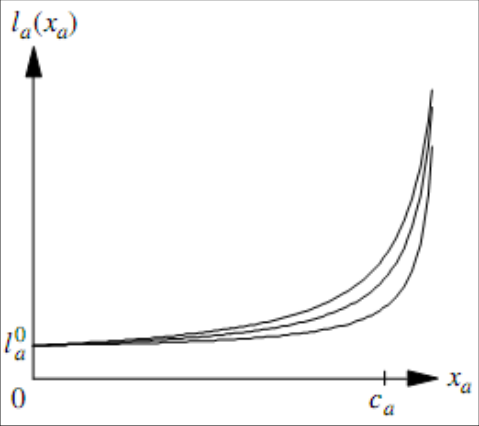 Figure 1
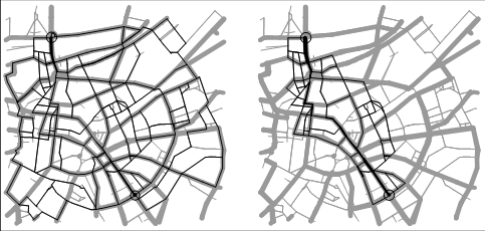 Figure 2
Introduction
Route guidance and information systems are intended to help drivers in making route decisions. Such gadgets can give data (e.g., conditions drivers are probably going to involvement) or give proposals (e.g., "leave the highway at the following way out and turn right"). We will focus on in-vehicle course direction gadgets that give suggestions to drivers. Drivers enter their goals toward the start of the outing, and the framework computes routes in view of advanced maps, cutting-edge traffic data, and ebb and flow vehicle positions decided with the assistance of the Global Positioning System. These gadgets ordinarily utilize visual and acoustic pointers to help drivers in following the proposed route. The subject of finding the shortest path or route for given static travel times has been a focal issue in enhancement for a very long while. For the circumstance that the travel times changes after some time less is known. The subject of this paper is to explore how different routing problems are influenced by influencing the go to time dynamic. All the more particularly, we consider time subordinate calculations for various optimization problems. Presently, numerous autos are as of now furnished with basic renditions of these gadgets and with costs going down, numerous more are probably going to have them not long from now. Thus, it is generally trusted that route guidance systems can help to lighten the blockage caused by the as yet expanding measure of road traffic. Indeed, even little enhancements can have a critical effect given that the "clog charge" in the United States alone was $67.5 billion in the year 2000, comprising of 3.6 billion hours of postponement in addition to 5.7 billion gallons of gas (Texas Transportation Institute 2002) [1] . A few sorts of in-auto route frameworks have been proposed. The easiest gadgets perform static direction (Bottom 2000) [2] , i.e., they work with data that is rarely refreshed. Most by far of the in-auto direction reassures deployed today is of this sort. Their principle objective is to give data to drivers who don't have the foggiest idea about the region well. From an algorithmic perspective, they are clear: They just computeshortest paths (or approximations thereof) to the goals as for travel time, geographic distance, or other suitable measures. Computational challenges for these methodologies emerge "exclusively" from the enormous size of the basic road networks (Yang et al. 1991) [3] .
More advanced route guidance systems make utilization of data on current conditions in the traffic network. To execute this, one-way-or shockingly better, two-routecorrespondence with a traffic control focus must be accessible. With one-way communication, current street conditions are resolved through sensors set in the network and after that communicated to clients, who can utilize the data to compute realistic shortest ways to their goals. With bidirectional correspondence hardware, the traffic control focus would get clients' present positions and goals, enabling it to process some sort of traffic assignment. Routes in the task would be haphazardly doled out to genuine drivers and transmitted back to the route guidance devices.
Review of Literature
The most progressive approach, called expectant guidance, predicts future demands and traffic conditions and gives suggestions appropriately. The issue is the manner by which future conditions ought to be anticipated. At the point when market penetration is low, direction frameworks can fundamentally disregard their own impact. On the other extraordinary, when most clients are guided and they consent to the guidance, the truth is probably going to be as anticipated. Between the two extremes, the circumstance is more fragile. These route guidance systems must foresee how clients will act (e.g., take after the suggestion or not) to guide traffic in a way that is reliable with the forecasts. Something else, guidance can neglect to accomplish the coveted goal since suggestions were given making presumptions concerning the future that may not appear. As indicated by Bottom (2000) [2] , there is no accord in the group on which of the last two approaches-responsive or expectant-ought to be utilized as a part of training. For the present paper, we receive responsive direction since it is thoughtfully less difficult. As opposed to the static traffic task issue considered here, Merchant and Nemhauser (1978) [4] proposed to work with dynamic models. From that point forward, there has been critical exertion towards the dynamic investigation of traffic networks. Dissimilar to static traffic assignment, where models and solution methods are settled, the dynamic traffic assignment issue has been considered from a few alternate points of view with no single for the most part acknowledged model or approach. We allude the peruser to the articles by Mahmassani and Peeta (1995) [5] and Peeta and Ziliaskopoulos (2001) [6] , which give a discourse of the inborn challenges and relating arrangement endeavors. For instance, let us say that DynaMIT (2002) [7] , a reenactment based continuous framework to give travel information, computes k shortest paths previously as for a few static connection execution capacities. Among different measures, it considers free-stream travel times, crest period travel times, geographic lengths, and the quantity of signalized crossing points. At that point, performing traffic simulation, it computes the dynamic client harmony in which clients are limited to taking just those paths.
Current Route Guidance Systems: None of the current or proposed guidance systems consider the productivity of the arrangement they propose (except for framework ideal arrangements, which are not implementable as a result of their shamefulness). Accordingly, the requirement for integrated algorithms that really focus on the framework wide execution has been perceived. As said before, the most prominent approach is to route drivers as indicated by client harmony. In that way, drivers are routed along their individual least dormancy paths so that there are no ways they would want to the ones they are given. The subsequent stream design was initially presented by Wardrop (2002) [8] to display normal driver conduct, and it has been considered widely in the writing. Truth be told, transportation engineers have utilized it to foresee network utilization for arranging purposes. Give a complete treatment of mathematical formulations and algorithms for figuring the static client balance. While client balance ought to fulfill the drivers, it doesn't really limit the aggregate travel time in the framework, which is characterized as the total of all individual travel times. Rough garden and Tardos (2002) [9] give cases that demonstrate that the aggregate travel time in harmony can be discretionarily vast contrasted with that of the framework ideal, in spite of the fact that it is never more than the travel time brought about by optimally routing twice as much traffic.
The Model: We consider a model of responsive route guidance that enables us to work with static streams. While not considering dynamic streams may block the immediate application to genuine circumstances, our approach can give traffic planners limits on the aggregate travel time that are more precise (contrasted with the conventional framework ideal). Also, Sheffi (2004) [10] calls attention to that there are times when traffic exhibits consistent state conduct, e.g., amid surge hours. In the case of nothing else, this research is an initial phase in expressly consolidating framework wide impacts into route guidance systems.
Preliminaries:
We represent the road network by a directed multi graph with two attributes on each arc a ∈ A: The normal length serves as an a priori estimate for its traversal time in the solution we seek; the link performance function , the rate of traffic on arc a, to its actual traversal time . Normal lengths can be chosen to be any metric for the arcs that are fixed in advance. However, their proper choice will allow us to produce solutions with desirable features; we refer to for details.
Fig 1: Typical link performance functions
Link performance functions measure the impedance of arcs for different congestion levels. We require them to be no decreasing and differentiable, and to be convex. These requirements are naturally met by common link performance functions used to reflect congestion effects. Figure 1 x and a path , its actual traversal time is while is its normal length. A traffic pattern fulfilling this guideline is usually called client harmony. It is "reasonable" as in clients between a similar OD match experiences a similar deferral. Nonetheless, it is notable that client harmony, all in all, does not limit the aggregate travel time in the framework. We will likely choose more productive traffic patterns without losing the reasonableness property. To influence this more exact, let us to present a few ideas of shamefulness of an answer. For a given stream, we characterize the injustice of a specific explorer as follows:
Loaded unfairness: ratio of her experienced travel time to the experienced travel time of the fastest traveler for the same OD pair, where "experienced travel time" means travel time measured in terms of the current congestion level.
Normal unfairness: ratio of the length of her path to the length of the shortest path for the same OD pair, both measured with respect to normal arc lengths.
User equilibrium (UE) unfairness: ratio of her experienced travel time to the travel time for the same OD pair in a user equilibrium (which is the same for all users of that OD pair).
Free-flow unfairness: ratio of her experienced travel time to the length of the fastest path for the same OD pair w.r.t. freeflow travel times. The respective notion of unfairness for a particular flow is the maximum over all OD pairs of the maximum unfairness of a traveler between that OD pair. More formally, for a given flow x and an equilibrium flow f, The thoughts of stacked and typical shamefulness are comparable. Both look at, utilizing changed measurements, the travel times of clients to the shortest travel times between their comparing OD sets. The UE injustice, presented by Rough garden (2002) [9] in the single-ware setting, demonstrates how the travel times of the arrangement identify with those in client harmony. Practically speaking however, drivers ordinarily don't have the foggiest idea about the travel times in harmony; it is apparently more vital to them how their travel times contrast with the real travel times of others. The free-stream injustice measures the corruption of execution that clients encounter because of the pervasiveness of clog impacts. Note that the typical, the stacked, and the free-stream injustice are constantly more prominent than or equivalent to 1, while the UE shamefulness can be any nonnegative number.
Problem Formulation: As it is difficult to directly control the loaded unfairness, we will instead impose an upper bound on the normal unfairness and show that by doing so the other notions of unfairness will be small as well. In particular, we consider solutions for which the normal length of any used path between OD pair k is not much greater than that of a shortest (with respect to normal lengths) for all
. More specifically, we fix a tolerance factor and restrict the normal unfairness to be smaller than.
In other words, a path is feasible if is the normal length of a shortest path between If we let denote the set of all feasible paths for OD pair k,we can define the entire set of feasible paths as
The constrained system optimum (CSO) that we propose to use in route guidance systems is an optimal solution to the following min-cost multi commodity flow problem with separable convex objective function and path constraints:
Problem CSO
Note that the flow variables are not required to be integral because they describe abstract flow rates. If paths were not restricted to be feasible (i.e., in
), an optimal solution to this formulation would coincide with an ordinary system optimum. We refer to an optimal solution to the problem with tolerance factor Figure 2 demonstrates the effect of path constraints on the system optimum. One commodity is routed through the road network between two clearly marked terminals. In the picture on the left, we display the (unconstrained) systemoptimum.
Conclusion
When planning a route guidance system, it is attractive to unequivocally go for diminishing the aggregate (and consequently the normal) travel time by placing it into the target capacity of the hidden optimization problem. In any case, without promote imperatives; this would incorporate the likelihood that a few vehicles are appointed to unjustifiably long paths to make the shorter paths accessible to different drivers. Clearly, this marvel would render such a framework inadmissible for a few drivers, endangering the coveted impact of enhanced framework execution. We propose to catch this part of human conduct by forcing limitations on ways to dispense with long bypasses. While it might be perfect to expressly implement that travel times of recommended routes between a similar OD match don't digress fundamentally from each other, our computational results legitimize the utilization of a computationally easier model, in which the deviation is not measured concerning the real stream, but rather as for a "typical length." Our computational examination proposes that the travel time in client balance is a magnificent decision for characterizing the ordinary length. Aside from the evidence of idea, we consider our algorithm practical for issues with a few thousand hubs, bends, and wares. Future work should join the dynamic perspective of traffic and the conduct of unguided users.
References
9 in the original paper- Bottom JA. Consistent anticipatory route guidance. Ph.D. thesis, Department of Civil and Environmental Engineering, Massachusetts Institute of Technology, Cambridge, MA, 2000.
- Yang TA, Shekhar S, Hamidzadeh B, Hancock PA. Path planning and evaluation in IVHS databases. Proc. IEEE Vehicle Navigation and Information Systems Conf., Society of Automotive Engineers, Warrendale, PA, 1991; 1:283-290.
- Merchant DK, Nemhauser GL. A model and an algorithm for the dynamic traffic assignment problems. Transportation Sci. 1978; 12:183-199.
- Mahmassani HS, Peeta S. System optimal dynamic assignment for electronic route guidance in a congested traffic network. N. H. Gartner, G. Improta, eds. Urban Traffic Networks. Dynamic Flow Modeling and Control. Springer, Berlin, Germany, 1995, 3-37.
- Peeta S, Ziliaskopoulos AK. Foundations of dynamic traffic assignment: The past, the present and the future. Networks Spatial Economy. 2001; 1:233-265.
- Dyna MIT. DynaMIT/ DynaMIT-P (v 0.9) User's Manual. Intelligent Transportation Systems Program, Massachusetts Institute of Technology, Cambridge, MA, 2002.
- Wardrop JG. Some theoretical aspects of road traffic research. Proc. Inst. Civil Engineers, Part II, 2002; 1:325378.
- Roughgarden T, Tardos É. How bad is selfish routing? J. ACM. 2002; 49:236-259.
- Sheffi Y. Urban Transportation Networks. Prentice-Hall, Englewood Cliffs, NJ, 2004.