
Research article · 2017 · Full text
International Journal of Veterinary Sciences and Animal HusbandryEffect of seminal plasma and temperature changes on qualities of frozen-thawed semen extended with egg yolk citrate or skimmed milk extender in Myanmar local bucks
Volume 2(5) · Pages 39–42
Research areasSperm and Testicular Function
Abstract
Author-writtenThis research was carried out to observe the effects of seminal plasma and extenders on the motility and viability of local buck spermatozoa at 5 °C and at -20 °C. Three matured bucks were used for this experiment. From each buck, semen was collected two times per week by means of electroejaculator. A total of sixteen ejaculates were collected from each buck. After collecting semen, the effects of seminal plasma removal were analyzed by using two different extenders (Skimmed milk and egg yolk citrate extenders). The removal of seminal plasma gave higher and significant (p<0.01) effect in the motility, and live spermatozoa at 5 °C and at -20 °C. For two different extenders, however, the differences were not observed at 5 °C and at -20 °C on the semen quality of local buck.
Summary
Source-checkedPlain-language reading of the full paper, prepared with AI and checked against the text. Each point links to the authors' own words.
Why it matters
- Artificial insemination is a fundamental tool in goat breeding used to spread high-genetic-value semen. View evidence ↗
- Seminal plasma is considered a limiting factor that can negatively impact the fertility and ability to freeze buck semen. View evidence ↗
- When unwashed goat semen is mixed with milk or egg yolk extenders, seminal plasma can have toxic effects and cause deterioration. View evidence ↗
The question
- The study aimed to investigate how seminal plasma, two types of extenders, and temperature changes affect the semen quality of local Myanmar bucks before freezing and after thawing. View evidence ↗
What they did
- The study used two extenders, both containing 1.75% DMSO: egg yolk citrate and skimmed milk. View evidence ↗
- Semen samples were evaluated after being held at 5 °C for two hours and then at -20 °C for two hours before thawing. View evidence ↗
What they found
- There were no statistically significant differences (p < 0.05) in semen quality between the use of skimmed milk extender and egg yolk citrate extender. View evidence ↗
What it means
- The authors concluded that removing seminal plasma improves semen quality at both 5 °C and -20 °C. View evidence ↗
- The authors state that further research is needed to understand these effects over longer durations (more than two hours) at 5 °C. View evidence ↗
Visual summary
2 visualsIllustrations explain the paper; charts are replotted from the paper's own table values.
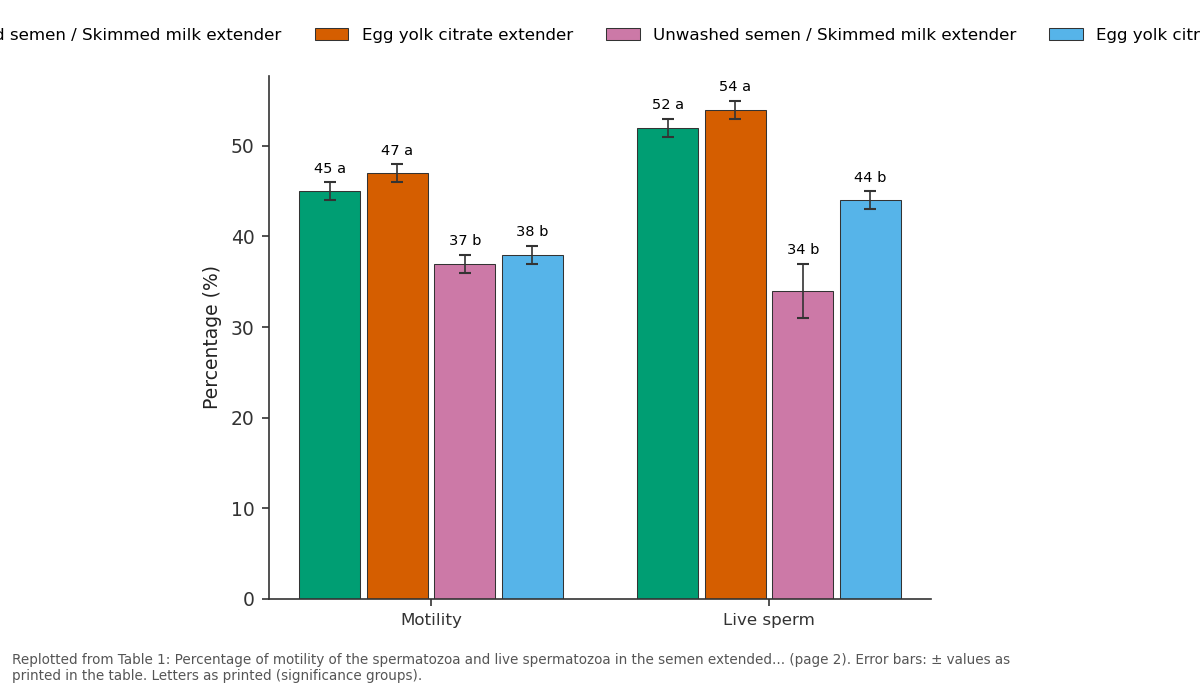
Washed semen / Skimmed milk extender and Egg yolk citrate extender and more: Motility vs Live sperm
Replotted from Table 1 (page 2) of the original paper. Every bar is the paper's own table value.
View source evidence ↗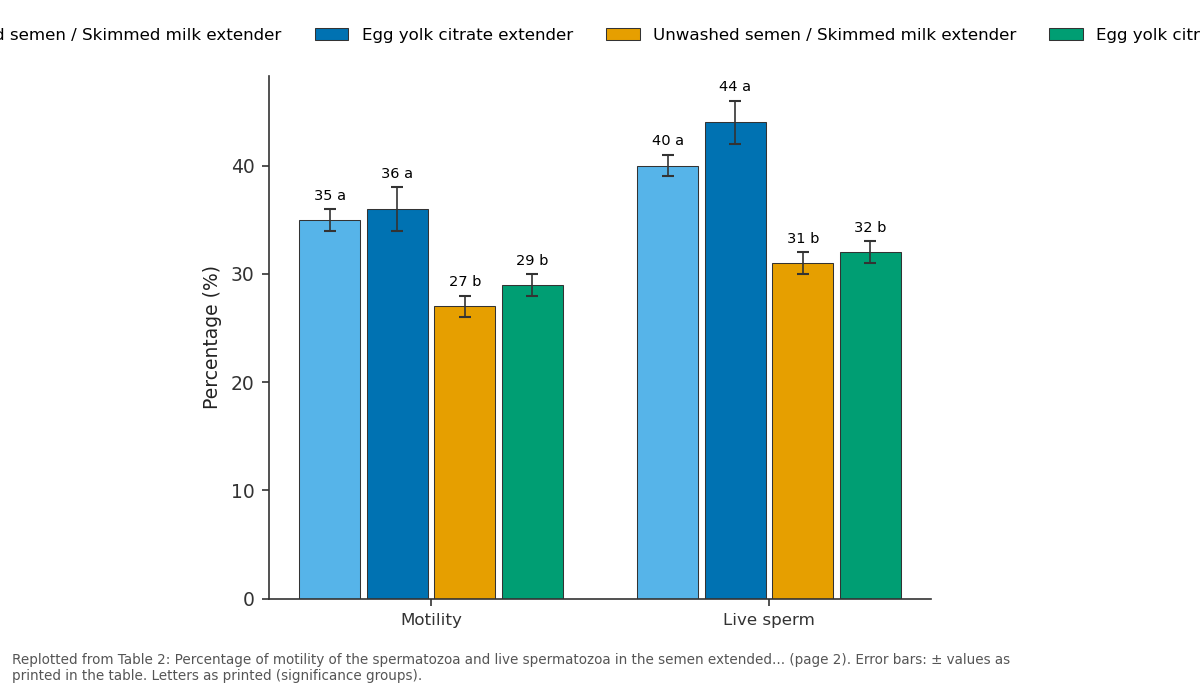
Washed semen / Skimmed milk extender and Egg yolk citrate extender and more: Motility vs Live sperm
Replotted from Table 2 (page 2) of the original paper. Every bar is the paper's own table value.
View source evidence ↗Figures & tables
From the original paper Table 1
 Table 2
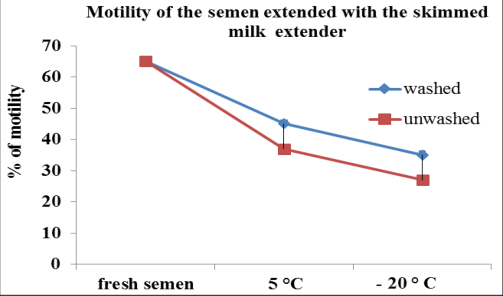 Figure 2
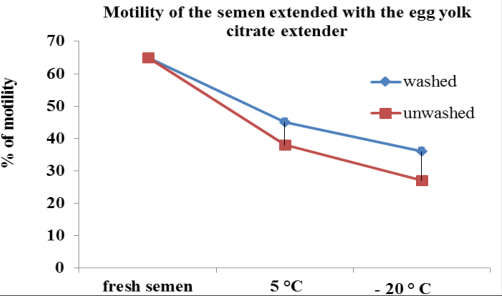 Figure 1
Introduction
Artificial insemination with fresh, chilled or frozen-thawed semen is a basic tool in goat breeding allowing the diffusion of caprine semen of high genetic value (Hidalgo et al., 2007) [16] . The success of an artificial insemination program depends on the appropriate management of semen collection, storage and use (Etches, 1996) [12] . Cryopreservation of semen is a complex process that involves balancing a number of interrelated factors, such as freezing technique, extender, dilution, cooling rates and thawing methods. In case of buck semen cryopreservation, seminal plasma has been blamed as a limiting factor of buck semen freeze ability and fertility. The deterioration and toxic effect of the seminal plasma were observed when unwashed goat semen was diluted with egg yolk or milk extender. Nowadays, these extenders are widely used for the frozen storage of small ruminant semen (Salamon and Maxwell, 2000) [21] . Notably, it is generally accepted that a substantial number of spermatozoa are damaged during cryopreservation. This damage may decrease sperm motility, viability and fertilization rate. Therefore, the composition of extender, suitable cryoprotectant and optimum freezing and thawing rates are important factors for a better fertilization rate (Curry, 2000; Eiman et al., 2004 and Matsuoka et al., 2006) [9,11,22] . In regards with the cryopreservative agents (CPAs), dimethylsulphoxide (DMSO) has been widely used alone or in combination with other cryoprotectants (Singh et al., 1995, Snedeker and Gaunya, 1970) [30,31] . Regarding to the preparation of extenders, either egg yolk or milk or combination of the two have been used as a basic ingredient. Nowadays, the generally used media for buck semen liquid storage (4-5 °C) are skimmed milk, sodium citrate egg yolk and Tris egg yolk diluents (Leboeuf et al., 2000) [20] . Therefore, this study attempted to investigate the effect of seminal plasma, two different extenders and temperature changes on the semen quality of local buck before freezing and after thawing.
Materials and Methods
Materials and Methods
Experimental animals and management
Three bucks of local breed, with the age of ten to twelve months and body weight ranging from thirty-two to thirty-five kilogram were used during successive periods. The bucks, namely A1, A2 and A3, were kept in individual cages in the campus of University of Veterinary Science, Yezin, Nay Pyi Taw. They were supplied with concentrate, green roughage and straw (ad libitum). All the animals had free access to fresh water.
Experimental designs
Three bucks (A1, A2 and A3) were used. From each buck, semen was collected twice a week, and a total of sixteen ejaculates were collected. After collecting semen, a small amount of the semen was washed to remove the seminal plasma. Then, both of the washed and unwashed spermatozoa was extended separately in the egg yolk citrate extender and in the skimmed milk extender, and placed at 5 °C for two hours. Motility and live sperm cell percent were assessed. After that, the spermatozoa were placed at -20 °C. Two hours later, the motility and viability were assessed. Experimental period lasted for 8 weeks.
Semen Collection and Evaluation
Semen samples were collected from three mature local bucks. The volume of each ejaculate was measured in a graduated test tube. The sperm concentration of each ejaculate was determined by means of a haemocytometer. Live and dead spermatozoa were assessed using nigrosin-eosin stain (Evan and Maxwell, 1987). The percentage of the motility of spermatozoa in each specimen was evaluated under a phase contrast microscope at ×200 magnification by placing a small drop of raw semen on a slide covered with a glass cover slip (22 mm × 22 mm) from three selected representative fields subjectively.
For the assessment of motility and viability of sperm cells, egg yolk citrate extender containing 1.75% DMSO and skimmed milk extender containing 1.75% DMSO were prepared separately in the beakers. Each extender was suspended by a clean and dry pipette. The beakers were labelled and kept in the refrigerator. Into each test tube, sperm and extender were added at the ratio of 1:4 (sperm: extender). Into the test tube 1, washed sperm and egg yolk citrate extender were put. Into the test tube 2, unwashed sperm and egg yolk citrate extender were put. Into the test tube 3, washed sperm and skimmed milk extender were put. Into the test tube 4, unwashed sperm and skimmed milk extender were put. The test tubes were gently shaken and placed at 5 °C for two hours. After equilibration time, the cooled samples were rewarmed by placing the test tubes in the water bath at 37 °C for two seconds. Then semen samples were assessed for motility and live spermatozoa. After that, the test tubes were moved to the freezer (-20 °C). Two hours later, the samples were thawed for a few seconds in a water bath at 37 °C and assessed for motility and live spermatozoa.
Statistical Analysis
The data were analyzed using the SPSS software system (Version 20, SPSS). The values were expressed as the mean ± the standard error of the mean (S.E.M) and the level of statistical significance was considered as p<0.05.
Results
The removal of seminal plasma had a significant influence on semen quality before freezing and after thawing (Table 1 and2). Washing of spermatozoa provided significantly (p<0.01) higher effect on the percentage of motility and live spermatozoa before freezing. After thawing, washed spermatozoa were found to have significant (p<0.01) effects on the percentage of motility and live spermatozoa. No significant differences (p<0.05) were observed between the two different extenders in all the semen quality of local bucks.
| — | Washed semen | — | Unwashed semen | — | p value |
|---|---|---|---|---|---|
| Skimmed milk extender | Egg yolk citrate extender | Skimmed milk extender | Egg yolk citrate extender | ||
| Motility | 45 ± 1a | 47 ± 1a | 37 ± 1b | 38 ± 1b | <0.01 |
| Live sperm | 52 ± 1a | 54 ± 1a | 34 ± 3b | 44 ± 1b | <0.01 |
Table text extracted from the original PDF; superscript letters are shown inline. The original table image is below.
View original table image
Table 1:
Percentage of motility of the spermatozoa and live spermatozoa in the semen extended with the skimmed milk extender and egg yolk citrate extender placed at 5 °C (Mean ± SEM).
Washed semen Unwashed semen p value Skimmed milk extender Egg yolk citrate extender Skimmed milk extender Egg yolk citrate extender
Washed semen Unwashed semen p value Skimmed milk extender Egg yolk citrate extender Skimmed milk extender Egg yolk citrate extender
Discussion
Removal of seminal plasma from semen has a beneficial effect on the freezing ability of Boer goat semen ( [20,14,19,33,25] . Leboeuf et al. (2003) [20] stated that a specific problem in the preservation of goat semen was the detrimental effect of seminal plasma on the subsequent viability of spermatozoa in vitro. In this experiment, the removal of the seminal plasma has a beneficial effect on the semen quality of Myanmar bucks, at 5 °C and -20 °C (Table 1 and2). Seminal plasma had a negative effect on Myanmar goat sperm viability diluted in 20% egg-yolk-citrate extender and kept at ambient temperature (Than Than Sint, 2004). Phillips and Lardy (1940) [26] described that when bovine spermatozoa were stored at 5 °C, they remained viable and capable of fertilizing ova for 3-4 days. Beer-Ljubic et al. (2009) [4] , reported that seminal plasma cholesterol concentration, which was most probably related to the use of extracellular lipids for the protection of sperm membrane integrity vary between seasons. Washing of semen prior to freezing has also been advised but generally it is time consuming and can affect the sperm viability (Gacitua and Arav 2005) [14] . A detrimental effect of seminal plasma on the maintenance of motility of cooled equine spermatozoa; however, the mechanism for the adverse effect of seminal plasma during cooled storage remains undetermined. In this experiment, the percentage of motile and live spermatozoa in the washed semen extended with the egg yolk citrate and skimmed milk extenders were higher than those in the unwashed semen extended with the egg yolk citrate and skimmed milk extenders at 5 °C and -20 °C. Phillips and Lardy (1940) [26] and De Leeuw et al. (1993) [10] , reported that egg yolk extender could prevent sperm cell damage during cooling and freezing. Egg yolk had lipoprotein and lecithin which could maintain and protect the integrity of spermatozoa (Blackshow, 1954) [5] . Higher percentage of motility at -20 °C was occurred when the seminal plasma was present than when it was removed (Ritar and Salamon, 1983; Chauhan and Anand, 1990; Tuli and Holtz, 1994 and Azerado et al., 2001) [27, 7, 32, 3] . Plasma removal and subsequent addition of the extender containing egg yolk had deleterious effects to sperm (Azerêdo et al., 2001, Gil et al., 2002 and Viana et al., 2006) [3,15,34] . Goat semen contains coagulating enzymes which convert the lecithin in the egg yolk to lysolecithin and this substance seemed to be lethal to sperms (Leboeuf et al., 2000) [21] . The addition of egg yolk based extenders to buck semen, give rise to coagulation of egg yolk and sperm died owing the action of an enzyme secreted by the bulbourethral gland named egg yolk coagulation enzyme. The enzyme hydrolyses the lecithin of the egg yolk to fatty acids and lysolecithin which are toxic to spermatozoa and cause coagulation of the storage medium (Roy 1957; Iritani et al., 1961, 1964; Aamdal et al. 1965, Iritani and Nishikawa, 1972) [28,18,2] . When egg yolk was included in the diluted buck seminal plasma, hydrolysis of lecithin led to further deterioration of the environment. As a consequence, the spermatozoa did not survive beyond two hours (Iritani and Nishikawa 1961). Egg yolk show negative effect on frozen goat semen due to the presence of phospholipase (Iritani and Nishikawa, 1972) [18] . Low density lipoprotein is better than whole egg yolk to preserve sperm motility after freezing (Moussa et al., 2002; Amirat et al., 2004) [24,1] .
Leboeuf et al. (2003) [20] found motility parameters of goat sperm, diluted in skimmed milk extenders and stored at 4 °C, could be maintained with success until Day 4. Seminal plasma has an adverse effect on the survival of goat spermatozoa stored frozen in milk-based extenders (Corteel 1980; Memon et al., 1985) [8] . However, a glycoprotein component of bulbourethral gland secretion contains lipase activity that is detrimental to sperm motility when stored in skimmed milkbased extenders (Carver et al., 2002) [6] . Bulbourethral secreting BUSgp60 has a triacylglycerol hydrolase activity that causes deterioration of buck spermatozoa in skimmed milk extender. BUSgp60 causes a decrease in the percentage of motile spermatozoa and the death of buck spermatozoa in bucks (Leboeuf and Salamon, 2000) [21] .
Conclusion
In this experiment, it is found that removal of the seminal plasma had beneficial effect on the semen quality at 5 °C and -20 °C. There was no difference between the beneficial effects of egg yolk citrate extender and skimmed milk extender on the percentages of motility and live spermatozoa at 5 °C and -20 °C. Further researches are needed to deeply understand the beneficial effects of removal of seminal plasma and the effects of egg yolk citrate extender and skimmed milk extender on the percentages of motility and live spermatozoa kept at 5 °C for longer (more than two hours) duration in Myanmar local bucks.
Figures and tables from the paper
| — | Washed semen | — | Unwashed semen | — | p value |
|---|---|---|---|---|---|
| Skimmed milk extender | Egg yolk citrate extender | Skimmed milk extender | Egg yolk citrate extender | ||
| Motility | 35 ± 1a | 36 ± 2a | 27 ± 1b | 29 ± 1b | < 0.01 |
| Live sperm | 40 ± 1a | 44 ± 2a | 31 ± 1b | 32 ± 1b | < 0.01 |
Table text extracted from the original PDF; superscript letters are shown inline. The original table image is below.
View original table image
References
33 in the original paper- Amirat L, Tainturier D, Jeanneau L, Thorin C, Gérard O, Courtens JL et al. Bull semen in vitro fertility after cryopreservation using egg yolk LDL: a comparison with Optidyl ® , a commercial egg yolk extender. Theriogenol. 2004; 61:895-907.
- Aamdal J, Lyngset O, Fossum K. Toxic effect of lysolecithin on sperm. Nord. Vet. Med. 1965; 17:633634.
- Azeredo GA, Esper CR, Resende KT. Evaluation of plasma membrane integrity of frozen-thawed goat spermatozoa with or without seminal plasma. Small. Rumin. Res. 2001; 41:257-263.
- Beer-Ljubic B, Aladrovic J, Marenjak TS, Laskaj R, Majic-Balic I, Milinkovic-Tur S. Cholesterol concentration in seminal plasma as a predictive tool for quality semen evaluation. Theriogenol. 2009; 72:11321140.
- Blackshow AW. The prevention of temperature shock of bull and ram semen. Aust. J. Biol. Sci. 1954; 7:573-582.
- Carver DA, Ball BA. Lipase activity in stallion seminal plasma and the effect of lipase on stallion spermatozoa during storage at 5 °C. Theriogenol. 2002; 58:1587-95.
- Chauhan MS, Anand SR. Effect of egg yolk lipids on the freezing of goat semen. Theriogenol. 1990; 34:10031013.
- Corteel JM. Effects du plasma séminal sur la survie et la fertilité des spermatozoïdes conservés in vitro. Reprod. Nutri Déve. 1980; 20:1111-1123.
- Curry MR. Cryopreservation of semen from domestic livestock. Indian. Vet. J. 2000; 5:46-52.
- De Leeuw FE, De Leeuw AM, Den Daas JH, Colenbrander B, Verkleij AJ. Effects of various cryoprotective agents and membrane-stabilizing compounds on bull sperm membrane integrity after cooling and freezing. Cryobiology. 1993; 30:32-44. International Journal of Veterinary Sciences and Animal Husbandry 11. Eiman M, Aboagla E, Terada T. Effects of egg yolk during the freezing step of cryopreservation on the viability of goat spermatozoa. Theriogenol. 2004; 62:1160-1172.
- Etches RJ. The Egg. Reproduction in Poultry. CAB International, Chapter 2, 1996, 10-39.
- Evans G, Maxwell WMC. Salamon's artificial insemination of sheep and goats, 1987.
- Gacitua H, Arav A. Successful pregnancies with directional freezing of large volume buck semen. Theriogenol. 2005; 63:931-938.
- Gil J, Rodriguez-Irazoqui M, Soderquist L, Martinez HR. Influence of centrifugation or low extension rates prefreezing on the fertility of sêmen after cervical insemination. Theriogenol. 2002; 57:1781-1792.
- Hidalgo M, Rodrı´guez I, Dorado JM. The effect of cryopreservation on sperm head morphometry in Florida male goat related to sperm freezability. Anim. Reprod. Sci. 2007; 100:61-72.
- Iritani A, Nishikawa Y, Nagasawa S. Studies on the eggyolk coagulating enzyme in goat semen. VII. Variations in the enzyme activity of the semen between breeding season and non-breeding season, and in each ejaculate collected three times successively. Jpn. J. Report. 1964; 10:52-56.
- Iritani A, Nishikawa Y. Studies on the egg yolk coagulating enzyme (phosphlipase) in goat semen. IX. Enzyme concentration in the semen collected from the Cowper's gland removed goat Memoirs of the College of Agriculture Kyoto University. 1972; 101:57-63.
- Kozdrowski R, Dubiel A, Bielas W, Dzięcioł M. Two protocols of cryopreservation of goat semen with the use of computer-assisted semen analysis system. Acta Vet. Scand. 2007; 76:601-604.
- Leboeuf B, Guillouet P, Batellier F, Bernelas D, Bonne JL, Forgerit Y et al. Effect of native phosphocaseinate on the in vitro preservation of fresh semen. Theriogenol. 2003; 60:867-877.
- Leboeuf B, Restall B and Salamon S. Production and storage of goat semen for artificial insemination. Anim. Reprod. Sci. 2000; 62:113-141.
- Matsuoka TH, Imai H, Kohno H, Fukui Y. Effects of bovine serum albumin and trehalose in semen diluents for improvement of frozen-thawed ram spermatozoa. J. Reprod. Dev. 2006; 60:498-506.
- Memon MA, Bretzlaff KN, Ott RS. Effect of washing on motility and acrosome morphology of frozen-thawed goat spermatozoa. Am. J. Vet. Res. 1985; 46:473-475.
- Moussa M, Martinet V, Tainturier D, Anton M. Low density lipoproteins extracted from hen egg yolk by an easy method: cryoprotective effect on frozen-thawed bull semen. Theriogenol. 2002; 57:1695-1706.
- Naing SW, Haron AW, Goriman MAK, Yusoff R, Abu Bakar MZ, Sarsaifi K et al. Effect of seminal plasma removal, washing solutions, and centrifugation regimes on Boer goat semen cryopreservation. Trop. J Agric. Sci. 2011; 34:271-279.
- Phillips PH, Lardy HA. A yolk-buffer pablum for the preservation of bull semen. J. Dairy. Sci. 1940; 23:399404.
- Ritar AJ, Salamon S. Fertility of fresh and frozen-thawed semen of the Angora goat. Aust. J. Biol. Sci. 1983; 36:49-59.
- Roy A. Egg yolk coagulating enzyme in the semen and Cowper's gland of the goat. Nature. 1957; 179:318-319.
- Salamon S, Maxwell WMC. Frozen storage of ram semen. I. Processing freezing thawing and fertility after cervical insemination. Anim. Prod. Sci. 1995; 37:185.
- Singh MP, Sinha AK, Singh BK. Effect of cryoprotectants on certain seminal attributes and on the fertility of buck spermatozoa. Theriogenol. 1995; 43:1047-1053.
- Snedeker WH, Gaunya WS. Diemethylsulfoxide as a cryoprotective agent for freezing bovine semen. J. Anim. Sci. 1970; 30:953-956.
- Tuli RK, Holtz W. Effect of glycerolization procedure and removal of seminal plasma on post-thaw survival and goat-release from Boer goat spermatozoa. Theriogenol. 1994; 42:547-555.
- Ustuner B, Gunay U, Nur Z. Effect of seminal plasma, egg yolk, and season on the freezability of saanen buck semen. Bull. Vet. Inst. Pulawy. 2009; 53:369-374.
- Viana AKS, Chalhoub M, Ribeiro Filho AL, Almeida AK, Portela A PM, Bittencourt RF et al. Avaliação in vitro do semen caprino resfriado, com ou sem centrifugação do plasma seminale diluído em leite desnatado-glicose e tris-gema de ovo. Ciência Anim Brasileira. 2006; 7:67-76.