
Research article · 2017 · Full text
International Journal of Statistics and Applied MathematicsAllocation of emergency units response areas
Volume 2(6) · Pages 124–125
Research areasFacility Location and Emergency ManagementAdvanced Manufacturing and Logistics Optimization
Abstract
Author-writtenThe average travel times for emergency units such as are engines, ambulances, and police patrol cars which respond to specially distributed incidence, is not necessarily minimized by always dispelling the closest available units in each incident. Methods are described for changing response areas so as to reduce average travel time and also reduce the imbalance of workload among units. The recent year optimization techniques have begun to be applied to problem of urban emergency service systems such as fire departments, police patrol systems, and ambulance services. This paper describes an example of such an application which has led to new principles for designing the response areas of emergency units.
Summary
Source-checkedPlain-language reading of the full paper, prepared with AI and checked against the text. Each point links to the authors' own words.
Why it matters
- In emergency services, simply dispatching the closest available unit to an incident does not always minimize the average travel time. View evidence ↗
- Certain urban areas can experience high incident densities, leading to some emergency units handling as many as 20 incidents in a single busy night, which causes staff burnout. View evidence ↗
- Workload imbalance is common in emergency services, where areas just a few miles apart can have vastly different levels of activity. View evidence ↗
The question
- The study aims to describe methods for adjusting response areas to simultaneously reduce average travel times and balance the workload across units. View evidence ↗
- The authors seek to estimate how much travel times would increase if response areas were modified to relieve overworked units. View evidence ↗
What they did
- The proposed strategy involves contracting the response areas of the busiest units and expanding those of the least busy units to distribute workload more evenly. View evidence ↗
- The arrival of emergency alarms in a given region is modeled as a Poisson process with a specific rate (λm). View evidence ↗
- The standard dispatching protocol is designed to minimize the travel time for each unit responding to an incident. View evidence ↗
What they found
- The application of optimization techniques to urban emergency systems has resulted in new principles for the design of response areas. View evidence ↗
What it means
- The authors conclude that adjusting response areas by contracting busy zones and expanding quiet ones will lead to a more even distribution of workload. View evidence ↗
Visual summary
1 visualsIllustrations explain the paper; they do not show study data.
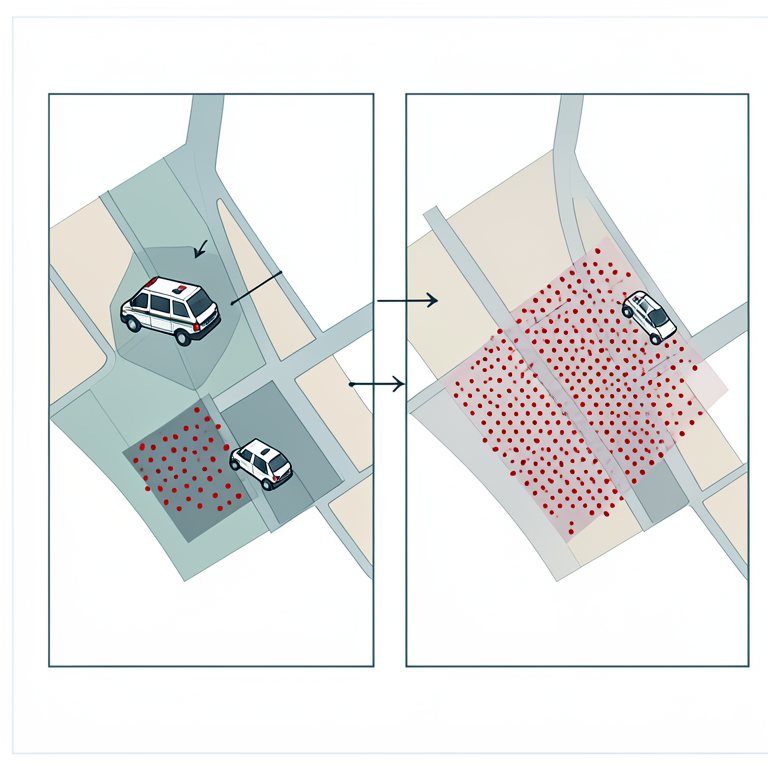
Workload Balancing Concept
AI-generated conceptual illustration (city street maps with emergency vehicle icons). It explains the idea and does not show study data.
View source evidence ↗Introduction
To set the stage, we will give a brief description of the dispatch operations of a typical emergency service. A membered the public ordinarily reports emergencies activating an alarm box located on the street or in a building, or by calling an emergencies telephone number. Each alarm box has a code number which indicates its location, and when the box is activated the code number register at the appropriate dispatch centre. (Some of these boxes permit voice communication between the caller and the dispatcher, so that the dispatcher can obtain additional information about the nature of the emergency)Ones the box number is known, the dispatcher consults a file giving, in the case of mobile units such as police patrol car, the identification of the units in whose patrol area the box is located, or in the case unites dispatched from fixed facilities such as fire hours, the identity of the closest facility or a sequenced list of facilities in order of their distance from the box. If the call is reported by telephone rather than by alarm box, the dispatcher determines the address or approximate location of the incident and then consults a fill which identified the patrol area or alarm box closest to the address once the dispatcher knows the alarm box number, he can find the list of facilities as if he has received a box alarm.
Methodology
The selection of units which will be dispatched to the incident is essentially determined by the information obtains from the file by the dispatcher. In the case of mobile units, if the patrol area found in the file contains an available unit that will be dispatched to the incident. (There is of course no guarantee that this unit is actually closer to the incident than any other unit). If the emergency is a fire, ordinarily several unit of different types will be dispatched. When ni units of type 1 are supposed to be dispatched, the first ni units on the sequence list will be dispatched, if they are available for service. If one or more of the first ni are available, the dispatcher may in some cases dispatch those units which are available, while in other cases we may search further down the list for additional available units to dispatcher. In any event, the units dispatched to the incident will always be the ones which the dispatcher believes are closer to the incident than any other available unit of the same type. The objective underlying this dispatching protocol is to minimize each component of the vector which gives the travel times of units responding to incident. (It is useful to note that the dispatchers method described here allows us to define a response area for each unit; it consist of all locations is which the units will be dispatched if all units are available.) The possibility of changing the standard dispatching strategy arose as parts of our concern on collapse of buildings are outbreak, bombs, accidents and consequences in Bauchi-Nigeria. Some of the first departments, hospitals, e.t.c oaten faced the problems that some parts of the city have incidences that the units in those areas might right as many as 20 incidences in a busy might, leading to a condition in which the fire fighters felt overworked. However, nearly areas, sometimes not more than a mile or two away might have a much lower level of activity. A Natural idea for helping to relieve the excessive workload of some units to collect the response areas for the busiest units and expand the response areas for the least busy ones. This will tend to distribute the workload more evenly among the units. But we felt we should find out what would happen to travel times if such a chance were made? Presumably travel times would increase, and the problem is to estimate the magnitude of the increase. Thus, we wished to calculate expected travel times and workloads of units as functions of the response area. Because the travel time and workloads depend on which units are dispatched to each alarm, and the choice of units to dispatched depend on the availability of units, in general kinds that the qualities of interest one functions of the arrival rules for alarm, the service times units, and the dispatching policy. The arrival process can be modelled assuming that there are several types of alarm arriving in any region A according to a poison process with rate λm (A). Then each λm is a measured on the region under consideration. (Poissonicity is an excellent approximation, but in practice the arrival rate are not actually constant over time. The alarm`` time "may distinguish building fires from bush fires, or other appropriate characteristics of the incident.) The service time may be modelled by assuming that if a group G of unit is dispatched is an alarm at location Ϫ then the service time are given by a main x Fm (X, G) whose і јcomponent is the servicetime distribution of the j th xzzunits of type I. The dispatching policy can then be thought or as a function Hn (X,F,A).
References
11 in the original paper- Dunleavy P. The urban basis of political alignment: social class, domestic property ownership, and state intervention in consumption process. British Journal of Political Science, 1979, 9.
- Elandt Johnson RC. some prior and posterior distributions in survival analysis: a critical insight of relationships derived from cross-sectional data. Journal of the Royal Statistic Society, series B, 1980; 42:96-106.
- Flinn CJ, Heckman JJ. Models for the analysis of labor force dynamics. Advances in Econometrics. 1982; 1:35-95.
- Goldthorpe JH, Lockwood D, Beckhofer F, Platt J. The Affluent Worker. Political Attitudes and Behaviour, Cambridge University press, 1968.
- Harrop M. The urban basis of political alignment, a comment. British journal of political science, 1980; 10:388-398.
- Heckman JJ, Singer B. A method for minimizing the impact of distributional assumptions on econometrica, 1984; 52:271-320.
- Jonson L, Henser D. application of multinominal probit to a two-period panel data set. Transportation research A. 1982; 16:457-464.
- Joshi H. women's participation in paid work: Further analysis of the Women and Employtment HMSO, 1984.
- Lancaster T, Nickell S. the analysis of re-employment probabilities for the unemployed. Journal of the royal statistical society series A. 1980; 143:141-165.
- Main, B.G.M (1985) Earnings, expected earnings, and unemployment among school leavers. Discussion paper 1985:2 Department of Economics, University of Edinburgh.
- Salvil, B. and I. Crewe (1983) Decade of Dealignment Cambridge University Press.
Cited by 2
From OpenAlex, OpenCitations and reference lists read by Scinovex
- A PENOLOGIA PÓS-MODERNA E O DESAPARECIMENTO DO CARÁTER ÉTICO-POLÍTICO DE LEGITIMAÇÃO DO PODER PENAL ESTATAL ↗
André Leonardo Copetti Santos · Revista Direito em Debate · 2017
O presente artigo tem como objetivo principal desvelar a utilização de um modo de pensar calculador na formulação e justificação das novas políticas penais – Nova Penologia –, onde o ser humano é mais um entre vários entes disponíveis para a ação do Estado, em detrimento de uma fundamentação filosófica- antropológica, baseada num pensar meditative ético, espaço no qual o…
❝ 1PDF - O REPRESSIVISMO PÓS-MODERNO BRASILEIRO DE ALTA INTENSIDADE. O DIREITO PENAL NA ENCRUZILHADA ENTRE O PENSAR CALCULADOR E A FUNDAMENTAÇÃO ÉTICO-POLÍTICA ↗
André Leonardo Copetti Santos · Novos Estudos Jurídicos · 2019
O presente artigo tem como objetivo principal desvelar a utilização de um modo de pensar calculador na formulação e na justificação das novas políticas penais – repressivismo penal pós-moderno de alta intensidade –, no qual o ser humano é mais um entre vários entes disponíveis para a ação do Estado, em detrimento de uma fundamentação filosófica – antropológica, baseada num…
❝ 0PDF