
Research article · 2016 · Full text
International Journal of Veterinary Sciences and Animal HusbandryEffects of graded levels of rumen digesta based diets with or without enzyme supplementation on the blood chemistry of weaner rabbits
Volume 1(2) · Pages 43–46
Research areasRabbits: Nutrition, Reproduction, HealthRuminant Nutrition and Digestive Physiology
Abstract
Author-writtenEight weeks feeding experiment was conducted to investigate the effect of replacing maize with Dried Rumen Digesta (DRD) with or without enzyme supplementation on the haematology and serum chemistry of weaner rabbits. Thirty six weaner rabbits between 4 and 5 weeks old were randomly allocated to six dietary treatments of six rabbits per treatment in a Completely Randomised Design (CRD). There were three replicates of two rabbits each. DRD replaced maize at 0%, 12.5%, 25% levels. There was no significant difference (P>0.05) among the WBC values of the experimental animals and the values were within the normal range for Rabbits. There were significant differences (P<0.05) in the RBC and the PVC among the treatments. The Mean Corpuscular Haemoglobin Concentration (MCHC) values of T3 and T5 showed no significant differences (P>0.05). The result also showed significant differences (P<0.05) between T2 and the rest diets. The protein concentration, Cholesterol, ALT, AST and potassium levels showed no significant differences (P<0.05) among the treatments. In conclusion, the study suggested up to 25% DRD replacement.
Summary
Source-checkedPlain-language reading of the full paper, prepared with AI and checked against the text. Each point links to the authors' own words.
Why it matters
- Improving rabbit production in Nigeria is important to increase animal protein supplies because beef and chicken are expensive. View evidence ↗
- The high cost of commercial poultry feeds used for rabbits limits the expansion of rabbit farming in Nigeria and other developing countries. View evidence ↗
- Rumen content, which is not consumable by humans, contains undigested feed and microbial products like protein, fatty acids, and vitamins. View evidence ↗
The question
- The study aimed to investigate how replacing maize with Dried Rumen Digesta (DRD), with or without enzyme supplementation, affects the blood chemistry and haematology of weaner rabbits. View evidence ↗
What they did
- The experiment used 36 mix-bred weaner rabbits between 4 and 5 weeks of age. View evidence ↗
- Rabbits were randomly assigned to six dietary treatment groups using a Completely Randomized Design, with six rabbits per treatment. View evidence ↗
- The six diets tested included 0%, 12.5%, and 25% DRD replacement for maize, each tested both with and without enzyme supplementation. View evidence ↗
- Data were analyzed using ANOVA via the SAS package, and Fisher's LSD was used to separate means at a significance level of P<0.05. View evidence ↗
What they found
- White Blood Cell (WBC) values showed no significant differences across the six groups and remained within the normal range for rabbits. View evidence ↗
- Red Blood Cell (RBC) counts differed significantly among treatments, with values ranging from 3.9± 1.2 to 4.8± 0.8 /mm3. View evidence ↗
- Packed Cell Volume (PCV) showed significant differences, ranging from 36± 1.5% to 42± 1.5%. View evidence ↗
- Glucose levels differed significantly between treatments, with the highest in T1 (145±2.2 mg/dl) and the lowest in T5 and T6 (130 mg/dl). View evidence ↗
- There were no statistically significant differences across treatments for protein concentration, cholesterol, ALT, AST, and potassium levels. View evidence ↗
What it means
- The authors conclude that rumen digesta can replace up to 25% of maize in rabbit diets, with or without enzymes, without causing adverse effects. View evidence ↗
- The authors state that further research on organ histopathology and carcass quality is necessary to fully understand the health status of the rabbits. View evidence ↗
Visual summary
2 visualsIllustrations explain the paper; charts are replotted from the paper's own table values.
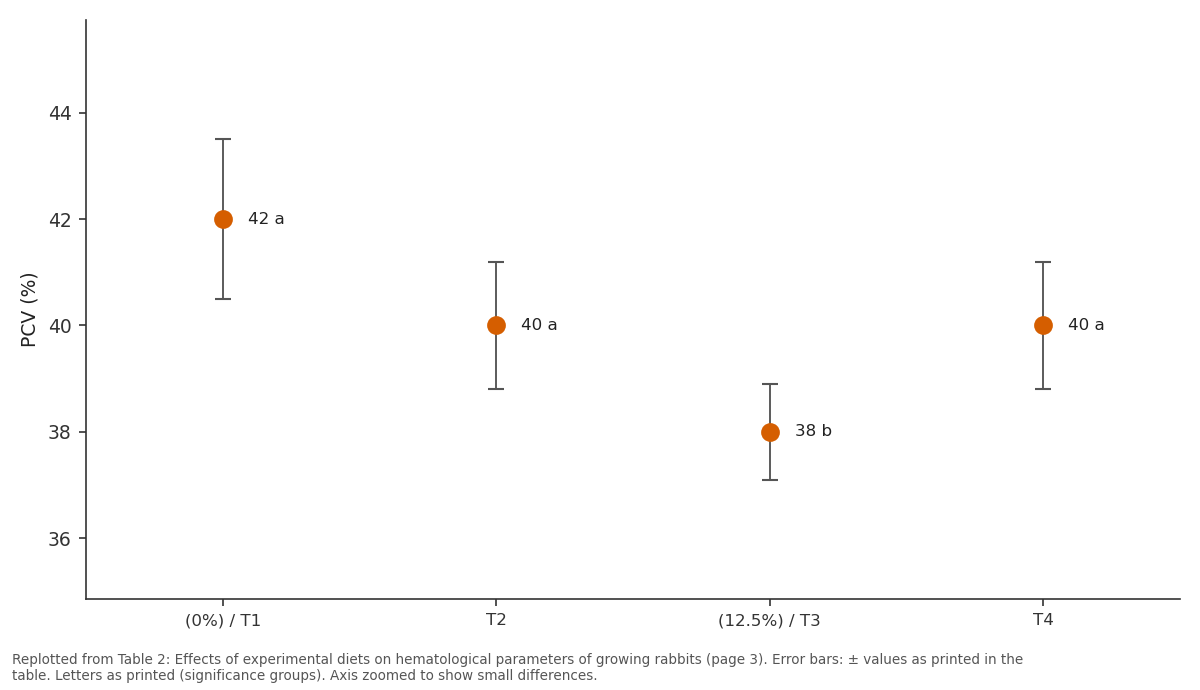
PCV (%): (0%) / T1 vs T2 vs (12.5%) / T3 vs T4
Replotted from Table 2 (page 3) of the original paper. Every bar is the paper's own table value.
View source evidence ↗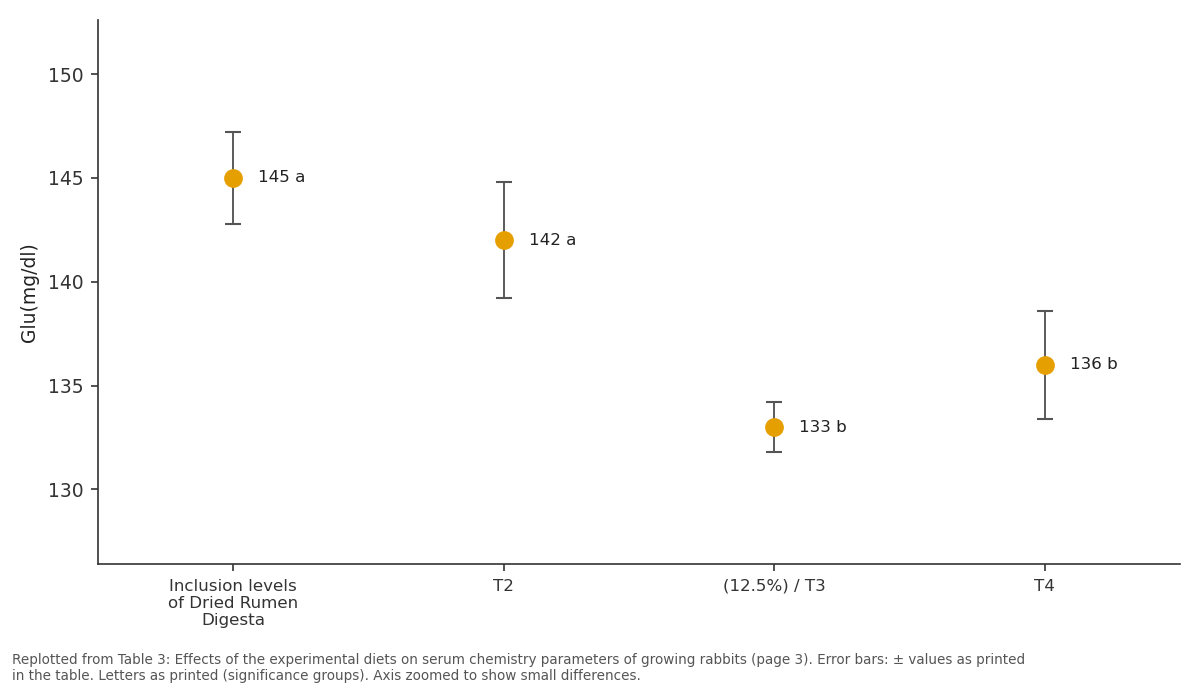
Glu(mg/dl): Inclusion levels of... vs T2 vs (12.5%) / T3 vs T4
Replotted from Table 3 (page 3) of the original paper. Every bar is the paper's own table value.
View source evidence ↗Figures & tables
From the original paper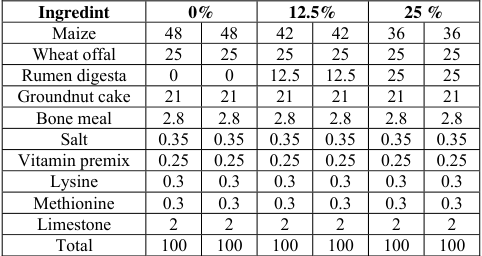 Table 1
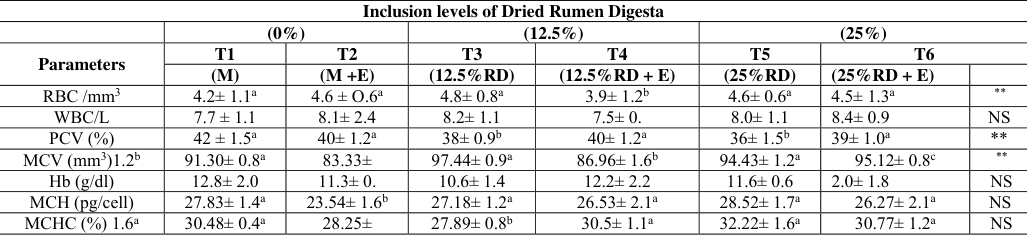 Table 2
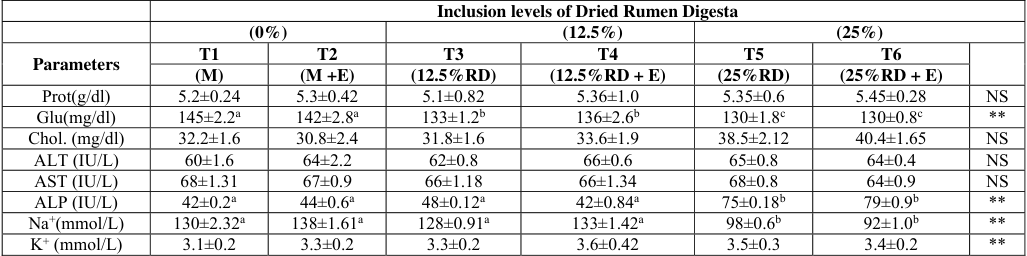 Table 3
Introduction
Rabbit is a herbivorous, monogastric and pseudo-ruminant animal that can effectively and efficiently convert fodder to meat (Leba, 1980) [11] . Rabbit is blessed with unique digestive tract that can convert fibrous materials to animal protein. One of the challenges of animal researchers and nutritionists, is to provide feeding strategies for monogastric animals especially poultry pigs and rabbits. The strategies should be able to minimize the cost of production and reduce competition between animal and human for the feed ingredients (Biobaku, 2002) [5] . The nutrition of the rabbits is one of the most important aspects of its production. The nonavailability and/or insufficient supply of rabbit pellets which consist mainly of cereal grains hampered their production (Aduku and Olukosi, 1990) [2] . The search for alternative sources of energy in rabbit remained a topical issue among animal nutritionists (Igwebuike, 2001) [9] . The need to improve rabbit production in Nigeria to increase supplies of animal protein is clear, due to the high cost of beef and chicken, also the animal protein shortage facing Nigeria cannot be solved by large animals with their slow production cycle. Animal like rabbit, which are prolific and has short gestation period, can help this protein shortage problem. Rabbit can be produced on forages alone although production can improve by adding other feed supplements. Rabbit posses various attribute that are advantageous in comparison to other livestock. Rabbit meat is of excellent protein quality, low in total as well as saturated fat, cholesterol and sodium, therefore, rabbit production is considered as a good source of meat in tropical developing countries where there is abundance of by-products which can be used as feedstuff. Currently commercial rabbits are reared mostly on expensive poultry feeds, as commercial feed are available for rabbit but not widely use because it is expensive. This is one of the important factors limiting the expansion of rabbit farming in Nigeria and other developing nations.
The rumen content is obtained from the abattoir and cannot be consumed by man. Rumen content is made up of undigested feed eaten by the ruminants animal with lots of microorganism that aid in feed degradation, the feed and synthesized protein, fatty acids and vitamins produced by the microbes. Rumen content is highly fibrous, hence supplements that can aid digestion of fibber such as enzyme may be needed when using rumen content in feed formulation especially for monogastrics animals. When rumen content (R C) is processed to feedstuff, it has repulsive and inherent colour which affects the acceptability when fed to livestock (Balogun et al., 2001) [4] . Enzymes are one of the many types of protein in biological systems. Their essential characteristic is to catalyze the rate of reaction but without being altered by it. Several studies carried out on poultry and pigs have shown that the poor quality feed can be enhanced by supplementation or supplemental enzymes. There is increase in the demand for cereal gains for human consumption, industrial use and as a major ingredient in livestock feed, thus making it unaffordable for small scale farmers. Hence the search for alternative energy sources that could be of value and cheaper.
Materials and methods
Thirty six (36) mix-bred, 4-5 weeks weaner rabbits with a balanced initial determined weight were used. The animals were randomly allocated to six dietary treatment groups in a Completely Randomized Design (CRD). The experiment was replicated thrice with two rabbits per replicate thereby giving a total of six rabbits per treatment. Rumen content was collected fresh from the abattoir immediately the visceral of the cattle was opened and boiled for about two hours with constant stirring to prevent burning. After boiling, it was sundried to reduce the moisture content to about 12%. The sundried material was subjected to particle size reduction followed by proximate analysis. Six diets were compounded for the experiment. The ingredients used for formulating the diet include G.N.C, maize, wheat offal, bone meal common salt, vitamin premix, lysine methionine and rumen digesta. The experimental ingredients was included at 0% DRD without enzyme (T1), 0% DRD with enzyme (T2), 12.5% DRD without enzyme (T3), 12.5% DRD with enzyme (T4), 25% DRD without enzyme (T5) and 25% DRD with enzyme (T6) respectively. The (DRD) replaced maize weigh for weight each diet was formulated to meet the minimum protein requirement (16 -18%CP) of weaner rabbits. Within the last week of the feeding trial, one rabbit from each replicate was selected at random. The bleeding was done in the morning before feeding. 10ml of blood was obtained from the jugular vein using a sterilized needle and syringe into a sample bottle. EDTA bottle containing anticoagulant and another set of plain bottles without anticoagulants were used for this exercise. About 3ml of the blood sample was put into the EDTA sample bottle while the remaining was put into the plain sample bottle. The samples in the plain bottles were allowed to clot so as to obtain the serum that was used in the determination of some serum metabolites as described by Toro and Ackermann (1975) [17] and Kaneko (1989) [10] . Parameters evaluated include: Red Blood Cell counts (RBC), Parked Cell Volume (PCV), Haemoglobin (HB), Mean Corpuscular Volume (MCV), Mean Corpuscular Haemoglobin (MCH), Mean Corpuscular Haemoglobin Concentration (MCHC) and White Blood Cell counts (WBC). Serological parameters evaluated are total protein, glucose, urea and cholesterol.
Analytical techniques
Packed cell volume was determined by microhematocrit method (Igene and Iboh, 2004) [7] . Haemoglobin content was determined as described by Jain (1993) [8] and Red blood cell was measured with the aid of Neubaur counter (haemocytometer) as reported by Oni et al. (2010) [13] . Total protein determination was carried out by the Biuret method of Savory and Sunderman (1968) [16] , serum electrolytes was determined by atomic absorption spectroscopy as reported by Adejumo and Onifade (2005) [1] .
Data Analysis
The data generated were subjected to analysis of variance (ANOVA) using the SAS package (1999-2000). Fisher LSD was used to separate means (P<0.05) where differences manifest.
Results and discussion
Results of the effect of the dietary treatments on the hematological parameters and serum chemistry are shown in table 1 and 2 respectively. There were no significant difference (P>0.05) amongst the WBC values of the 6 groups and the respective values are within the normal range for rabbits indicating the absence of negative effect of the diets on the experimental animal. However, there were significant differences (P<0.05) between the other parameters with RBC ranging from 4.2 -4.8/mm 3 and T3 showing significant difference from the other groups. There were also significant differences (P<0.05) in the packed cell volume (PCV) and the MCV among the treatments. The results further showed significant differences (P<0.05) in the Mean Corpuscular Haemoglobin (MCH). In table 2, there were no statistically significant differences amongst the various feed treatments (p>0.05) on the protein concentration, cholesterol levels, ALT, AST and potassium levels. However, apart from T1 and T2, there were significant differences (P<0.05) on the glucose levels between the various treatments.
| Inclusion levels of Dried Rumen Digesta | — | — | — | — | — | — | — |
|---|---|---|---|---|---|---|---|
| (0%) | (12.5%) | (25%) | |||||
| Parameters | T1 | T2 | T3 | T4 | T5 | T6 | |
| (M) | (M +E) | (12.5%RD) | (12.5%RD + E) | (25%RD) | (25%RD + E) | ||
| RBC /mm3 | 4.2± 1.1a | 4.6 ± O.6a | 4.8± 0.8a | 3.9± 1.2b | 4.6± 0.6a | 4.5± 1.3a | ** |
| WBC/L | 7.7 ± 1.1 | 8.1± 2.4 | 8.2± 1.1 | 7.5± 0. | 8.0± 1.1 | 8.4± 0.9 | NS |
| PCV (%) | 42 ± 1.5a | 40± 1.2a | 38± 0.9b | 40± 1.2a | 36± 1.5b | 39± 1.0a | ** |
| MCV (mm3)1.2b | 91.30± 0.8a | 83.33± | 97.44± 0.9a | 86.96± 1.6b | 94.43± 1.2a | 95.12± 0.8c | ** |
| Hb (g/dl) | 12.8± 2.0 | 11.3± 0. | 10.6± 1.4 | 12.2± 2.2 | 11.6± 0.6 | 2.0± 1.8 | NS |
| MCH (pg/cell) | 27.83± 1.4a | 23.54± 1.6b | 27.18± 1.2a | 26.53± 2.1a | 28.52± 1.7a | 26.27± 2.1a | NS |
| MCHC (%) 1.6a | 30.48± 0.4a | 28.25± | 27.89± 0.8b | 30.5± 1.1a | 32.22± 1.6a | 30.77± 1.2a | NS |
Table text extracted from the original PDF; superscript letters are shown inline. The original table image is below.
View original table image
| Ingredint | 0% | — | 12.5% | — | 25 % | — |
|---|---|---|---|---|---|---|
| Maize | 48 | 48 | 42 | 42 | 36 | 36 |
| Wheat offal | 25 | 25 | 25 | 25 | 25 | 25 |
| Rumen digesta | 0 | 0 | 12.5 | 12.5 | 25 | 25 |
| Groundnut cake | 21 | 21 | 21 | 21 | 21 | 21 |
| Bone meal | 2.8 | 2.8 | 2.8 | 2.8 | 2.8 | 2.8 |
| Salt | 0.35 | 0.35 | 0.35 | 0.35 | 0.35 | 0.35 |
| Vitamin premix | 0.25 | 0.25 | 0.25 | 0.25 | 0.25 | 0.25 |
| Lysine | 0.3 | 0.3 | 0.3 | 0.3 | 0.3 | 0.3 |
| Methionine | 0.3 | 0.3 | 0.3 | 0.3 | 0.3 | 0.3 |
| Limestone | 2 | 2 | 2 | 2 | 2 | 2 |
| Total | 100 | 100 | 100 | 100 | 100 | 100 |
Table text extracted from the original PDF; superscript letters are shown inline. The original table image is below.
View original table image
The results of this study is in agreement with Ogungbesan et al. (2014) who monitored blood profiles as influenced by Gliricidia leaf meal (GLM) supplemented with Maxigrain® enzyme in laying hens also concluded that supplementation of feed with Maxigrain® enzyme caused no discomfort or diseases to the animals, furthermore, and most importantly the combination is of high health importance because of low cholesterol content. Blood is known to be vital to the life of an organism. This is a medium through which nutrients are conveyed to various parts of the body system of an organism. A readily available and fast means of assessing clinical and nutritional status of an animal on feeding trial may be the use of blood analysis (Olabanji et al., 2007) [12] . Haematological parameter is an important and reliable medium used to monitor and evaluate health and nutritional status of animals (Babatunde et al., 1992; Onifade, 1993; Gupta, et al., 2007) [3,14,6] . Therefore, the absence of any negative effects of the experimental diets used in this study suggested that the experimental diets were able to supply the required nutrition which maintained the normal blood parameters of the experimental animals. means within the same column bearing different superscripts are significantly different (p<0.05).. T1 control (0% DRD without enzyme) T2 control (0% D RD with enzyme), T3 12.5% DRD without enzyme, T412.5% DRD with enzyme, T5 25% DRD without enzyme, T6 25% DRD with enzyme, ± SEM, (NS) not significantly different among the six(6) treatment, (**) there is significant different among the six (6) treatment.
Conclusion
This study showed that from the various parameters monitored, rumen digesta can be used with or without enzyme supplementation as partial replacement for maize in providing energy and protein requirements for weaner rabbits without any significant effects on hematological and serum chemistry parameters. It can be concluded that rumen digesta can be included up to 25% with or without enzyme supplementation in maize concentrate diets for rabbits without any adverse effects. However, further investigation on carcass quality and histopathology of some organs are necessary as these will help to provide further information on the health status of the rabbits.
Figures and tables from the paper
| — | Inclusion levels of Dried Rumen Digesta | — | — | — | — | — | — |
|---|---|---|---|---|---|---|---|
| (0%) | (12.5%) | (25%) | |||||
| Parameters | T1 | T2 | T3 | T4 | T5 | T6 | |
| (M) | (M +E) | (12.5%RD) | (12.5%RD + E) | (25%RD) | (25%RD + E) | ||
| Prot(g/dl) | 5.2±0.24 | 5.3±0.42 | 5.1±0.82 | 5.36±1.0 | 5.35±0.6 | 5.45±0.28 | NS |
| Glu(mg/dl) | 145±2.2a | 142±2.8a | 133±1.2b | 136±2.6b | 130±1.8c | 130±0.8c | ** |
| Chol. (mg/dl) | 32.2±1.6 | 30.8±2.4 | 31.8±1.6 | 33.6±1.9 | 38.5±2.12 | 40.4±1.65 | NS |
| ALT (IU/L) | 60±1.6 | 64±2.2 | 62±0.8 | 66±0.6 | 65±0.8 | 64±0.4 | NS |
| AST (IU/L) | 68±1.31 | 67±0.9 | 66±1.18 | 66±1.34 | 68±0.8 | 64±0.9 | NS |
| ALP (IU/L) | 42±0.2a | 44±0.6a | 48±0.12a | 42±0.84a | 75±0.18b | 79±0.9b | ** |
| Na+(mmol/L) | 130±2.32a | 138±1.61a | 128±0.91a | 133±1.42a | 98±0.6b | 92±1.0b | ** |
| K+ (mmol/L) | 3.1±0.2 | 3.3±0.2 | 3.3±0.2 | 3.6±0.42 | 3.5±0.3 | 3.4±0.2 | ** |
Table text extracted from the original PDF; superscript letters are shown inline. The original table image is below.
View original table image
References
17 in the original paper- Adejumo DO, Onifade AA. Effects of graded levels of feather meal as a dietary protein source on growth performance, haematology, serum chemistry and clinical enzyme activities in rabbits. An International Journal of Agricultural Science, Science, Environment and Technology, 2005; 5:51-61.
- Aduku AO, Olukosi JO. Rabbit management in the tropics; Production, Processing, Utilization, Marketing, Economics, Practical Training, Research and Future Prospects. Living Book Series, GU Publication, Abuja FCT, 1990, 1-105.
- Babatunde GM, Fajimi AO, Oyejide AO. Rubber seed oil versus palm oil in broiler chicken diets. Effects on performance, nutrient digestibility, haematology and carcass characteristics. Animal Feed Science and Technology 1992; 35:133-146.
- Balogun OO, Adeniji AA, Awotoye AV. blood rumen content mixture with molasses for broiler, Nig. J of animal production., invest. 2001; 4:193-199.
- Biobaku WO. The potential of Irolanut tea m rabbit feeding: Proceeding of the 20th Annual National Conference of the Nigerian Society for Animal Production, F.U.T Minna, Niger State, 2002.
- Gupta AR, Putra RC, Sani M, Swarup D. Haematology and serum biochemistry of Chital (Axis axis) and barking deer (Muntiacus muntijax) reared in semi-captivity. Veterinary Research Communications, 2007; 31:801-808
- Igene FU, Iboh SO. Growth performance and haematological responses of cockerel chicks fed diets containing different levels of rice offals as replacement for wheat offals. Proceedings of the 9th Annual Conference of Animal Science Association of Nigeria, 2004, 20-22.
- Jain NC. Schalm's veterinary haematology 4th. Edn. Lea and Febiger, Philadelphia. 1993.
- Igwebuike JU. Utilization of Acacia albida pods for rabbit feeding. PhD thesis submitted to the Department of Animal Production, University of Agriculture, Makurdi, Nigeria, 2001.
- Kaneko JJ. Clinical biochemistry no f domestic animal - 4 th Edition. Academic press inc. N. York, 1989.
- Lebas F. Nutrient requirement and feeding of meat rabbit. J Appl. Rabbit Res. 1980; 3:15-20.
- Olabanji RO, Farinu GO, Akinlade JA, Ojebiyi OO. Growth Performance, Organ Characteristics and Carcass Quality of Weaner Rabbits Fed Different Levels of Wild Sunflower (Tithonia diversifoliaHemsl A. Gray) LeafBlood Meal Mixture. International Journal of Agricultural Research. 2007; 2:1014-1021.
- Oni AO, Arigbede OM, Sowande OS, Anele UY, Aderingboye RY, Yusuf KO. Haematological and serum biochemical parameters of West African dwarf goats Fed dried cassava leaves based concentrate diets. Proceedings of the 15th Conf. of Animal Science Association of Nigeria. 2010, 213-217
- Onifade AA. Comparative utilization of three dietary fibre sources of broiler chickens. PhD Thesis submitted to the Department of Animal Science, University of Ibadan, Nigeria 1993, 186.
- SAS. Statistical Analysis System, user's guide: statistics. SAS Institute Inc. 6thed. Carry, North Carolina, USA, 2000.
- Savory J, Pu PH, Sunderman FW. (jr.) A Biuret method for the determination of protein in normal urine. Clinical Chemistry, 1968; 14:1160-1171.
- Toro G, Ackermann GP. Practical clinical chemistry. Little Brown and Company, Boston, Massachusetts, 1975.
Cited by 2
From OpenAlex, OpenCitations and reference lists read by Scinovex
- The Potential of Animal By-Products in Food Systems: Production, Prospects and Challenges ↗
Babatunde Oluwasegun Alao, Andrew Bamidele Falowo, Amanda Yucca Chulayo, Voster Muchenje · Sustainability · 2017
The consumption of animal by-products has continued to witness tremendous growth over the last decade. This is due to its potential to combat protein malnutrition and food insecurity in many countries. Shortly after slaughter, animal by-products are separated into edible or inedible parts. The edible part accounts for 55% of the production while the remaining part is regarded as inedible…
❝ 217PDF - Feeds of animal origin in rabbit nutrition – a review ↗
Andrzej Gugołek, D. Kowalska · Annals of Animal Science · 2022
Abstract Rabbits are classified as obligate herbivores. However, under natural conditions, some members of the family Leporidae incorporate animal products into their diets. Therefore, it seems biologically justified to supplement the diets of farmed rabbits with feeds of animal origin as sources of protein, fat and minerals. The aim of this review was to describe, from a historical perspective, the…
❝ 4PDF