
Research article · 2017 · Full text
International Journal of Veterinary Sciences and Animal HusbandryA Retrospective Study on the Prevalence of Fracture in Animals Slaughtered at Jos Abattoir, Plateau State, Nigeria
Volume 2(4) · Pages 01–03
Research areasAnimal Diversity and Health Studies
Abstract
Author-writtenFracture is a common condition among livestock slaughtered in abattoirs across Nigeria. This study determined the prevalence of fracture in animals (cattle, goats and pigs) slaughtered at Jos abattoir within eleven years (2006-2016), and ascertained the difference in fracture prevalence between the species. Relevant data were obtained from the abattoir records, analyzed using Microsoft Excel and subjected to chi-square test using Graph-Pad Prism. Out of the 209,792 animals slaughtered, 2,835 (1.4%) had fractures. Annual prevalence varied between 2.4% (2007) and 0.6% (2010). Species prevalence was higher (3.4%) in pigs than goats (0.8%) and cattle (1.9%). There was significant difference (P<0.0001) in fracture prevalence amongst the species. The high prevalence was attributed to poor animal welfare, including inhumane transportation and poor handling. It was therefore recommended that specially designed vehicles be used for conveying animals to abattoirs. Also, government should implement and enforce policies to regulate cruelty to animals.
Summary
Source-checkedPlain-language reading of the full paper, prepared with AI and checked against the text. Each point links to the authors' own words.
Why it matters
- Animal welfare is a critical factor in meat production because pre-slaughter stress is known to negatively impact the quality of the meat. View evidence ↗
- Fractures in livestock often occur during transport from farms or markets to abattoirs, caused by bad roads and animals hitting the walls of transport vehicles. View evidence ↗
- Animal welfare and meat quality are generally not prioritized in developing countries compared to developed countries. View evidence ↗
What they did
- The study analyzed cattle, goats, and pigs slaughtered at the Jos abattoir between 2006 and 2016. View evidence ↗
- Researchers used abattoir records for data collection, analyzing the results with Microsoft Excel and performing chi-square tests via Graph-Pad Prism. View evidence ↗
- Data analysis included the use of simple descriptive statistics, such as percentages and line graphs. View evidence ↗
What they found
- Across all species, 1.4% of the 209,792 slaughtered animals had fractures, totaling 2,835 cases. View evidence ↗
- The annual prevalence of fractures fluctuated, peaking at 2.4% in 2007 and reaching a low of 0.6% in 2010. View evidence ↗
- Pigs had the highest prevalence of fractures at 3.4%, followed by cattle at 1.9% and goats at 0.8%. View evidence ↗
- The difference in fracture prevalence between the three species was statistically significant (P<0.0001). View evidence ↗
- For cattle, annual prevalence ranged from 0.5% (2013) to 5.0% (2007), while for goats, it ranged from 0.4% (2010) to 3.6% (2014). View evidence ↗
- Pigs showed an annual fracture prevalence peak of 7.4% in 2014 and a minimum of 1.3% in 2009. View evidence ↗
What it means
- The authors attribute the prevalence of fractures to poor animal welfare, specifically inhumane handling and transportation. View evidence ↗
- The authors recommend using specially designed transport vehicles and the government enforcement of policies to regulate animal cruelty. View evidence ↗
- The authors note that their use of secondary data may have introduced inaccuracies due to potential poor data entry. View evidence ↗
Visual summary
2 visualsIllustrations explain the paper; charts are replotted from the paper's own table values.
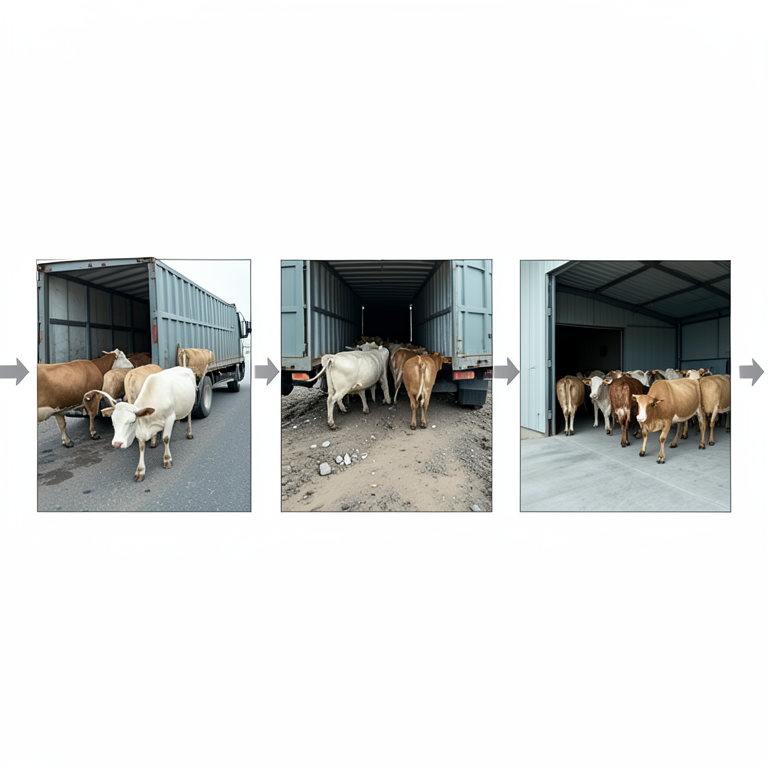
Causes of Livestock Fractures
AI-generated conceptual illustration (cattle and goats). It explains the idea and does not show study data.
View source evidence ↗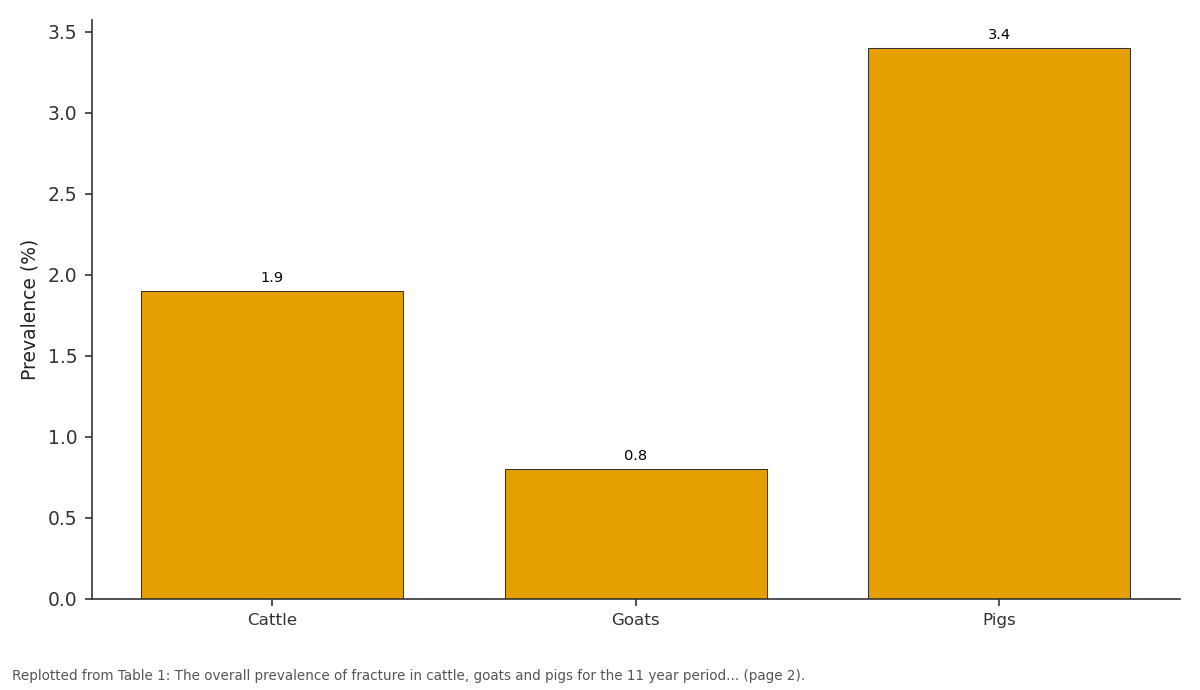
Prevalence (%): Cattle vs Goats vs Pigs
Replotted from Table 1 (page 2) of the original paper. Every bar is the paper's own table value.
View source evidence ↗Figures & tables
From the original paper Table 1
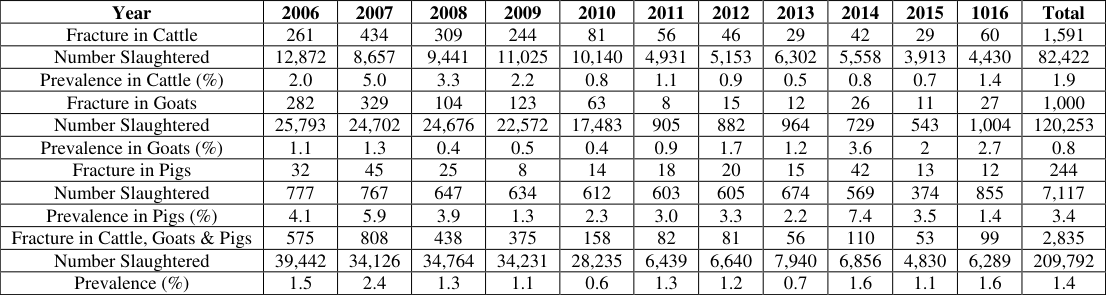 Table 2
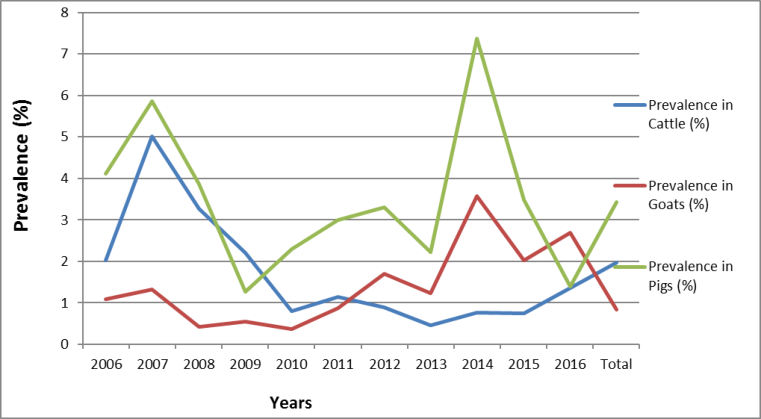 Figure 1
Introduction
There is an emerging social ethic regarding farm animal welfare [1] .The concern for animal welfare is now a major consideration in meat production based on the belief that animals can suffer [2] . The relationship between pre-slaughter stress and meat quality has been established in previous studies [3] , in which it was found that stress impacts negatively on meat quality and that some of the changes meat undergoes after slaughter depend on the pre-slaughter handling of animals. Fracture is a condition commonly encountered in farm animals slaughtered in abattoirs across Nigeria. Most of the fractures observed at ante-mortem inspection of animals usually occur during the transportation of animals from either farms or markets to abattoirs [4] . The jostling associated with road travel resulting from bad roads can lead to falls and bangs against the walls of trucks or crates which often cause wounds, internal hemorrhage and broken bones [5] . Birds caught and thrown quickly into transportation crates often suffer fracture and internal hemorrhages [6] . In addition, cows transported in pairs inside crates to abattoirs are prone to collapse than those in groups [7] . Abattoirs in developed countries operate in ways that ensure animal welfare and meat quality are sustained while in the developing countries, animal welfare and meat quality are not of uttermost priority [8] . There are reported cases of fracture in animals slaughtered at the Jos abattoir. The aim of this study is to determine the prevalence of fracture in animals slaughtered at the abattoir over a period of eleven years and to analyze the difference in fracture between the species slaughtered.
Materials and methods
Materials and methods
Data Collection
Data on reported cases of fracture in cattle, goats and pigs at the Jos abattoir between 2006 and 2016 were obtained from the record files of animals slaughtered at the abattoir. The records of number of animals slaughtered were also retrieved.
The data collected for the respective years were analyzed to determine the prevalence and the difference in fracture between the species.
Data analysis
The data collected were analyzed using simple descriptive statistics such as percentages, and line graph of Microsoft Excel spreadsheet 2007. Data were further subjected to chisquare using graph pad prism for the establishment of significance.
Result
The total number of animals (cattle, goats and pigs) slaughtered during the 11 year period was 209,792 out of which 2,835 (1.4%) had fracture (Table 1). The annual prevalence of fracture for the three species was highest (2.4%) in 2007 and lowest (0.6%) in 2010. The overall specie prevalence of fracture during the study period was observed to be highest (3.4%) in pigs and lowest (0.8%) in goats (Table 2). 2).
| Year | 2006 | 2007 | 2008 | 2009 | 2010 | 2011 | 2012 | 2013 | 2014 | 2015 | 1016 | Total |
|---|---|---|---|---|---|---|---|---|---|---|---|---|
| Fracture in Cattle | 261 | 434 | 309 | 244 | 81 | 56 | 46 | 29 | 42 | 29 | 60 | 1,591 |
| Number Slaughtered | 12,872 | 8,657 | 9,441 | 11,025 | 10,140 | 4,931 | 5,153 | 6,302 | 5,558 | 3,913 | 4,430 | 82,422 |
| Prevalence in Cattle (%) | 2.0 | 5.0 | 3.3 | 2.2 | 0.8 | 1.1 | 0.9 | 0.5 | 0.8 | 0.7 | 1.4 | 1.9 |
| Fracture in Goats | 282 | 329 | 104 | 123 | 63 | 8 | 15 | 12 | 26 | 11 | 27 | 1,000 |
| Number Slaughtered | 25,793 | 24,702 | 24,676 | 22,572 | 17,483 | 905 | 882 | 964 | 729 | 543 | 1,004 | 120,253 |
| Prevalence in Goats (%) | 1.1 | 1.3 | 0.4 | 0.5 | 0.4 | 0.9 | 1.7 | 1.2 | 3.6 | 2 | 2.7 | 0.8 |
| Fracture in Pigs | 32 | 45 | 25 | 8 | 14 | 18 | 20 | 15 | 42 | 13 | 12 | 244 |
| Number Slaughtered | 777 | 767 | 647 | 634 | 612 | 603 | 605 | 674 | 569 | 374 | 855 | 7,117 |
| Prevalence in Pigs (%) | 4.1 | 5.9 | 3.9 | 1.3 | 2.3 | 3.0 | 3.3 | 2.2 | 7.4 | 3.5 | 1.4 | 3.4 |
| Fracture in Cattle, Goats & Pigs | 575 | 808 | 438 | 375 | 158 | 82 | 81 | 56 | 110 | 53 | 99 | 2,835 |
| Number Slaughtered | 39,442 | 34,126 | 34,764 | 34,231 | 28,235 | 6,439 | 6,640 | 7,940 | 6,856 | 4,830 | 6,289 | 209,792 |
| Prevalence (%) | 1.5 | 2.4 | 1.3 | 1.1 | 0.6 | 1.3 | 1.2 | 0.7 | 1.6 | 1.1 | 1.6 | 1.4 |
Table text extracted from the original PDF; superscript letters are shown inline. The original table image is below.
View original table image
| Species | Total No. of animals slaughtered | Total number of animals with fracture | Prevalence (%) |
|---|---|---|---|
| Cattle | 82,422 | 1,591 | 1.9 |
| Goats | 120,253 | 1000 | 0.8 |
| Pigs | 7117 | 244 | 3.4 |
| Total | 209,792 | 2835 | 1.4 |
Table text extracted from the original PDF; superscript letters are shown inline. The original table image is below.
View original table image
The difference in the prevalence of fracture between species was statistically significant (p<0.0001). Generally, the annual prevalence of fracture throughout the study period was undulating across the species during the study period (Figure 1).
Discussion
Animals being transported to the abattoir for slaughter are prone to fractures due to many factors including poor pre-slaughter handling procedures and the fact that vehicles not designed for animal transportation are utilized in the transportation of animals to the abattoir [9] . Such practices are common in developing countries especially in Africa, Nigeria inclusive, as most of the abattoirs are poorly managed due to lack of resources. The overall prevalence of fracture from this study was 1.4% which confirmed that fracture cases are prevalent and are part of the problems encountered at the Jos abattoir resulting in poor meat quality. Other cases of fracture in livestock at the abattoir have been reported [10,11] . However, it is pertinent to state here that there is dearth of information on the prevalence of fracture in abattoirs. The annual prevalence of fracture for the three species was highest (2.4%) in 2007 and lowest (0.6%) in 2010. The high fracture prevalence could be attributed to poor management during boarding and animal handling at the point of loading and unloading prior to slaughter at the abattoir. The undulating annual percentages of fracture throughout the study period is in disagreement with the findings of Bueno et al. [11] who reported a steady increase over the years. The overall prevalence of fracture in cattle was 1.9%, and the annual prevalence varied between 5.0% in 2007 and 0.5% in 2013. The prevalence (3.3%) in 2008 was lower than the 6.5% reported by [10] in a nine-month study at Zaria abattoir within the same year. The reason for the disparity was not clear, but could be as a result of the fact that the latter used a set of primary data, whereas the data reported in this study are secondary, which could have been influenced by poor data entry. The overall prevalence for goats was 0.8%, and the annual prevalence varied between 3.6% in 2014 and 0.4% in 2008 and 2010. The relatively lower prevalence recorded in goats could be due to the hardiness, relative smaller body size and weight of goats, as reported by Jansen and Van den burg [12] . In pigs, the overall prevalence was 3.4%, and the annual prevalence was highest in 2014 (7.4%), and lowest in 2009 (1.3%). On the average, the findings of this study showed lower prevalence compared to those of the three-year (2007-2009) study by Bueno et al. [11] The latter reported 4.6% (2007), 14.8% (2008) and 26.7% (2009) whereas the findings of this study were 5.9%, 3.9%, and 1.3% for the respective years. Comparatively, pigs accounted for much higher prevalence of fracture (3.4%) than cattle (1.9%) and goats (0.8%). Previous studies have shown that lack of skill team in animal handling prior to slaughter [13,14] , bone loss which occurs in pigs reared solely on pasture [15] and the usual physical activities associated with transportation to slaughter houses mounting pressure on the skeleton already weakened by nutritional osteoporosis [15] contribute to the higher prevalence in the species.
Conclusion
Fracture is confirmed to be a common condition observed in animals for slaughter at the Jos abattoir. It is therefore recommended that vehicles designed for transporting livestock should be used in the transport of animals to the abattoir. Stockmen and other livestock handlers should be taught proper handling and restrain techniques in accordance with the European Union (EU) convention for the protection of animals during transportation.
Acknowledgement
AcknowledgementThe authors wish to acknowledge the management and staff of Jos Abattoir, Plateau State, Nigeria for providing the data analysed and reported in this study.
References
15 in the original paper- Rollin BE. Annual meeting keynote address. Animal agriculture and emerging social ethics for animals. J. Anim. Sci. 2004; 82(3):955-964.
- Monteca X. Neurophysiological assessment of welfare. Proc. Int. Congress of meat sci. Technol. 1998; 44:146153.
- Vecerok V, Dobsikova R, Blahova S, Pistekova P, Bedenova E. Stress In broilers resulting from shackling. Poultry sci. 2006; 86:1065-1069.
- Gebresenbe G, Wikner I, Bobobee EYH, Maria G, Villarroeln M. Effect of transportation, time and handling on physiological responses of cattle. J. Agric. Sci. Technol. 2012; 2:800-814.
- Broom DM. Causes of poor welfare in large animals during transport: Vet. Res. Comm. 2003; 1:515-518.
- Gregory NG, Wilkins LJ. Skeletal damage and bone defects during catching and processing. In C.C. Whitehead (Ed). Bone biology and skeletal disorders in poultry. 1992, 313-328.
- Lambooy E, Hulsegge B. Long distance transport of pregnant heifer by truck. Appl. Anim. Behav. Sci. 1988; 20:249-258.
- Adzitey F. Mini Review-Effect of pre slaughter animal handling on carcass and meat quality. Int. Food Res. J. 2011; 18:485-491.
- Samuel F, Girma G, Emmanuel B, Elias DA, Ibrahim H. Effect of transportation and pre slaughter handling on welfare and meat quality of cattle. Case study of Kumasi abattoir, Ghana, Vet. Sci. 2014; 1:174-191.
- Raji MA, Salami SO, Ameh JA. Pathological conditions and lesions observed in slaughtered cattle in Zaria abattoir. Journal of Clinical Pathology and Forensic Medicine. 2010; 1(2):9-12.
- Bueno LS, Caldara FR, Naas IA, Salgado DD, Garcia RG. Swine carcass condemnation in commercial slaughter houses. Rev. MVZ Cordoba, 2013; 18:3.
- Jasen C, Van den burg K. Goat keeping in the tropics. Fourth (Ed), 2004; 6-7.
- Lambooy E, Hulsegge B, Klont RE, WinkelmanGoedhart HA, Reimert HG, Kranen RW. Effects of housing conditions of slaughter pigs on some postmortem muscle metabolites and pork quality characteristics. Meat Sci. 2004; 66(4):855-862.
- Bench C, Schaefer A, Faucitano L. The welfare of pigs during transport. In: Schaefer A, Faucitano L. Vol:6, Wageningen Academic; New York, 2008, 161-180.
- Liesgang A, Burgi E, Sassi ML, Ristel J, Wannet M. Influence of a vegetarian diet versus a diet with fish meal on bone in growing pigs. J. Vet. Med. 2002; 49:230-238.
Cited by 1
From OpenAlex, OpenCitations and reference lists read by Scinovex
- Animal Welfare Conditions: A Case Study of Ogbomoso North Local Government Area, Oyo State, Nigeria ↗
Caesar Ewutsa Anyaku, Taiwo Abiola Otunla, Nurudeen Aderemi Ajibola, Stephanie Mngusonun Ukpi · Asian Journal of Research in Animal and Veterinary Sciences · 2023
This study seeks to evaluate the respondents' comprehension of animal welfare practices and identify factors influencing animal welfare, especially during transit.The welfare of animals is fundamental to the general wellbeing of humanity, and adherence to welfare standards in husbandry operations enhances farmers' revenue.The research was conducted in governmentcontrolled facilities responsible for routine animal inspection and slaughter services in various livestock…
❝ 2PDF