
Research article · 2017 · Full text
International Journal of Veterinary Sciences and Animal HusbandryLipase activity in Allodapa suctoria (nematode) and in Anonchotaenia gaugi (Cestode)
Volume 2(2) · Pages 44–45
Research areasDiet and metabolism studies
Abstract
Author-writtenLipase which hydrolyses trigloycerides to diglycerides further to monoglycerides and finally to glycerol have been reported in helminth parasites. The lipase activity was demonstrated titremetrically in Anonchotaenia gaugi and Allodapa suctoria. The results obtained showed that lipase activity was present in both the helminth parasites and were comparable to the values reported by other workers on helminth parasites. The functional significance of lipase in helminth parasites have been discussed.
Summary
Source-checkedPlain-language reading of the full paper, prepared with AI and checked against the text. Each point links to the authors' own words.
Why it matters
- Lipases are enzymes that catalyze the hydrolysis of triacylglycerols, which are high-energy lipids, into a usable form. View evidence ↗
- Lipase activity, which breaks down triglycerides into diglycerides, monoglycerides, and glycerol, has been previously documented in helminth parasites. View evidence ↗
The question
- The study aimed to investigate the lipase activity in two specific avian parasites: Allodapa suctoria and Anonchotaenia gaugi. View evidence ↗
What they did
- Parasites were collected from the intestines of birds sacrificed in a laboratory and cleaned using saline water to remove food particles and mucus. View evidence ↗
- The biochemical analysis was performed using live, mature worms of consistent size and length. View evidence ↗
- Worms were dried using Whatman’s Filter No. 1, weighed, and then homogenized for the experiment. View evidence ↗
- Lipase enzyme activity was measured using the method described by Cherry and Crandall (1932). View evidence ↗
What they found
- The mean lipase activity was 0.30 units/ml of extract for Allodapa suctoria and 0.48 units/ml for Anonchotaenia gaugi. View evidence ↗
- Lipase activity was found to be slightly higher in the cestode Anonchotaenia gaugi compared to the nematode Allodapa suctoria. View evidence ↗
- The observed lipase activities were comparable to those reported in other helminths, such as Ascaridia columbae (0.50 units/ml) and various cestodes ranging from 0.398 to 1.64 units/ml. View evidence ↗
What it means
- The authors conclude that lipase activity is present in both Allodapa suctoria and Anonchotaenia gaugi, with levels similar to other known helminth parasites. View evidence ↗
- The authors state that the functional significance of these lipases cannot be fully assessed without a more comprehensive understanding of lipid metabolism in helminth parasites. View evidence ↗
Visual summary
2 visualsIllustrations explain the paper; charts are replotted from the paper's own table values.
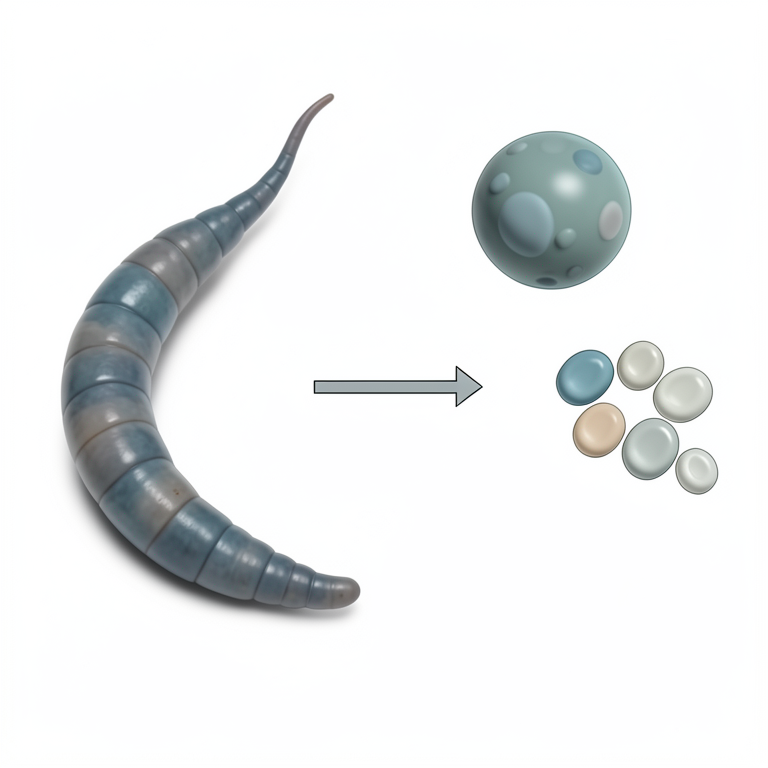
Lipase Hydrolysis Process
AI-generated conceptual illustration (Allodapa suctoria nematode and Anonchotaenia gaugi cestode). It explains the idea and does not show study data.
View source evidence ↗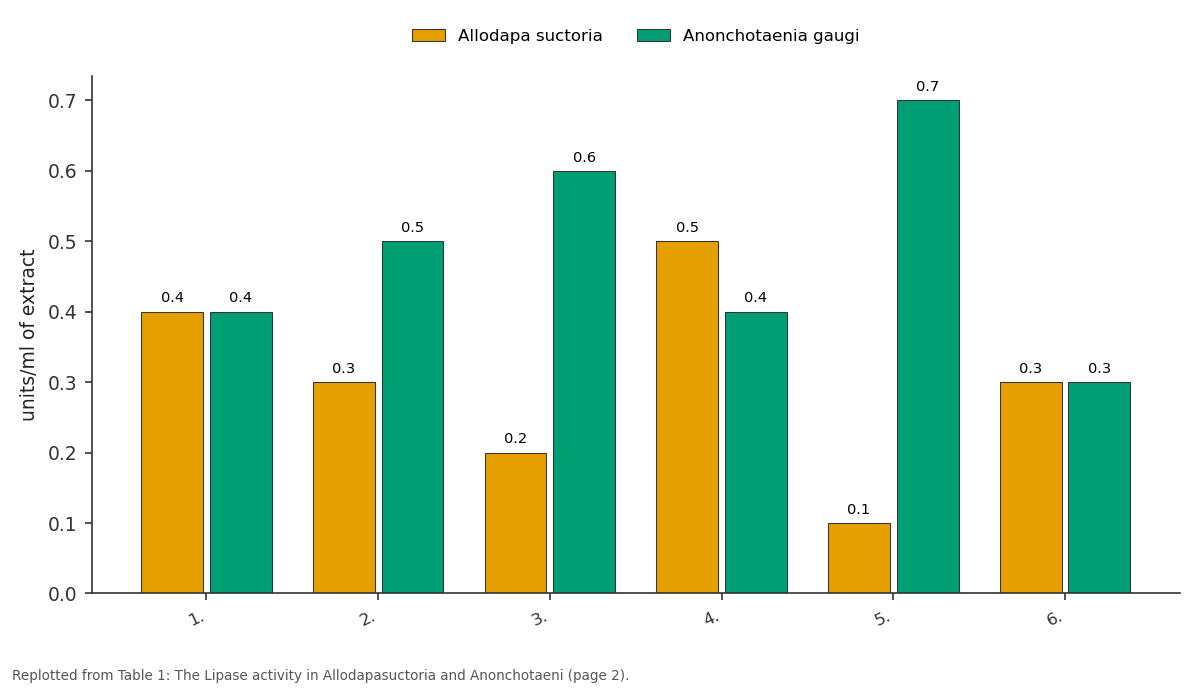
Allodapa suctoria and Anonchotaenia gaugi: 1. vs 2. vs 3. vs 4. vs 5.
Replotted from Table 1 (page 2) of the original paper. Every bar is the paper's own table value.
View source evidence ↗Figures & tables
From the original paper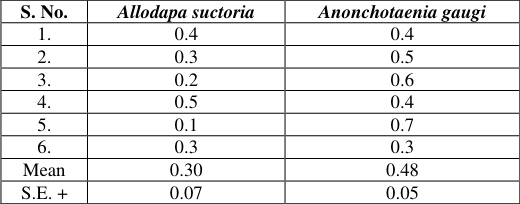 Table 1
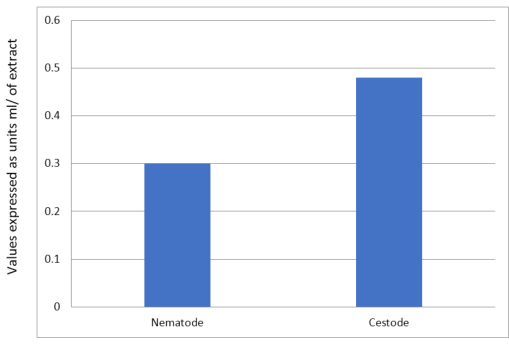 Figure 1
Introduction
Lipids in general, but triacylglycerols in particular have a high energy content that is largely released in a utilisable form on hydrolysis. This hydrolysis is catalysed by lipases. Triglyceride + H2O Lipase --------------- diglyceride + fatty acid Lipases are detected in many tissues and organs of mammals, i.e., heart, brain, muscles, arteries, kidney, pancreas, adipose tissue and serum. Lipases were also reported in plants and micro-organisms, gastric and intestinal lipases are also known to occur.
The recent studies on lipases are in a number of parasitic helminths qualitatively and quantitiatively are listed here in cestodes: Hymenolepis diminuta (Bailey and Fairbairn, 1968) [1]. Cotugnia digonopora and Raillietina tetragona (Reddy, 1981), and Avitellina Centripunctata and Stilesia globipunctata (Patwari 1981). Lipases were also reported in the intenstinal tract of some nematodes (Rogerrs, 1941, Carpenter, 1952, Lee, 1958) [2, 6]. In the present investigation, an attempt have been made to study the lipase activity in two avian parasites i.e., Allodapa suctoria and Anonchotaenia gaugi.
Materials And Methods
Anonchotaenia gaugi and Allodapa suctoria are avian parasites. They were selected for present investigation. Birds were sacrified in the laboratory. The intestine were then cut open and the parasites were flushed into saline water to remove and adhering mucus and food particles.
Generally, mature and live worms of same size and length were taken for biochemical studies. The parasites then transferred to Whatman’s Filter No. 1 to remove the adhering moisture then the parasites were weighed and homogenised for the experiment. The enzyme activity of lipase was determined by the method of cherry of Crandall (1932) [4].
Results
The lipase activity in Allodapa suctoria was 0.30 units/ml of extract while 0.48 units/ml for Anonchotaenia gaugi. The lipase activity of Anonchotaenia gaugi was slightly higher than that of Allodapa suctoria. VET 2017; 2(2): 44-45 MR Siva Sai Kumari Department of Zoology, The Adoni Arts & Scicnce College, Adoni, Andhra Pradesh, India Correspondence MR Siva Sai Kumari Department of Zoology, The Adoni Arts & Scicnce College, Adoni, Andhra Pradesh, India Table 1: The Lipase activity in Allodapasuctoria and Anonchotaeni 6. Lee D, Atkinson HJ.
| S. No. | Allodapa suctoria | Anonchotaenia gaugi |
|---|---|---|
| 1. | 0.4 | 0.4 |
| 2. | 0.3 | 0.5 |
| 3. | 0.2 | 0.6 |
| 4. | 0.5 | 0.4 |
| 5. | 0.1 | 0.7 |
| 6. | 0.3 | 0.3 |
| Mean | 0.30 | 0.48 |
| S.E. + | 0.07 | 0.05 |
Table text extracted from the original PDF; superscript letters are shown inline. The original table image is below.
View original table image
Physiology of Nematodes, Oliver agaugi and Boyd Ltd. 1972. 7. Lumsden RD, Harrington GW. Incorporation of linoleic acid by the cestode hymenolepis diminuta, J. Parasit, 1966; 52:665-670. 8.
Rogers WP. Digestion in paracitic nematodes II. The digestion of fats, J. Helminthol. 1964; 19:35-46. 9.
Smyth JD. The physiology of tape worms. Biol. Rev. 1947; 22:214-238. 10.
Thompson JJ, Mosetting, Von Brand. Unsaponifiable lipids of Taenia taeniaeformis and Moniezia spp. Expt. Parasitol. 1960; 9:127-130. 11.
Von Brand T. Biochemistry of parasites. Academic Press, New York, London. 1973. S.
No. Allodapa suctoria Anonchotaenia gaugi 1. 0.4 0.4 2. 0.3 0.5 3. 0.2 0.6 4. 0.5 0.4 5. 0.1 0.7 6. 0.3 0.3 Mean 0.30 0.48 S.E. + 0.07 0.05 Values expressed as units/ml of extract
Discussion
The results obtained showed that the lipase activity was present in both parasites. When these values were compared with the values obtained by Patwari (1981) in Avitellina Centripunctata and Stilesia globipunctata ranging from 0.990 to 0.398 units/ml extract: Also in cotugnia digonopora and Raillietina tetragona ranging from 1.25 to 1.64 units/ml extract by Reddy (1981) and the values obtained by Geeta (1985) [5] in Ascaridia columbae was 0.50 units/ml extract. Catabolism of Lipids in parasitic helminths are less important and are also in energy source. Cestodes and Nematodes appear neither capable of de nonvo synthesis of long chain fatty acids, nor they can introduce double bonds into absorbed chains.
It is clearly seen that greater part of the metabolically inert lipids are stored in the parenchyma until the proglottids are shed (Lumsden and harrigton 1966, King and Lumsden, 1969). Hence, without a clear knowledge of lipid metabolism in helminth parasites it would not be possible to assess the functional significance of lipases to the parasites. Fig 1: Lipase activity in Allodapa Suctorid and in Anonchotaenia Gaugi
References
5 in the original paper- Balley HH, Fairbarn D. Lipid metabolism in helmi parasites V Absorption of fatty acids and monoglycerides from micellar solution by Hymenolepis diminuta. Comp. Biochem Physiol. 1968; 26:819-839.
- Carpenter MFP. In biochemistry of parasites, edited by Von, 1952.
- Brand T. Academic Press, New York and London, 1972.
- Cherr, Crandall. Chemistry (edited by Oser. B.L., 1954), Mc Grraw Hill Book Company, New York, 1932.
- Geeta Rajlingam. Studies on biochemical and ecologyical aspects of avian parasites. Ph.D. thesis submitted to Osmania University, Hyderabad, (A.P.) India. 1985.