
Research article · 2017 · Full text
International Journal of Veterinary Sciences and Animal HusbandryInfluence of reproductive status and housing system on maintenance and reproductive behaviour patterns of dog (Canis familiaris)
Volume 2(4) · Pages 16–20
Research areasHuman-Animal Interaction StudiesWildlife Ecology and ConservationNeuroendocrine regulation and behavior
Abstract
Author-writtenThe objective of the present paper to study maintenance and reproductive behaviour patterns of healthy dog and bitches in relation to reproductive status and housing system (kennel and open yard) in pre estrous and estrous phase. This study was forty animals (20 dogs & 20 bitches). The results indicated that maintenance and reproductive behaviour varies with reproductive status and housing systemq as scent marking was significantly different in bitch in relation to reproductive state, with higher rate during pre- estrus than estrus, as well as, dogs in kennel, Also in open yard during pre-estrus bitch was scent marking on several object and dogs were noticed together besid bitch after olfaction the object where bitch previously scent marking. The rate of feeding and drinking were significantly different in relation to housing system and reproductive statues. Mean of lying time was higher in open yard than in kennel and the differences were significant. We are suggested that during estrus had no significant difference in bitch and dog.
Summary
Source-checkedPlain-language reading of the full paper, prepared with AI and checked against the text. Each point links to the authors' own words.
Why it matters
- Scent marking through eliminative behavior is a key method for dogs to recognize each other and manage social contact, defense, and breeding. View evidence ↗
- Sniffing serves as a primary mechanism for recognition among dogs. View evidence ↗
The question
- The study aimed to examine how reproductive status (pre-estrus vs. estrus) and housing location (kennel vs. open yard) influence the maintenance and reproductive behaviors of domestic dogs. View evidence ↗
What they did
- Behavior was observed visually for 12 hours per week over a 3-week period, using a focal sample technique with 15-minute intervals per hour during daylight. View evidence ↗
- Data analysis was performed using t-tests via SPSS software to identify differences in behavioral patterns. View evidence ↗
What they found
- In bitches housed in kennels, scent marking was significantly higher during pre-estrus (2.80 ± 0.33) than during estrus (1.09 ± 0.164). View evidence ↗
- In dogs housed in kennels, scent marking was significantly more frequent during pre-estrus (6.66 ± 0.60) compared to estrus (2.88 ± 0.27). View evidence ↗
- Feeding frequency was significantly higher during pre-estrus than estrus for both bitches (3.27 ± 0.25 vs 1.18 ± 0.16) and dogs (3.02 ± 0.26 vs 1.21 ± 0.13) in kennels. View evidence ↗
- Lying time for bitches was significantly higher during pre-estrus than estrus, with higher values observed in the open yard (10.40 ± 0.68 min) compared to the kennel (5.09 ± 0.44 min). View evidence ↗
- The duration of the tie lock during copulation was significantly longer in the kennel (33.60 ± 1.68 min) than in the open yard (15.92 ± 1.03 min). View evidence ↗
- Phantom ties occurred more frequently in the kennel (5.00 ± 0.70) than in the open yard (1.80 ± 0.58). View evidence ↗
- Aggression from the bitch after the tie was broken was significantly higher in the kennel (5.00 ± 1.09) than in the open yard (3.80 ± 0.73). View evidence ↗
What it means
- The authors conclude that scent marking is a primary way dogs recognize each other and understand reproductive behavior, and that these behaviors are influenced by both housing systems and reproductive status. View evidence ↗
- The authors suggest that for copulation to be successful, it should take place in an environment the bitch is accustomed to. View evidence ↗
Visual summary
2 visualsIllustrations explain the paper; charts are replotted from the paper's own table values.
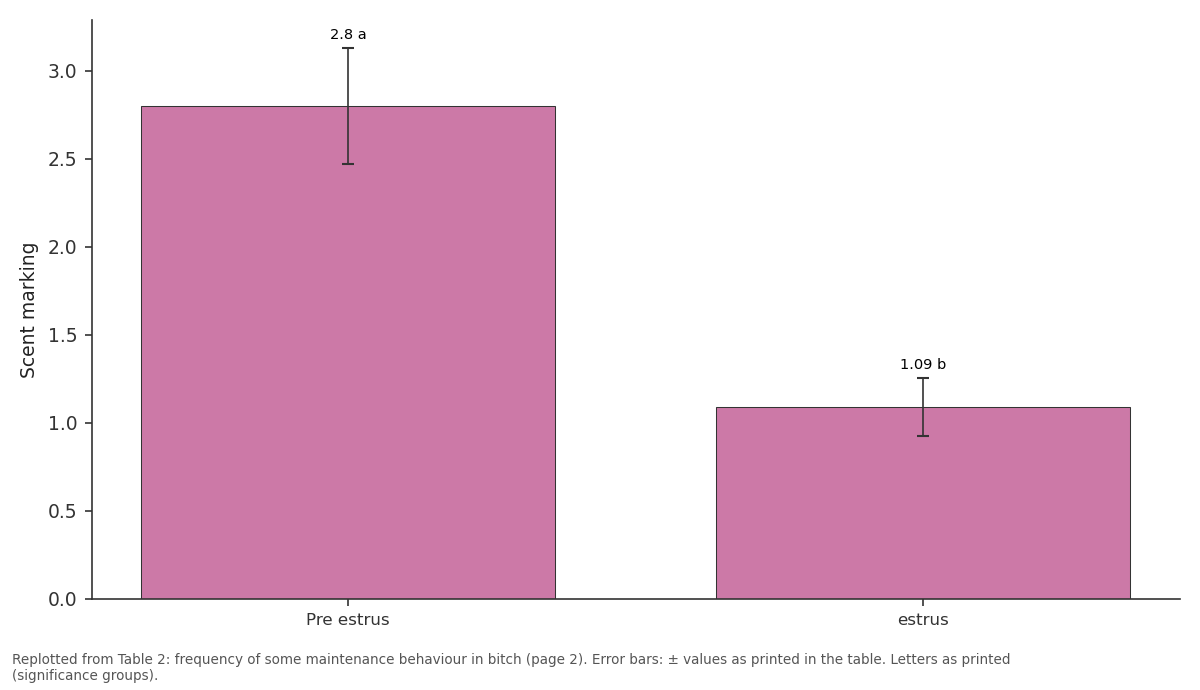
Scent marking: Pre estrus vs estrus
Replotted from Table 2 (page 2) of the original paper. Every bar is the paper's own table value.
View source evidence ↗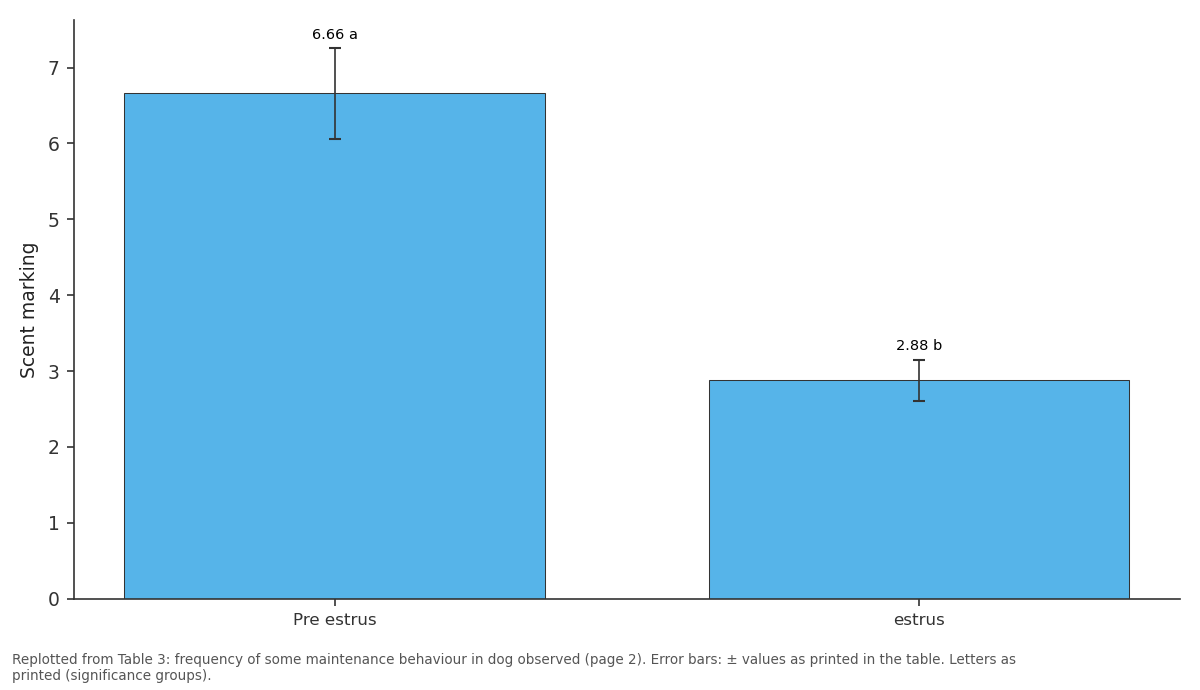
Scent marking: Pre estrus vs estrus
Replotted from Table 3 (page 2) of the original paper. Every bar is the paper's own table value.
View source evidence ↗Figures & tables
From the original paper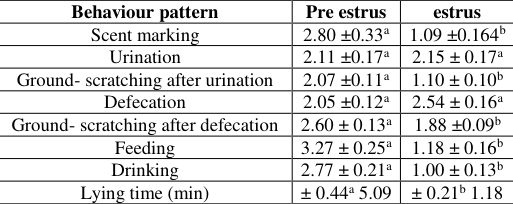 Table 2
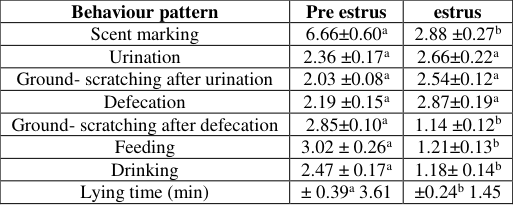 Table 3
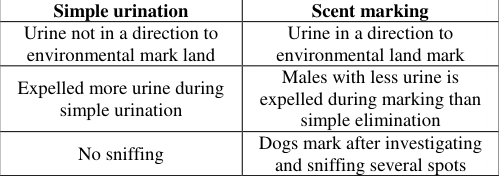 Table 1
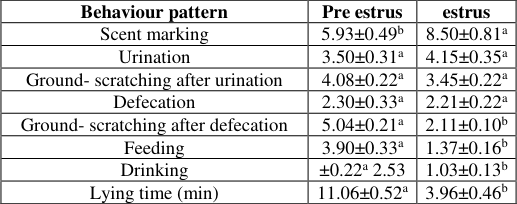 Table 5
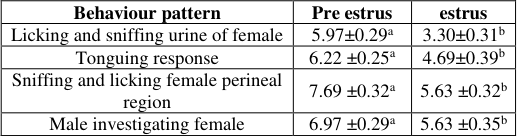 Table 6
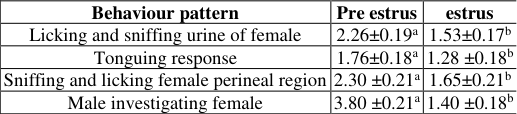 Table 7
 Table 8
Introduction
Reproductive behaviour of dogs had attracted the interest of scientists for a long peroid. Alot of searches on the reproductive behaviour had been made in the dogs [1,2] . Most of the last researches deal with attentions between the animals of the differ sex when the bitches were in estrus. Among the dogs in this papper, both dogs and bitches were highly attention for each other when the bitches were in estrus. Dogs were more attention to the bitches than vice versa; however, all the dogs during presences in mating places were not give similar attention to special bitch [2] . Dogs were used sniffing as a main goal for recognition and this is clear in dogs. Pheromone was made by some glands that secreted in the external environment, both sebaceous and sweat glands [3] . Marking by eliminative behaviour is distinct recognition in dogs in social contact, area of defense, protection newborns and breeding. Scent marking by urination is most action in the dog which had been appear on the principles of both sex, postures during marking and frequency of marking rates in different social contact [4][5][6] . Bitch made scent marking by urine only at the time of estrus but dogs scent marking are recognized from simple urination, in dogs during marking the urine flow is directional to some environmental object. Dogs less urine is expelled during scent marking than simple elimination. Sometimes the dogs scent mark after olfaction different object [7] . The purpose of this study was to study some maintenance and reproductive behaviour of domestic dog in relation to reproductive status (pre estrus phase or estrus phase) and location (kennel or open yard).
Material and methods
This study was carried out in Security and Guarding Dog Training Center, Cairo, Egypt.
Animals used and management
Animals used and management
Animals and housing
Twenty dog & twenty bitches German Shepherd was used in this study and divided into two equal group, group (A) were housed in kennel and group (B) were housed in open yard. Kennel (3.0m length,2.0m width and 2.5 m height) wall of kennel covered from inside by ceramic and opened from upper as a source of ventilation and light during day time and electric light (lamp 60 watt) during the night, Kennel sheltered with asbestos. Height of kennel door is 2.5 m which opened in pass way (60.0m length and 2.0m width) and pass way opened with another door which opened in fenced green yard 4200m2 with swings and agility training. Kennel floor covered with ceramic and provided with a slatted floor system with height 20cm during winter, but removed during summer and sleep on the floor directly.
Feeding
Dog and bitch receive 500gm of fresh cocked minced cow meat with soap and 750gm of cooked rice applied in clean bowl twice daily, at 6:00 a.m. and the other at 6:00 p.m. and in between variable amounts of dry food wetted with water.
Handling
Dog and bitch in were kept freely the kennel, but during walking, playing and training secured by head collar may be woven nylon, metal or leather with buckle, then clip leash, which may be short leash for walking and much longer one for training.
Identification of animals
Animal identification was done by metal piece, which right on it, bitch or dog name right on head collar
Behavioural observation
The observation was carried out visually by recording 12 hours per week (15 minutes interval per one hour observation for each animal) by represent during daylight hours for a peroid of this study (3 weeks). Using focal sample technique and observation sheet and stop watch. The observation away from observed animal to avoid any disturbance [8] . The following behavioural pattern observed: 1. mean frequency of urination and scent marking in pre estrous and estrous phase per 12 hours observation.
Statistical analysis
The statistical analysis of the obtained results from this investigation were conducted using t-test and by using SPSS [9] for examining the differences, between reproductive patterns of dog and bitches observed in kennel and open yard in pre estrous and estrous phase in the domestic dog. 2) illustrated that urine marking was significantly different in bitch in relation to reproductive state, with higher rate during pre-estrus as well as in dogs in kennel, also in open yard during pre-estrus bitch marked on several spots and dogs were observed together near bitch after sniffing the spots where bitch previously marked. It is interesting to note that in table (3) during estrus in bitch differentiate between scent marking as a form of elimination and urinary behaviour, which urination had no significant difference in bitch and dog. Regarding to table(4,5) the rate of feeding and drinking were significantly different in relation to location and reproductive statues where in place with sufficient food gave chance for dogs to mark food material of and drinker well marked them before leaving place of feeding and drinking as scent marking behaviour, as well as, increased scavenging behaviour of dogs. The mean of lying time (min.) higher in kennel than in open yard and thin observation due to environ mental pressure as limited lying place in open yard away from kennel.
Results
The results in table (6, 7) found that courting place influence on court ship behaviour pattern with relation to reproductive status and the difference was significant. In dog found housing system related differences with respect to frequency of copulation pattern in table (8) as Tie lock, Phantom tie, Aggression of the bitch after tie broken in kennel and open yard and the difference was significant.
Discussion
Between the dogs in this paper, dogs and bitches were highly attention to each other through the bitches were in estrus. Dogs were more attention to the bitches than vice versa; and dogs placed in the mating area Tables (2&3) illustrated that scent marking was significantly different in bitch in relation to reproductive state, with higher rate during pre-estrus than estrus as well as, in dogs in kennel, Also in open yard during pre-estrus bitch scent marking on several object and dogs appear together beside bitch after olfaction the object while bitch previously scent marking. It is interesting to note that during estrus in bitch differentiate between scent marking as a form of elimination behaviour, which urination had no significant difference in bitch and dog. These observations suggested by [10][11][12] as they found that dogs in open yard with linked scent marking especially, if bitch in estrus. As well as, the obtained results similar to that obtained with [10] as they suggested that relationship between scent marking and reproductive status of dog, which free ranging exhibited higher rates of urination directed toward a target object in the environment. The scent marking behaviour in the dog have a action used for making strange dog familiarized and recognized by the strange area. Urine marking on spots and especially on strange object to familiarize the objects with in their area [7,13] . Studied a range of aspects of the kennel environment have yet to be studied in any detail including the effect of over-stimulation of the visual, olfactory and auditory senses, and lack of control and predictability in the environment. It is unfortunate that the environment of an animal which was the first to be domesticated and with which we have arguably the strongest relationship has been so poorly [14] . Illustrated that dogs urinated more frequently than females (P<0.0001 at both shelters) and opposite more of their urinations against hard object (P<0.0001 at both shelters) [15] . Stated that dogs that are kenneled can show numerous signs of stress. There are physiological issues that will need to be addressed, management of structural containment spaces, as well as training for social skills and desensitization to novelty. The longer the dog is kenneled, the more emphasis is needed to address these issues in contrary [16] as they study on elimination behaviour dogs and reported a relatively small increase in this behaviour in bitches with in observation in Kennel. As well as [17] , found that housing system did not effect on frequency of defecation, Also [18] illustrated that no difference in frequency of defecation, in relation to place. But in relation to housing system (kennel or open yard), the elimination behaviour of adult dogs is sexually differ with related to the posture (dogs lift a leg and bitches squat), rate of urination (dogs urinate more than bitches), and ability to direct urine at special spots in the terroritry (dogs are more ability than bitches to left their urine at special spots), as the elimination in bitches does not function solely in elimination behaviour, but that it also had a significant action in scent marking, when females are not in estrus [18] .
For the most part, ground scratching act as a principle tool in sending signal especially in estrus, which act as a signal depend on vision and pheromones [12,[19][20][21] as they illustrated that ground scratching after urination or defecation act as a scent marks left on the ground as ascent as visual signal between dog and bitch. In this study founded that ground scratching did not influence by housing system (kennel and open yard) but affected by reproductive status, which noticed that higher rate in dog and bitch during pre-estrus than estrus which may be related to ground scratching act as chemical signals similar to scent marking. This opinion agreed by [18] as they stated that spayed bitches as well as non-estrus healthy females to ground-scratch after eliminative behaviour. The rate of feeding and drinking were significantly different in relation to housing system and reproductive statues where in place with sufficient food gave chance for dogs to mark food material of and drinker well marked them before leaving place of feeding and drinking as scent marking behaviour, as well as increased scavenging behaviour of dogs as previously illustrated by [22] . The mean of lying time (min) higher in open yard than in kennel and observation due to environmental pressure as limited lying place in kennel. The results in table (4) found that courting place influence on court ship behavioural pattern with relation to reproductive status and the difference was significant. These results were in agreement with that obtained with [23][24][25] as they observed that licking and sniffing bitch and scent higher in kennel than in open yard and higher in pre estrus than estrus stage. The rate of scent marking was high in the courting place, among males scent marking was appear. Scent marking related with feeding behaviour. The frequency of scent marking occurred by the dogs near the space area during walking by neighboring dogs for territorial defense. Also [26] stated that during courtship pattern, in 12 spots (average duration 30 min) three dogs during courting pattern were made scent marking on the same 42 foreign object that were made by their bitches partners per hour as well as, the scent marking by urination is a main tool of communication in dogs, it was refer to social area of dogs. The scent marking of dogs in different seasons and areas and with different postures of dogs were affected by dog psychology. Scent marking was significantly affected by different seasons, and it was appear at the middle period of mating peroid. The rate of scent marking was higher in the courting places, almost when bitches were in estrus. During estrus the bitches made scent marking on a lot of object and the dogs appear to gather beside the estrus bitches after olfaction the objects where that bitches had made scent marking previously [27] . Suggested that there was a positive correlation between the mean time of courting period and the mean frequency of mounting. Some of external natural factors as reproductive status of bitch and area of courting effect on the time period of copulatory ties. Individual variation in relation to reproductive behavior were appear both in dogs and bitches, and the present authors [27,28] sggested that both inter-and intra-reproductive behaviour of dogs psychology and situations. In dog found housing system related differences with respect to frequency of copulation pattern in table (5) as Tie lock, Phantom tie, Aggression of the bitch after tie broken in kennel and open yard and the difference was significant. These results were similar to that obtained with [17] as they found that housing system influence on frequency of defecation, Also [18] as they illustrated that no difference in of tie lock, phantom tie and aggression of the bitch after tie broken, Also found that there were differences in frequency of copulation pattern in relation to housing system. Territorial aggression was appearing a lot common within the territorial place and at any period of the year [29] . On the other hand [26] found that alpha dog on was appear to made threat aggression display in the courting area or after driving out a trespasser near the territorial area. So, these aggressive postures during courting made disturbance in the courting area and also near the territorial place may be as indication of dominance, aggression and threat display.
Conclusions
From this work it could be concluded that scent marking had long been recognized as an a main form of dog recognized each other, understood reproductive behaviour of bitch and dogs influenced by housing system and reproductive status, also for successful copulation should be in a accustomed place for the bitch.
Conflict of interest
Conflict of interest
Acknowledgement
The authors declare no conflict of interest. AcknowledgementWe are grateful to all members in security and guarding dog training center, Cairo, Egypt to finish this study. We would like to thank anonymous referees for their helpful comments on the manuscript.
Figures and tables from the paper
| Behaviour pattern | Pre estrus | estrus |
|---|---|---|
| Scent marking | 2.80 ±0.33a | 1.09 ±0.164b |
| Urination | 2.11 ±0.17a | 2.15 ± 0.17a |
| Ground- scratching after urination | 2.07 ±0.11a | 1.10 ± 0.10b |
| Defecation | 2.05 ±0.12a | 2.54 ± 0.16a |
| Ground- scratching after defecation | 2.60 ± 0.13a | 1.88 ±0.09b |
| Feeding | 3.27 ± 0.25a | 1.18 ± 0.16b |
| Drinking | 2.77 ± 0.21a | 1.00 ± 0.13b |
| Lying time (min) | ± 0.44a 5.09 | ± 0.21b 1.18 |
Table text extracted from the original PDF; superscript letters are shown inline. The original table image is below.
View original table image
| Behaviour pattern | Pre estrus | estrus |
|---|---|---|
| Scent marking | 6.66±0.60a | 2.88 ±0.27b |
| Urination | 2.36 ±0.17a | 2.66±0.22a |
| Ground- scratching after urination | 2.03 ±0.08a | 2.54±0.12a |
| Defecation | 2.19 ±0.15a | 2.87±0.19a |
| Ground- scratching after defecation | 2.85±0.10a | 1.14 ±0.12b |
| Feeding | 3.02 ± 0.26a | 1.21±0.13b |
| Drinking | 2.47 ± 0.17a | 1.18± 0.14b |
| Lying time (min) | ± 0.39a 3.61 | ±0.24b 1.45 |
Table text extracted from the original PDF; superscript letters are shown inline. The original table image is below.
View original table image
| Behaviour pattern | Pre estrus | estrus |
|---|---|---|
| Scent marking | 5.93±0.49b | 8.50±0.81a |
| Urination | 3.50±0.31a | 4.15±0.35a |
| Ground- scratching after urination | 4.08±0.22a | 3.45±0.22a |
| Defecation | 2.30±0.33a | 2.21±0.22a |
| Ground- scratching after defecation | 5.04±0.21a | 2.11±0.10b |
| Feeding | 3.90±0.33a | 1.37±0.16b |
| Drinking | ±0.22a 2.53 | 1.03±0.13b |
| Lying time (min) | 11.06±0.52a | 3.96±0.46b |
Table text extracted from the original PDF; superscript letters are shown inline. The original table image is below.
View original table image
| Behaviour pattern | Pre estrus | estrus |
|---|---|---|
| Licking and sniffing urine of female | 5.97±0.29a | 3.30±0.31b |
| Tonguing response | 6.22 ±0.25a | 4.69±0.39b |
| Sniffing and licking female perineal region | 7.69 ±0.32a | 5.63 ±0.32b |
| Male investigating female | 6.97 ±0.29a | 5.63 ±0.35b |
Table text extracted from the original PDF; superscript letters are shown inline. The original table image is below.
View original table image
| Behaviour pattern | Pre estrus | estrus |
|---|---|---|
| Licking and sniffing urine of female | 2.26±0.19a | 1.53±0.17b |
| Tonguing response | 1.76±0.18a | 1.28 ±0.18b |
| Sniffing and licking female perineal region | 2.30 ±0.21a | 1.65±0.21b |
| Male investigating female | 3.80 ±0.21a | 1.40 ±0.18b |
Table text extracted from the original PDF; superscript letters are shown inline. The original table image is below.
View original table image
| Behaviour pattern | Kennel | Open yard |
|---|---|---|
| Tie lock | 33.60±1.68a | 15.92±1.03b |
| Phantom tie | 5.00±0.70a | 1.80±0.58b |
| Aggression of the bitch after tie broken | 5.00±1.09a | 3.80±0.73b |
Table text extracted from the original PDF; superscript letters are shown inline. The original table image is below.
View original table image
References
29 in the original paper- Whitney LF. How to Breed Dogs, Orange Judd Publishing, 1947, New York, NY, USA.
- Pal SK, Ghosh B, Roy S. Inter-and intra-sexual behaviour of free-ranging dogs (Canis familiaris). Applied Animal Behaviour Science, 1999; 62(2-3):267278.
- Gorman ML, Trowbridge BJ. Role of odour in the social lives of carnivores. In: Gittleman JL. (Ed.) Carnivore Behaviour, Ecology and Evolution. Chapman and Hall London, 1989; 57-88.
- Anisko JJ. Communication by chemical signals in Canidae. In: Doty RL (Ed.) Mammalian Olfaction Reproductive Processes and Behaviour. Academic Press, 1976, 283-293.
- Dunbar I. Olfactory preferences in dogs: The response of male and female beagles to conspecific urine. J Behav Biology, 1978; 3:273-286.
- Bekoff M. Ground-scratching by male domestic dogs: a composite signal. J Mammal, 1979; 60:847-848.
- Kleiman D. Scent marking in the canidae. Symp Zool Soc Lond, 1966; 18:167-177.
- Altuman J. Observational study of behavior: sampling method. Behaviour, 1974; 49:227-267.
- Tamhane AC, Dunlop DD. Statistics and data analysis from elementary to intermediate, Upper Saddle River. USA, 2000.
- Beach FA, Gilmore RW. Responses of male dogs to urine from females in heat. J Mammal. 1949; 30:391-392.
- Eisenberg JF, Kleiman DG. Olfactory communication System in mammals. Ann Rev Ecol, 1972; 3:1-32.
- Fox MW, Cohen JA. Canid communication. In: Sebeok, T. (Ed.), How Animals Communicate. Indiana University: Press, 1977; 728-748.
- Taylor KD, Mills DS. The effect of the kennel environment on canine welfare: a critical review of experimental study Animal Welfare, 2007; 16:435-447.
- Mc Guire B. Scent marking in shelter dogs: Effects of sex and age. Applied Animal Behaviour Science, 2016; 182:15-22.
- Camille B. Understanding Kennel Stress in Canines (Canis familiaris) A Review of the Literature. Journal of Applied Companion Animal Behavior, 2010; 4(1):1-14.
- Ranson E, Beach FA. Effects of testosterone on ontogeny of urinary behavior in male and female dogs. J Horm Behaviour, 1985; 19:36-51.
- Gese EM, Ruff RL. Scent-marking by coyotes Canis latrans: the influence of social and ecologicalfactors. J Anim Behaviour, 1997; 54:1155-1166.
- Wirant SC, McGuir B. Urinary behavior of female domestic dogs (Canis familiaris): Influence of reproductive status, location and age. J Appl Anim Behav Science, 2004; 85:335-348.
- Peter RP, Mech D. Scent marking in wolves. Anim sci, 1975; 63:628-637.
- Bekoff M. Scent marking by free-ranging domestic dogs. J Bio Behaviour, 1979; 4:123-139.
- Bekoff M, Wells MC. Social Study ecology behavior of coyotes. J Adv Behaviour, 1986; 16:251-338.
- Henry JD. The use of urine marking in the scavenging behaviour of the red fox (Vulpes vulpes). Behaviour, 1977; 61:82-105.
- Rothman RJ, Mech LD. Scent-marking in wolves and newly formed pairs. J Anim Behaviour, 1979; 27:750760.
- Wells MC, Bekoff M. An observational study of scentmarking in coyotes Canis latrans. J Anim Behaviour, 1981; 29:332-350.
- Thomson PC. The behavioural ecology of Dingoes in North-Western Australia. Part II. Activity patterns, breeding season and pup rearing. Wild Research, 1992; 19:519-530.
- Pal SK. Urine marking by free-ranging dogs (Canis familiaris) in relation to sex, season, place and posture. Appl Anim Behav Science. 2003; 80:45-59.
- Pal SK. Mating System of Free-Ranging Dogs (Canis familiaris) International Journal of Zoology. 2011, Article ID 314216, 1-10 pagesdoi:10.1155/2011/314216
- Macdonald DW, Carr GM. Variation in the dog society: between resource dispersion and social flux, in The Domestic Dog: its Evolution, Behaviour and Interactions with People. J. Serpell, Ed, 1995; 199-216. Cambridge University Press, Cambridge, UK.
- Boitani L, Francisci F, Ciucci P, Andreoli G. Population biology and ecology of feral dogs in centralItaly. In: Serpell, J. (Ed.), the Domestic Dog: Its Evolution, Behaviour and Interactions with People. Cambridge University press, Cambridge, 1995, 217-244.