
Research article · 2017 · Full text
International Journal of Veterinary Sciences and Animal HusbandryAssessment of productive and reproductive traits of Egyptian buffaloes in relation to parity and system of management
Volume 2(2) · Pages 35–38
Research areasLivestock Management and Performance ImprovementGenetic and phenotypic traits in livestockAgricultural Economics and Practices
Abstract
Author-writtenThis work was carried out to study the Productive reproductive status of Egyptian buffaloes in relation to parity and system of management. The obtained results revealed that the number of services per conception was increased with increase numbers of calving. There was significant increase in the days to 1st services with increase numbers of calving. The lactation length, daily and total milk production were significantly affected with the increase number of parity in buffaloes. While, there were no significant differences in the periods of pregnancy, dry off and calf weight due to differences in the numbers of parity. In the other hand, the productive and reproductive parameters were significantly affected due to differences in the systems of management, but the differences in pregnancy time and calf weight among the experimental groups did not reach the significance.
Summary
Source-checkedPlain-language reading of the full paper, prepared with AI and checked against the text. Each point links to the authors' own words.
Why it matters
- Buffaloes are critical for maintaining sustainable food production systems in many developing nations. View evidence ↗
- Water buffaloes are the second most significant species globally for milk production, following dairy cows. View evidence ↗
- Due to their slow milk ejection reflex and hard teat muscle sphincters, buffaloes require careful selection and management to optimize milk yield. View evidence ↗
The question
- The study aimed to evaluate how parity (number of calvings) and the system of management affect the reproductive and productive status of Egyptian dairy buffaloes. View evidence ↗
What they did
- Experiment one involved 40 female dairy buffaloes, aged 4 to 7 years, ranging from 2nd to 5th parity, all free from reproductive disorders. View evidence ↗
- For the first experiment, buffaloes were divided into four groups of 10 animals each based on their parity (2nd, 3rd, 4th, and 5th). View evidence ↗
- Experiment two used questionnaires to assess buffaloes aged 3 to 8 years across three management systems (Peasant, Specialized, and Large scale) in Sharkia governorate from January 2015 to January 2016. View evidence ↗
- Reproductive performance was measured by the number of services per conception, days to first service, pregnancy time, dry-off period, and the percentage of dystocia. View evidence ↗
- Productive parameters included birth weight of calves, lactation length, and both daily and total milk production. View evidence ↗
What they found
- Management systems significantly affected total milk production, with the large-scale system yielding the most (2091.63 ± 13.62 kg) and the peasant system the least (1612.41 ± 21.36 kg). View evidence ↗
- The dry-off period was significantly longer in the peasant system (103.9 ± 2.16 days) compared to the large-scale system (52.3 ± 1.51 days). View evidence ↗
- The system of management did not have a significant effect on the birth weight of calves. View evidence ↗
What it means
- The authors concluded that under subtropical conditions, reproductive efficiency and productive parameters of female dairy buffaloes decrease as the number of calvings increases. View evidence ↗
- The authors found that management systems influence traits, with large-scale systems providing the best reproductive and productive outcomes. View evidence ↗
Figures & tables
From the original paper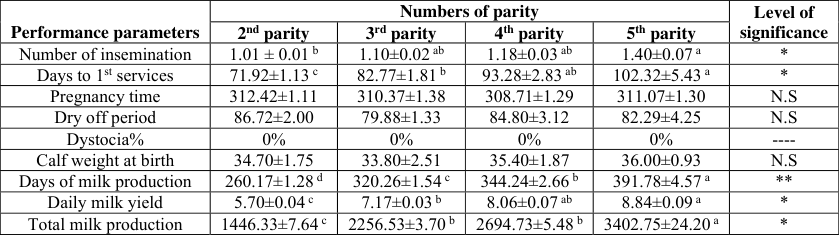 Table 1
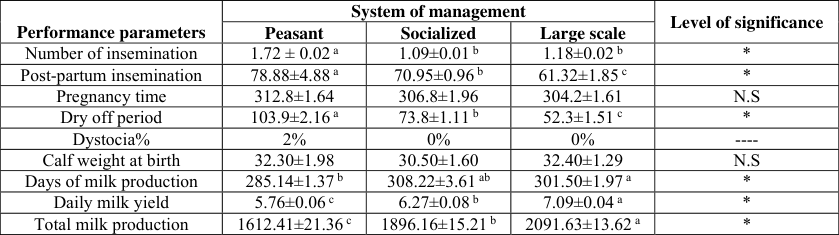 Table 2
Introduction
Buffaloes play a very important role in providing a sustainable food production system in most developing countries [1] . Buffaloes have a several morphological characters which reinforce their ability to live in shaded hot humid countries [2] as it has dark skin which covered by hair. The water buffaloes have poor thermoregulation system, as it needs a shade and water for wallowing [3] . Buffaloes have the ability to convert poor and coarse feed, straw and crop residues to protein rich meat with low cholesterol [4] . As well as, the buffaloes have high milk production during the lactation periods of 270 days is 2220 kg with 8.4% fat and 4.6 % protein [5] . The water buffaloes are the second most important species in the world for milk production after dairy cows [6] . It is economically important due to their excellent fertility efficiency and productivity, where ability of buffalo's have adaptive capacity to sub-tropical climatic conditions [7] . Buffaloes are slow and hard milkers because of their slow milk ejection reflex and hard teat muscle sphincter, the buffaloes should be carefully selected and managed for yield and ease to milk. Therefore, the objectives of this study were to assess the effect of parity and system of management in reproductive and productive status of Egyptian dairy buffaloes.
Material and Methods
Material and Methods
Experiment one:
Animal used and management: The study was carried out on 40 female dairy Buffaloes aged (4-7 years old), between the 2 nd and the 5 th parity, and free from reproductive disorders. All buffaloes were classified according to numbers of parities into 4 experimental groups (2 nd , 3 rd , 4 th and 5 th parity) with 10 buffaloes in each. The experiment was conducted in farm belonged to dairy buffaloes farm at Sharkia governorate, which included two shaded yards (20 animals /yard) and one milking room with automatic fans to maintain the cooling during the hot weathers. There was 2 concrete managers were located outside the fence one on each side allowed 1m/buffalo for feeding space. Lactating feeding program was used, a formulated total mixed ration 13% protein, energy 1. 4 Mcal and minerals was offered to the buffaloes. The main ration ingredients were corn, silage, soybean, hay, wheat straw, limestone, mono calcium phosphate, premix, antimycotoxine, vitamins and oil [8] .
Green fodder, roughage (berseem in winter, hay in summer) was used. The daily ration amount per animal (15-20kg) was calculated and offered at morning after the 1 st milking to be fed by the animal throughout the day, while the fresh water was ad-libitum. Animals were identified with a plastic ear tag, as well as, white paint numbers were applied on the sides of chest of each animal.
Milking system: Well cleaned, ventilated milking parlor was available with milking capacity 10 buffaloes /cycle. It provided with electronic digital display to record the female number and its production. Buffaloes were milked 2 times a day at 6.00 am and 6:00 pm. The udder was washed, dried with clean paper then the fore-milk stripping from the four teats before milking attempts.
Reproductive performance: it was included number of services per conception, days to 1 st services (interval from calving to first insemination) [9] , pregnancy time (day), dry off period (day) and dystocia%.
Productive parameters: it was represented in calf weight at birth (kg), lactation length (day), daily milk production (kg) and total milk production (kg) [10] .
Statistical analysis: All statistical procedures were performed using the SAS statistical system Package V9.2 [11] . Data were analyzed using repeated measure analysis of variance (ANOVA) and the comparison of means was carried out using Duncan's multiple range tests. Data were presented as Mean ± SE and significance was declared at (P < 0.05).
Experiment two:
This experiment was conducted in 3 managerial systems of dairy buffaloes in Sharkia governorate in period from January 2015 till January 2016 through questioners for owners to assess the reproductive and productive performance of dairy buffaloes aged between 3-8 years old.
Description of management systems:
Peasant system: it used in small scale, where each farmer has 1-2 buffaloes for work and milk production.
Specialized system: many farmers become more specializing, through having more than 2 until 10 buffaloes for milk production.
Large scale: it is in large scale, where one farm has at least 100 dairy buffaloes as in the farm of 2 nd military farm at Salhia city in Sharkia governorate.
Reproductive performance, productive parameters and statistical analysis: were as mentioned before in experiment one.
Results
There was significantly difference in the most of productive and reproductive traits as shown in Table (1) due to differences in numbers of parities, while the differences in pregnancy time, dry off period and calf weight at birth did not reach the significant. As well as, the results in Table (2) revealed that system of management has significantly effect in the most of reproductive and productive parameters of buffaloes except pregnancy time and calf weight at birth.
Discussion
The findings achieved in the present study revealed that, there were a highly significance differences in the numbers of services per conception post-partum in relation to the parity of female as it increases with increase numbers of calving (Table 1). These results are similar to that obtained by [12] as they stated that the parity and calving intervals in buffaloes affecting the postpartum productive status of buffaloes due to hormonal irregularities. While, the obtained results were differ with [13] as they suggested that the age of female buffaloes as well as, the parity did not affect the post-partum reproductive efficiency of the buffaloes. While [14] found that there was no significance differences between the parity and post-partum reproductive traits as, well as, the results were disagree with [15] as they showed that 60% of repeat breeder in buffaloes were increased with decreased parity, but [16] showed that higher number of services occur at 1 st parity due to low intensity of estrus in buffaloes compared with multiparous ones. Nevertheless, there were no significant differences in pregnancy time and dry off period among experimental groups, although the period of dry off was the highest in 2 nd parity. While, the calf weight at birth was higher in 5 th parity than others with no significant difference. During questioner, there were no cases of dystocia in all different parities. Moreover, the lactation length, daily and total milk production were significantly correlated with numbers of parity, where it was the highest in 4 th and 5 th parity respectively and the lowest in 2 nd parity with significant differences (P ≤ 0.05). These results were dissimilar to [17,18] as they mentioned that the milk production and lactation length (days) were decreased with increase the parity of animals. On the other hand, [19,20] suggested that the milk production was not affected by parity of the buffaloes but improved with management and breeding only of buffaloes. Other mentioned that parity had highly significant (P < 0.01) effect on daily milk yield [21] . While, the differences among parities were significant for daily milk yield which increased with the increase in order of lactation until the third one [22] . On the other hand, [23] indicated that the effect of parity on daily milk yield was non-significant. Concerning the results in Table (2) showed that the number of insemination and post-partum insemination were significantly affected by housing system, where it was the highest in peasant system (1.72 and 78.88, respectively). These results agree with [21] as they found that housing system had effect in number of insemination and days open (interval from calving to conception). Pregnancy time was higher in peasant system than specialized and large scale but the differences did not reach the significant. From the obtained results in Table (2) found that dry off period was significantly differed among experimental farms and was higher in peasant than others. This result may be due to effect of housing system in lactation length and milk production [21] . The percentage of dystocia was 2% in peasant system, while it had been recorded in other systems. Housing systems had no significant effect in calf weight at birth. This result was agreed with [24] , who cited that housing systems did not have any significant effects on calf body weight and growth rate. In the other hand [25] , reported that effect of housing system on initial body weight of lambs was not significant. Nevertheless, Days of milk production, daily and total milk yield were significantly higher in large scale than other systems, which is agreed with [21] , who mentioned that housing system affected significantly (P < 0.05) daily milk yield.
| Performance parameters | Numbers of parity | — | — | — | Level of significance |
|---|---|---|---|---|---|
| 2nd parity | 3rd parity | 4th parity | 5th parity | ||
| Number of insemination | 1.01 ± 0.01 b | 1.10±0.02 ab | 1.18±0.03 ab | 1.40±0.07 a | * |
| Days to 1st services | 71.92±1.13 c | 82.77±1.81 b | 93.28±2.83 ab | 102.32±5.43 a | * |
| Pregnancy time | 312.42±1.11 | 310.37±1.38 | 308.71±1.29 | 311.07±1.30 | N.S |
| Dry off period | 86.72±2.00 | 79.88±1.33 | 84.80±3.12 | 82.29±4.25 | N.S |
| Dystocia% | 0% | 0% | 0% | 0% | ---- |
| Calf weight at birth | 34.70±1.75 | 33.80±2.51 | 35.40±1.87 | 36.00±0.93 | N.S |
| Days of milk production | 260.17±1.28 d | 320.26±1.54 c | 344.24±2.66 b | 391.78±4.57 a | ** |
| Daily milk yield | 5.70±0.04 c | 7.17±0.03 b | 8.06±0.07 ab | 8.84±0.09 a | * |
| Total milk production | 1446.33±7.64 c | 2256.53±3.70 b | 2694.73±5.48 b | 3402.75±24.20 a | * |
Table text extracted from the original PDF; superscript letters are shown inline. The original table image is below.
View original table image
Conclusion
From this study it could be concluded that the reproductive efficiency and productive parameters of female dairy buffaloes was decreased with increase the number of calving under subtropical conditions. There were differences in reproductive and productive traits among different systems, where buffaloes in large scale had good reproductive and productive traits.
Acknowledgement
AcknowledgementWe are grateful to all staff of the Zagazig University for their support with this study. We would like to thank anonymous referees for their helpful comments on the manuscript.
Figures and tables from the paper
| Performance parameters | System of management | — | — | Level of significance |
|---|---|---|---|---|
| Peasant | Socialized | Large scale | ||
| Number of insemination | 1.72 ± 0.02 a | 1.09±0.01 b | 1.18±0.02 b | * |
| Post-partum insemination | 78.88±4.88 a | 70.95±0.96 b | 61.32±1.85 c | * |
| Pregnancy time | 312.8±1.64 | 306.8±1.96 | 304.2±1.61 | N.S |
| Dry off period | 103.9±2.16 a | 73.8±1.11 b | 52.3±1.51 c | * |
| Dystocia% | 2% | 0% | 0% | ---- |
| Calf weight at birth | 32.30±1.98 | 30.50±1.60 | 32.40±1.29 | N.S |
| Days of milk production | 285.14±1.37 b | 308.22±3.61 ab | 301.50±1.97 a | * |
| Daily milk yield | 5.76±0.06 c | 6.27±0.08 b | 7.09±0.04 a | * |
| Total milk production | 1612.41±21.36 c | 1896.16±15.21 b | 2091.63±13.62 a | * |
Table text extracted from the original PDF; superscript letters are shown inline. The original table image is below.
View original table image
References
25 in the original paper- Pasha TN, Hayat Z. Present situation and future perspective of buffaloes production in Asia. J plant Anim. Science, 2012; 22:250-256.
- De Rosa G, Grassa F, Pacelli C, Napolitano F, Winkler C. The welfare of dairy buffaloes. Ital J Anim Science, 2009; 8:103-116.
- Khongdee T, Sripoon S, Vajrabukka C. The effects of high Temperature and roof modification on Physiological responses of swamp buffaloes Bubalus bubalis in the tropics. International J Biometeorology, 2013; 57:349354.
- Desta TT. Introduction of domestic buffaloes (Bubalus bubalis) into Ethiopia would be feasible. J Agri. Food systems, 2012; 27:305-313.
- Borghese A. Buffaloes livestock and products in Europe. J Buffaloes Bulletin, 2013; 32:50-74.
- Coroian A, Erler S, Matea CT, Coroian CO. Seasonal changes of buffalo's colostrum: physicochemical parameters, fatty acids and cholesterol. J Variation chemistry Central, 2013; 7:2-9.
- Bernardes O. Buffaloes breeding in Brazil: position and economic relevancy. Rev Bras Reprod. Anim., 2007; 31:293-298.
- NRC. Nutrient Requirement of non-human Primate, 2 nd edition. Washington: National Academy press D.c. 2003.
- Mavi PS, Bahga CS, Verma HK, Uppal SK, Sidhu SS. Postpartum performance as influenced by body weight changes at parturition in buffaloes. Indian Journal of Animal Reproduction, 2011; 32:61-63.
- Abdel-Hamid E, Abdel Fattah F. Some productive performance of Egyptian dairy buffaloes in relation to the reproductive status. Alexandria Journal of Veterinary Sciences, 2016; 50(1):135-139.
- SAS. SAS statistical system Package-Jmp 8 User's Guide. 2 nd Cary, NC, SAS Institute Inc. USA, 2009.
- Sastry NS, Tripathi VN. Modern managemental innovations for optimizing buffalo's production. In Buffaloes production and health companion of latest research information based on indian studies, 2 nd world buffaloe congress. Indian council of agricultural Research: New Delhi university press, 1998; 38-62.
- Kumar R, Singh R. Incidence of repeat breeding in buffaloes under rural conditions. J Indian Anim. Science, 2009; 79:442-444.
- Saraswat CS, Purohit GN. Repeat breeding: incidence, risk factors and diagnosis in buffaloes. J. Asian pacific Reproduction, 2016; 5:87-95.
- Sah SK, Nakao T. Characteristics of repeat breeding buffaloes in Nepal. J Repord Development, 2006; 52:335-341.
- Verma KK, Prasad S, Mohanty TK, Layek SS, Pathanbha TK. Behavioural signs of oestrus in different parity of Murrah buffaloes. J Indian Anim Research, 2014; 48:620 -624.
- Bonfatti V, Gervaso M, Colelta A, Carnier P. Effect of parity, days in milk and milk yield on detailed milk protein composition in Mediterranean water buffaloes. J Dairy Science, 2012; 95:4223-4229.
- Dhar YM, Deshpande N. Genetic studies on lactation, milk yield and lactation length in Murrah buffaloes. J Indian Dairy Science, 1995; 48:164-166.
- Shrinivas J, Govindaiah MG, Jayashankar MR. Genetic studies on first Lactation performance of surti buffaloes. J Buffaloes Bulletin, 1997; 16:51-55.
- Tailor SP, Jain LS, Vsavara T. Genetic studies on Lactation length and dry period in surti buffaloes. J Inter Anim Science, 1992; 7: 115-117.
- Ashour G, Sadek RR, Ibrahim MA, Samoul AM. Effect of housing system on productive and reproductive performance of Holstein cows in a commercial herd in Egypt. Egyptian J. Anim. Prod., 2015; 51:79-87.
- Sadek RR, Helali EA, Safwat MA, Ibrahim SA, AbdelFatah A. Evaluation of Holstein cattle performance in commercial farms in Egypt. Egypt. J. Anim. Prod., 1994; 31:43-64.
- Hussein K. Environmental and genetically factors affecting milk production of Friesian breed. Ph. D. Thesis, Fac. Agric., Mansoura Univ., Egypt, 2000: 145p.
- Abd-Allah M., Elaref MY, Zanouny AI. Influence of different managerial systems on performance and physiological responses of developing buffalo calves during fattening period. Egyptian J. Anim. Prod. 2015; 52:1-9.
- M.Sc. Thesis, Faculty of Agric, Assiut Univ, Egypt, 2002.