
Research article · 2016 · Full text
International Journal of Veterinary Sciences and Animal HusbandrySerum biochemical parameters during the postestrus period in Murrah buffaloes (Bubalus bubalis)
Volume 1(3) · Pages 30–31
Research areasReproductive Physiology in Livestock
Abstract
Author-writtenThe knowledge in blood constituents is important for assessing the physiological status and the health of animals. The present study was carried out to find out whether the estrus affect the concentrations of total cholesterol (TC), triglycerides (TG), total protein (TP), albumin (ALB), uric acid (UA) in Murrah buffaloes. The result indicated that the highest-level of TG was observed during the follicular phase.
Summary
Source-checkedPlain-language reading of the full paper, prepared with AI and checked against the text. Each point links to the authors' own words.
Why it matters
- Understanding blood constituents is essential for evaluating the overall health and physiological state of animals. View evidence ↗
- Serum and plasma biochemical profiles are widely used in veterinary medicine to perform metabolic and clinical evaluations of animals. View evidence ↗
- Various factors, including the phase of the estrous cycle, can influence the physiological values of serum biochemical markers. View evidence ↗
The question
- The study aimed to evaluate changes in ghrelin, leptin, and serum biochemical parameters during the postestrus period in Murrah buffaloes. View evidence ↗
What they did
- Estrus was identified through hourly behavioral observations, the use of a teaser bull three times daily, and confirmation via rectal palpation of uterine tone. View evidence ↗
- Blood was collected via coccygeal venipuncture every two days, starting from the day estrus was confirmed (d-0) through the sixteenth day post-estrus. View evidence ↗
- The researchers measured concentrations of albumin, total protein, uric acid, total cholesterol, and triglycerides using commercial kits. View evidence ↗
- An ANOVA test was used to compare biochemical parameters across different postestrus days, with significance set at P < 0.05. View evidence ↗
What they found
- The study collected a total of 207 blood samples from the 23 buffaloes. View evidence ↗
What it means
- The authors concluded that the highest levels of triglycerides are observed during the follicular phase of the estrous cycle. View evidence ↗
Visual summary
1 visualsIllustrations explain the paper; they do not show study data.
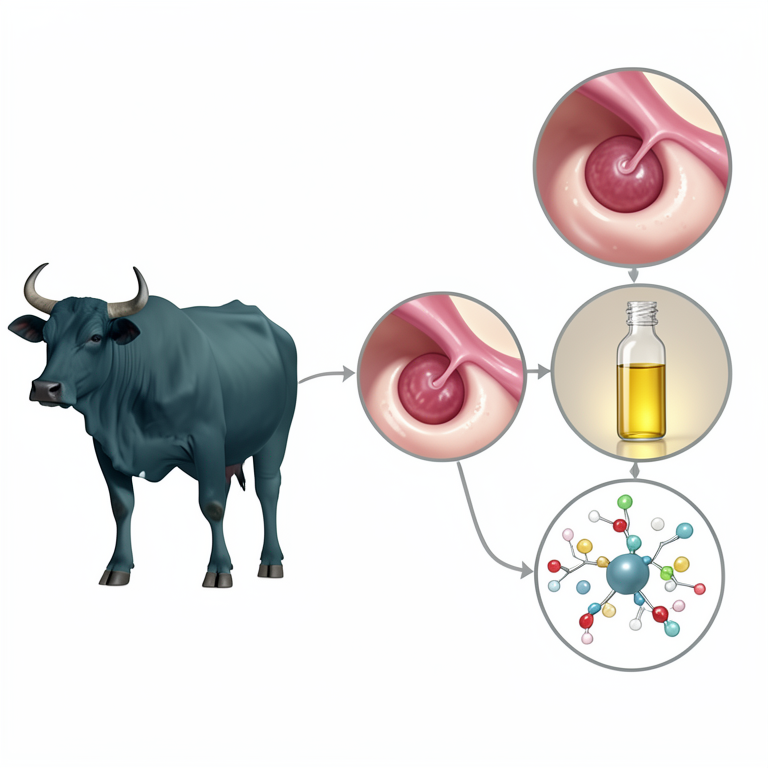
Postestrus Biochemical Monitoring
AI-generated conceptual illustration (Murrah buffaloes). It explains the idea and does not show study data.
View source evidence ↗Introduction
Plasma and/or serum biochemical profiles were used extensively in veterinary medicine for the clinical and metabolic evaluation of individual animals and of groups or herds. When processed and correctly interpreted, these profiles provide relevant information on the animal's clinical condition and nutritional state and also serve to underpin the prescription and monitoring of specific therapeutic protocols and to establish prognoses. Several factors can affect the physiological values of serum biochemical markers. Among them are sex, age, breed, diet, muscular activity, environmental conditions, gestation, puerperium, lactation and the phase of the estrous cycle (Downs et al., 1994; Mundim et al., 2007) [2,3] . The aim of the present study has been to assess the changes of serum biochemical parameters, leptin and ghrelin during the postestrus period in Murrah buffaloes.
Material and methods 2.1 Animals:
The study was conducted at Guangxi Buffalo Research Institute Farm, Nanning, China. Twenty-three cycling Murrah buffaloes (2 nd -4 th parity) that had calved between 48 and 96 days ago were selected from the buffalo herd for experiments. The animals selected for the study were free from any anatomical and reproductive disorders and were not suffering from any health problems. All the selected animals were in good body condition. The animals in the dairy farm were housed in an open free-stall barn and provided ad libitum access to a balanced total mixed ration. No treatment was given to induce or synchronize the estrus in these buffaloes. Occurrence of estrus in the animals was monitored by hourly observation of various behavioral estrus signs and by vasectomised bull (teaser) parading at 08:00, 14:00, 20:00 h for 30 minutes and further confirmed by observing uterine tone on rectal palpation. The behavioural estrus signs exhibited during spontaneous estrus by buffaloes including swollen vulva, excitement, frequent urination, bull mounting, chasing by bull, mucus discharge, tail raising, bellowing and so on.
Blood sampling:
Blood samples were collected via coccygeal venipuncture into 10 mL tubes without anticoagulants (Hunan Pingan Medical Devices Technology CO., LTD) at two days interval from the day estrus confirmed by rectal palpation until the sixteenth day after the estrus confirmed. The day of the estrus confirmed was specified as d-0. All the blood samples were kept in box containing ice (4 °C) and carried back to laboratory immediately. Blood samples were centrifuged immediately at 3,500 rpm for 15 min and serum was stored at -20 °C until analyzed.
Serum Biochemical analysis:
Using commercially available kits (Nanjing Jiancheng Bioengineering Institute, China), we used the serum samples to determine the concentrations of total cholesterol (TC), triglycerides (TG), total protein (TP), albumin (ALB), uric acid (UA). UV/VIS spectrophotometer (UV-2102C, Unico (Shanghai) Instrument Co., Ltd.) was used for the biochemical analysis.
Statistical analysis:
Mean values of biochemical parameters were reported throughout with the standard error of the mean (± SEM). Analysis of variance (ANOVA) test was used to compare the biochemical parameters between the different days postestrus of Murrah buffaloes, respectively. Differences were considered significant at P<0.05.
Results
A total of 207 blood samples were collected from 23 cycling Murrah buffaloes. The highest-level TG in the serum (10.83±2.55 mmol/L) was observed during the follicular phase (d-16) (P< 0.05 in comparison with all remaining days).
Discussion
The serum concentrations of total cholesterol, triglycerides, total protein, albumin, and uric acid have been investigated in some species. In ruminants, cholesterol is transported from the liver in the form of lipoproteins. Cholesterol plays a significant role in the physiology of the ovary, as it is the precursor of steroid hormones secreted by this organ. Aller et al. (2013) [1] reported that serum TG concentrations were affected by the follicular wave, and the concentration was higher in the second wave than in first follicular wave.
Acknowledgement
AcknowledgementsThis work was funded by the College of Animal Science project, Yangtze University.
References
3 in the original paper- Aller JF, Callejas SS, Alberio RH. Biochemical and steroid concentrations in follicular fluid and blood plasma in different follicular waves of the estrous cycle from normal and superovulated beef cows. J Animal Reproduction Science, 2013; 142(3-4):113-120.
- Downs LG, Zani V, Wills JM. Changes in plasma lipoprotein during the oestrous cycle of the bitch J Research in Veterinary Science. 1994; 56(1):82-88.
- Mundim AV, Coelho AO, Hortêncio SM. Influence of age and sex on the serum biochemical profile of Doberman dogs in the growth phase J. Comparative Clinical Pathology. 2007; 16(1):41-46.