
Research article · 2017 · Full text
International Journal of Veterinary Sciences and Animal HusbandryImpact of status of subtropical buffaloes during milking on some maintenance behavioral patterns
Volume 2(2) · Pages 16–19
Research areasGenetic and phenotypic traits in livestockLivestock Management and Performance Improvement
Abstract
Author-writtenThis work was carried out to study the effect of the status of female buffaloes during milking on some maintenance behavior. The obtained results revealed that the feeding time was increased with hard milker female buffaloes, but the differences were non significance. There were significances differences of rumination time, as it decreases with hard milker female buffaloes. There were highly significant differences in resting and standing behavior between normal and hard milker, as it decreased with the hard milkers while the movement was increased. The daily milk yield either at morning and evening milk was decreased with hard milker female buffaloes. It was reached to 4.50 kg in comparison with normal ones (8.16 kg) and the difference was highly significant.
Summary
Source-checkedPlain-language reading of the full paper, prepared with AI and checked against the text. Each point links to the authors' own words.
Why it matters
- Buffaloes are critical for maintaining sustainable food production systems in many developing nations. View evidence ↗
- Water buffaloes are the second most significant species globally for milk production, following dairy cows. View evidence ↗
- Due to a hard teat muscle sphincter and slow milk ejection reflex, buffaloes can be difficult to milk, necessitating careful selection and management. View evidence ↗
The question
- The study aimed to determine the relationship between a buffalo's temperament during milking (specifically 'hard' milkers) and their general maintenance behavior. View evidence ↗
What they did
- The research involved 20 female dairy buffaloes aged 4 to 7 years at the Samy Asaed dairy farm in Egypt from April to June 2015. View evidence ↗
- Animals were categorized as 'Normal milking' if they remained calm during teat cup application, or 'Hard milking' if they showed aggression, such as kicking and frequent tail movement. View evidence ↗
- Researchers used focal sample observation with stopwatches and digital cameras to record the timing and frequency of maintenance behaviors and milk production. View evidence ↗
What they found
- Milk yield was significantly lower for hard milkers in both morning (2.83 ± 0.30 kg vs 4.50 ± 0.34 kg) and evening (6.16 ± 0.30 kg vs 8.16 ± 0.30 kg) sessions. View evidence ↗
- The time required for milking was significantly longer for hard milkers in both the morning (18.33 ± 0.80 min vs 13.33 ± 0.76 min) and evening (8.16 ± 0.30 min vs 6.16 ± 0.31 min). View evidence ↗
What it means
- The authors conclude that buffaloes with aggressive temperaments during milking should either be culled from the parlor or milked separately from calm animals. View evidence ↗
Visual summary
1 visualsIllustrations explain the paper; they do not show study data.
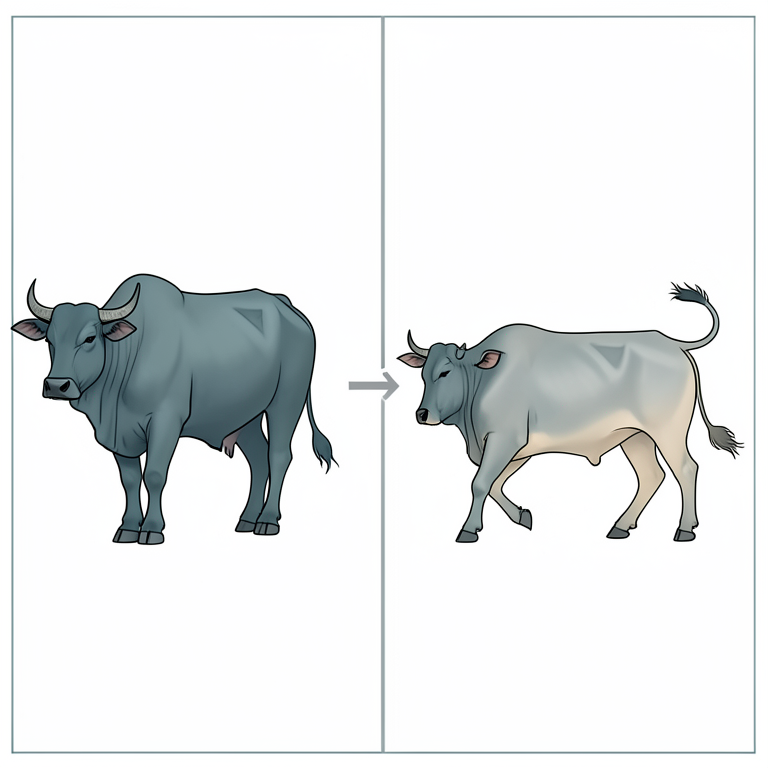
Buffalo Temperament Classification
AI-generated conceptual illustration (subtropical buffaloes). It explains the idea and does not show study data.
View source evidence ↗Figures & tables
From the original paper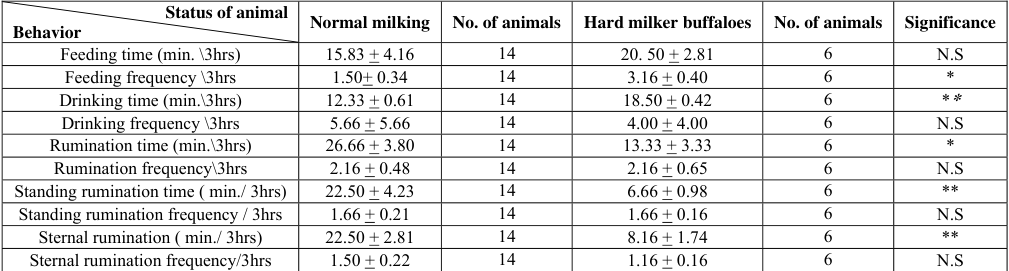 Table 1
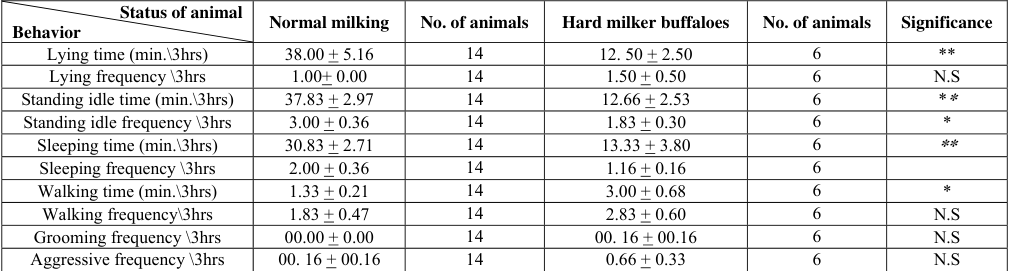 Table 2
 Table 3
Introduction
Buffaloes play a very important role in providing a sustainable food production system in most developing countries [1] . Buffaloes have a several morphological characters which reinforce their ability to live in shaded hot, humid countries [2] as it has dark skin which covered by hair. The water buffalo has a poor thermoregulation system, as it needs a shade and water for wallowing [3]. Buffaloes have the ability to convert poor and coarse feed, straw and crop residues in protein rich meat with low cholesterol [4]. The water buffaloes are the second most important species in the world for milk production after the dairy cows [5] .The buffaloes are semi-wild in behavior as spend 99% of their waking hours in feeding, rumination, resting, drinking water, the remaining 1% in locomotion and other activities [6] . Buffaloes are slow and hard milkers because of their slow milk ejection reflex and hard teat muscle sphincter, the buffaloes should be carefully selected and managed to yield and ease to milk [7] .
Material and Methods
The investigation was carried out to show the relationship between the buffaloes which are hard in their temperament during milking process and their maintenance behavior.
Animal used and Housing
The study was carried out on 20 female dairy Buffaloes aged (4-7 years old) belonged to Samy Asaed dairy farm which locate at Abou-Hamad city at Sharkiya governorate from the period of 1st April to end of June 2015 This farm includes two shaded pyres and one milking room. The animals were allocated equally into 2 shaded yards (10 animals /yard). Two concrete managers were located outside the fence on one each side allowed 1m/buffalo for feeding space. Automatic fans were adapted to maintain the cooling during the hot weather.
Feeding system
The lactating feeding program was used, a formulated total mixed ration 13% protein, energy 1. 4 Mcal and minerals was offered to the buffaloes. The main ration ingredients were corn, silage, soybean, hay, tibn, limestone, mono calcium phosphate, permix, antimycotoxine, vitamins and oil according to [8] . Green fodder and roughage (berseem in winter, hay in summer) were used. The daily ration amount per animal (15-20kg) was calculated and offered at morning after the first milking to be fed by the animal throughout the day. Drinking: ad-libitum from water trough.
Milking system and management
Well cleaned, ventilated milking parlour was available with milking capacity 10 buffaloes / cycle. It provided with electronic digital display to record the female number and its production. Buffaloes were milked 2 times a day at 6.00 am and 6:00 pm. The udder was washed, dried with clean paper, then the fore-milk stripping from the four teats before milking attempts.
Animal identification:
Animals were identified with a plastic ear tag. As well as, white paint numbers were applied to the sides of the chest of each animal (number from 1-20).
Observation technique
The maintenance behavior of 20 female buffaloes was observed through a focal sample observation [9] , the timing and frequencies of different activities were recorded by using a stopwatch, digital camera and observation sheet, as well as, the milk production parameters were collected. The behavioral activities of both normal group A (normal milking) and other group B (hard milking) were recorded during 12 hrs observation / month (3 minute interval per one hour observation for each animal) the observation represented the daylight hour through the period of this study (3 months). The animals were classified according to their temperament during the milking process into:-1-Normal milking, as they appeared calm during application of teat cup of milking machine. 2-Hard milking, as they became aggressive with frequent tail movement and kicking during application of teat cup of milking machine. The following behavioral patterns were observed and recorded. 1. Ingestive behavior time& frequency. 2. Rumination (time and frequency). 3. Standing idle (time and frequency). 4. Lying (time and frequency). 5. Sleeping (time and frequency). 6. Walking (time and frequency). According to [10] . Milking times of each group (morning &evening) were recorded according to [11] . Table (1) showed that the feeding time increased with hard milker female buffaloes than the normal ones but the differences were non significances. Feeding frequency increased with hard milker and the differences was significant. There were significances differences of rumination time, as it decreases with hard milker female buffaloes. The obtained results in Table (2) found that there were highly significant differences in resting and standing behavior between normal and hard milker, as it decreased with the hard milkers while the movement was increased. From the obtained results in Table (3) found that the daily milk-yield either morning and evening milk were decreased with hard milkers it reaches to 4.50 kg in comparison with normal ones (8.16 kg) and the differences were highly significances, as well as, the time spent for milking either morning or evening were increased with hard milkers.
Results
Results
Discussion
The findings achieved in the present study revealed that in table (1) the feeding time increased with hard milker female buffaloes than the normal ones but the differences were non significances. Feeding frequency increased with hard milker and the differences was significant. There were significances differences of rumination time, as it decreases with hard milker female buffaloes. These results agree with [12,13] as they found that expose the buffaloes to violent physical changes lead to Physiological stress, which decrease rumination behavior, while the results were obtained with [14] , were differed. Hard milkers become more stressful, more urinated, more defecated than other buffaloes thus increased time elapsed for milking, these results similar to [12,15] showed that expose the buffaloes to milking machines lead to acute stress in the form of kicking, defecating, pulling the teat cup and urination. The obtained results in Table (2) found that there were highly significant differences in resting and standing behavior between normal and hard milker, as it decreased with the hard milkers while the movement was increased. These results go hand in hand with [14] . In contrast, [12,16,17] stated that stress caused by mechanical milking leading to increase agonistic behavior and decrease the time of locomotion, increased standing, resting & sleeping time. There was a nonsignificance difference in grooming and aggressive behavior between normal and hard milker female buffaloes, although the aggression was increased with hard milker, these results were similar to [12,15] suggested that kicking, stomping and urination significantly increased with hard milking buffaloes. From the obtained results in Table (3) found that the daily milk-yield either morning and evening milk were decreased with hard milkers it reaches to 4.50 kg in comparison with normal ones (8.16 kg) and the differences were highly significances, as well as, the time spent for milking either morning or evening were increased with hard milkers. These results were similar to that obtained with [12,13,15] as they stated that hard milker female buffaloes were more stressed, kicking thus decreased amount of milk production. Moreover the hard milker buffaloes having mechanical stress in the milking process in the form of kicking, removal teat cups of milking machine, thus increased the time elapsed for milking than normal ones so decrease the amount of milk production. As well as, [18] suggested that the buffalo is well known as a hard milker animal and to overcome this problem by feeding good concentrates and injection of oxytocin hormones. [19] showed that milking ability of buffaloes was so many difficult and describe as hard milkers.
Conclusion
From this study it could be concluded that the buffaloes which are hard in temperament as aggressive with frequent tail movement and kicking during the milking process should be culled from the parlor or milked separately from normal calm ones.
Figures and tables from the paper
| Status of animal Behavior | Normal milking | No. of animals | Hard milker buffaloes | No. of animals | Significance |
|---|---|---|---|---|---|
| Feeding time (min. \3hrs) | 15.83 + 4.16 | 14 | 20. 50 + 2.81 | 6 | N.S |
| Feeding frequency \3hrs | 1.50+ 0.34 | 14 | 3.16 + 0.40 | 6 | * |
| Drinking time (min.\3hrs) | 12.33 + 0.61 | 14 | 18.50 + 0.42 | 6 | ** |
| Drinking frequency \3hrs | 5.66 + 5.66 | 14 | 4.00 + 4.00 | 6 | N.S |
| Rumination time (min.\3hrs) | 26.66 + 3.80 | 14 | 13.33 + 3.33 | 6 | * |
| Rumination frequency\3hrs | 2.16 + 0.48 | 14 | 2.16 + 0.65 | 6 | N.S |
| Standing rumination time ( min./ 3hrs) | 22.50 + 4.23 | 14 | 6.66 + 0.98 | 6 | ** |
| Standing rumination frequency / 3hrs | 1.66 + 0.21 | 14 | 1.66 + 0.16 | 6 | N.S |
| Sternal rumination ( min./ 3hrs) | 22.50 + 2.81 | 14 | 8.16 + 1.74 | 6 | ** |
| Sternal rumination frequency/3hrs | 1.50 + 0.22 | 14 | 1.16 + 0.16 | 6 | N.S |
Table text extracted from the original PDF; superscript letters are shown inline. The original table image is below.
View original table image
| Status of animal Behavior | Normal milking | No. of animals | Hard milker buffaloes | No. of animals | Significance |
|---|---|---|---|---|---|
| Lying time (min.\3hrs) | 38.00 + 5.16 | 14 | 12. 50 + 2.50 | 6 | ** |
| Lying frequency \3hrs | 1.00+ 0.00 | 14 | 1.50 + 0.50 | 6 | N.S |
| Standing idle time (min.\3hrs) | 37.83 + 2.97 | 14 | 12.66 + 2.53 | 6 | ** |
| Standing idle frequency \3hrs | 3.00 + 0.36 | 14 | 1.83 + 0.30 | 6 | * |
| Sleeping time (min.\3hrs) | 30.83 + 2.71 | 14 | 13.33 + 3.80 | 6 | ** |
| Sleeping frequency \3hrs | 2.00 + 0.36 | 14 | 1.16 + 0.16 | 6 | |
| Walking time (min.\3hrs) | 1.33 + 0.21 | 14 | 3.00 + 0.68 | 6 | * |
| Walking frequency\3hrs | 1.83 + 0.47 | 14 | 2.83 + 0.60 | 6 | N.S |
| Grooming frequency \3hrs | 00.00 + 0.00 | 14 | 00. 16 + 00.16 | 6 | N.S |
| Aggressive frequency \3hrs | 00. 16 + 00.16 | 14 | 0.66 + 0.33 | 6 | N.S |
Table text extracted from the original PDF; superscript letters are shown inline. The original table image is below.
View original table image
| Status of animal Milk production | Normal milking | No. of animals | Hard milker buffaloes | No. of animals | Significance |
|---|---|---|---|---|---|
| Morning milk (kg) | 4.50+ 0.34 | 14 | 2. 83 + 0.30 | 6 | ** |
| Evening milk (kg) | 8.16+ 0.30 | 14 | 6.16 + 0.30 | 6 | ** |
| Morning milk time(min.) | 13.33 + 0.76 | 14 | 18.33 + 0.80 | 6 | ** |
| Evening milk time (min.) | 6.16 + 0.31 | 14 | 8.16 + 0.30 | 6 | ** |
Table text extracted from the original PDF; superscript letters are shown inline. The original table image is below.
View original table image
References
18 in the original paper- Pasha TN, Hayat Z. Present situation and future perspective of buffalo production in Asia. J plant Anim science, 2012; 22:250-256.
- De Rosa G, Grassa F, Pacelli C, Napolitano F, Winkler C. The welfare of dairy buffaloes. Ital. J Anim Science. 2009; 8:103-116.
- Khongdee T, Sripoon S, Vajrabukka C. The effects of high Temperature and roof modification on Physiological responses of swamp buffalo Bubalus bubalis in the tropics. International J Biometeorology, 2013; 57:349354.
- Desta TT, Introduction of domestic buffalo (Bubalus bubalis) into Ethiopia would be feasible. J Agri Food systems, 2012; 27:305-313.
- Coroian A, Erler S, Matea CT, Coroian CO. Seasonal changes of buffaloes colostrum: physicochemical parameters, fatty acids and cholesterol. J Variation chemistry Central, 2013; 7:2-9.
- Fundora O, Tuera O, Gonzalez ME, Rivadineira W, Vera AM. Comparative study of the feeding behavior of river buffaloes and Siboney de Cuba bread at the fattening stage. J Cuban Agri Science, 2007; 41:231-235.
- Animal husbandry: a text book Tnau agritech portal Source: http://www.milk production.com 2009.
- NRC: (National research Council): Nutrient Requirement of nonhuman Primate, 2 nd edition. Washington: National Academy press DC. 2003.
- Overton MW, Sischo WM, Twmple GD, Moore DA. Using time-Lapse video Photography to assess dairy cattle lying behavior in a free stall barn. J dairy science, 2002; 85:2407-2413.
- Martin P, Pateson P. Measuring behavior: an introductory guide, 2 nd edition. Cambridge University, press 1995; 6367.
- Najafi M, Mortazavi SA, Koocheki A, Khorami J, Rekik B. Fat and Protein contents, acidity and somatic cell count in bulk milk of Holstein cows in the Khorasan Razavi province. Iran. J Inter Dairy Technology, 2009; 62:19-26.
- Cavallina R, Roncoroni C, Campagna MC, Canali E. Buffaloe behavioral response to machine milking in early lactation. Ital J Anim Science, 2008; 7:287-295.
- Popescu S, Borda C, Diugan EA, Spinu M, Sandru CD. Dairy cows welfare quality in tie stall housing system with or without access to exercise. J Acta Veterinaria Scandinavica, 2013; 55:43.
- De Rose G, Napditano F, Grasso F, Pacelli C, Bordi A, On the development of monitoring scheme of buffalo welfare at farm level. Ital J Animal Science, 2005; 4: 115-125.
- Tripaldi C, De Rosa G, Grasso F, Napalitano F. Housing system and welfare of buffalo cow. J Anim science, 2004; 78:477-483.
- Stafford KJ, Gregory NG. Implications of intensification of pastoral animal production of animal welfare. J Newzeoland veterinary, 2008; 56:274-280.
- Verma AK, Sastry NSR. Milking management of Murrah buffaloes followed in rural India. In proceedings of the 4 th world buffalo congress. Brazil, 1994, 2
- Sastry NSR, Tripathi VN, Morden managemental innovations for optimizing buffalo production. In Buffalo production and health companion of the latest research information based on Indian studies, 2 nd world buffalo congress. Indian council of agricultural Research: New Delhi university press, 1998, 38-62.