
Research article · 2017 · Full text
International Journal of Statistics and Applied MathematicsFourth-order Steffensen type methods for nonlinear equations
Volume 2(4) · Pages 11–15
Research areasIterative Methods for Nonlinear EquationsAdvanced Optimization Algorithms ResearchFractional Differential Equations Solutions
Abstract
Author-writtenIn this paper, we introduce a new one-parameter family of fourth-order derivative-free iterative methods for solving nonlinear equations. The proposed family is based on central difference technique to approximate the derivative of a given function. Convergence theorem is also established to show its fourth-order convergence. Several numerical examples are included to demonstrate the efficiency of the proposed method and the results obtained are compared existing methods.
Summary
Source-checkedPlain-language reading of the full paper, prepared with AI and checked against the text. Each point links to the authors' own words.
Why it matters
- Solving nonlinear equations is a critical and difficult task in science and engineering, with applications in fields like elasticity, operation research, and the kinetic theory of gases. View evidence ↗
- Derivative-free methods are necessary when a function's explicit form is unknown or its derivative is too difficult to calculate. View evidence ↗
- Central difference approximation is generally considered more efficient than forward or backward approximations for estimating derivatives. View evidence ↗
The question
- The study aims to introduce a new one-parameter family of fourth-order Steffensen-type methods to solve nonlinear equations. View evidence ↗
What they did
- The proposed method utilizes central difference approximation and requires four function evaluations per iteration. View evidence ↗
- The authors established a convergence theorem showing that the method is at least cubically convergent, reaching fourth-order convergence when the parameter γ equals β − 2. View evidence ↗
What they found
- Numerical comparisons indicate that the proposed method provides superior results in terms of accuracy and computational speed compared to other methods. View evidence ↗
What it means
- The authors conclude that their new one-parameter family of fourth-order derivative-free methods is more efficient and accurate than existing alternatives. View evidence ↗
Visual summary
2 visualsIllustrations explain the paper; charts are replotted from the paper's own table values.
Conceptual Workflow of the Proposed Method
AI-generated conceptual illustration (A mathematical function curve on a 2D coordinate plane). It explains the idea and does not show study data.
View source evidence ↗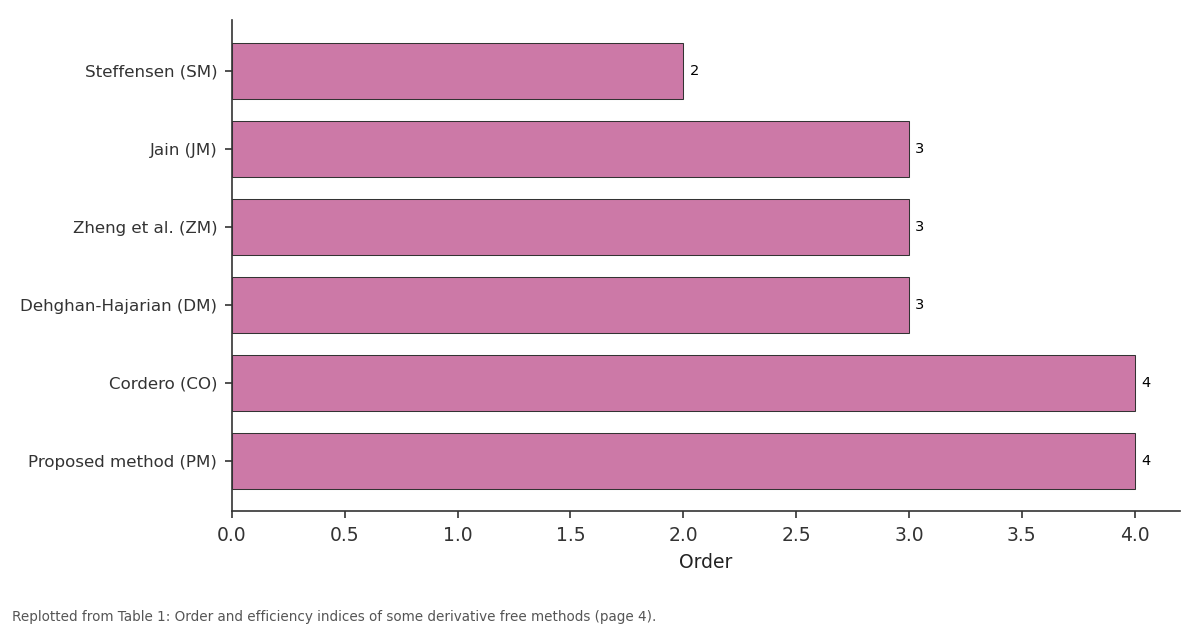
Order: Steffensen (SM) vs Jain (JM) vs Zheng et al. (ZM) vs Dehghan-Hajarian (DM) vs Cordero (CO)
Replotted from Table 1 (page 4) of the original paper. Every bar is the paper's own table value.
View source evidence ↗Figures & tables
From the original paper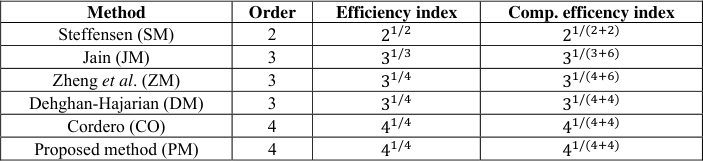 Table 1
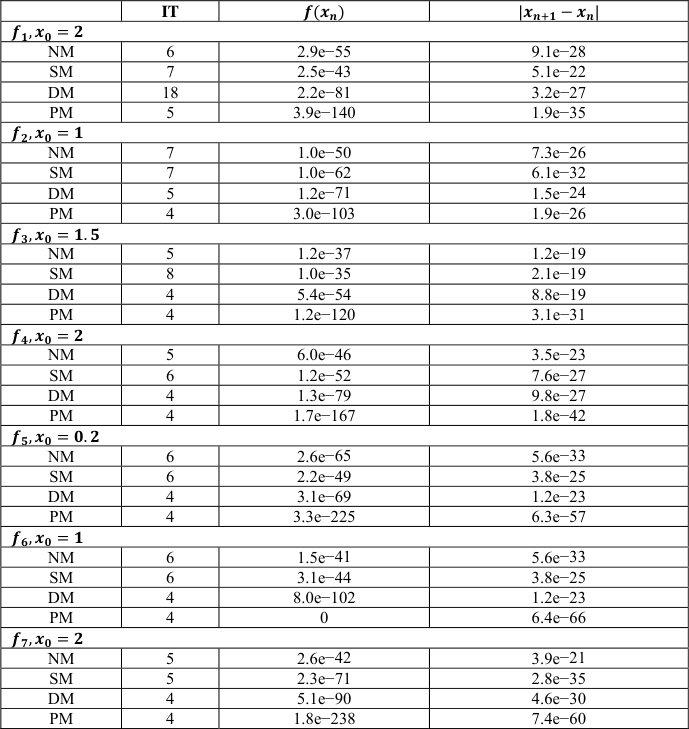 Table 2
Introduction
Solving nonlinear equations is one of the most important and challenging problem in science and engineering. Many problems arising in Kinetic theory of gases, elasticity, operation research and other applied areas [1][2][3] can be reduced to solving nonlinear equations. In this work, we mainly focusing on finding real and simple root of a nonlinear equation.
where f : D ⊂ R → R for an open interval D is a continuously differentiable scaler function.
Generally, iterative methods are used to solve these type of problem because it is very difficult to solve them analytically. In the literature, researchers have proposed a large number of higher order iterative methods for solving nonlinear equations. (see Ostrowski [1], Traub [2] and Ortega and Rheinboldt) [3] . These methods involve the evaluation of a function and its derivatives. The quadratically convergent Newton's method is the well known method for solving (1.1) can be written as = -
In order to improve the rate of convergence, many authors have modified the Newton's method in a number of ways at the additional cost of a function evaluation and its derivatives. These methods are not applicable when the function is not known explicitly or the derivative of a function is difficult to compute. So, many authors have developed derivative-free methods which require only evaluation of a function at different points. If we replace the derivative of a function in Newton's method by forward difference approximation, i.e.
Then, Newton's method (1.2) becomes
which is known as Steffensen's method [3] . Both the methods (1.2) and (1.4) are quadratically convergent and require two function evaluations but Steffensen's method is derivative free.
Sharma and Goyal [4] presented two new one-parameter families of fourth-order derivative free methods using forward and backward approximations of derivatives. A faimly of Steffenden like methods was established by Jain [5] which require three function evaluations with third order of convergence. Zheng et al. [6] also considered the third-order derivative free methods which require the four function evaluations per step. By using the backward approximation of derivatives, Peng et al. [7] presented the fourth-order derivative free algorithm to solve nonlinear equations. A family of higher order derivative free methods is proposed by Cordero et al. [8] for nonsmooth equations. It is well known that central difference approximation is more efficient than forward and backward approximation. Dehghan and Hajarian [9] considered the central difference approximation to obtain the third-order derivative free methods which require four evaluations of a function. Recently, Cordero et al. [10] also established the derivative free Ostrowski method with fourth and sixth order of convergence using central difference approximation. The aim of this paper is to propose a new one parameter family of fourth-order Steffensen type methods for solving nonlinear equations of the form (1.1). The proposed family of methods is based on central difference approximation of derivatives which requires four evaluations of a function. The convergence theorem is established to show fourth order convergence. Several numerical examples are worked out and results obtained are compared with existing methods. The fourth-order derivative-free Ostrowski method given by Cordero et al. [10] is a special case of the proposed family. This paper is organized as follows. In section 2, we briefly describe the fourth-order derivativefree methods and its convergence analysis. In section 3, the proposed method is tested on a number of examples to demonstrate its efficiency and accuracy. Finally conclusions are included in section 4.
The Proposed method and its convergence analysis
In this section, we shall describe a family of fourth-order derivative-free methods which is based on the central difference approximation of derivatives. Consider the following iteration 2 scheme of the form
where β, γ ∈ R and h( ) is the central difference approximation to the derivative of a given function. In the following theorem, we discuss the convergence analysis of the proposed iteration scheme to establish fourth order convergence. 2) is at least cubically convergent. However, for γ = β -2, the order of convergence is four.
Proof. Let = - * be the error in nth iterate. Using Taylor series of ( ) about * , we have
Conclusions
A new one-parameter family of fourth-order derivative-free methods has been proposed for solving nonlinear equations. Central difference approximation technique has been used for approximating the derivative of a given function. The convergence analysis of the proposed family has been discussed in a simpler way to show its fourth-order convergence. Numerical results shows that the proposed method provides the improved results in terms of computational speed and accuracy. The method developed in [10] is seen as a special case of the family.
Figures and tables from the paper
| Method | Order | Efficiency index | Comp. efficency index |
|---|---|---|---|
| Steffensen (SM) | 2 | 2ଵ/ଶ | 2ଵ/(ଶାଶ) |
| Jain (JM) | 3 | 3ଵ/ଷ | 3ଵ/(ଷା) |
| Zheng et al. (ZM) | 3 | 3ଵ/ସ | 3ଵ/(ସା) |
| Dehghan-Hajarian (DM) | 3 | 3ଵ/ସ | 3ଵ/(ସାସ) |
| Cordero (CO) | 4 | 4ଵ/ସ | 4ଵ/(ସାସ) |
| Proposed method (PM) | 4 | 4ଵ/ସ | 4ଵ/(ସାସ) |
Table text extracted from the original PDF; superscript letters are shown inline. The original table image is below.
View original table image
References
11 in the original paper- Ostrowski AM. Solution of equations in Euclidian and Banach Spaces, Academic Press, New York and London, 1973.
- Traub JF. Iterative method for the solution of equations, Prentice-Hall, Englewood Cliffs, New Jeresy, 1964.
- Ortega JM, Rheinboldt WC. Iterative solutions of nonlinear equations in several variables, Academic Press, New York and London, 1970.
- Sharma JR, Goyal RK. Fourth-order derivative-free methods for solving non-linear equations, International Journal of Computer Mathematics. 2006; 83:101-106.
- Jain P. Steffensen type methods for solving nonlinear equations, Applied Mathematics and Computation, 2007; 194:527-533.
- Zheng Q, Wang J, Zhao P, Zhang L, A Steffensen-like method and its higher-order variants, Applied Mathematics and Computation. 2009; 214:10-16.
- Peng Y, Feng H, Li Q, Zhang X. A fourth-order derivative-free algorithm for nonlinear equations, Journal of Computational and Applied Mathematics. 2011; 235:2251-2559.
- Cordero A, Hueso JL, Mart´ınez E, Torregrosa JR. A family of derivative-free methods with high order of convergence and its application to nonsmooth equations, Abstract and Applied Analysis, 2012, 1-15.
- Dehghan M, Hajarian M. Some derivate free quadratic and cubic convergence iterative formulas for solving nonlinear equations, Computational and Applied Mathematics, 2010; 29:19-30.
- Cordero A, Hueso JL, Mart´ınez E, Torregrosa JR. Steffensen type methods for solving nonlinear equations, Journal of Computational and Applied Mathematics. 2012; 236:3058-3064.
- Gautschi W. Numerical analysis,: An introduction, Birkhauser, 1997.