
Research article · 2017 · Full text
International Journal of Statistics and Applied MathematicsPeristaltic flow of a couple stress fluid in an inclined channel under the effect of magnetic field with slip condition
Volume 2(4) · Pages 01–06
Research areasNanofluid Flow and Heat TransferRheology and Fluid Dynamics StudiesVibration and Dynamic Analysis
Abstract
Author-writtenThe present paper investigates the peristaltic motion of a couple stress fluid in a two dimensional inclined channel with the effect of magnetic field using slip condition. The effects of various physical parameters on velocity, pressure gradient and friction force have been discussed & computed numerically. The effects of various key parameters are discussed with the help of graphs.
Summary
Source-checkedPlain-language reading of the full paper, prepared with AI and checked against the text. Each point links to the authors' own words.
Why it matters
- Peristalsis is a primary transport mechanism for physiological fluids, occurring via progressive waves of contraction and expansion in flexible tube walls. View evidence ↗
- Analyzing couple stress fluids is valuable for understanding complex rheological fluids, including human blood and liquid crystals. View evidence ↗
- Couple stress fluids are a specific type of non-Newtonian fluid where the size of the particles is considered. View evidence ↗
The question
- The study aims to investigate how peristalsis interacts with the flow of a couple stress fluid in a two-dimensional inclined channel under the influence of a magnetic field and slip conditions. View evidence ↗
What they did
- The model uses a two-dimensional channel of width 2a, inclined at an angle α to the horizontal. View evidence ↗
- Computational analysis was performed to determine the frictional force, pressure gradient, and velocity profiles. View evidence ↗
- The governing equations were simplified by neglecting the wave number and applying a long wavelength approximation. View evidence ↗
- The equations of motion for the fluid were solved using analytical methods. View evidence ↗
What they found
- Axial velocity (u) decreases as the couple stress parameter (γ) increases. View evidence ↗
- Increasing the magnetic field (M) leads to a decrease in axial velocity (u). View evidence ↗
- Axial velocity (u) increases as the angle of inclination (α) increases. View evidence ↗
- Axial velocity (u) increases with an increase in the gravitational parameter (G). View evidence ↗
- The study reports that axial velocity (u) increases with an increase in the slip parameter (β). View evidence ↗
- The effects of the physical parameters on the friction force (F) are opposite to their effects on the pressure rise. View evidence ↗
What it means
- The authors conclude that axial velocity is positively influenced by the gravitational parameter, angle of inclination, and slip parameter, but negatively influenced by the couple stress parameter and magnetic field. View evidence ↗
Visual summary
1 visualsIllustrations explain the paper; they do not show study data.
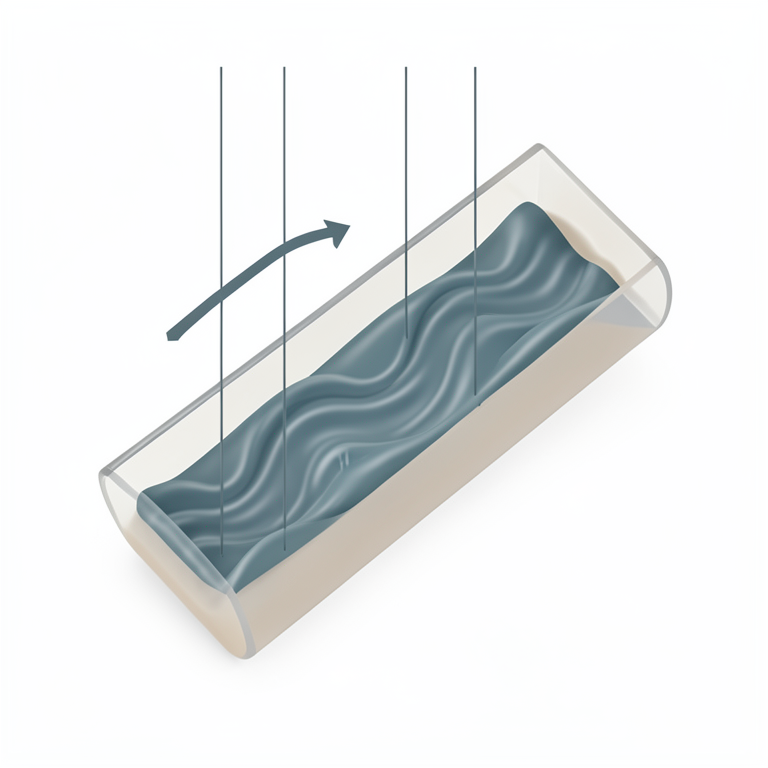
System Geometry
AI-generated conceptual illustration (A couple stress fluid flowing through an inclined two-dimensional channel). It explains the idea and does not show study data.
View source evidence ↗Introduction
Peristalsis is known to be one of the main mechanisms of transport for many physiological fluids, which is achieved by the passage of progressive waves of area contraction and expansion over flexible walls of a tube containing fluid. Various studies on peristaltic transport, experimental as well as theoretical, have been carried out by many researchers to explain peristaltic pumping in physiological systems. The study of couple stress fluid is very useful in understanding various physical problems because it possesses the mechanism to describe rheological complex fluids such as liquid crystals and human blood. By couple stress fluid, we mean a fluid whose particles sizes are taken into account, a special case of non-Newtonian fluids. Srivastava et al., [1] peristaltic transport of a physiological fluid: part I flow in non-uniform geometry. Latham [2] investigated the fluid mechanics of peristaltic pump and science. Mekhemier [3] studied non-linear peristaltic transport a porous medium in an inclined planar channel. Srivastava and Srivastava [4] studied peristaltic transport of a non-newtonian fluid: applications to the vas deferens and small intestine. El-dabe and El-Mohandis [5] have studied magneto hydrodynamic flow of second order fluid through a porous medium on an inclined porous plane. Rathod and Asha [6] effects of magnetic field and an endoscope on peristaltic motion. Rathod and Mahadev [7] studied effect of magnetic field on ureteral peristalsis in cylindrical tube. Rathod and Pallavi [8] studied the influence of wall properties on MHD peristaltic transport of dusty fluid. Rathod and Pallavi [9] studied the effect of slip condition and heat transfer on MHD peristaltic transport through a porous medium with complaint wall. Rathod and Mahadev [10] studied slip effects and heat transfer on MHD peristaltic flow of Jeffrey fluid in an inclined channel. Rathod and Laxmi [11] investigated effects of heat transfer on the peristaltic MHD flow of a Bingham fluid through a porous medium in an inclined channel. Rathod and Laxmi [12] studied effects of heat transfer on the peristaltic MHD flow of a Bingham fluid through a porous medium in a channel. Jayarami Reddy et al., [13] studied peristaltic flow of a Williamson fluid in an inclined planar channel under the effect of a magnetic field. Ramana Kumari and Radhakrishnamacharya [14] studied effect of slip on peristaltic transport in an inclined channel with wall effects. Reddappa et al., [15] studied the peristaltic transport of a Jeffrey fluid in an inclined planar channel with variable viscosity under the effect of a magnetic field. Sridhar [16] studied effect of thickness of the porous material using porous media on the peristaltic pumping of couple stress fluid through nonerodible porous lining tube. Rathod and Sridhar [17] studied peristaltic transport of couple stress fluid in uniform and non-uniform annulus through porous medium.
Rathod et al., [18] studied peristaltic pumping of couple stress fluid through non -erodible porous lining tube wall with thickness of porous material. Rathod and Sridhar [19] studied effect of magnetic field on peristaltic transport of a couple stress fluid in a channel. Rathod and Sridhar [20] studied peristaltic flow of a couple stress fluid in an inclined channel. Rathod et al., [21] studied peristaltic flow of a couple stress fluid in an inclined channel under the effect of magnetic field. Rathod et al., [22] studied peristaltic transport of a conducting couple stress fluid through a porous medium in a channel. Sridhar [23] studied effects of magnetic field with variable viscosity and an endoscope on peristaltic transport of couple stress fluids through a porous medium. The present research aim is to investigate the interaction of peristalsis for the flow of a couple stress fluid in a two dimensional inclined channel with the effect of magnetic field using slip condition. The computational analysis has been carried out for drawing velocity profiles, pressure gradient and frictional force.
Formulation of the problem
We consider a peristaltic flow of a Couple stress fluids through two-dimensional channel of width 2a and inclined at an angle α to the horizontal symmetric with respect to its axis. The walls of the channel are assumed to be flexible. The wall deformation is
Where 'b' is the amplitude of the peristaltic wave, 'c' is the wave velocity, ' ' is the wave length, t is the time and X is the direction of wave propagation.
The governing equations are
u and v are velocity components, 'p' is the fluid pressure, ' ' is the density of the fluid, ' ' is the coefficient of viscosity, ' * ' is the coefficient of couple stress, 'g' is the gravity due to acceleration, ' ' angle of inclination, ' ' is electric conductivity and ' ' is applied magnetic field.
Introducing a wave frame (x, y) moving with velocity c away from the fixed frame (X, Y) by the transformation , , , , ( , )
(5) We introduce the non-dimensional variables:
Equation of motion and boundary conditions in dimensionless form becomes
where, n k is Knudsen number (slip parameter) Using long wavelength approximation and neglecting the wave number , one can reduce governing equations:
Solving the Eq.( 12) with the boundary conditions (10), we get
The volumetric flow rate in the wave frame is defined by
The expression for pressure gradient from Eq.( 14) is given by
The instantaneous flux Q (x, t) in the laboratory frame is 0 ( , )
The average flux over one period of peristaltic wane is Q
From equations ( 15) and ( 17), the pressure gradient is obtained as
The pressure rise (drop) over one cycle of the wave can be obtained as
The dimensionless frictional force F at the wall across one wavelength is given by
Results and discussions
In this section we have presented the graphical results of the solutions axial velocity u, pressure rise P , friction force F for the different values of couple stress ( ), magnetic field (M), angle of inclination ( ), gravitational parameter (G) and slip parameter ( ). The axial velocity is shown in Figs. (1 to 5). The Variation of u with , we find that u depreciates with increase in (Fig. 1). The Variation of u with magnetic field M shows that for u decreases with increasing in M (fig. 2).The Variation of u with angle of inclination shows that for u increases with increasing in (Fig 3)
Conclusion
In this paper we presented a theoretical approach to study the peristaltic flow of a couple stress fluid in an inclined channel with the effect of a magnetic field using slip condition. The governing Equations of motion are solved analytically. Furthermore, the effect of various values of parameters on Velocity, Pressure rise and Friction force have been computed numerically and explained graphically. We conclude the following observations:
1. The velocity u increases with increasing in gravitational parameter G, angle of inclination , slip parameter but, decreases with increasing in couple stress parameter & magnetic field M.
2. The pressure P increases with increasing in gravitational parameter G, angle of inclination , couple stress parameter & magnetic field M but, decreases with increasing in slip parameter .
3. The friction force F decreases with increasing in gravitational parameter G, angle of inclination , couple stress parameter
& magnetic field M but, increases with increasing in slip parameter .
References
23 in the original paper- Srivastava LM, Srivastava VP, Sinha SK. Peristaltic transport of a physiological fluid: part I flow in non-uniform geometry, Biorheol, 1983; 20:428-433.
- Latham TW. Fluid mechanics of peristaltic pump and science, M.Sc. Thesis, MIT, Cambridge MA, 1966.
- Kh. Mekhemier S. Non-linear peristaltic transport a porous medium in an inclined planar channel, J.Porous. Media, 2003; 6(3):189-201.
- Srivastava LM, Srivastava VP. Peristaltic transport of a non-newtonian fluid: applications to the vas deferens and small intestine Annals, Biomedical Engineering, 1985; 13:137-153.
- El-dabe NT, El-Mohandis S. Magneto hydrodynamic flow of second order fluid through a porous medium on an inclined porous plane. The Arabian J. for Sci. and Eng. 1995; 20(3):571-580.
- Rathod VP, Asha SK. Effects of magnetic field and an endoscope on peristaltic motion, Journal of Applied Mathematics, 2011; 2(4):102-109.
- Rathod VP, Mahadev. Effect of magnetic field on ureteral peristalsis in cylindrical tube, Ultra Scientist of Physical Sciences, 2011; 23:135-142.
- Rathod VP, Pallavi Kulkarni. Effect of magnetic field on ureteral peristalsis in cylindrical tube, Advances in Applied Science Research. 2011; 2(3):265-279.
- Rathod VP, Pallavi. Effect of slip condition and heat transfer on MHD peristaltic transport through a porous medium with complaint wall, Int. J. Applied Mathematical Sciences. 2011; 5(12):47-63.
- Rathod VP, Mahadev. Slip effects and heat transfer on MHD peristaltic flow of Jeffrey fluid in an inclined channel, J.Chemical, Biological & Physical Sci. 2012; 2:1987-97.
- Rathod VP, Laxmi. Effects of heat transfer on the peristaltic MHD flow of a Bingham fluid through a porous medium in an inclined channel, Mathematical sciences international research Journal. 2014; 3(1).
- Rathod VP, Laxmi. Effects of heat transfer on the peristaltic MHD flow of a Bingham fluid through a porous medium in a channel, International Journal of Biomathematics. 2014; 7(6):1450060-1450080.
- Jayarami Reddy B, Subba Reddy MV, Nadhamuni Reddy C, Yogeswar Reddy P. Peristaltic flow of a Williamson fluid in an inclined planar channel under the effect of a magnetic field, Advances in Applied Science Research, 2012; 3(1):452-461.
- Ramana Kumari AV, Radhakrishnamacharya G. Effect of slip on peristaltic transport in an inclined channel with wall effects, Int. J. of Appl. Math and Mech. 2011; 7(1):1-14.
- Reddappa B, Subba Reddy MV, Ramakrishana Prasad S. Peristaltic transport of a Jeffrey fluid in an inclined planar channel with variable viscosity under the effect of a magnetic field, International Journal of Mathematical Archive. 2011; 2(11):22852294.
- Sridhar NG. Effect of thickness of the porous material using porous media on the peristaltic pumping of couple stress fluid through non -erodible porous lining tube., Transactions on Mathematics, 2017; 3(2):1-13.
- Rathod VP, Sridhar NG. Peristaltic transport of couple stress fluid in uniform and non-uniform annulus through porous medium, international journal of mathematical archive. 2012; 3(4):1561-1574.
- Rathod VP, Sridhar NG, Mahadev M. Peristaltic pumping of couple stress fluid through non -erodible porous lining tube wall with thickness of porous material, Advances in Applied Science Research. 2012; 3(4):2326-2336.
- Rathod VP, Sridhar NG. Effect of magnetic field on peristaltic transport of a couple stress fluid in a channel, Advances in Applied Science Research. 2016; 7(1):134-144.
- Rathod VP, Sridhar NG. Peristaltic flow of a couple stress fluid in an inclined channel, International Journal of Allied Practice Research and Review, 2015; II(VII):25-36.
- Rathod VP, Navrang Manikrao, Sridhar NG. Peristaltic flow of a couple stress fluid in an inclined channel under the effect of magnetic field, Advances in Applied Science Research. 2015; 6(9):101-109.
- Rathod VP, Navrang Manikrao, Sridhar NG. peristaltic transport of a conducting couple stress fluid through a porous medium in a channel. International Journal of Mathematical Archive. 2015; 6(9):106-113.
- Sridhar NG. Effects of magnetic field with variable viscosity and an endoscope on peristaltic transport of couple stress fluids through a porous medium. International Journal of Mathematical Archive. 2017; 8(7):6-15.