
Research article · 2016 · Full text
International Journal of Veterinary Sciences and Animal HusbandryEffect of breed, weaning age and feeding regime on chemical composition of rabbit meat
Volume 1(1) · Pages 12–13
Research areasRabbits: Nutrition, Reproduction, HealthAnimal Nutrition and PhysiologyBiochemical effects in animals
Abstract
Author-writtenThe study was carried out on New Zealand White (NZW) and Soviet Chinchilla (SC) rabbits. Thirty male kits from each breed were identified and randomly assigned to three groups G1, G2 and G3 which were weaned at 4, 5 and 6 weeks of age respectively. Each group was divided into 2 units comprising of 5 kits. The animals were kept in individual galvanized wire mesh cages measuring 0.60m x 0.60m x 0.30m. The samples were mixed thoroughly and stored at chiller for a short period before analysis. The proximate composition viz., moisture, fat, protein and ash were estimated as per A.O.A.C. (1990) and the data were statistically analyzed using ‘ANOVA’ of MS excel programme. Breed and feeding regime also had no influence on moisture per cent of rabbit meat. Palanska et al. (1981) studied moisture percentages in rabbits of 4, 6, 8, 10, 12, 14 and 16 weeks age and mentioned that the total moisture content decreased significantly with increasing age, from 76.3 to 73.77 per cent. In respect to ash content, rabbit of Soviet Chinchilla (SC) breed weaned at 5th and 6th week had higher ash content than those weaned at 4th week. The proximate composition viz., moisture, fat, protein and ash were estimated as per A.O.A.C. (1990) and the data were statistically analyzed using ‘ANOVA’ of MS excel programme.
Summary
Source-checkedPlain-language reading of the full paper, prepared with AI and checked against the text. Each point links to the authors' own words.
Why it matters
- Rabbit farming is encouraged in developing countries because rabbits have a small body size, high prolificacy, short generation intervals, and can be marketed early. View evidence ↗
- Rabbit meat production is highly energy-efficient, requiring only 25% of the food energy needed for lamb or beef and 70% of that needed for pork to produce 1 kg of meat. View evidence ↗
- Rabbit meat is beneficial for preventing vascular diseases due to its very low levels of sodium (393 ppm) and cholesterol (136 mg %). View evidence ↗
The question
- The study aimed to evaluate how different breeds, weaning ages, and feeding regimes affect the proximate chemical composition of rabbit meat. View evidence ↗
What they did
- Two feeding regimes were tested: one consisting solely of concentrate (C) and another where 50% of the concentrate was replaced by Congo signal grass (C+G) in the evening. View evidence ↗
- Rabbits were slaughtered at 12 weeks of age after a 12-hour fast, and the Longissimus dorsi muscle was collected for analysis. View evidence ↗
- Moisture, fat, protein, and ash levels were measured according to A.O.A.C. (1990) standards and analyzed using ANOVA. View evidence ↗
What they found
- Neither the breed, the feeding regime, nor the weaning age had a significant effect on the moisture percentage of the rabbit meat. View evidence ↗
- Fat content was influenced by weaning age but not by breed or feeding regime; rabbits weaned at 6 weeks had higher fat percentages than those weaned at 4 or 5 weeks. View evidence ↗
- In the Soviet Chinchilla (SC) breed, rabbits weaned at 5 and 6 weeks exhibited higher ash content compared to those weaned at 4 weeks. View evidence ↗
What it means
- The authors conclude that rabbits can be weaned as early as 4 weeks of age without negatively impacting the quality of the meat. View evidence ↗
- The authors state that early weaning does not significantly influence the moisture, protein, fat, or ash percentages in the meat of either the NZW or SC breeds. View evidence ↗
Figures & tables
From the original paper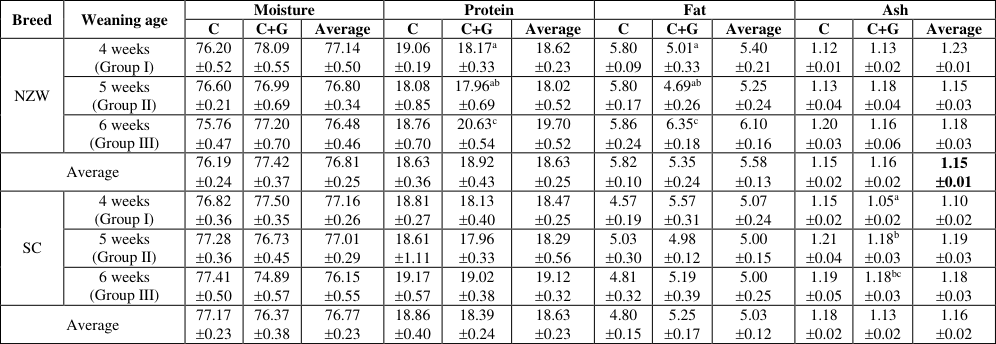 Table 1
Introduction
Rabbit (Oryctolagus cuniculus) is a versatile animal and one of its utilities is production of meat. It can efficiently utilize fibrous plant materials and agricultural by-products for their nutrition. Rabbit farming has also been encouraged by the FAO (1987) [4] solely for meat production in the developing countries for its small body size, shorter generation interval, high prolificacy and early marketability. The production of 1 kg of rabbit meat requires only 25 per cent of the food energy needed to produce the same amount of lamb or beef and 70 per cent of the food required for the equivalent quantity of pork (Lebas and Metheron, 1982) [5] . The per capita consumption of animal protein is 8.3g against the requirement of 15g per head per day according to the Indian Council of Medical Research (Chatterjee 1995). As reported by Das (1998) [3] India's rabbit meat production was only 75 thousand ton with a consumption rate of 9 g/head/year only. Rabbit production for meat is expanding, because of its meat being wholesome, tasty and protective food having high protein (Bora, 1995) [2] . Rabbit meat has extremely low cholesterol (136 mg %) and sodium (393 ppm), thus plays a vital role in the prevention of vascular diseases (Rao et al., 1978) [7] . The present study was undertaken to evaluate the proximate composition of meat of two rabbit breeds weaned at various ages which were fed with different feeding regimes.
Materials and methods
The study was carried out on New Zealand White (NZW) and Soviet Chinchilla (SC) rabbits. Thirty male kits from each breed were identified and randomly assigned to three groups G1, G2 and G3 which were weaned at 4, 5 and 6 weeks of age respectively. Each group was divided into 2 units comprising of 5 kits. One unit was fed with concentrate (C) where the daily fed allowance was divided into 2 splits and supplied in the morning and left afternoon. The other unit was provided with (C+G) i.e. 50 per cent concentrate in the morning and the remaining 50 per cent substituted with Congo signal grass (Brachiaria brizantha) fed ad libitum in the evening. The proximate composition of the experimental concentrate pellet was estimated at 10.22 per cent moisture, 15.68 per cent crude protein, 7.12 per cent ether extract and 11.37 per cent crude fibre and the corresponding values of Congo signal fodder were 76.2, 8.08, 1.93 and 28.04 per cent, respectively. All the kits were provided with wholesome drinking water round the clock. The animals were kept in individual galvanized wire mesh cages measuring 0.60m x 0.60m x 0.30m. The cages were placed in a semi open shed with C.I. sheet roof and concrete floor. The shed had sufficient cross ventilation and provision for optimum light and proper drainage system. The rabbits were slaughtered at 12 weeks of age.The feed was withdrawn 12 hours before slaughter. After slaughter, Longissimus dorsi muscle was collected from each unit, trimmed and cut into small pieces. The samples were mixed thoroughly and stored at chiller for a short period before analysis. The proximate composition viz., moisture, fat, protein and ash were estimated as per A.O.A.C. (1990) and the data were statistically analyzed using 'ANOVA' of MS excel programme.
Results and discussion
Results of the present study (Table 1) revealed that there was no significant difference in respect of moisture per among the groups. Breed and feeding regime also had no influence on moisture per cent of rabbit meat. Palanska et al. (1981) [6] studied moisture percentages in rabbits of 4, 6, 8, 10, 12, 14 and 16 weeks age and mentioned that the total moisture content decreased significantly with increasing age, from 76.3 to 73.77 per cent. In respect to ash content, rabbit of Soviet Chinchilla (SC) breed weaned at 5 th and 6 th week had higher ash content than those weaned at 4 th week. Arrington and Kelley (1976) [1] reported the ash percentage of rabbit meat to be 4.8, which is much higher than the value observed in the present study. This difference might be due to the difference in aim of the experiment. The results obtained in the present study are not comparable with the above workers due to the fact that the study was conducted on weaning and feeding regimes in two different breeds. However, the meat of G III showed a significantly (P<0.05) higher protein per cent than those of GI and GII, whereas there was no significant difference between group I and II. Thus the study indicated that the weaning age has an impact on the protein content of meat. Similarly, the fat content of meat also influenced by the weaning age, however, breed and feeding regime had no effect. The rabbits that weaned at 6 th week of age had higher fat per cent compared to those weaned at 4 th and 5 th week. Rao et al. (1978) [7] concluded that protein content (18.6 to 19.4%) was not influenced by slaughter age; whereas, fat (7.9 to 10.9%) and moisture (68.5 to 72.0%) contents of the rabbit meat were affected (P<.05) by the slaughter ages. The moisture content tended to go down while the fat content went up as the slaughter age increased. Their experiment showed a contrasting result with the present study that weaning age had no effect on any of the chemical components. Results of this study indicate that rabbit can be weaned at 4 weeks of age without affecting the meat quality. In chemical composition, rabbit meat is comparable to chicken and is higher in protein content than the other meats (USDA, 1973). In addition rabbit showed a lower fat content than most of the other meats (USDA, 1973).
| Breed | Weaning age | Moisture | — | — | Protein | — | — | Fat | — | — | Ash | — | — |
|---|---|---|---|---|---|---|---|---|---|---|---|---|---|
| C | C+G | Average | C | C+G | Average | C | C+G | Average | C | C+G | Average | ||
| NZW | 4 weeks (Group I) | 76.20 0.52 | 78.09 0.55 | 77.14 0.50 | 19.06 0.19 | 18.17a 0.33 | 18.62 0.23 | 5.80 0.09 | 5.01a 0.33 | 5.40 0.21 | 1.12 0.01 | 1.13 0.02 | 1.23 0.01 |
| 5 weeks (Group II) | 76.60 0.21 | 76.99 0.69 | 76.80 0.34 | 18.08 0.85 | 17.96ab 0.69 | 18.02 0.52 | 5.80 0.17 | 4.69ab 0.26 | 5.25 0.24 | 1.13 0.04 | 1.18 0.04 | 1.15 0.03 | |
| 6 weeks (Group III) | 75.76 0.47 | 77.20 0.70 | 76.48 0.46 | 18.76 0.70 | 20.63c 0.54 | 19.70 0.52 | 5.86 0.24 | 6.35c 0.18 | 6.10 0.16 | 1.20 0.03 | 1.16 0.06 | 1.18 0.03 | |
| Average | 76.19 0.24 | 77.42 0.37 | 76.81 0.25 | 18.63 0.36 | 18.92 0.43 | 18.63 0.25 | 5.82 0.10 | 5.35 0.24 | 5.58 0.13 | 1.15 0.02 | 1.16 0.02 | 1.15 0.01 | |
| SC | 4 weeks (Group I) | 76.82 0.36 | 77.50 0.35 | 77.16 0.26 | 18.81 0.27 | 18.13 0.40 | 18.47 0.25 | 4.57 0.19 | 5.57 0.31 | 5.07 0.24 | 1.15 0.02 | 1.05a 0.02 | 1.10 0.02 |
| 5 weeks (Group II) | 77.28 0.36 | 76.73 0.45 | 77.01 0.29 | 18.61 1.11 | 17.96 0.33 | 18.29 0.56 | 5.03 0.30 | 4.98 0.12 | 5.00 0.15 | 1.21 0.04 | 1.18b 0.03 | 1.19 0.03 | |
| 6 weeks (Group III) | 77.41 0.50 | 74.89 0.57 | 76.15 0.55 | 19.17 0.57 | 19.02 0.38 | 19.12 0.32 | 4.81 0.32 | 5.19 0.39 | 5.00 0.25 | 1.19 0.05 | 1.18bc 0.03 | 1.18 0.03 | |
| Average | 77.17 0.23 | 76.37 0.38 | 76.77 0.23 | 18.86 0.40 | 18.39 0.24 | 18.63 0.23 | 4.80 0.15 | 5.25 0.17 | 5.03 0.12 | 1.18 0.02 | 1.13 0.02 | 1.16 0.02 |
Table text extracted from the original PDF; superscript letters are shown inline. The original table image is below.
View original table image
Summary
From the above findings it may be concluded that the moisture, protein, fat and ash percentages of rabbit meat may be affected due to variation in weaning age, feeding treatment and breed. Late weaning could increase the protein and fat per cent of rabbit meat. Significant change in ash content was also noticed in the meat of SC breed. From the above it can be precisely concluded that early weaning in rabbits had no significant influence on the moisture, protein, fat and ash per cent in the meat of NZW and SC breed.
References
8 in the original paper- Arrington LR, Kelley KC. Domestic rabbit biology and production. University presses of Florida. Gainesville, Fla. USA, 1976, 7-230.
- Bora A. Effect of dietary fibre levels on weight gain, feed conversion efficiency and blood biochemical profiles in rabbits. Ph.D. Thesis Assam Agric. Univ., Khanapara, Guwahati-1995, 781-022.
- Das SK. Effect of housing management floor space and season on growth and carcass traits of broiler rabbits. Ph.D. Thesis. Assam Agric. Univ. Khanapara, Guwahati-1998, 781-022.
- FAO Report on Expert consultation on rural poultry and rabbit production, Rome. 1981, 1.
- Lebas F. Matheron G. Livestock Rabbits. Livestock Production Science, 1982; 9:235.
- Palanska O, Zelnik J, Gazo M, Palenik S. Study of the physical, chemical and biochemical properties of the skeletal musculature of the domestic rabbit (Oryctolagus cuniculus) during postnatal development. Fleischwirtschaft, 1981; 61(2):266.
- Rao DR, Chen CP, Sunki GR, Johnson, WM. Effect of Weaning and Slaughter Ages on Rabbit Meat Production. II. Carcass Quality and Composition. J Anim Sci. 1978; 46:578583.
- USD A. The ABC's of Domestic Farm-raised Rabbit Meat. Circular No. 549. Washington, DC. 1973.
Cited by 7
From OpenAlex, OpenCitations and reference lists read by Scinovex
- Environmental heat stress in rabbits: implications and ameliorations ↗
M. O. Abioja, T. G. Johnson, Khaled A. Metwally, Mohamed F. A. Farghly, Khalid Mohamed Mahrose · International Journal of Biometeorology · 2021
❝ 73 - Comparison of the effects of probiotic-based formulations on growth, feed utilization, blood constituents, cecal fermentation, and duodenal morphology of rabbits reared under hot environmental conditions ↗
Mahmoud M. Alagawany, Samar S. Bassiony, Mohamed S. El-Kholy, Karima El‐Naggar, Abeer E. El‐Metwally, Adham Abdullah Al-Sagheer · Annals of Animal Science · 2023
Abstract The present study aimed to assess the effects of three probiotic-supplemented diets on growth, cecal fermentation, blood biochemical, and intestinal morphological features in growing rabbits reared under summer conditions. Rabbits were allotted into four groups: G1 rabbits were fed the basal diet (control), G2 rabbits received Enterococcus faecium (EF) and Clostridium butyricum (CB) complexes (1 × 10 8 and…
❝ 15PDF - Chemical Quality of Fresh New Zealand White Rabbit Meat in Batu, Indonesia ↗
Anik Fadlilah, Djalal Rosyidi, Agus Susilo · IOP Conference Series Materials Science and Engineering · 2020
Abstract Batu was one of the cities in the province of East Java, Indonesia that one of the leading tourist cities in Indonesia. Rabbit satay was one of the Batu city famous foods. Many tourists visited Batu City for consume it. Rabbits were obtained from rabbit breeders in the Batu city. The environment and the pattern of rearing rabbits had…
❝ 9PDF - Agro-industrial byproducts in rabbit food: Case of the complex of detoxified apricot kernel cake and dehydrated tomato pulp ↗
Yasmine Arbouche, Achour MENNANI, Lamya Ouzzir, Rafik Arbouche, Fodil Arbouche · Veterinary World · 2021
BACKGROUND AND AIM: The use of agro-industrial byproducts as an unconventional source of raw materials for monogastric feed is one possible solution. This study aimed to determine the effects of incorporating detoxified apricot kernel meal (DAKM) as a substitute for soybean meal and dehydrated tomato pulp (DTP) as a substitute for alfalfa hay on the local rabbit fattening. MATERIALS AND…
❝ 5PDF - Chemical composition of meat from different species of animals ↗
Büşra Yaranoğlu, Muhittin Zengi̇n, Makbule GÖKÇE, Özlem VAROL AVCILAR, Beşir Berhun POSTACI, Çiğdem ERDOĞAN et al. · International Journal of Agriculture Environment and Food Sciences · 2023
The study aimed to comparatively examine meats in terms of chemical composition originating from beef, lamb, chicken, and rabbit consumed in Türkiye and to reveal their superior aspects compared to each other and also to determine the place of rabbit meat, which is not commonly consumed among other meats. As material of the study 48 meat samples were used, 12…
❝ 3PDF - CLIMATE CHANGES EFFECTS ON RABBIT PRODUCTION ↗
Mohamed Elsawy · Journal of Productivity and Development · 2023
One of the major problems facing rabbit production is heat stress in hot regions of the world, especially in Egypt through summer season.This is further aggravated by global warming being experienced as a result of climate change.Climate change is a variation or change in the climate (temperature, wind, precipitation patterns) in a specific location, region, or the entire planet.This change…
❝ 3PDF - PROSPECTS FOR THE USE OF MINERALS IN RABBIT NUTRITION ↗
M. Yuzviak, Y. V. Lesyk, Yuriy Tarasovych Salyha · Izdevniecība “Baltija Publishing” eBooks · 2023
ПЕРСПЕКТИВИ ЗАСТОСУВАННЯ МІНЕРАЛЬНИХ РЕЧОВИН У ЖИВЛЕНІ КРОЛІВЮзьвяк М. О., Лесик Я
❝ 2PDF