
Research article · 2017 · Full text
International Journal of Veterinary Sciences and Animal HusbandryEfficiency of thawing cum controller unit against normal water bath for determining the cattle sperm quality parameter test
Volume 2(2) · Pages 20–22
Research areasGenetic and phenotypic traits in livestockEffects of Environmental Stressors on LivestockReproductive Physiology in Livestock
Abstract
Author-writtenArtificial insemination (AI) is the first generation reproductive biotechnology that has made a biggest contribution to the genetic improvement, particularly in dairy cattle. Frozen semen in straws has become the universally accepted unit of storage and transfer of bovine genetics to cattle procedures which depends on preserve the functional activity of spermatozoa (viability and fertilizing ability) [1]. High viability and motility of spermatozoa are important factors for successful artificial insemination (AI) because a significant correlation between post-thawing sperm viability and subsequent conception rate has been reported [2]. Many techniques are there in India to thaw frozen semen straws before insemination which not only affecting the motility of sperm it also affect the sperm morphology ex Acrosome intactness. For this a study was conducted in which 15 bulls and buffaloes frozen semen straws are thawed and tested in different commercially available portable thawing kit in compare to normal water bath and results are found to be satisfactory. There was non-significant difference in between sperm quality parameters thawed in all the three thawing unit and thawing cum controller can be used in the farms where the artificial inseminations processes are carried out.
Summary
Source-checkedPlain-language reading of the full paper, prepared with AI and checked against the text. Each point links to the authors' own words.
Why it matters
- Artificial insemination (AI) is a key reproductive biotechnology used to improve the genetics of dairy cattle. View evidence ↗
- The success of AI depends on high sperm viability and motility, as these factors correlate with conception rates. View evidence ↗
- Variations in temperature during the thawing process can lead to significant sperm mortality. View evidence ↗
The question
- The study aimed to compare the effects of different thawing units on the motility, hypo-osmotic swelling (HOS) test, and percent intact acrosome of frozen cattle and buffalo semen. View evidence ↗
What they did
- The researchers used frozen semen from 15 different breeds of bulls and buffaloes. View evidence ↗
- Semen straws were thawed for 30 seconds at 37°C using three methods: a conventional water bath, a vertical Mayuresh thawing cum controller unit, and a horizontal Mayuresh thawing cum controller unit. View evidence ↗
- Post-thaw motility was evaluated subjectively using a phase-contrast microscope at 400x magnification with a 38°C warm slide. View evidence ↗
- Sperm membrane integrity was tested using the hypo-osmotic swelling (HOS) test, involving incubation of 0.1 ml of specimen with 1 ml of NaCl solution at 37°C for one hour. View evidence ↗
- Acrosome integrity was measured using the Giemsa staining technique, counting 100 sperm per smear under an oil immersion objective. View evidence ↗
What they found
- For cattle semen, post-thaw motility was similar across units: 54.0 ± 1.77% (water bath), 54.0 ± 1.11% (vertical), and 53.6 ± 1.58% (horizontal). View evidence ↗
- Cattle semen acrosome integrity was 71.4 ± 0.89% in the water bath, 70.1 ± 0.97% in the vertical unit, and 70.8 ± 1.01% in the horizontal unit. View evidence ↗
- For buffalo semen, post-thaw motility was 56.3 ± 0.59% (water bath), 57.3 ± 0.67% (vertical), and 55.2 ± 0.81% (horizontal). View evidence ↗
- Buffalo semen HOS reacted sperm percentages were 66.8 ± 1.51% (water bath), 63.1 ± 1.08% (vertical), and 66.2 ± 0.94% (horizontal). View evidence ↗
What it means
- The authors conclude that both the horizontal and vertical Mayuresh Thawing-Cum-Controller units are satisfactory and can be used for thawing semen in the field. View evidence ↗
Visual summary
3 visualsIllustrations explain the paper; charts are replotted from the paper's own table values.
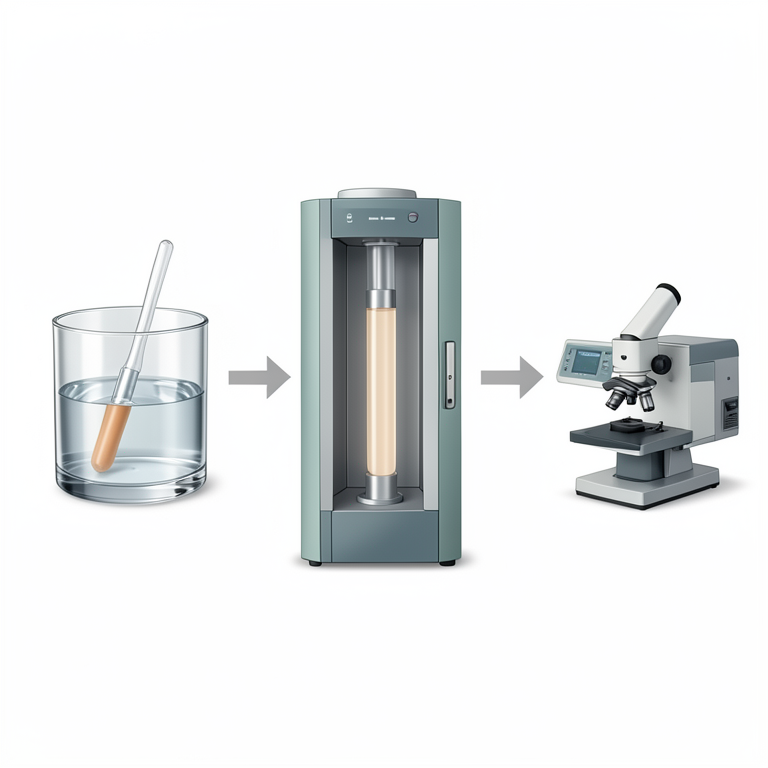
Thawing Comparison Setup
AI-generated conceptual illustration (cattle semen straws in thawing equipment). It explains the idea and does not show study data.
View source evidence ↗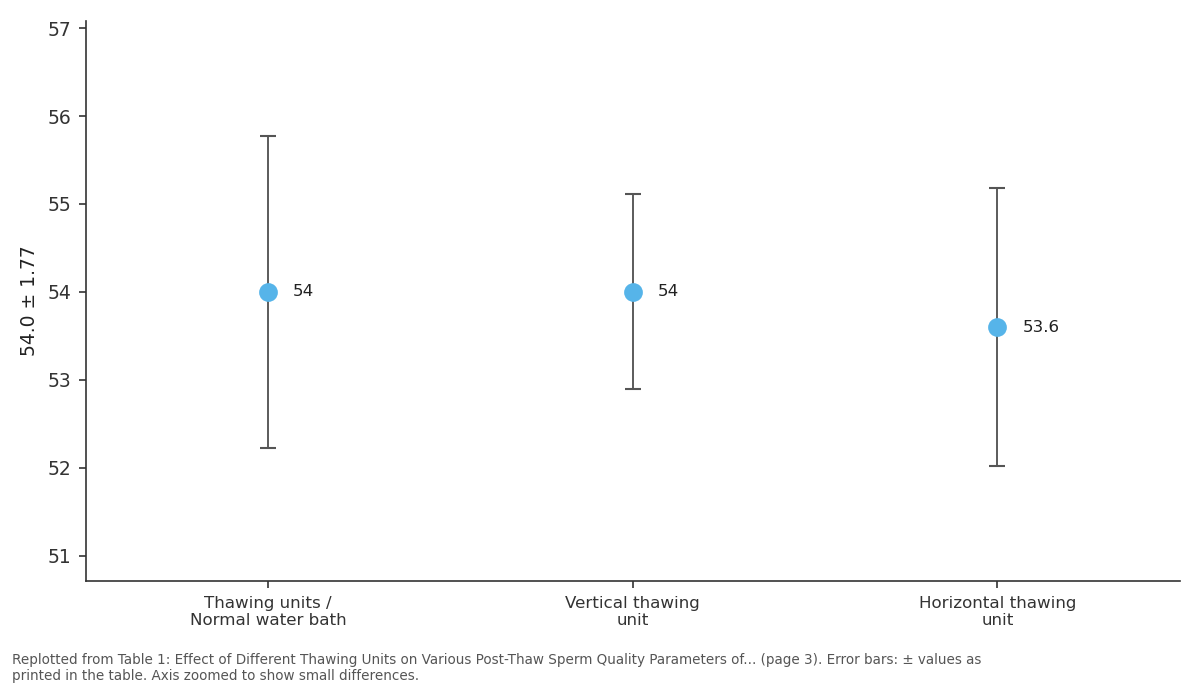
54.0 ± 1.77: Thawing units / Normal... vs Vertical thawing unit vs Horizontal thawing unit
Replotted from Table 1 (page 3) of the original paper. Every bar is the paper's own table value.
View source evidence ↗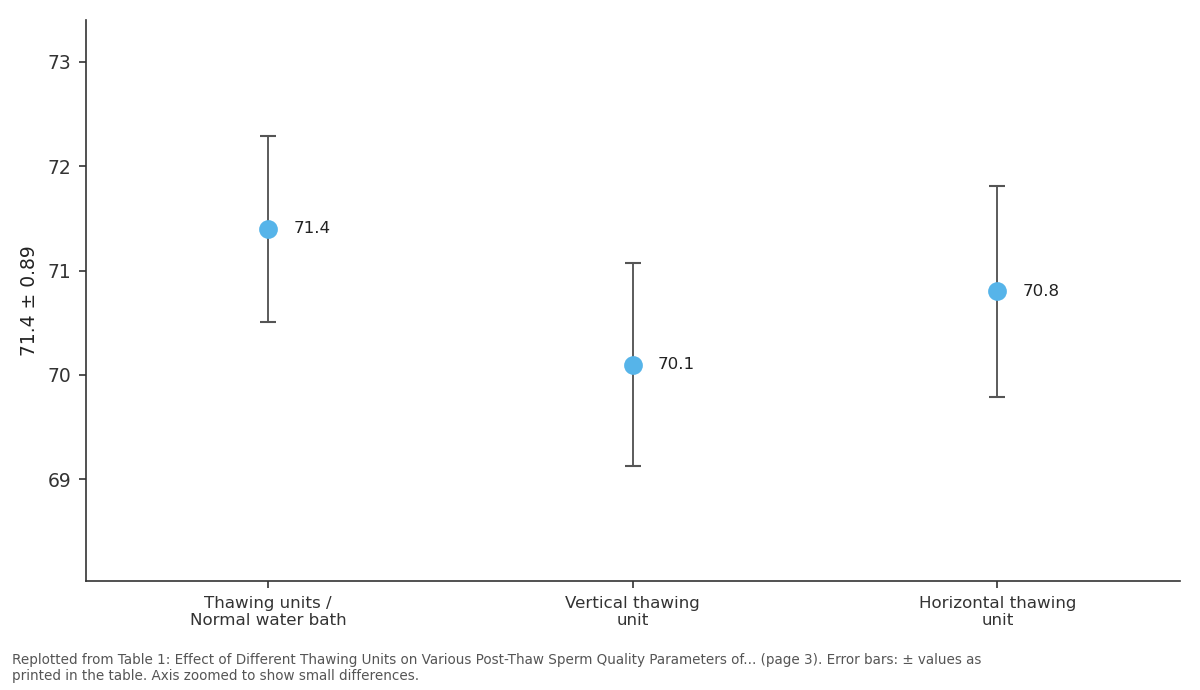
71.4 ± 0.89: Thawing units / Normal... vs Vertical thawing unit vs Horizontal thawing unit
Replotted from Table 1 (page 3) of the original paper. Every bar is the paper's own table value.
View source evidence ↗Figures & tables
From the original paper Table 1
 Table 2
 Table 3
Introduction
Artificial insemination is a reproduction technique used to introduce semen into a female vagina, cervix, uterus or fallopian tubes without sexual intercourse. This method is predominantly used in animal breeding. AI is cheaper and closer to natural reproduction compared with other methods of assisted reproduction, including in vitro fertilization. AI helps to pass on desirable characteristics of a male more quickly [3] . As AI plays such a critical role in the reproduction and genetic improvement of farm animals, it is essential that studies continue to improve methods commonly used. There has been significant research conducted on temperature variances and their effects on thawed semen. These studies have concluded that temperature variances can cause significant mortality rates of spermatozoa. Thawed semen may be exposed to temperature variances in transfer from the thaw bath to the female, thus alternative procedures to reduce this variation could increase the conception rates in cattle 4 . Thawing of frozen semen brings back the frozen spermatozoa to life and to the physiologically active state. Therefore, it is essential to carry out thawing carefully at an optimal temperature for sufficient time to minimize the loss of semen quality during thawing procedure. Worldwide, different workers conducted trials to determine the optimal thawing temperature and duration, and to know the adequate thawing rate that may result in the highest percentage of viable spermatozoa in different species after thawing process [5,6] . Evaluation of the quality of frozen semen has been based on a variety of methods, including routine semen analysis (motility, morphology and Acrosome integrity) [7] , zona free hamster ova test and hypoosmotic swelling test [8] . The plasma membrane is of crucial importance to freeze-thaw survival of spermatozoa and regarded as the primary site of freezing injury [9] . Hypo-osmotic swelling test (HOST) has recently been shown to be useful in detecting subtle changes in the sperm membranes of rams, boars, stallions, dogs and bulls [10][11][12][13] .
As the post thaw motility is one of the most important processes in artificial insemination so the aim of the present study was to the comparative effect of different thawing unit on Motility HOS test and Percent Intact Acrosome of frozen cattle and buffalo semen.
Materials methods
Frozen semen from 15 different bulls breed and buffalo breed were used. Cattle semen Packaged in 0.25 ml French straws were provided by the laboratory of the Department Quality Control of Frozen Semen assessment lab BAIF Development and Research Foundation (Uruli Kanchan Pune). Only semen with motility and concentration values higher than 70 % and 600 x 106/ml were used in this study. Semen was extended with egg yolk extender at a rate to obtain 20 x106 spermatozoa/straw. Extended semen was cooled to 5 °C in 45 minutes, and after glycerolisation it was subjected to equilibration for2 hours. Semen in straws was frozen at -110 °C for 7 minutes and stored in liquid nitrogen. Semen of 15 different breed bulls and buffaloes of was used in this study.
Thawing procedures
The straws were thawed by placing them into different portable thawing units (Mayuresh Thawing cum controller unit Horizontal and Vertical, Mayuresh Industries Kolhapur Maharashtra) and conventional water bath for 30 seconds at 37 degree Celsius. Four mini frozen semen straws from each bull and buffaloes were submitted to different thawing procedures in three different thawing units.
Assessment of frozen-thawed semen
Post thaw motility: Post-thaw sperm motility was assessed subjectively using a phase-contrast microscope (x 400) with a warm slide (38 °C).
Sperm membrane integrity: Sperm membrane integrity was assessed with minor modifications [15] . The semen was submitted to HOS test. Add 0.1 ml of the specimen containing the spermatozoa with 1 ml of hypo-osmotic solution sodium chloride (NaCl). The solution is then incubated at 37°c for one hour. Similarly 0.1 ml of semen is incubated in 1.0 ml in Distilled water for one hour. A single drop from both solutions is placed on the clean glass slide and covered with a cover glass and observed under phase-contrast microscope at x 400 magnifications. A total of 200 sperm are counted in at least 5 different fields and reactive and nonreactive sperms are counted (Both in Distilled water and NaCl).
Sperm morphology: Percent Intact Acrosome by Staining Technique (Giemsa method)
Equal drops of 0.2% trypan blue and frozen semen are mixed with tip and smeared. A thin smear of semen is made on a clean grease free slide. After drying, the slide is immersed in ethanol absolute (No more than 1% of water) for 10 minutes at 37 °c and fixed. Than the slide is immersed in freshly prepared Giemsa stain overnight and then washed in running tap water and dried. From stock Giemsa stain solution, 3ml is taken and mixed with 2ml of Sorenson's phosphate buffer (ph-7.0) and 45ml-distilled water. Fresh stain should be prepared every time for staining the smear. Examine the smear under the oil immersion objective of the microscope and count total of 100 sperms recording number of sperms with intact, altered and completely lost acrosome. Calculate the % of acrosome alteration in the form of loose, detached, ruffled, knobbed, vacuolated acrosome.
Statistical analysis
The mean semen parameters obtained from 15 bulls and 15 buffaloes were subjected to an analysis of variance (ANOVA, SPSS 10.0) by General Linear Model procedure using the factor bull and the factor group (thawing protocol).
Results and discussion
The comparative study of Mayuresh Thawing kit ( 1 and2 shows the values quality parameters value for each thawing unit (Mayuresh Thawing cum controller unit Horizontal and Vertical) and conventional water bath for 30 seconds at 37 degree Celsius) for each bull and buffalo semen sample. The Mean ± SEM of post thaw motility of cattle semen and buffalo semen thawed in each thawing unit (Mayuresh Thawing cum controller unit Horizontal and Vertical) and normal water bath is estimated to be ( 53.6±1.58, 54.0±1.77, 54.0±1.11). Percent intact acrosome of Mean ± SEM value of cattle and buffalo semen thawed in each thawing unit (Mayuresh Thawing cum controller unit Horizontal and Vertical) and conventional water bath are (53.6±1.58, 54.0±1.77, 54.0±1.11). Like this the Mean ± SEM of HOS reacted sperm percentage of cattle semen thawed in each thawing unit (Mayuresh Thawing cum controller unit Horizontal and Vertical) and conventional water bath are (53.6±1.58, 54.0±1.77, 54.0±1.11) respectively.All the semen parameters results were statistically nonsignificant in all the three thawing units among bulls. (Table 3) shows the significant values for motile spermatozoa in all the three thawing units P =0.590) Percent intact acrosome (P =0.207), other HOST reacted sperm percentage (P = 0.401). Thawing procedures which plays the most significant role in artificial insemination but in villages peoples doesn't take it seriously so they use to thaw frozen semen in inappropriate manner like in pockets, under arms or in rubbing in palms etc all these are not a good process to thaw the frozen semen straws as the thawing doesn't done properly by all this manners. As thawing of frozen semen should be properly thawed for a good result for artificial insemination process so it affects the percentage of conceiving rate. And conception rates can also be vary based on semen quality, temperatures and other environmental conditions. This study evaluated the efficiency of convenient water bath with (Mayuresh thawing cum controller horizontal and vertical unit) and all the three thawing unit are having more or less the same value for the entire three sperm quality parameter test.
| Sperm quality parameters | No. samples observed (N) | Significant value (P<0.05) for all the three thawing unit |
|---|---|---|
| Post thaw motility | 30 | 0.590 |
| Percent Intact Acrosome | 30 | 0.207 |
| HOST reactive percentage | 30 | 0.401 |
Table text extracted from the original PDF; superscript letters are shown inline. The original table image is below.
View original table image
Conclusion
Thawing procedure is just as important as the freezing procedure in terms of its impact on the survival of spermatozoa [15] . Inseminators use to carry frozen-thawed semen straw either in pocket which was not a good practice and it's also effect the motility and sperm abnormalities. After performing the Quality control tests by both the Mayuresh Thawing-Cum-Controller units both Horizontal and Vertical in comparison to normal water bath the results are found to be satisfactory. And Mayuresh Thawing-Cum-Controller units both Horizontal and Vertical can be used in Artificial Insemination for thawing purpose in fields.
Acknowledgement
Authors are indebted to Mr. Sanjeev Gokhale (Mayuresh Industries, Kolhapur, and Maharashtra) for providing us the two (vertical and horizontal) thawing cum controller unit for the experimental set up which was very essential for conducting this study.
Figures and tables from the paper
| Sperm Quality of Parameters | Thawing units | — | — |
|---|---|---|---|
| Normal water bath | Vertical thawing unit | Horizontal thawing unit | |
| Post Thaw motility | 54.0 ± 1.77 | 54.0 ± 1.11 | 53.6 ± 1.58 |
| Percent Intact Acrosome | 71.4 ± 0.89 | 70.1 ± 0.97 | 70.8 ± 1.01 |
| HOST reacted sperm percentage | 63.4 ± 1.44 | 64.3 ± 1.19 | 64.4 ± 1.45 |
Table text extracted from the original PDF; superscript letters are shown inline. The original table image is below.
View original table image
| Sperm Quality of Parameters | Thawing units | — | — |
|---|---|---|---|
| Normal water bath | Vertical thawing unit | Horizontal thawing unit | |
| Post Thaw motility | 56.3 ± 0.59 | 57.3 ± 0.67 | 55.2 ± 0.81 |
| Percent Intact Acrosome | 70.9 ± 0.86 | 69.8 ± 0.78 | 72.0 ± 0.85 |
| HOST reacted sperm percentage | 66.8 ± 1.51 | 63.1 ± 1.08 | 66.2 ± 0.94 |
Table text extracted from the original PDF; superscript letters are shown inline. The original table image is below.
View original table image
References
14 in the original paper- Bearden HJ, Fuquay F, Willard ST Applied animal reproduction. 6 th ed. Pearson Prentice Hallm: New Jersey. 2004.
- Correa JR, Rodriguez MC, Patterson DJ, Zavos PM Thawing and processing of cryopreserved bovine spermatozoa at various temperatures and their effects on sperm viability, osmotic shock and sperm membrane functional integrity. Theriogenology 1996; 46:413.
- Kaczyk Brittni Lanay. Thesis A comparison of semen thawing for artificial insemination in cattle mir center, Angelo state university, San Angelo, Texas. 2011
- Dobrin N, Zamfirescu S, Coprean D, Anghel AH. Effect of thawing time and temperature variation on the quality of frozen-thawed ram semen. Rom. Biotechnol. Lett. 2014; 19(1):8935-8940.
- Badry-Al, I.K. Effect of various thawing times and temperatures on frozen semen quality of Friesian bulls in Iraq. International Journal of Animal and Veterinary Advances. 2012; 4(6):384-388, ISSN: 2041-2908.
- Hafez ESE. (ed.).Iraq. Inter. J. Anim. Vet. Adv, 4(6): 384-388.8.Semen evaluation Hafez: Reproduction in farm animals. (6 th ed.). Lea and Febiger, Philadelphia, 1993; 405-423.
- IK Ileri, K Ak, Payet yontemine gore dondurulmus boga spermas1n1n eritilmesinde eritme 1s1s1 ve surelerinin spermaztozoitlerin motilite ve akrozom yap1lar1 uzerine etkileri. Istanbul Universitesi Veteriner Fakultesi ve Munich Ludwing-Maximilian Universitesi Veteriner Fakultesi Turk-Alman Gunleri; Nisan-May1s Tebligler, 1993; 29-30:58-62.
- Söderquist L, Madrid-Bury N, Rodriquez-Martinez H, Assessment of ram sperm membrane integrity following different thawing procedures. Theriogenology, 1997; 48:1115-1125.
- Vazquez JM, Martinez EA, Martinez P, Garciaartiga C, And Roca J, Hypo-osmotic swelling of boar spermatozoa compared to other methods for analyzing the sperm membrane. Theriogenology, 1997; 47:913-922.
- Watson PF, Recent developments and concepts in the cryopreservation of spermatozoa and the assessment of their post-thawing function. Reprod. Fertil. Dev, 1995: 7, 871-891.
- Neild D, Chaves G, Flores M, Mora N, Beconi M. And Agüero A: Hypo-osmotic swelling test in equine spermatozoa. Theriogenology, 1999, 51, 721-727.
- Kumi-Diaka J.: Subjecting canine semen to the hypoosmotic test. Theriogenology, 1993, 39, 1279-1289.
- Correa J.A., Heersch G. And Zavos P.M: Sperm membrane functional integrity and response of frozenthawed bovine spermatozoa during the swelling test incubation at varying temperatures. Theriogenology, 1997; 47, 715-729.
- Nur Z, Dogan I, Soylu M, Ak K. Effect of different thawing procedures on the quality of bull semen. Rev Med Vef. 2003; 154(7): 487-490.