
Research article · 2017 · Full text
International Journal of Veterinary Sciences and Animal HusbandryLiquid chromatographic assay for ciprofloxacin residue in milk
Volume 2(1) · Pages 04–06
Research areasAntibiotics Pharmacokinetics and Efficacy
Abstract
Author-writtenThe present study was conducted to investigate residues of Ciprofloxacin in raw milk of cow. A total of 175 raw milk samples of cow were collected from different districts of Assam. Ultra High Performance Liquid Chromatography (UHPLC) with diode array detection system was employed for detection of ciprofloxacin in the milk samples. A mixture of water and acetonitrile (70:30 v/v) was used as the mobile phase. The flow rate was maintained in an isocratic mode at a speed of 1.0 ml.min-1. The wavelength for the detector was set at 277 nm. A standard calibration curve with coefficient of determination of 99.64%. The method yielded good recovery percentage of ciprofloxacin in milk which ranged from 94-99%. Out of the 175 screened samples, 0.57 % sample was detected to be positive for residues of Ciprofloxacin.
Summary
Source-checkedPlain-language reading of the full paper, prepared with AI and checked against the text. Each point links to the authors' own words.
Why it matters
- Ciprofloxacin is used in veterinary medicine as a broad-spectrum antimicrobial agent with extensive antibacterial activity. View evidence ↗
- Indiscriminate use of ciprofloxacin on dairy farms can lead to drug residues remaining in cow's milk. View evidence ↗
- Because of public health concerns, the FAO/WHO has established Maximum Residue Limits (MRL) for ciprofloxacin in milk. View evidence ↗
The question
- The study aimed to investigate the presence of ciprofloxacin residues in raw cow's milk. View evidence ↗
What they did
- The researchers collected 175 raw cow milk samples from various districts in Assam. View evidence ↗
- Sample preparation involved mixing 10 ml of milk with 10 ml of acetonitrile, shaking for 5 minutes, and centrifuging at 6000 rpm for 10 minutes. View evidence ↗
- Extract cleanup was performed using a Solid Phase Extraction (SPE) method with a C18 cartridge preconditioned with methanol and HPLC grade water. View evidence ↗
- Detection was performed using UHPLC with a diode array detector at 277 nm, an isocratic flow rate of 1.0 ml.min-1, and a water:acetonitrile (70:30 v/v) mobile phase. View evidence ↗
- Quantification was based on a standard solution of 100µg.ml-1, which was further diluted to concentrations of 5.0, 4.0, 3.0, 2.0, and 1.0 µg.ml-1. View evidence ↗
What they found
- The assay's standard calibration curve showed a high coefficient of determination of 99.64%. View evidence ↗
- The method demonstrated high efficiency, with ciprofloxacin recovery rates in milk ranging from 94% to 99%. View evidence ↗
- Out of all the milk samples screened, ciprofloxacin residues were detected in only 0.57% of them. View evidence ↗
What it means
- The authors conclude that ciprofloxacin is used judiciously in Assam's dairy farms because most samples were free of residues. View evidence ↗
- From a public health perspective, the screened milk samples were considered safe for human consumption. View evidence ↗
Visual summary
1 visualsIllustrations explain the paper; charts are replotted from the paper's own table values.
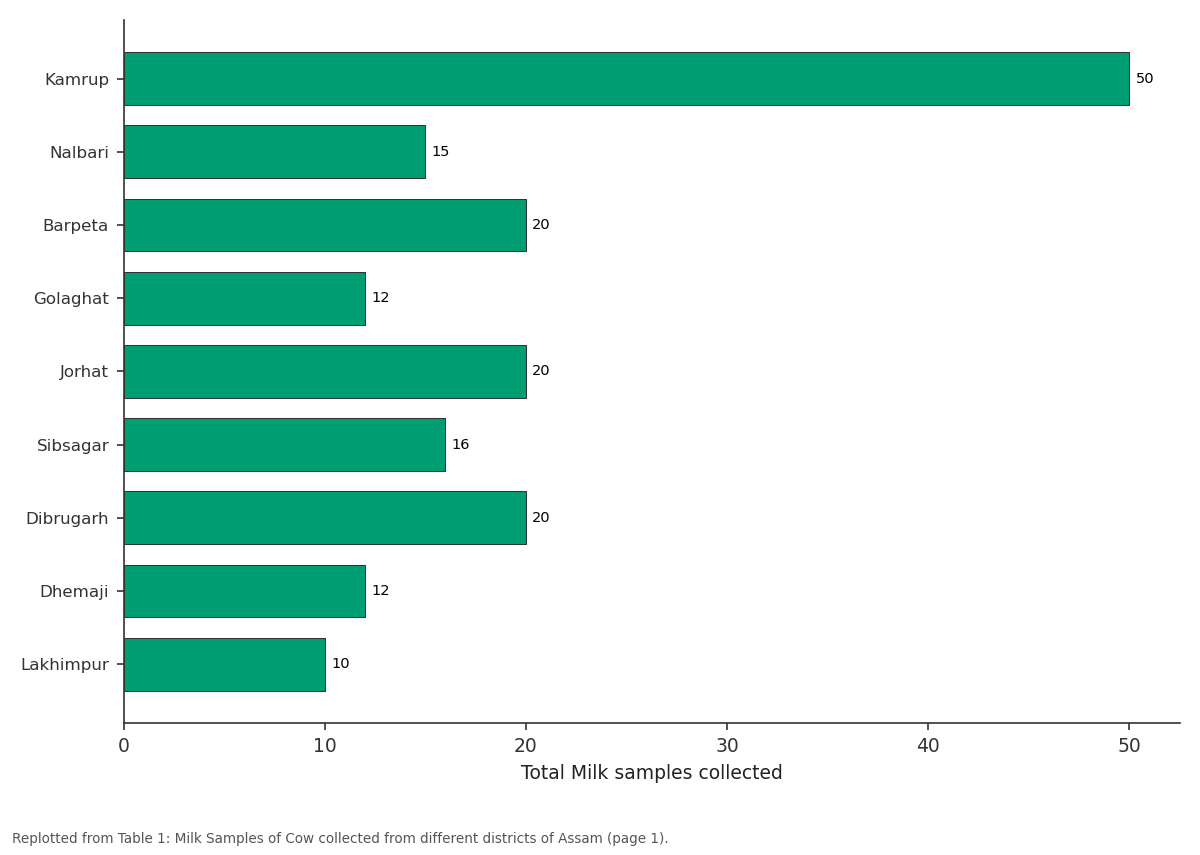
Total Milk samples collected: Kamrup vs Nalbari vs Barpeta vs Golaghat vs Jorhat
Replotted from Table 1 (page 1) of the original paper. Every bar is the paper's own table value.
View source evidence ↗Figures & tables
From the original paper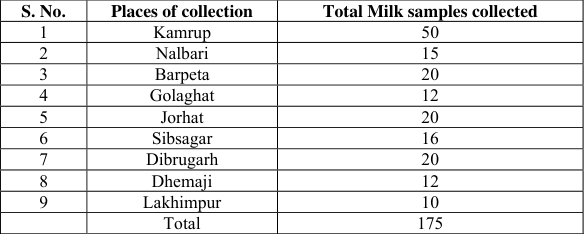 Table 1
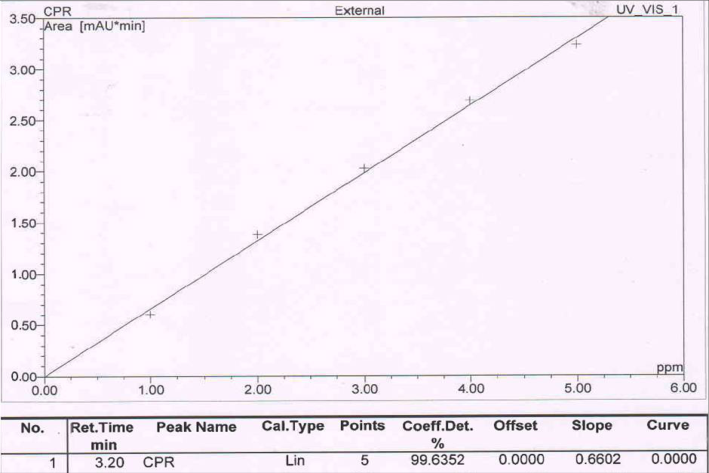 Figure 1
Introduction
Ciprofloxacin is a broad-spectrum antimicrobial agent which has a wide range of antibacterial activity and so have been in use in veterinary medicine (Nouws et al., 1988) [7] . It is mainly used against urinary, pulmonary and digestive infections (Bauditz, 1990) [1] . An increase in the spectrum of activity and potency of the drugs is seen (Spoo et al., 1995) [8] . Ciprofloxacin acts by inhibiting the bacterial DNA-gyrase (Gilles et al., 1991) [5] . Ciprofloxacin may be found as residues in milk of cow due to indiscriminate use in dairy farms. Due to the rising concern of public health, FAO/WHO has recommended Maximum Residue Limits (MRL) for Ciprofloxacin in milk (FAO/WHO, 2002) [4] . India is the world's largest milk-producing country with an annual production of 132 million tonnes (BAHS, 2014) [2] . The total milk production of the State of Assam for the year 2012-13 was estimated at 838 thousand tonnes (Economy Survey of Assam, 2013-14) [3] . Thus, the present study was conducted to investigate residues of Ciprofloxacin in raw milk of cow.
Materials and Methods
Materials and Methods
Sample collection
In this study, raw milk samples of cow (175 nos.) of about 100 ml were collected in sterile containers from different districts of Assam (Table 1). The milk samples after collection were transported to the laboratory in thermo-cooled containers jacketed with ice.
| S. No. | Places of collection | Total Milk samples collected |
|---|---|---|
| 1 | Kamrup | 50 |
| 2 | Nalbari | 15 |
| 3 | Barpeta | 20 |
| 4 | Golaghat | 12 |
| 5 | Jorhat | 20 |
| 6 | Sibsagar | 16 |
| 7 | Dibrugarh | 20 |
| 8 | Dhemaji | 12 |
| 9 | Lakhimpur | 10 |
| Total | 175 |
Table text extracted from the original PDF; superscript letters are shown inline. The original table image is below.
View original table image
Extraction and cleanup
10 ml of the milk sample was taken in a 50 ml centrifuge tube. 10 ml of acetonitrile was added followed by vigorous shaking for 5 mins. The sample was then centrifuged at 6000 rpm for 10 mins. The supernatant was collected and filtered through a Whatman filter paper No. 42. Cleanup of the extract was done by using Solid Phase Extraction (SPE) method. The filtrate was loaded on a C18 cartridge preconditioned with 3 ml of methanol and 3 ml of HPLC grade water. The cartridge containing the sample was washed with 3 ml of water and then finally eluted with 3 ml of methanol. The extract so obtained was filtered through syringe filter (0.2µm). 20µl of the eluted sample was then injected into the UHPLC system for analysis.
Chromatographic condition
Ultra High Performance Liquid Chromatography (UHPLC) with diode array detection system was employed for detection of ciprofloxacin in the milk samples. A mobile phase of Water: Acetonitrile (70:30 v/v) was used. The flow rate was kept at 1.0 ml.min -1 keeping mode as isocratic. The wavelength for the detector was set at 277 nm.
2.4 Quantification 10 mg of pure Ciprofloxacin standard (Sigma chemicals) was dissolved in 100 ml of HPLC grade water with drop of HCl until complete dissolution to obtain a concentration of 100µg.ml -1 . Further dilutions were made from this solution in the descending concentration of 5.0, 4.0, 3.0, 2.0 and 1.0 µg.ml -1 respectively. An aliquot of 20µl each of these solutions were injected into the UHPLC system. Peak areas were recorded.
Results and Discussion
The presence of residues of antimicrobial agents in food producing animals has received worldwide attention from national and international regulatory agencies due to its public health importance. In the present study, a total of 175 samples of raw milk of cow were collected and screened for residues of ciprofloxacin. The assay of drug residues like ciprofloxacin in biological matrices such as milk is difficult due to presence of many interfering substances like fats, proteins and other components which may interfere with the separation of peak. To solve this, acetonitrile was incorporated in for precipitating protein.
After protein precipitation, centrifugation and solid-phase extraction (SPE) the extracts were analyzed by Ultra High Performance Liquid Chromatography (UHPLC) system. Reverse phase chromatography helped in good separation of peaks. Diode array detector at 277 nm detected the residues of ciprofloxacin in the sample. A standard calibration curve with coefficient of determination of 99.64% was obtained by plotting concentration of standard solutions against peak areas obtained (Figure 1). The method yielded good recoveries of ciprofloxacin in milk which ranged from 94-99%. Similar recovery was reported by Navratilova et al. (2011) [6] . After screening all the milk samples, Ciprofloxacin residue was detected in only 0.57% of the total samples. In comparison to the findings of Navratilova et al. (loc. cit), ciprofloxacin residue was detected in very few samples. This may be due to proper milking of cow after the withdrawal period.
Conclusion
It may be concluded from the present study that Ciprofloxacin is judiciously used in dairy farms of Assam as most of the milk samples were free from residues. So, from public health point of view milk samples screened in the present study were safe for human consumption.
Acknowledgement
The authors acknowledge the assistance and help received from ICAR and AAU, Jorhat
References
4 in the original paper- Gilles CJ, Magonigle RA, Grinshaw WTR, Tanner AC, Risk JE, Lynch MJ. et al. Journal of Veterinary Pharmacology and Therapeutics. 1991; 14:400.
- Navratilova P, Borkovcova I, Vyhnalkova J, Vorlova L. Fluoroquinolone Residues in Raw Cow's Milk. Czech Journal of Food Science. 2011; 29(6):641-646.
- Nouws JFM, Mevius DJ, Vree TB, Baars AM, Laurensen. Veteinary Quaterly. 1988; 10:156-163.
- Spoo JW, Riviere JE. Veterinary Pharmacology and Therapeutics. 1995, 832.