
Research article · 2017 · Full text
International Journal of Statistics and Applied MathematicsComparative analysis of different methods for solving fuzzy transportation problem
Volume 2(4) · Pages 19–21
Research areasOptimization and Mathematical Programming
Abstract
Author-writtenA variety of methods are proposed for solving fuzzy transportation problems but all the methods in literature, demonstrate the parameters by normal fuzzy numbers. In most of the work it is quite impossible to limit the membership function to the normal form. So in this paper a generalized approach for fuzzy numbers for transportation problem is proposed. In proposed work, a new approach is presented for solving real life fuzzy transportation problems by assuming that a decision maker is uncertain about the accurate values of the demand, availability as well as the transportation cost of the given product. In this paper Vogel’s Approximation Method (VAM) is introduced which provide optimum initial solution rather than northwest corner method and intuitive low cost method. In the proposed method demand, availability as well as the transportation cost of the product are represented by generalized trapezoidal fuzzy numbers. The proposed VAM method is very easy to understand and easy to apply on real life fuzzy transportation problems for the decision makers.
Summary
Source-checkedPlain-language reading of the full paper, prepared with AI and checked against the text. Each point links to the authors' own words.
Why it matters
- The transportation problem is a specific type of linear programming problem focused on minimizing the total cost of moving goods from sources to destinations based on supply and demand. View evidence ↗
- In real-world applications, parameters like stock, requirements, and unit transportation costs are often uncertain. View evidence ↗
- Existing literature on fuzzy transportation problems typically uses normal fuzzy numbers, which the author argues may be too restrictive for many membership functions. View evidence ↗
The question
- The paper aims to propose a generalized approach for using fuzzy numbers to solve transportation problems. View evidence ↗
What they did
- The proposed method represents demand, availability, and transportation costs using generalized trapezoidal fuzzy numbers. View evidence ↗
- A new ranking method is introduced to map generalized trapezoidal fuzzy numbers directly onto a real line using a trapezoid as a reference point. View evidence ↗
- The study evaluates three methods for finding the initial basic feasible solution (North-west corner, least cost, and VAM) and uses the u-v method for optimization. View evidence ↗
What they found
- In a numerical example, the North-west corner method, least cost method, and VAM produced total transportation costs of 3700, 2500, and 2450 respectively. View evidence ↗
- Among the three methods for finding the initial basic feasible solution, Vogel's Approximation Method (VAM) was found to be the most effective for calculating total cost. View evidence ↗
- Applying the u-v optimization method to the result of the North-west corner method reduced the transportation cost from 3700 Rs to 2450 Rs. View evidence ↗
What it means
- The author concludes that applying the u-v method to the VAM result can further reduce the transportation cost below 2450 Rs. View evidence ↗
- The author states that the proposed VAM method is easy for decision makers to understand and apply to real-life fuzzy transportation problems. View evidence ↗
Visual summary
1 visualsIllustrations explain the paper; they do not show study data.
Optimization Workflow
AI-generated conceptual illustration (A logistics network of warehouses and retail stores connected by transport routes). It explains the idea and does not show study data.
View source evidence ↗Figures & tables
From the original paper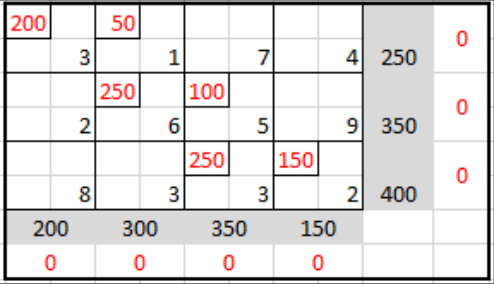 Figure 1
Introduction
In the field of either mathematics or economics, transportation fundamentals is a name assigned to the study of optimal transportation and allocation of resources. Transportation theory is a platform to provide a robust framework to meet the deadlines. The fundamental transportation problem was first developed by Hitchcock [1] . Transportation problem is a special kind of linear programming problem (LPP) in which goods are transported from a set of sources to a set of destinations subject to the supply and demand of the sources and destinations respectively [2] . Such that the total cost of transportation is minimized. There are two types of transportation problem: one is balanced and other one is unbalanced. When demand and supply are equal, problem is balanced otherwise unbalanced. In general, transportation LPP is simplified with the assumption that the decision parameters such as unit transportation cost, requirement and availability. But in day to day life applications, stock, requirement and unit transportation cost may be uncertain due to various factors [3] . The estimate data may be represented by fuzzy numbers or in terms of crisp values. Fuzzy numbers may be normal, general, triangular and trapezoidal. Ranking method is used to change the fuzzy number into crisp form. In daily life, there are many differing situations due to uncertainty in judgments, lack of evidence etc. Sometimes it is quite impossible to get relevant precise data for the cost parameter [4] . This type of uncertain data is never well represented by random variable selected from a probability distribution. Fuzzy number may represent this data. The objective of fuzzy transportation problem is to find the minimum transportation cost of some commodities through a capacitated network when the stock and requirement of nodes and the capacity and cost of edges are represented as fuzzy numbers [6][7][8] . An initial basic feasible solution (IBFS) for the transportation problem can be procured by using the north-west corner method (NWCM) and least cost method and Vogel's approximation method. VAM is most useful for determining the optimal solution for the given fuzzy transportation problem. A fuzzy transportation problem is a problem in which the transportation expenditures, demand and supply quantities are belongs to fuzzy set. This paper is organized as follows: In Section 2, generalized trapezoidal fuzzy numbers topology is presented. In Section 3, Different methods to find initial basic feasible solution for transportation problem is presented. Also u-v method is described to find the optimal final solution. The conclusions are discussed in Section 4.
Generalized trapezoidal fuzzy number
A new concept for ranking of generalized trapezoidal fuzzy number is presented using trapezoid as reference point. This Ranking methods map fuzzy number directly in to the real line. Let A= (p1, q1, r1, s1; ω1) and B= (p2, q2, r2, s2; ω2) be two generalized trapezoidal fuzzy numbers then the following steps to differentiate A and B:
Different method
Any optimize solution for a given transportation problem is solved in two phases: 1. Finding the initial basic feasible solution in first phase. 2. Second phase involves optimization of the initial basic feasible solution (IBFS) obtained in phase 1. In order to find the initial basic feasible solution we can use North-west corner cell method, least cost cell method and Vogel's approximation method (VAM).In order to optimizing initial basic feasible solution u-v method is used in this paper.
Problem: For the balanced fuzzy transportation problem given below, find the fuzzy quantity of the product transported from each source to various destinations so that the total fuzzy transportation cost is minimum. The above problem can be solved by above mentioned three methods in order to get IBFS.
Source
Source
Method 1: North-west Corner Method
Firstly, it is cleared that the problem should be balanced otherwise it is made balanced problem by adding dummy row as well column. But here no need to add any dummy cell. To optimize this initial basic solution u-v method is applied over this problem. First find out the u values (u1, u2, u3) for rows and v values (v1, v2, v3, v4) for columns. Mathematical formula to find u-v values:
Conclusion
In this proposed work, the transportation costs are taken as generalized fuzzy numbers. Mathematical formulation of fuzzy transportation problem is discussed with suitable numerical example for different basic feasible solution finding methods. Numerical example shows that using this formulation one can have the optimal solution as well as the crisp and fuzzy optimal total cost with a particular method. To illustrate the north-west corner method, least cost method and VAM method a numerical example is solved and transportation cost is calculated. All three methods give total transportation cost are 3700, 2500 and 2450 respectively. In all above three methods which provides the initial basic feasible solution, VAM is quite better to calculate total cost. But to calculate the optimize transportation cost, here a u-v method is introduced. By applying u-v method over northwest corner method we reduce the cost from 3700 Rs to 2450 Rs. It is concluded that if u-v method is applied over VAM method, we can further reduce its transportation cost from 2450 Rs. However, believing that the results obtained in this paper gives us the optimum cost for the fuzzy transportation problems.
Figures and tables from the paper
References
10 in the original paper- Hitchcock FL. The distribution of a product from several sources to numerous localities, J. Math. Phys. 1951; 20:224-230.
- Charnes A, Cooper WW. The stepping-stone method for explaining linear programming calculation in transportation problem, Management Science, 1954, 4969.
- Liu ST, Kao C. Solving Fuzzy Transportation Problems based on extension Principle. European Journal of Operational Research. 2004; 153:661-674.
- Liang TF, Chiu CS, Cheng HW. Using possibilistic linear programming for fuzzy transportation planning decisions, 2005, 93-112.
- Gani A, Razak KA. Two stage fuzzy transportation problem. J. Phys. Sci. 2006, 63-69.
- Pandian P, Natarajan G. A new algorithm for finding a fuzzy optimal solution for fuzzy transportation problems. Applied Mathematical Science, 2010; 4:79-90.
- Wahed WFAE. A multi-objective transportation problem under fuzziness, Fuzzy Sets and Systems, 2001; 117:2733.
- Mohanaselvi S, Ganesan K. Fuzzy Optimal Solution to Fuzzy Transportation Problem: A New Approach. International Journal of Computer Science and Engineering. 2012; 4(3):367-375.
- Shanmugasudari M, Ganesan K. A Novel Approach for the Fuzzy optimal solution of Fuzzy Transportation", International Journal of Engineering Research and Applications. 2013; 3(1):1416-1424.
- Ramanuja Rao K, Rajnesh Mudaliar K. A perfect Mathematical Formulation of Fuzzy Transportation Problem Provides an Optimal Solution Speedily. AsiaPacific World Congress on Computer Science and Engineering, 2016, 271-278.
Cited by 1
From OpenAlex, OpenCitations and reference lists read by Scinovex
- Application of Selected Optimization Methods in Car Distribution Planning on the Example of Polish Market ↗
Marta Jarocka · Eurasian studies in business and economics · 2020
❝ 0