
Research article · 2017 · Full text
International Journal of Veterinary Sciences and Animal HusbandryThe antihelminthıc effıcıency of N. meyer Benth. and N. cataria L. specıes that spread in the nakhchıvan autonomous republıc flora
Volume 2(1) · Pages 40–43
Research areasEssential Oils and Antimicrobial ActivityPlant Ecology and Taxonomy StudiesBee Products Chemical Analysis
Abstract
Author-writtenThe article deals with the antihelminthıc effıcıency of N. meyer Benth. and N. cataria L. species spreading in the Nakhchivan Autonomous Republic flora and growing widely in the areas of natural pastures and hayfields. İn the taxonomic spectrumthese plants are included into the Lamiaceae L. (=Lobioto Juss) family, Stachyoidae Briq. semi-family, Nepetae Benth. triba, Nepeta L. species. the both plants are essential oily. The main components of the essential oil compositions consist of nepetalacton. There have been used both the essential oil and aqueous extract as the anti-helminthic drug in the investigation. There have been got the high helminthosid efficiency in vitro and in vivo. The helminthocide efficiency of N. meyer Benth. essential oil was 78,6%, but N. cataria L. essential oil was 82,1%. This high helminthocide influence of essential oil is connected with being rich in nepetalakton isomers with bactericide composition. But anti-helminthic efficiency of aqueous extract of N. meyer Benth. and N. cataria L. respectively was 60,3% and 62,7%. So, the helminthocide drugs could be prepared by the essential oil and the aqueous extractof both plants and it is recommended to use them to cure helminthoses.
Summary
Source-checkedPlain-language reading of the full paper, prepared with AI and checked against the text. Each point links to the authors' own words.
Why it matters
- Chemically synthesized anti-helminthic drugs can accumulate in animal organisms and their products, potentially causing negative aftereffects in humans. View evidence ↗
- Modern pharmaceutical chemistry aims to develop drugs that are naturally synthesized within plants as a safer alternative. View evidence ↗
- The essential oils of N. meyer Benth. and N. cataria L. are composed of 63-70% nepetalacton isomers. View evidence ↗
The question
- The study aimed to evaluate the anti-helminthic efficiency of essential oils and aqueous extracts from N. meyer Benth. and N. cataria L. found in the Nakhchivan flora. View evidence ↗
What they did
- Essential oils were obtained via hydro distillation, and aqueous extracts were prepared by soaking 200 g of dried plant mass in 1L of hot water for 30 minutes. View evidence ↗
- The research used helminthological samples from 15 sheep for in vitro tests and 42 sheep for in vivo tests. View evidence ↗
What they found
- In vitro, essential oils caused Haemonchus, Nematodirus, and Strongilyatus to perish within 2-4 hours, while Trichocephalus survived for 22-25 hours. View evidence ↗
- Aqueous extracts were less potent than essential oils in vitro, with Trichocephalus perishing in 32-33 hours. View evidence ↗
- Clinical inspections indicated that the doses used were not toxic, as animals showed normal temperature, breathing, and behavior. View evidence ↗
What it means
- The authors recommend using the essential oils of N. meyer and N. cataria to treat helminthoses. View evidence ↗
Visual summary
1 visualsIllustrations explain the paper; charts are replotted from the paper's own table values.
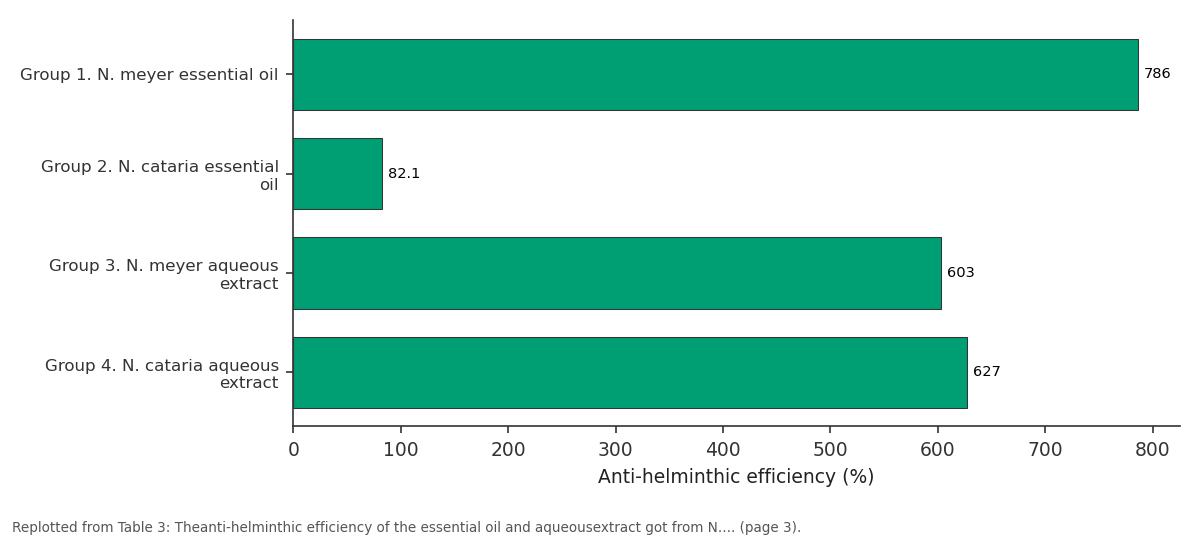
Anti-helminthic efficiency of the plants: Group 1. N. meyer... vs Group 2. N. cataria... vs Group 3. N. meyer... vs Group 4. N. cataria...
Replotted from Table 3 (page 3) of the original paper. Every bar is the paper's own table value.
View source evidence ↗Figures & tables
From the original paper Table 1
 Table 2
 Table 3
Introduction
In recent years, there have been increased using the chemically synthesized drugs against helminthes. These drugs destroy the helminthes, but also they gather in the adjoining animal organism and animal products and make aftereffect. While havingsuch kind of animal products, the chemical substances make negative influence in the people’s organisms too. Ultimate goal of the modern pharmaceutical chemistry is to get drugs that have been naturally synthesized within the plants.
This is one of the state importance problems to investigate the natural wealth and study the usage perspectives from this point, too. The antimicrobial, antifugal, antiviral and anti-helminthic effects of the plants being rich in effective fitoncide substances have been studied by some investigators [1, 3, 5]. The bactericid efeatures of the Nepeta species including into the Lamiaceae L. have been investigated, too. The chemical compositions of these plants are rich in biological active substances as nepetalacton, epinepetalacton, sitral, geraniol, sitronella, saponin.
In most investigations, nepetalacton has found affirmation as an influential active bactericide substance against microorganisms, like other monotherpens [6, 9. 11]. Identification of the essential oil got from the N. meyer Benth. and N. cataria L. species concerning to the Nepeta L. genus, showsthat the 63-70 %of the component composition consists of nepetalacton isomers (4aα,7α,7aβ and 4aα,7α,7aα). But there has not been met any information about anti-helminthic efficiency of the plants in the investigations. Helminthocide influence of the essential oil got from of N. meyer Benth. and N. cataria L. species have been studied by us.
Material And Methods
Researches have been carried out in the laboratory condition. The purpose of the investigation is to study the efficiency of the essential oil and aqueous extract of the N. meyer Benth. and N. cataria L. species spreading in the Nakhchivan flora. The N. cataria L. species spreading in VET 2017; 2(1): 40-43 Ezize Huseynova Nakhchivan State University, Azerbaijan Saleh Maharramov Nakhchivan State University, Azerbaijan Correspondence Ezize Huseynova Nakhchivan State University, Azerbaijan the physiological solution. This vivo influence has been studied on 42 sheep.
Results And Discussions
In vitro method, there have been used the essential oil got from the N. meyer and N. cataria, in the 2% alcohol solution, the cleared mixture in relation 1:5, 1:10 and 1:20; and also have been used when the aqueous extract prepared from the over ground parts of the plants. The experiences have been carried out on hemonxus, nematodirus, strongilyats and trixosefalyus es put into the physiological solution separately. According to the methodsthe helminthes were first put into the influential solution and in each 15 minutes moved to the physiological solution and checked their passiveness or perishing [2]. There has been watched the perishing period of the helminthes that were put into the physiological solution.
The results of the investigations are represented at Table 1 and 2. the Ordubad region subalpine zones 2000-2400 m higher sea level and N. meyer Benth. spreading in the lowlands of the Julfa region, have been gathered in the phase of blossoming. The green over ground parts of the plants cut into small parts and dried in the shade. Essential oil has been got from the dried plants by hydro distillation method [10]. Also there has been gotthe aqueous extract of dried plants.
| Helminthes | Degree of becoming limpid in the physiological solution | — | — | — | — | — | Bowl of supervision |
|---|---|---|---|---|---|---|---|
| N. meyer Benth. | N. cataria L. | ||||||
| 1:5 | 1:10 | 1:20 | 1:5 | 1:10 | 1:20 | ||
| Haemonchus | 2h.40 min. | 2h.55min. | 3h.15min. | 2h.20min | 2h.35min. | 3h.05min. | 25h. |
| Nematodirus | 2h.55 min. | 3h.10min. | 3h.30 min. | 2h.40min. | 3h. | 3h.20min. | 27h. |
| Strongilyatus | 3h.25min. | 3h.40min. | 4h.20min. | 3h. | 3h.55min. | 4h. | 28h. |
| Trichocephalus | 23h.45min. | 24h.40 min. | 25h.10min. | 22h.40min. | 23h.30min. | 24h.10min. | 37h. |
Table text extracted from the original PDF; superscript letters are shown inline. The original table image is below.
View original table image
For this purpose, there has been taken 200 g dried plant mass, added 1l hot water and kept in the water bath for 30 minutes, cooled and filtered [7]. The helminthocide investigation has been carried out by method of in vitro and in vivo. To study the in vitro effect, there have been cut 15 sheep and taken helminthological samples from their intestines [8]. The taken samples have been investigated in the Nakhchivan State University Veterinary laboratory and there have been used the Vishnyauskas method while investigating the parasites [4].
The samples taken from the sheep intestines have been washed and purified and the helminthes found by helminthoscopic inspection were put into Table 1: Helminthocide influence of essential oil gotfrom N. meyer Benth. and N. cataria L. species (in the 2% alcohol solution) in the in vitro method. influence period of essential oil differed depending on the kinds of the helminthes. Haemonchus, nematodirus, strongilyatus esperished in 2- 4 hours under the influence of nepetalacton, but trichocephaluses can remain a live for 22-25 hours. Helminthes Degree of becoming limpid in the physiological solution Bowl of supervision N. meyer Benth. N. cataria L. 1:5 1:10 1:20 1:5 1:10 1:20 Haemonchus 2h.40 min. 2h.55min. 3h.15min. 2h.20min 2h.35min. 3h.05min. 25h.
Nematodirus 2h.55 min. 3h.10min. 3h.30 min. 2h.40min. 3h. 3h.20min. 27h. Strongilyatus 3h.25min. 3h.40min. 4h.20min. 3h. 3h.55min. 4h. 28h. Trichocephalus 23h.45min. 24h.40 min. 25h.10min. 22h.40min. 23h.30min. 24h.10min. 37h. As seen from the table: Results got from the alcohol solution of the essential oil cleared in 1:5 relations was higher in comparison with other solutions cleared in 1:10 and 1:20 relations.
This is connected with helminthocide influence of N. meyer Benth. and N. cataria L. essential oil. Also there has been specified from the table that, the helminthocide Table 2: Helmintocide influence of the N. meyer Benth. and N. cataria L. aqueous extractin the in vitro method Plants Helminths N. meyer Benth. N. cataria L. Physiological solution Death period Haemonchus 4h.40min. 4h.20min. 25h.
| Plants Helminths | N. meyer Benth. | N. cataria L. | Physiological solution |
|---|---|---|---|
| Death period | |||
| Haemonchus | 4h.40min. | 4h.20min. | 25h. |
| Nematodirus | 5h.10min. | 4h.40min. | 27h. |
| Strongilyatus | 6h.40min. | 5h.55 min. | 28h. |
| Trichocephalus | 33h. | 32h.. | 36h. |
Table text extracted from the original PDF; superscript letters are shown inline. The original table image is below.
View original table image
Nematodirus 5h.10min. 4h.40min. 27h. Strongilyatus 6h.40min. 5h.55 min. 28h. Trichocephalus 33h. 32h.. 36h. As seen from the results that, the helmintocide influence of both plants are close to each other.
But the helminthes remaining alive for a long time in the physiological solution shows the high anti-helminthic efficiency degree of these plants. The experience shows that the trichocephaluses perish in the anti-helminthic substances for 32-33 hours. This shows their partial durability against influential active substances. But in physiological solution death of trichocephaluses happening later, in 37 hours, is the result of the helminthocide efficiency of investigated substances.
There has also been studied the helminthocide efficiency of the essential oil and aqueous extract of N. meyer and N. cataria species by the in vivo method. As the essential oil has the specific smell it has been cleared in olive oil in relations1:3. Animals for investigation have been separated for 6 groups, 7 heads of sheep for each. Fecal was taken from the animals before the experience, done helmintoovoscopy by Vishnyauskas method, counted the strongylyat eggs and got an average number [4].
The essential oily drug was given to the 1st and the 2nd group animals and the aqueous extract drug was given to the 3rd and the 4th group animals. The 5th group animals were fed with greenover ground parts of these plants, but the 6th supervision group grazed in the areas of natural pasture. The 1st group animals were given to drink 4-5 ml N. meyer essential oily drug in the mornings for 3 days, the 2nd group animals were given to drink 4-5 ml N. cataria essential oily drug for 3 days in the mornings. These drugs supposed to have toxic influence.
So the animals were kept under the veterinary supervision. At the result of the clinical inspection there was not registered any reaction to the environment, no heart stress, the body temperature was normal, any aggressive motion not being in behavior and the physiological processes, their breathing also was normal. The 3rd group animals were given 100 ml solution of N. meyer in the mornings for 3 days. The 4th group animals were given 100 ml solution of N. cataria in the mornings for 3 days.
The physiological processes of the animals were kept under control. The Vet registered the normal behaviors of the animals and no heart stresses and there has been determined that the high doze of the drug was not toxic for the animals. The 5th group animals were fed by mixtures of N. meyer and N. cataria plants in the mornings for 3 days. The rest hours of those days the animals were fed with strong forage.
The supervised 6th group animals grazed in the areas of natural pastures and were not given anyanti-helminthic drugs. At the end of the experience period there were taken fecal samples from the animals again and investigated. The results of the investigation have been marked at the Table 3. Table 3: Theanti-helminthic efficiency of the essential oil and aqueousextract got from N.
| Groups | The number of eggs of the parasites / in 3g of fecal | — | — |
|---|---|---|---|
| Before experience | After experience | Anti-helminthic efficiency of the plants | |
| Group 1. N. meyer essential oil | 915.1 | 195,9 | 78,6% |
| Group 2. N. cataria essential oil | 894.5 | 160,1 | 82.1% |
| Group 3. N. meyer aqueous extract | 835,8 | 331,8 | 60,3% |
| Group 4. N. cataria aqueous extract | 802,1 | 299,2 | 62,7% |
| Group 5. Over ground parts of both plants | 876,3 | 421,5 | 51,9% |
| Group 6. Group of the supervision | 925,3 | 938,9 | - |
Table text extracted from the original PDF; superscript letters are shown inline. The original table image is below.
View original table image
Meyer Benth. and N. cataria L. Species but it is not considered to be satisfactory. The supervision group that were not given the Helmintocide drugs, there have been observed not only decrease bur even increase in the number of the helminthic eggs before and after the experience. This result shows the anti-helminthic efficiency of the plants that we studied above.
Groups The number of eggs of the parasites / in 3g of fecal Before experience After experience Anti-helminthic efficiency of the plants Group 1. N. meyer essential oil 915.1 195,9 78,6% Group 2. N. cataria essential oil 894.5 160,1 82.1% Group 3. N. meyer aqueous extract 835,8 331,8 60,3% Group 4.
N. cataria aqueous extract 802,1 299,2 62,7% Group 5. Over ground parts of both plants 876,3 421,5 51,9% Group 6. Group of the supervision 925,3 938,9 - The investigation carried out in the in vivo method shows that the drugs got from N. meyer and N. cataria plants have high degree of anti-helminthic efficiency against gastro- enterostomic strongilyats. As nepetalacton is the dominant component of the essential oils of the both plants the helminthocide results seem to be close.
Though the 5th group efficiency intensity is not lower than the other group animals, 4. Kotelnikov GA. Helminthological research animals and the environment. M.: Kolos, 1984, 208. 5.
Maharramov SG, Hajiyev YG, Eminov RS. The use of pasture herbs for combating helminth sheep. J Agricultural Science. M. 1993; 1:37-38 6.
Mammedova ZA, Ibadullayeva SJ. Antimicrobe characteristics of essence oils of some species of the Nepeta L. genus. Journal of Medicinal Plants Research, 2011; 5(17):4369-4372. 7. Rabinovich MI.
Veterinary Herbal Medicine. M.: Rosagropromizdat, 1988, 166. 8. Skryabin KI, Shikhobalova NP, Schulz RS. Strongilatus s.
The determinant of parasitic nematodes. M.: АН USSR, 1952; 3:890. 9. Adiguzel A, Ozer H, Sokmen M, Gulluce M, Sokmen A, Kilic H et al. Antimicrobial and antioxidant activity of the essential oil and methanol extract of Nepeta cataria.
Polish Journal of Microbiology. 2009; 58:69-76. Diagram 1: Anti-helminthic efficiency of N. meyer Benth.and N. cataria L. species applied in 3 days As seen from the Diagram the Anti-helminthic efficiency got from essential oils was comparatively rather higher than aqueous extract. This is connected with essential oil compositions being rich in effective bactericide mono- sescviterpens. The results were comparatively higher in essential oil than aqueous extract.
So in N. meyer it was 23,3% and in N. cataria it was 23,6%. The essential oils of these both plants are recommended to be used in the cure of the helminthoses.
References
5 in the original paper- Veterinary medicine/Eyyubov İ.Z. and Baku Azeredition, 2005, 723.
- Hajiyev YH. İnstructions collection about fight events against animals' helminthasis. Baku, 2002, 78.
- Maharramov SH. Antihelmint effect of some plants which are spreadin Nakhchivan Autonomous Republic/ NSU Scientific work, Nakhchvan, Qeyret. 2009; 1(26):82-85.
- Clevenger JF. Apparatus for the determination of volatile oil. // Journal of the American Pharmaceutical Association. 1928; 17:340.
- Nostro A, Cannatelli MA, Giuseppe C, Alonzo V. The effect of Nepeta cataria extracts on adherence an enzyme production of Staphylococcus aureus. Int J Antimicrob. 2001; 18:583-585.
Cited by 1
From OpenAlex, OpenCitations and reference lists read by Scinovex
- Investigation of Anthelmintic Effects of Some Thyme Species (Thymus kotschyanus and Thymus collinus) Against Gastrointestinal Parasites ↗
Saleh Maharramov, Azize Hüseynova · Kafkas Universitesi Veteriner Fakultesi Dergisi · 2017
Bu çalışma, Nahçıvan Özerk Cumhuriyeti arazisinde bulunan Thymus kotschyanus ve Thymus collinus adlı kekik türlerinin koyunlarda gasrointestinal parazitlere karşı antelmentik etkisinin belirlenmesi amacıyla in-vitro ve in-vivo olarak yapılmıştr.Araştırmada antelmentik preparat olarak bu bitkilerin uçucu yağları ve ekstrakları (özüt) kullanılmıştır.In-vitro koşullarda sindirim sisteminden toplanan helmint türlerine (Trichostrongylus axei, Nematodirus abnormalis, Trichocephalus ovis, Haemonchus contortus) karşı antelmentik etki belirlenmiştir.Ayrıca in-vivo şartlarda ise…
❝ 0PDF