
Research article · 2016 · Full text
International Journal of Veterinary Sciences and Animal HusbandryLiquid chromatographic screening of packaged meat products for enrofloxacin residue
Volume 1(1) · Pages 08–09
Research areasPesticide Residue Analysis and SafetyAnalytical Methods in PharmaceuticalsAnalytical Chemistry and Chromatography
Abstract
Author-writtenThe present study was undertaken to monitor packaged meat products for Enrofloxacin residues using Ultra High Performance liquid Chromatography (UHPLC). A total of 60 samples of packaged chicken sausages, chicken meat balls and chicken nuggets were collected for the study. The samples after collection were preserved at -20 °C. Analyses of the samples were done using Ultra High Performance Liquid Chromatography with Diode Array Detection system. Recovery ranged from 85-97%. No residue of enrofloxacin was detected in any of the screened samples. The samples were safe for consumption as per public health point of view.
Summary
Source-checkedPlain-language reading of the full paper, prepared with AI and checked against the text. Each point links to the authors' own words.
Why it matters
- Enrofloxacin is a broad-spectrum antimicrobial agent commonly used in veterinary medicine. View evidence ↗
- The indiscriminate use of enrofloxacin poses a risk because residues can remain in meat products intended for human consumption. View evidence ↗
- To manage safety, the FAO/WHO have established Maximum Residue Limits (MRL) for enrofloxacin in animal tissues. View evidence ↗
The question
- The study aimed to monitor packaged meat products from local shops in Guwahati city for enrofloxacin residues using Ultra High Performance liquid Chromatography (UHPLC). View evidence ↗
What they did
- The analysis for enrofloxacin residues was conducted using a UHPLC system equipped with a diode array detector. View evidence ↗
- The method used an isocratic mobile phase of water, acetonitrile, and tetraethylamine (83:14:0.45 v/v) with UV detection at 277 nm. View evidence ↗
- Sample preparation included solid phase extraction using a C18 polymeric cartridge and final filtration through a 0.22µm nylon filter. View evidence ↗
What they found
- The enrofloxacin standard produced a linear calibration curve with a correlation coefficient (R2) of 0.999. View evidence ↗
- Analyte separation was completed in under 5 minutes. View evidence ↗
- The recovery rate of enrofloxacin in spiked samples was between 85% and 97%. View evidence ↗
- No enrofloxacin residues were detected in any of the screened chicken sausage, meat ball, or nugget samples. View evidence ↗
What it means
- The authors concluded that the tested chicken sausages, meat balls, and nuggets are safe and free from enrofloxacin residue. View evidence ↗
- The authors state that there is a continuing need to monitor these products periodically. View evidence ↗
Visual summary
1 visualsIllustrations explain the paper; they do not show study data.
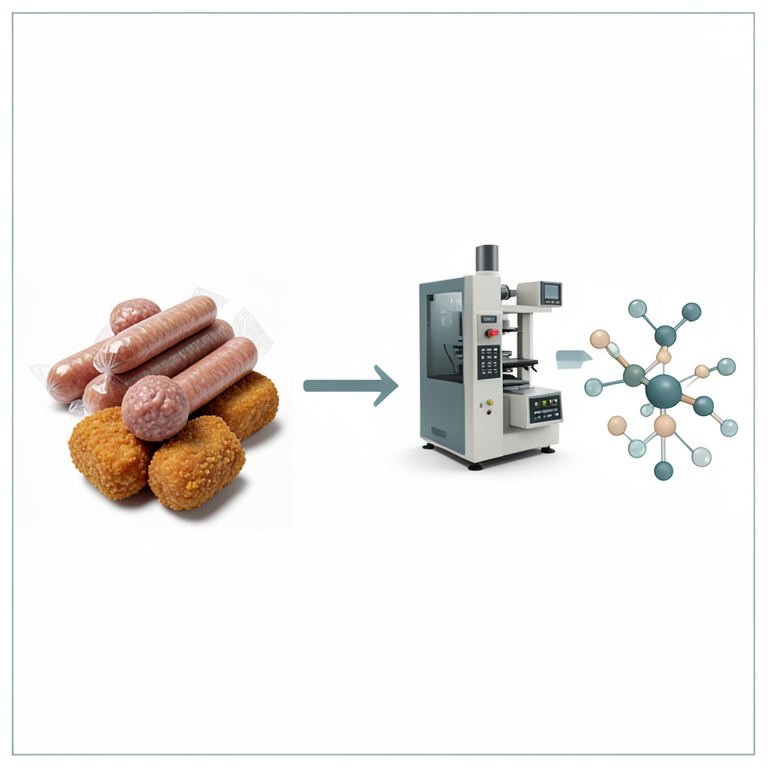
Study Workflow
AI-generated conceptual illustration (packaged chicken sausages, meatballs, and nuggets). It explains the idea and does not show study data.
View source evidence ↗Introduction
Enrofloxacin is a broad spectrum antimicrobial agent which is widely used in veterinary medicine (Nouws et al. 1988) [4]. Enrofloxacin residues are reported in animal tissues (Schneider, 2001; Cornejo et al., 2011) [5, 2]. The indiscriminate use of this agent possesses a considerable risk due to the presence of residues in meat and meat products meant for human consumption. The FAO/WHO have recommended Maximum Residue Limits (MRL) for Enrofloxacin in animal tissues (FAO/WHO, 2002) [3].
Packaged meat products like sausages, meat balls and nuggets are considered as important food item and has become popular in recent times. There may be every chance of presence of drug residues in such products. Thus the present study was undertaken to monitor packaged meat products for Enrofloxacin residues available in local shops of Guwahati city using Ultra High Performance liquid Chromatography (UHPLC).
Materials And Methods
A total of 60 samples (twenty each) of chicken sausage, chicken meat balls and chicken nuggets were collected from local shops of Guwahati city. The samples were then stored at - 20ºC till the time of processing. Screening and analysis of samples for the presence of Enrofloxacin residues was performed with Ultra High Performance Liquid Chromatography (UHPLC) system with diode array detector. The mobile phase consisted of mixture of water, acetonitrile and tetraethylamine (83:14:0.45 v/v).
Enrofloxacin was eluted under isocratic conditions. The excitation/emission wavelengths used for the UV detection was 277 nm for Enrofloxacin. Enrofloxacin standard (Sigma), HPLC grade acetonitrile, HPLC grade water and other chemicals and solvents of analytical grade were used for the study. About 10 g of the sample with equal volume of distilled water was taken in a tissue blender and mixed.
Ten grams of each blended sample was transferred in a beaker. After few minutes 10 ml of acetonitrile was added and left undisturbed for 10 min. The sample was then sonicated with the help of Ultrasonicator. The samples were then centrifuged at 10,000 rpm at 0 ˚C and the collected supernatant was filtered using Whatman Filter paper.
The filtrate was passed through solid phase extraction procedure using a C18 polymeric cartridge after which it was Further filtered using 0.22µm nylon filter paper. VET 2016; 1(1): 08-09 Gogoi R Department of Pharmacology & Toxicology, C.V.Sc, AAU, Khanapara, Guwahati, Assam, India Roy DC Department of Pharmacology & Toxicology, C.V.Sc, AAU, Khanapara, Guwahati, Assam, India Lahon LC Department of Pharmacology & Toxicology, C.V.Sc, AAU, Khanapara, Guwahati, Assam, India Laskar SK Department of LPT, C.V.Sc, AAU, Khanapara, Guwahati, Assam, India Correspondence: Gogoi R Department of Pharmacology & Toxicology, C.V.Sc, AAU, Khanapara, Guwahati, Assam, India
Results And Discussion
In the present study, linear calibration curve of Enrofloxacin standard having correlation coefficient (R2) of 0.999 was obtained. This was similar to that reported by Cinquina et al., 2003 [1]. The separation of the analytes was achieved in less than 5 mins. Acetonitrile was effective in the deproteinization of the samples and in the isolation of analytes from spiked samples.
This method allows the determination of residues of Enrofloxacin in different matrices with higher sensitivity. Recovery of enrofloxacin in spiked samples ranged from 85- 97%. This finding was in similar line as that reported by Cinquina (loc cit.) where average recovery was 88%. After screening all the samples of chicken sausage, chicken meat balls and chicken nuggets, residue of enrofloxacin was not detected in any of the samples.
This may be due to absence of the drug in the meat products.
Conclusion
It can be concluded from the present study that the samples of chicken sausages, chicken meat balls and chicken nuggets may be considered as safe and free from enrofloxacin residue, all though there is every need of monitoring these products from time to time.
References
5 in the original paper- Cinquina AL, Roberti P, Giannetti L, Longo F, Draisci, R, Fagiolo A et al. Journal of Chromatography A. 2003; 987(1):221-226.
- Cornejo J, Lapierre L, Iragüen D, Cornejo S, Cassus G, Richter P, et al. Journal of Veterinary Pharmacology and Therapeutics. 2011; 4:1365-2885.
- FAO/WHO. Evaluation of certain veterinary drug residues in food. Fifty-eight meeting of the Joint FAO/WHO Expert commmitte on food additives, WHO Technical Report Series, 2002, 911.
- Nouws JFM, Mevius DJ, Vree TB, Baars AM. Laurensen Veteinary Quaterly 1988; 10:156-163.
- Schneider MJ. Journal of Chromatographic Science. 2001; 39:351-356