
Research article · 2016 · Full text
International Journal of Statistics and Applied MathematicsMathematical analysis of MHD flow of an optically thin viscous fluid through a channel
Volume 1(2) · Pages 13–23
Research areasNanofluid Flow and Heat TransferFluid Dynamics and Turbulent FlowsFractional Differential Equations Solutions
Abstract
Author-writtenIn this paper, the influence of radiation on MHD flow of an optically thermal conductivity viscous incompressible fluid a through channel with a sliding wall and irregular temperatures are presented. The approximated analytical expressions of the dimensionless temperature and the dimensionless velocity are derived by using the New Homotopy analysis method. Further the analytical expression of the Nusselt number is also derived. The graphical representations of temperature and velocity profiles are depicted with the help of thermal conductivity variation parameters, thermal radiation parameter, axial pressure gradient parameter, magnetic parameter, Grashof number. We also present the qualitative of the critical relationship between the parameters. The New Homotopy analysis method can be further extended to solve some strongly non-linear boundary value problems in other MHD fluid flow in engineering problems.
Summary
Source-checkedPlain-language reading of the full paper, prepared with AI and checked against the text. Each point links to the authors' own words.
Why it matters
- Studying flow and heat transfer in parallel plate channels is important for applications in petrochemical industries and bio-medical engineering. View evidence ↗
- Designing relevant industrial equipment requires a deep understanding of high-temperature processes and radiative heat transfer. View evidence ↗
- The presence of thermal radiation and variable conductivity in thermal boundary layer equations creates a non-linear mathematical problem. View evidence ↗
The question
- The study aims to investigate how thermal radiation affects temperature-guided flows in a channel that has a sliding wall and a homogeneous magnetic field. View evidence ↗
What they did
- The model assumes a fluid with small electrical conductivity, negligible absorption, and very small produced electromagnetic force. View evidence ↗
- The analysis assumes all physical properties of the fluid are constant, except for thermal conductivity, which is modeled to vary linearly with temperature. View evidence ↗
- The New Homotopy analysis method (HAM) was used to derive approximate analytical expressions for dimensionless velocity and temperature. View evidence ↗
What they found
- Increasing the thermal conductivity variation parameter (α) leads to a decrease in dimensionless temperature for certain fixed values of the radiation parameter (R). View evidence ↗
- Dimensionless temperature decreases as the thermal radiation parameter (R) increases, given fixed values of the thermal conductivity variation parameter (α). View evidence ↗
- Increasing the thermal radiation parameter (R) results in a decrease in dimensionless velocity for some fixed parameter values. View evidence ↗
- An increase in the axial pressure gradient parameter (N) leads to a decrease in dimensionless velocity under some fixed parameters. View evidence ↗
- Increasing the Hartmann number (H) causes the dimensionless velocity to decrease for some fixed parameters. View evidence ↗
- An increase in the Grashof number (Gr) leads to an increase in the corresponding dimensionless velocity for some fixed parameter values. View evidence ↗
- Increasing the radiation parameter (R) improves the Nusselt number (Nu) at the upper wall region but decreases it at the lower wall region. View evidence ↗
- Increasing the thermal conductivity variation parameter (α) decreases the Nusselt number (Nu) when the radiation parameter (R) is fixed. View evidence ↗
What it means
- The authors conclude that the New Homotopy analysis method can be easily extended to solve other non-linear boundary value problems related to MHD fluid flow in the physical sciences. View evidence ↗
Visual summary
1 visualsIllustrations explain the paper; they do not show study data.
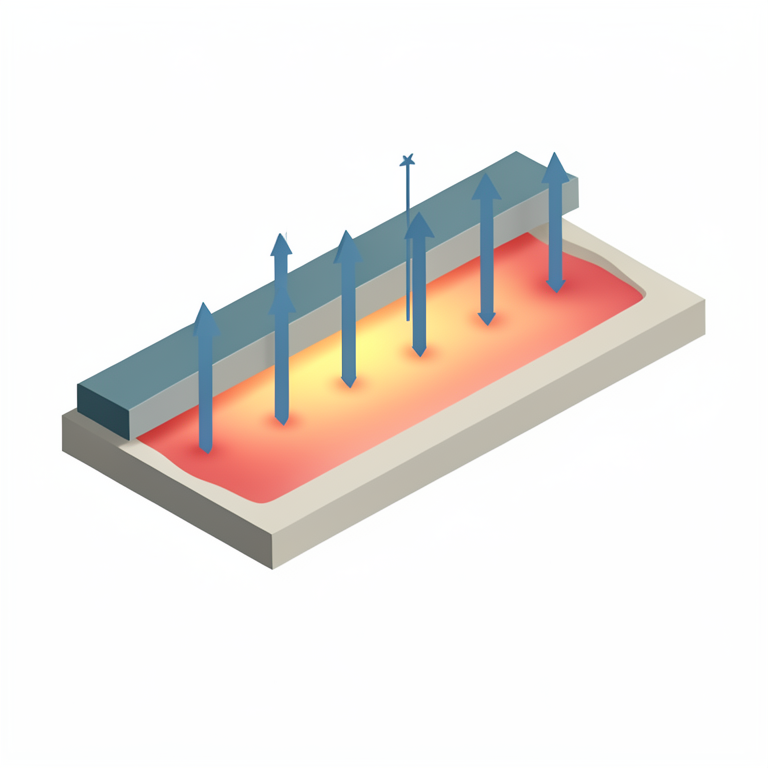
Physical Model of MHD Flow
AI-generated conceptual illustration (viscous fluid between two parallel plates in a channel). It explains the idea and does not show study data.
View source evidence ↗Figures & tables
From the original paper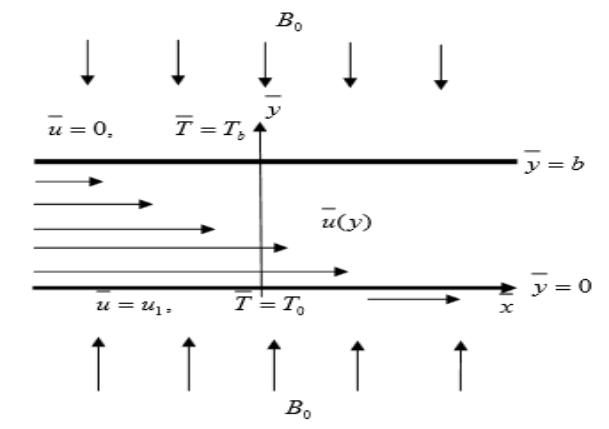 Figure 1
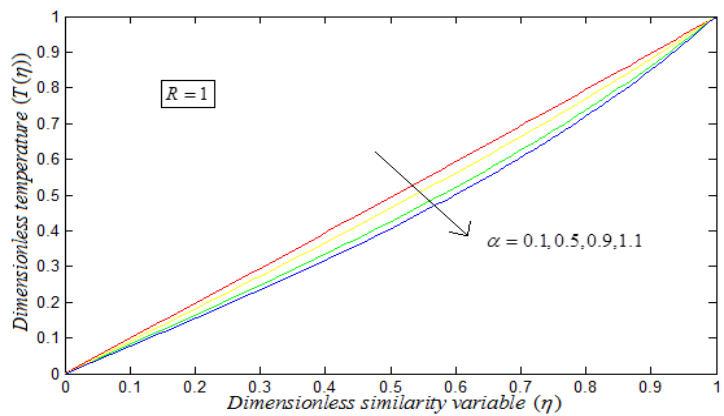 Figure 2
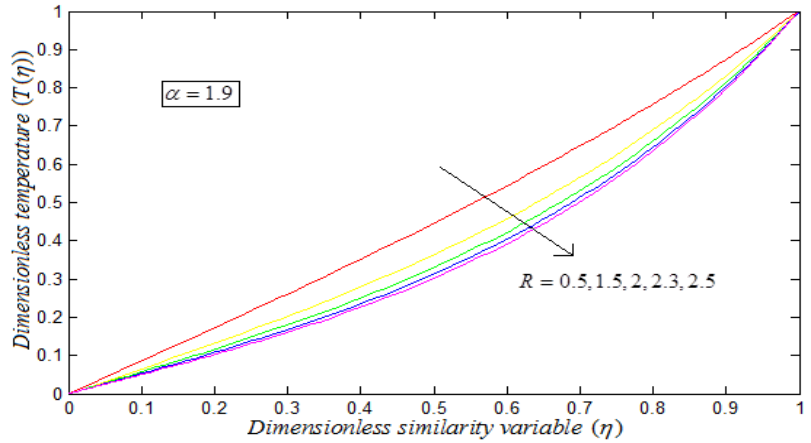 Figure 3
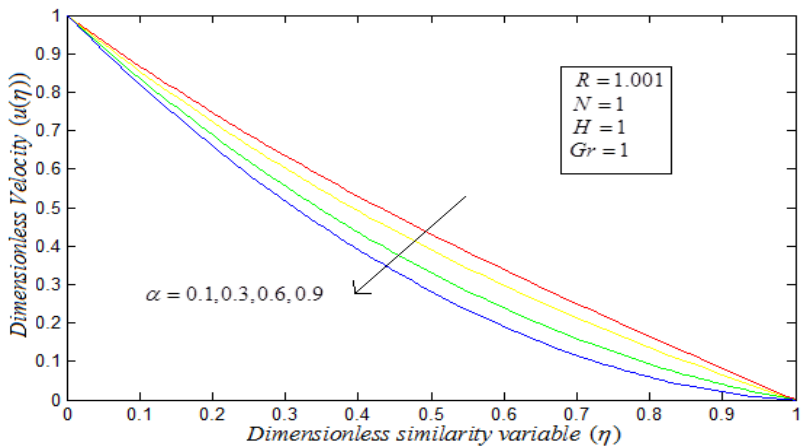 Figure 4
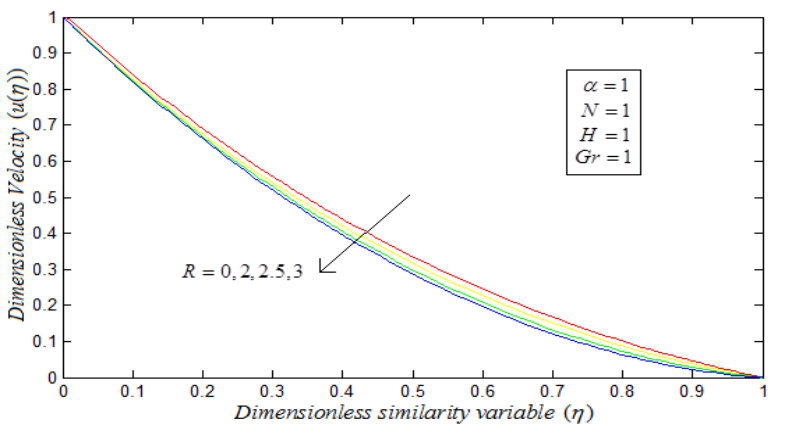 Figure 5
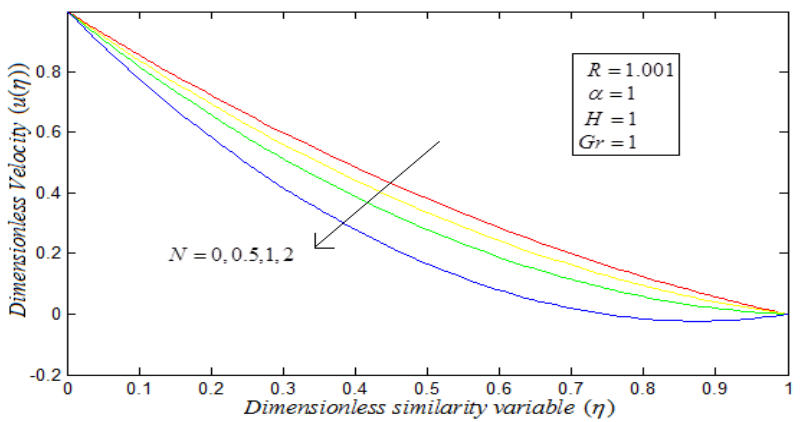 Figure 6
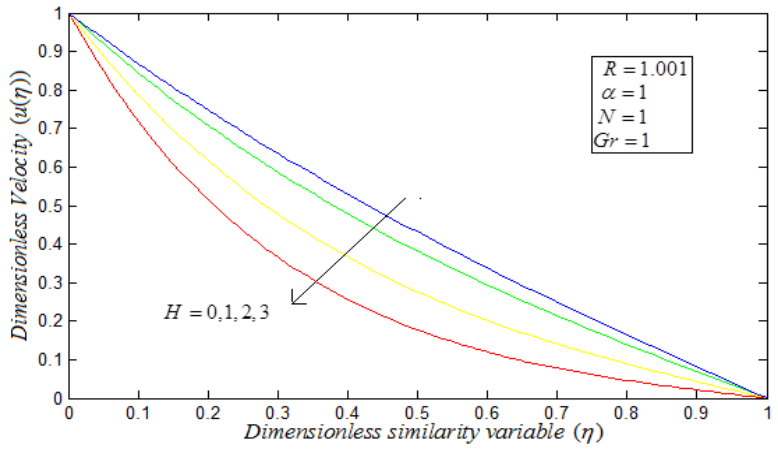 Figure 7
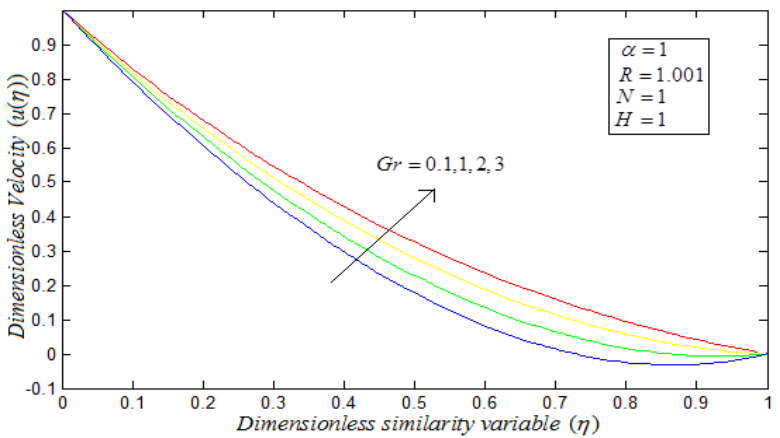 Figure 8
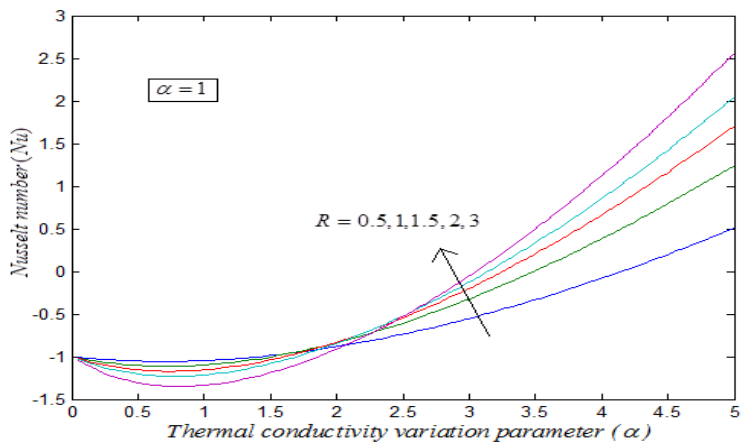 Figure 9
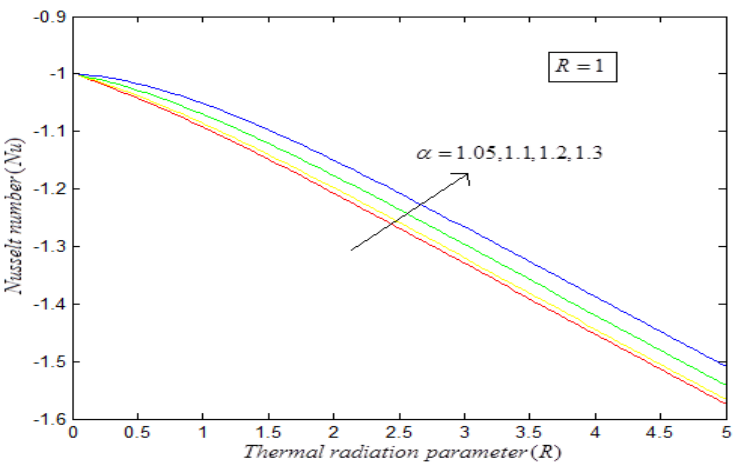 Figure 10
Introduction
Many authors Arpaci et al [1] , Makinde [2] , Sahin [3] has been studied about the flow and heat transfer between parallel plates channel and is applied in bio-medical engineering, petrochemical industries etc. To design the pertinent equipment, intensive knowledge of radiative heat transfer and high temperature technological process is required by Makinde and Mhone [4] . In the study of Kay [5] , the thermal conductivity of the fluid is kept constant and we know that the physical property may be change accordingly with temperature. The thermal boundary layer equation for variable conductivity fluid in the presence of thermal radiation composes a nonlinear problem. Thus, the solution of theory of non-linear differential equation is ideal for practical relevance in science and engineering. We have referred the variable viscosity and thermal radiation effects on entropy generation rate, the problem of irreversibility in the flow of a temperature dependent variable viscosity optically small size fluid through a channel with isothermal walls by Makinde [6] . The effect of variable thermal conductivity and viscosity on single phase convective heat transfer in slip flow was analyzed by Sadik et al [7] . The heat transfer to MHD oscillatory flow in a channel filled with porous medium was analyzed by Cogely [8] . The thermal radiation effects on steady boundary-layer flow with variable thermal conductivity over a non-isothermal stretching sheet placed at the bottom of a saturated porous medium was studied by Paresh and Archana [9] . The effect of combined radiation and convection in thermally developing poiseuille flow with scattering was studied by Chawla and Chan [10] . By the above analysis, the aim of this paper is to study the effect of thermal radiation on various temperature guidance flows through a channel with sliding wall applied homogenous magnetic field. It can be assumed that thermal conductivity different linearly temperature. It has, therefore prompted us to investigate heat transfer with thermal radiative and variable conductivity MHD flows through channel with a sliding wall by using New Homotopyanalysis method.
Mathematical formulation of the problem
We follows that a steady two-dimensional laminar incompressible flow of conducting optically thin viscous fluid through a channel with the lower sliding wall and irregular wall temperatures under guidance of an externally applied homogeneous magnetic field and radiative heat transfer. Consider the fluid with negligible absorption has small electrical conductivity and the electromagnetic force produced is very small. A Cartesian coordinate system is used and the flow is chosen along the x-direction under constant pressure-gradient which is driven solely by uniform velocity at the lower wall. That is the velocity linear with zero at the upper fixed wall and maximum value at the lower moving wall. Here u denotes flow velocity the x-direction, v denotes kinematic velocity, T denotes temperature, k denotes thermal conductivity, denotes density of the fluid, p represent the constant pressure, p c denotes specific heat at constant pressure, g denotes gravitational force, q denotes radiative heat flux, coefficient of volume expansion due to temperature, ) (
Following that the medium is optically thin and with relatively low density. The radiative heat flux is
Here is the mean radiation absorption coefficient. The dimensionless temperature represented as
The variable thermal conductivity is
Here denotes thermal conductivity variation parameter, R denotes radiation parameter H denotes Hartmann number and Gr
Grashof number respectively. The equations ( 1) and ( 2) together with boundary conditions ( 3) and ( 4) reduced to the form 0 ,
The velocity u and the temperature T as well as the wall heat transfer rate,
Solution of the problems using the New Homotopy analysis method HAM is a non perturbative analytical method for obtaining series solutions to nonlinear equations and has been successfully applied to numerous problems in science and engineering [7][8][9][10][11][12][13][14][15][16][17][18][19][20][21][22] . In comparison with other perturbative and non perturbative analytical methods, HAM offers the ability to adjust and control the convergence of a solution via the so-called convergencecontrol parameter. Because of this, HAM has proved to be the most effective method for obtaining analytical solutions to highly non-linear differential equations. Previous applications of HAM have mainly focused on non-linear differential equations in which the non-linearity is a polynomial in terms of the unknown function and its derivatives. As seen in ( 1), the non-linearity present in electro hydrodynamic flow takes the form of a rational function, and thus, poses a greater challenge with respect to finding approximate solutions analytically. Our results show that even in this case, HAM yields excellent results. Liao [7][8][9][10][11][12][13][14][15] proposed a powerful analytical method for non-linear problems, namely the Homotopy analysis method. This method provides an analytical solution in terms of an infinite power series. However, there is a practical need to evaluate this solution and to obtain numerical values from the infinite power series. In order to investigate the accuracy of the Homotopy analysis method (HAM) solution with a finite number of terms, the system of differential equations were solved. The Homotopy analysis method is a good technique comparing to another perturbation method. The Homotopy analysis method contains the auxiliary parameter h , which provides us with a simple way to adjust and control the convergence region of solution series. Using this method, we can obtain the following solution to (1) and (2) (see Appendix B). The approximate analytical solution of the equations ( 1) and (2) using HAM is given by
Results and discussion
In this section the effects of physical parameters including thermal conductivity variation parameter , thermal radiation parameter R , axial pressure gradient parameter N , magnetic parameter H , and Grashof number Gr will be presented. Fig. 1 shows that the physical model of the problem. Fig. 2 and3 shows the dimensionless temperature )) ( ( T versus the dimensionless similarity variable ) ( . From Fig. 2, we inferred that increasing the thermal conductivity variation parameter , decreases the dimensionless temperature in some fixed values of R . From Fig. 3, we depicts that the dimensionless temperature decreases, when the thermal radiation parameter R increases in some fixed values of . ( . From Fig. 4, we infer that the dimensionless velocity decreases, when the thermal conductivity variation parameter ) ( increases in some values of the fixed parameter. From Fig. 5, we illustrates that increasing the thermal radiation parameter R , decreases the dimensionless velocity in some fixed values of parameter. From Fig. 6, we observe that increasing the axial pressure gradient parameter N , decreases the dimensionless velocity in some fixed parameters. From Fig. 7, it is noted that when the Hartmann number H increases, the dimensionless velocity decreases in some fixed parameter. From Fig. 8 it is evident that when the Grash of number increases, the corresponding dimensionless velocity increases in some fixed values of parameter. Fig. 9 describes the Nusselt number ( Nu ) versus thermal conductivity variation parameter ( ).It is observed that Nusselt number Nu is improved with increasing ( R ) at the upper wall region, while a decrease in the Nusselt number at the lower wall region. Fig. 10, represent that Nusselt number ( Nu ) versus thermal radiation parameter ( R ). We demonstrate that increasing the thermal conductivity variation parameter , decreases the Nusselt number Nu with the fixed parameter R . If the auxiliary linear operator, the initial guess, the auxiliary parameter h, and the auxiliary function are so properly chosen, the series (A.4) converges at p =1 then we have:
Differentiating (A.2) for m times with respect to the embedding parameter p, and then setting p = 0 and finally dividing them by m!, we will have the so-called mth -order deformation equation as:
When
When
M
, get an accurate approximation of the original eqn. (A.1). For the convergence of the above method we refer the reader to Liao [20] . If an eqn. (A.1) admits unique solution, then this method will produce the unique solution.
Appendix B Approximate analytical expressions of the non-linear differential eqns. (10)-(13) using the New Homotopy analysis method
In this appendix, The eqns. (10) can be written in the following form
We construct the Homotopy for the eqn. (B.1) and (B.2) are as follows:
The approximate solution of the eqn. (B.3) and (B.4) are as follows:
... The initial approximations are as follows:
Comparing the coefficients of like powers of p in eqn. (B.8), we get the following eqn.
Comparing the coefficients of like powers of p in eqn. (B.11), we get the following eqn. 17)-( 18) respectively. According to the Homotopy analysis method we have
N
N
References
32 in the original paper- Arpaci VS, Selametand A, SH Kao. Introduction to Heat Transfer, Prentice-Hall, New York, 2000.
- Makinde Od. Entropy-generation analysis for variable-viscosity channel flow with non-uniform wall temperature, Applied Energy. 2008; 85:384-393.
- Sahin AZ. Effect of variable viscosity on the entropy generation and pumping power in a laminar fluid flow through a duct subjected to constant heat flux, Heat Mass Transfer, 1999; 35:499-506.
- Makinde OD, P.Y.Mhone, Heat transfer to MHD oscillatory flow in a channel filed with a porous medium, Journal physics, 2005; 50:931-938.
- Kay WM. Convective heat and mass transfer. Mc-Graw Hill, New York, 1996.
- Makinde OD. Hermite-pade approach to thermal radiation effect on inherent irreversibility in a variable viscosity channel flow, Computers and Mathematics with Applications, 2009; 58:2330-2338.
- Sadik Kakac, Almila G Yazicioglu, Arif Cem Gozukara, Effect of variable thermal conductivity and viscosity on single phase convective heat flow, Heat and Mass Transfer. 2011; 47:499-506.
- Cogley ACL, Vincenti WG, Gilles ES. Differential approximation for radiative heat transfer in a nonlinear quations-grey gas near equilibrium,Am.Inst.Aeronaut.Astronaut, 1968; 6:551-553.
- Paresh Vyas, Archana Rai. Radiative flow with variable effect on inherent irreversibility in a variable viscosity channel flow, Int. J Contemp Mayh Sciences. 2010; 54:2685-2698.
- Chawla TC, Chan SH. Combined radiation and convection in thermally developing poiseuille flow with scattering, Heat Transfer, 1980; 102:297-302.
- Liao SJ. The proposed homotopy analysis technique for the solution of non linear problems, Ph.D. Thesis, Shanghai Jiao Tong University, 1992.
- Liao SJ. An approximate solution technique which does not depend upon small parameters: a special example, Int. J NonLinear Mech. 1995; 30:371-380.
- Liao SJ. Beyond perturbation introduction to the Homotopy analysis method, 1 st edn. Chapman and Hall, CRC press, Boca Raton, 2003, 336.
- Liao SJ. On the Homotopy analysis method for nonlinear problems, Appl. Math. Comput. 2004; 147:499-513.
- Liao SJ. An optimal Homotopy-analysis approach for strongly nonlinear differential equations, Commun. Nonlinear Sci. Numer. Simulat. 2003-2016; 15:2010.
- Liao S J. The Homotopy analysis method in nonlinear differential equations, Springer and Higher education press, 2012.
- Liao SJ. An explicit totally analytic approximation of Blasius viscous flow problems. Int J Nonlinear Mech. 1999; 34:759-78.
- Liao SJ. On the analytic solution of magneto hydrodynamic flows non-Newtonian fluids over a stretching sheet. J Fluid Mech. 2003; 488:189-212.
- Liao SJ. A new branch of boundary layer flows over a permeable stretching plate. Int J Nonlinear Mech. 2007; 42:19-30.
- Domairry G, Bararnia H. An approximation of the analytical solution of some nonlinear heat transfer equations: a survey by using Homotopy analysis method, Adv. Studies Theory Phys. 2008; 2:507-518.
- Tan Y, Xu H, Liao SJ. Explicit series solution of travelling waves with a front of Fisher equation. Chaos Solitons Fractals. 2007; 31:462-72.
- Abbasbandy S. Soliton solutions for the equation with the homotopy analysis method. Appl Math Model: 2008; 32:2706-14.
- Cheng J, Liao SJ, Mohapatra RN, Vajravelu K. Series solutions of nano boundary layer flows by means of the homotopy analysis method. J Math Anal Appl. 2008; 343:233-245.
- Hayat T, Abbas Z. Heat transfer analysis on MHD flow of a second grade fluid in a channel with porous medium. Chaos Solitons Fractals. 2008; 38:556-567.
- Hayat T, Naz R, Sajid M. On the homotopy solution for Poiseuille flow of a fourth grade fluid. Commun Nonlinear Sci Numer Simul, 2010; 15:581-589.
- Jafari H, Chun C, Saeidy SM. Analytical solution for nonlinear gas dynamic Homotopy analysis method, Appl. Math. 2009; 4:149-154.
- Subha M, Ananthaswamy V, Rajendran L. Analytical solution of non-linear boundary value problem for the electrohydrodynamic flow equation. International Jouranal of Automation and Control Engineering. 2014; 3(2):48-56.
- Saravanakumar K, Ananthaswamy V, Subha M, Rajendran L. Analytical Solution of nonlinear boundary value problem for in efficiency of convective straight Fins with temperature-dependent thermal conductivity, ISRN Thermodynamics, Article ID. 2013; 282481:1-18.
- Ananthaswamy V, Subha M. Analytical expressions for exothermic explosions in a slab, International Journal of Research - Granthaalayah. 2014; 1(2):22-37.
- Ananthaswamy V, Uma Maheswari S. Analytical expression for the hydrodynamic fluid flow through a porous medium, International Journal of Automation and Control Engineering. 2015; 4(2):67-76.
- Ananthaswamy V, Sahaya Amalraj L. Thermal stability analysis of reactive hydromagnetic third-grade fluid using Homotopy analysis method, International Journal of Modern Mathematical Sciences, 2016; 14(1):25-41.
- Ananthaswamy V, yogeswari N. Astudy on MHD Jeffery-Hamel flow in nanofluids using New Homotpy analysis method, International journal of Scientific Research and Modern Education, 2016; 1(1).
Cited by 1
From OpenAlex, OpenCitations and reference lists read by Scinovex
- Ohmic Heating of Magnetohydrodynamic Viscous Flow over a Continuous Moving Plate with Viscous Dissipation Buoyancy and Thermal Radiation ↗
Kolawole Sunday Adegbie, Damilare John Samuel, Babatunde Oluwaseun Ajayi · Defect and diffusion forum/Diffusion and defect data, solid state data. Part A, Defect and diffusion forum · 2019
This study extends previous investigation on ohmic heating of magnetohydrodynamic viscous fluid flow over a continuous moving plate to include radiative heat-loss, viscous dissipation and buoyancy effects. The mathematical formulation representing the modified physical model involves a system of three partial differential equations, which are transformed into a system of two coupled non-linear ordinary differential equations using suitable dimensionless variables.…
❝ 17PDF