
Research article · 2016 · Full text
International Journal of Statistics and Applied MathematicsA problem on mathematical interactions due to ultra thermal laser source in micropolar mass diffusion material by using Laplace and Fourier transform
Volume 1(3) · Pages 43–48
Research areasThermoelastic and Magnetoelastic PhenomenaLaser Material Processing TechniquesThermography and Photoacoustic Techniques
Abstract
Author-writtenThe present investigation deals with the deformation in micropolar generalized thermoelastic medium with mass diffusion subjected to thermo mechanical loading due to thermal laser pulse. Laplace and Fourier transform technique is used to solve the problem. Concentrated normal force and thermal source are taken to illustrate the utility of approach. The closed form expressions of normal stress, tangential stress, tangential couple stress, mass concentration and temperature distribution are obtained in the transformed domain. Numerical inversion technique of Laplace transform and Fourier transform has been applied to obtain the resulting quantities in the physical domain after developing a computer program. The normal stress, tangential stress, tangential coupled stress, temperature distribution and mass concentration are depicted graphically to show the effect of relaxation times. Some particular cases of interest are deduced from the present investigation.
Summary
Source-checkedPlain-language reading of the full paper, prepared with AI and checked against the text. Each point links to the authors' own words.
Why it matters
- Micropolar theory of elasticity is used to model composite materials by accounting for both local deformation and the rotation of material points. View evidence ↗
- Laser pulses are critical for non-destructive material testing because they create localized temperature increases upon energy absorption. View evidence ↗
- Classical Fourier models of heat conduction fail during ultra-short laser heating due to the extreme thermal gradients and high energy flux at boundaries. View evidence ↗
The question
- The study aims to establish a mathematical model for a micropolar thermoelastic medium with mass diffusion, specifically considering the effects of ultra-short laser radiation. View evidence ↗
What they did
- The researchers used a combination of Laplace and Fourier transforms to solve the governing equations of the model. View evidence ↗
- To demonstrate the model's utility, the authors applied concentrated normal forces and thermal sources as boundary conditions. View evidence ↗
- A custom computer program was developed to perform numerical inversion of the transforms to translate results back into the physical domain. View evidence ↗
- The numerical analysis was performed using physical constants corresponding to a magnesium crystal-like material. View evidence ↗
What they found
- Tangential stress shows greater variation in a standard micropolar thermoelastic medium compared to one that includes mass diffusion. View evidence ↗
- The inclusion of mass diffusion increases the magnitude of the couple tangential stress compared to the micropolar thermoelastic case. View evidence ↗
- Mass concentration initially decreases and then exhibits oscillatory behavior as it moves toward the boundary surface away from the force application point. View evidence ↗
What it means
- The authors conclude that mass concentration has a significant impact on all calculated field variables in the medium. View evidence ↗
- The authors state that their model is more realistic and should motivate further research into microstretch generalized thermoelasticity under high heat flux or short-duration laser pulses. View evidence ↗
Visual summary
1 visualsIllustrations explain the paper; they do not show study data.
Model Components
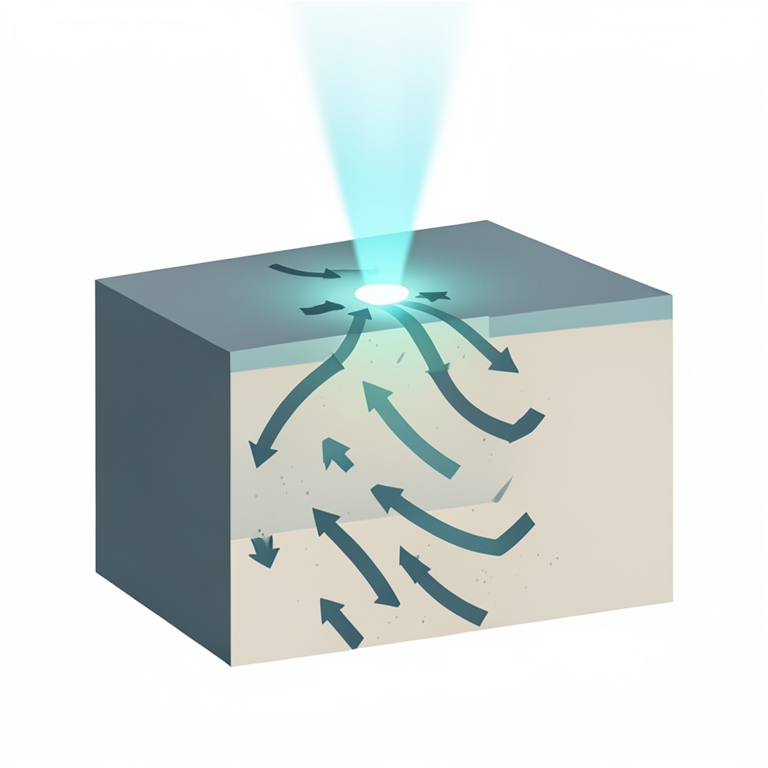
AI-generated conceptual illustration (a micropolar thermoelastic material block). It explains the idea and does not show study data.
View source evidence ↗Figures & tables
From the original paper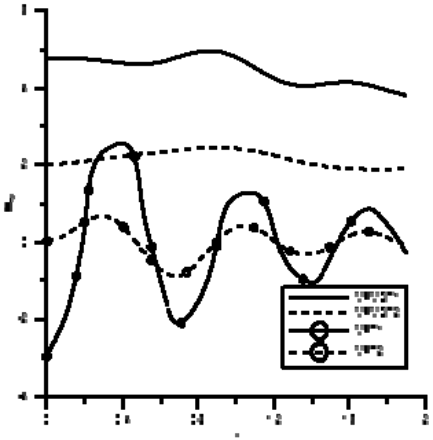 Figure 4
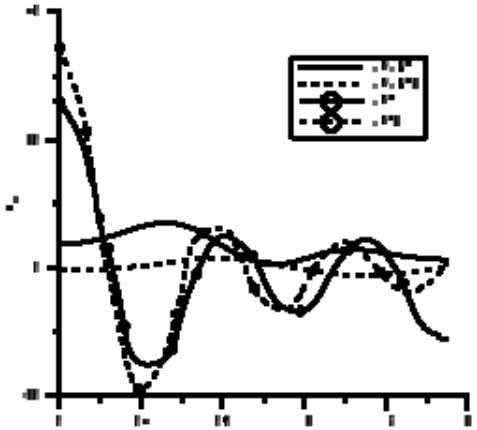 Figure 2
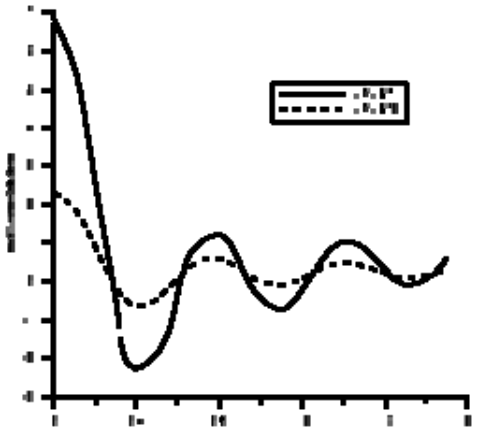 Figure 5
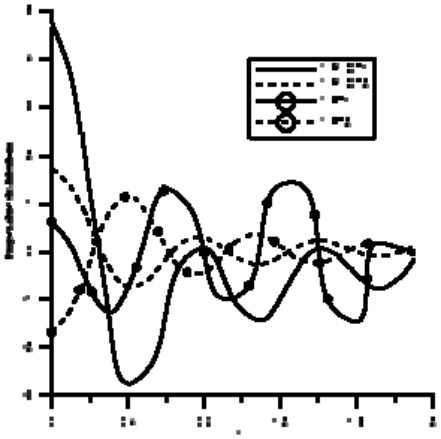 Figure 3
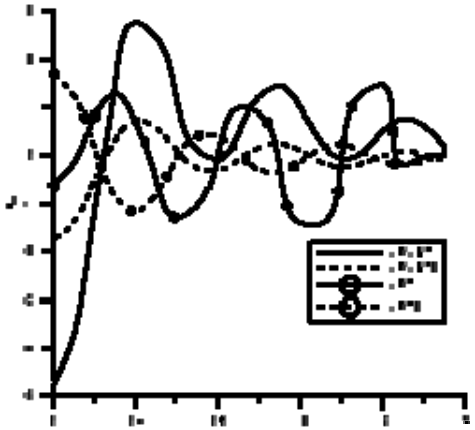 Figure 1
Introduction
Micropolar theory of elasticity was introduced by Eringen [1] . This theory incorporates the local deformation and rotation of the material points of the composite. This theory provides a model that can support body couples and surface couples and exhibits a high frequency optical wave spectrum. Eringen [2,3] , Maugin and Mild [4] , Nowacki [5] developed the linear theory of micropolar thermoelasticity by excluding the micropolar theory of elasticity to include the thermal effects. Touchert et al. [6] derived the basic equations of linear theory of micropolar coupled thermoelasticity. Diffusion is defined as the spontaneous movement of the particles from a high concentration region to the low-concentration region, and it occurs in response to a concentration gradient expresses as the change in the concentration due to change in position. Thermal diffusion utilizes the transfer of heat across a thin liquid or gas to accomplish isotope separation. Today, thermal diffusion remains a practical process to separate isotopes of noble gases e.g., Xenon and other light isotopes e.g., Carbon for research purposes. In most of the applications, the concentration is calculated using Fick's law. This into consideration is a simple law which does not take the mutual interaction between the introduced substance and the medium into which it is introduced or the effect of temperature of this interaction. However, there is a certain degree of coupling with temperature and temperature gradients as temperature speeds up the diffusion process. Nowacki [7,10] developed the theory of thermoelastic diffusion by using coupled thermoelastic model. Dudziak and Kowalski [11] and Olesiak and Pyryev [12] , respectively, discussed the theory of thermo diffusion and coupled quasi stationary problems of thermal diffusion for an elastic layer. Laser technology has a vital application in nondestructive materials testing and evaluation. When a solid is heated with a laser pulse, it absorbs some energy which results in an increase in localized temperature. This cause thermal expansion and generation of the ultrasonic waves in the material. There are generally two mechanisms for such wave generation, depending on the energy density deposited by the laser pulse. At high energy density, a thin surface layer of the solid material melts, followed by an ablation process whereby particles fly off the surface, thus giving rise to forces that generates ultrasonic waves. At low energy density, the surface material does not melt, but it expands at a high rate and wave and wave motion is generated due to thermoelastic processes. Very rapid thermal processes (e.g., the thermal shock due to exposure to an ultra-short laser pulse) are interesting from the stand point of thermoelasticity, since they require a coupled analysis of the temperature and deformation fields. A thermal shock induces very rapid movement in the structural elements, giving the rise to very significant inertial forces, and thereby, an increase in vibration. Rapidly oscillating contraction and expansion generates temperature changes in materials susceptible to diffusion of heat by conduction [13] . This mechanism has attracted considerable attention due to the extensive use of pulsed laser technologies in material processing and non-destructive testing and characterization [14,15] . The so-called ultra-short lasers are those with pulse durations ranging from nanoseconds to femto seconds. In the case of ultra-short pulsed laser heating, the high intensity energy flux and ultra-short duration lead to a very large thermal gradients or ultra-high heating may exist at the boundaries. In such cases, as pointed out by many investigators, the classical Fourier model, which leads to an infinite propagation speed of the thermal energy, is no longer valid [16] . Researchers have proposed several models to describe the mechanism of heat conduction during short-pulse laser heating, such as the parabolic one-step model [17] , the hyperbolic one-step model [18] , and the parabolic two-step and hyperbolic two-step models [19,20] . In this research, taking into account the mass concentration effect and radiation of ultra-short laser, we have established a model for micropolar thermoelastic medium with mass diffusion by using Laplace and Fourier transforms. The stress components and temperature distribution have been computed numerically. The resulting quantities are shown graphically to show the effect of mass concentration and temperature.
Problem Formulation
Following Eringen [3] and Al-Qahtani and Datta [30] the basic equations for homogeneous, isotropic micropolar generalized thermoelastic solid with mass diffusion in the absence of body forces and body couples are given by: ,
, ( 5) , ( 6) The plate surface is illuminated by laser pulse given by the heat input (7) where is the energy absorbed. The temporal profile is represented as, (8) Here is the pulse rise time. The pulse is also assumed to have a Gaussian spatial profile in (9) Where is the beam radius, and as a function of the depth the heat deposition due to the laser pulse is assumed to decay exponentially within the solid, (10) Equation ( 7) with the aid of (8,9 and 10) takes the form , (11) we take
For further consideration, it is convenient to introduce in equations (1.1)-(1.4) the dimensionless quantities defined as:
Making use of ( 13) in ( 1)-( 4) and with the aid of (12), we obtain:
Special case Micropolar Thermoelastic Solid:
In absence of mass diffusion effect in Equations ( 38) -( 42), we obtain the corresponding expressions of stresses, displacements and temperature for micropolar generalized thermoelastic half space.
Inversion of the transforms
The transformed displacements, stresses and temperature changes are functions of the parameters of Laplace and Fourier transforms and respectively and hence these are of the form . To obtain the solution of the problem in the physical domain, we must invert the Laplace and Fourier transform by using the method applied by Kumar [34].
Numerical Results and Discussion
The analysis is conducted for a magnesium crystal-like material. For numerical computations, following Eringen [3] , the values of physical constants are: , Comparison of the dimensionless form of the field variables for the cases of micropolar mass diffusion thermoelastic medium (MPMD) and micropoar thermoelastic medium (MP) for two different values of time t (t=.01 and t=.02), subjected to linearly distributed source is shown in Figures 12345. The values of all physical quantities for all cases are shown in the range .Solid lines, dash lines corresponds to micropolar thermoelastic mass diffusion medium (MPMDT1) for t =0.01andmicropolar thermoelastic mass diffusion medium (MPMDT2)fort=0.02 respectively. Solid lines with central symbol & dash line with central symbol corresponds to micropolar thermoelastic (MPT1 and MPT2) for t=.01and t=.02respectively.
Linearly distributed normal force
Fig. 1 shows the variation of normal stress with the distance . It is noticed that for MPMDT1 and MPMDT2, show similar behavior. The value of normal stress monotonically increases as and then oscillates. The value of increases near the application of the normal force due to the mass diffusion effect and then remain oscillating for all values of . Fig. 2 displays the variation of tangential stress with the distance . It is noticed that initially the behavior of for MPMDT1 and MPT1 show variable trend but for MPMDT1, MPMDT2 and MPT1, MPT2 exhibits similar behavior.
Initially decrease monotonically for all the cases. The variation in tangential stress in micropolar thermoelastic is more than that of micropolar thermoelastic with mass diffusion. Fig. 3 shows the variation of couple tangential stress with distance . The behavior and variation of for MPMDT1, MPMDT2, MPT1 and MPT2 remain similar to each other for all values of . The magnitude of couple tangential stress in micropolar thermoelastic with mass diffusion is more than that of micropolar thermoelastic Fig. 4 depicts the variation of temperature with distance . The trend and variation of is similar in case of MPMDT1, MPMDT2 and MPT1 initially. For these curves the initial behavior is monotonically decreasing and oscillator away from the point of application of normal force. MPT2 show opposite trend initially. Fig. 5 display the variation of mass concentration with distance . For MPMDT1 and MPMDT2 the graphs are similar. Initially the trend is decreasing. After some oscillatory behavior mass concentration approaches to the boundary surface away from the application of force.
Conclusions
The problem consists of investigating displacement components, scalar mass concentration, temperature distribution and stress components in a homogeneous isotropic micropolar mass diffusion thermoelastic half space due to various sources subjected to laser pulse. Integral transform technique is employed to express the results mathematically. Theoretically obtained field variables are also exemplified through a specific model to present the results in the transformed domain. The analysis of results permits some concluding remarks:
(1) It is clear from the figures that all the field variables have nonzero values only in the bounded region of space indicating that all the results are in agreement with the generalized theory of thermoelasticity. (2) The effect of the mass concentration is much pronounced in all the resulting quantities.
(3) It is noticed that the figures that the time plays a significant role in all the field quantities. Changes inthe value of time cause significant changes in all the simulated resulting quantities. (4) It can be easily concluded from the figures that the curves for various stresses in case of micropolar mass diffusion solid show similar trends. (5) The variation of mass concentration differs significantly due to the presence of normal force and due to the presence of thermal source. (6) Tangential stress, couple stress and temperature change are also affected due to diffusion effect as well as load/source applied. (7) The new model is employed in a micropolar mass diffusion thermoelastic medium as a new improvement in the field of thermoelasticity. The subject becomes more interesting due to irradiation of a laser pulse with an extensive short duration or a very high heat flux has found numerous applications. The method used in this article is applicable to a wide range of problems in thermodynamics. By the obtained results, it is expected that the present model of equations will serve as more realistic and will provide motivation to investigate microstretch generalized thermoelasticity problems regarding laser pulse heat with high heat flux and/or short time duration.
References
16 in the original paper- Eringen AC. Journal of Mathematics and Mechanics. 1966; 15:909.
- Eringen AC. Micropolar elastic solids with stretch, ed. by M.I. Anisina (Ari Kitabevi Matbassi, Istanbul, Turkey,). 1971.
- Eringen AC. Micro continuum Field Theories I: Foundations and Solids (Springer-Verleg, New York,). 1999.
- Maugin GA, Mild. International Journal of Engineering Sciences. 1986; 24:1474.
- Nowacki W. Arch. Mech. Stosow, 1970; 22:3.
- Touchert TR, Claus WD, Ariman T. International Journal of Engineering Sciences. 1968; 6:37.
- Nowacki W. Engg. Fracture Mechanics. 1976; 8:261.
- Dudziak W, Kowalski SJ. International Journal of Heat and Mass Transfer. 1989; 32(11):2005.
- Olesiak ZS, Pyryev YA. International Journal of Engineering Sciences. 1995; 33:773.
- Trajkovski D, Cukic R. Mech. Res Commun. 1999; 26:217.
- Wang X. Xu X. Journal of Thermal Stresses. 2002; 25:457.
- Joseph D, Preziosi L. Rev. Mod. Phys. 1989; 61:41.
- Ozisik MN, Tzou DY. ASME J. Heat Transfer. 1994; 116:526.
- Kim WS, Hector LG, Ozisik MN. J Appl Phys. 1990; 68:5478.
- Qiu TQ, Tien CL. ASME J Heat Transfer. 1993; 115:835.
- Tzou DY. Macro to micro scale heat transfer: The lagging behavior (Taylor and Francis, Bristol). 1999.