
Research article · 2017 · Full text
International Journal of Statistics and Applied MathematicsI-Optimal designs for third degree kronecker model mixture experiments
Volume 2(2) · Pages 35–40
Research areasOptimal Experimental Design Methods
Abstract
Author-writtenMixture experiments are special type of response surface designs where the factors under study are proportions of the ingredients of a mixture. In response surface designs, the main interest of the experimenter may be either on precise model estimation or precise predictions of responses. The main aim of I-optimality is to minimize the average prediction variance throughout the region of interest. Although mixtures experiments are usually intended to predict the response for all possible formulations of the mixture and to identify optimal proportions for each of the ingredients, little research has been done on I-optimal third degree Kronecker designs. I-optimal designs were studied in order to predict the response(s) and the optimal formulations for all possible ingredients in the simplex centroid. Weighted Simplex Centroid Designs (WSCD) and Uniformly Weighted Simplex Centroid Designs (UWSCD) mixture experiments were obtained in order to identify optimal proportions for each of the ingredients formulation. Maximal parameters of interest for third degree Kronecker model were considered. The general equivalence theorem for I-optimality was used to test optimality of different mixture formulations. UWSCD was found to perform better than WSCD in terms of average prediction variance with most formulations satisfying general equivalent theorem for I-optimality.
Summary
Source-checkedPlain-language reading of the full paper, prepared with AI and checked against the text. Each point links to the authors' own words.
Why it matters
- Mixture experiments are a specific type of response surface design where the factors are the proportions of ingredients in a mixture. View evidence ↗
- I-optimality is used in these designs to minimize the average prediction variance across the region of interest, which improves the precision of response predictions. View evidence ↗
- While mixture experiments aim to predict responses for all formulations and identify optimal proportions, there is limited research on I-optimal third-degree Kronecker designs. View evidence ↗
The question
- The study aims to investigate I-optimal designs to predict responses and identify optimal formulations for all possible ingredients within the simplex centroid. View evidence ↗
What they did
- The researchers utilized Weighted Simplex Centroid Designs (WSCD) and Uniformly Weighted Simplex Centroid Designs (UWSCD) to identify optimal ingredient proportions. View evidence ↗
- The general equivalence theorem for I-optimality was applied to test whether different mixture formulations were optimal. View evidence ↗
What they found
- WSCD performed better than UWSCD because it had a smaller average prediction variance, which allows for more accurate response predictions. View evidence ↗
- Pure blends in both the WSCD and UWSCD failed to satisfy the general equivalence theorem, meaning they were not I-optimal. View evidence ↗
- Binary, ternary, and quaternary blends satisfied the general equivalence theorem and were therefore found to be I-optimal. View evidence ↗
- The center point mixtures (1/4, 1/4, 1/4, 1/4) provided the most accurate predictions among all blends due to having the smallest average prediction variance. View evidence ↗
What it means
- The authors conclude that WSC designs yield more accurate results than UWSC designs because they have slightly lower average prediction variances. View evidence ↗
- The authors state that the centroid point provides more accurate predictions than any other point in the simplex for mixture formulations. View evidence ↗
Visual summary
1 visualsIllustrations explain the paper; they do not show study data.
Comparison of Prediction Variance
AI-generated conceptual illustration (A three-dimensional geometric simplex grid representing a mixture experiment design space). It explains the idea and does not show study data.
View source evidence ↗Figures & tables
From the original paper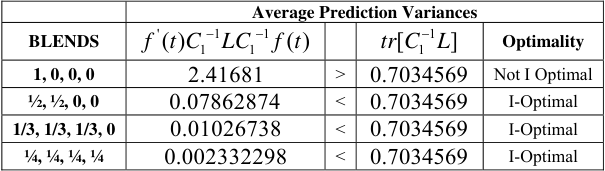 Table 1
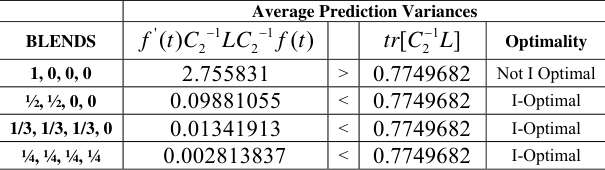 Table 2
Introduction
Mixture experiments are associated with the investigation of the m factors, assumed to influence the response only through proportions in which they are blended together. I-optimal designs minimize the average variance of prediction and therefore more appropriate for mixture experiments for precise predictions of responses. Average prediction variance provides a measure of the precision of the estimated response at any point in the design space. In available literature, the I-optimal designs criterion is often called the V-optimality criterion, Atkinson et al (2007) [1] , but the names IV-or Q-optimality have been used as well, Borskowski (2003) [2] . Laake (1975) [6] analytically derived the I-optimal weights for the design points in case 3 q , assuming that the design points are the points of the ( ,2) q . In experiments with mixtures, Liu and Neudecker (1995) [7] applied Weighted Simplex Centroid (WSC) to obtain V-optimal allocation of observations which was shown to be an optimal design over the entire simplex on Scheffé's polynomial model using the equivalence theorem. Goos et al (2016) studied I-optimal designs of mixture experiments for second order, special cubic and th q degree models. They presented I-optimal continuous designs and contrast them with published results. Goos and Syafitri (2014) [4] studied the problem of finding continuous V-optimal mixture designs for the qth degree model. They provided a critical look at the results published in Liu and Neudecker (1995) [7] and found out that their designs were not Voptimal.
The mixture ingredients t1, t2,…,tm are such that ti ≥0 and further restricted by
Under experimental condition m T t , the response t Y is taken to be a real-valued random variable. In a polynomial regression model the expected value ) ( t Y E is a polynomial function of t. The work done by Draper and Pukelsheim (1998) [3] is being extended to polynomial regression model for third degree mixture model. The S-polynomial is given as,
and the homogeneous third-degree K-polynomial is
in which the Kronecker powers
vectors, consists of pure cubic and three-way interactions of components of t in lexicographic order of the subscripts and with evident that third-degree restrictions are
and k i j
All observations taken in an experiment are assumed to be of equal unknown variance and uncorrelated. The moment matrix 1 ( ) ( ) ( ) ( ) ( )
for the third degree Kronecker model has all entries homogeneous in degree six and reflects the statistical properties of a design . The moment matrix can be partition into sub moments according to the number of ingredients in a simplex centroid design as follows
Information Matrix
The Kronecker model of the full parameter vector 3 m is not estimable. When fitting this model, the parameter subsystem considered in this study can be written as
The parameter subsystem K of interest is a maximal parameter system in the full parameter model. The information matrix for the parameter subsystem is given by
where L is the left inverse of coefficient matrix K and is defined by
Thus the information matrices for K are linear transformation of moment matrices. I-optimal design minimizes average or integrated prediction variance over the experimental region of interest.
The matrix M is the moment matrix because its elements are proportional to moments of uniform distribution on the design region .
In the calculation of average prediction variance (APV), we exploit the following formula
This expression can be simplified as
For parameter sub system of interest, inverse of information matrix (9) as, 11
Assuming that the experimental region is the full ( 1) q dimensional simplex 1 q S , the elements of R can be obtained using the formula,
When the experimental region is the full ( 1) q dimensional simplex 1 q S , then its its volume is given by
Therefore average prediction variance was obtained by
Equivalence Theorem
The general equivalence theorem provides a methodology to check the optimality of a given continuous design, for any convex and differentiable design optimality criterion. Atkinson (2007) [1] explain that a continuous design with information matrix C is Ioptimal if and only if
for each point t in the experimental region according to the general equivalence theorem. The equivalence theorem designs is not constructive, but it can be used to check optimality of a given designs.
Four Factors Mixture Experiments
Using simplex restrictions, we obtained the optimal weights for WSCD,
The Uniformly Weighted Simplex Centriod Designs (UWSCD) for four ingredients were assumed to assign uniform weights to the four elementary centroid designs, 1 2 3 4
, , and n n n n , such that all weights are equal. That is,
The moment matrix for uniformly weighted simplex centriod designs in (5) for four ingredients is given by 21), ( 22), ( 23) and ( 24) respectively.
The coefficient matrix K for the four ingredients parameter subsystems of interest in ( 7) and ( 8) is given as
The left inverse L in (10) for four ingredients is given as,
Application of I-Optimal in Four Ingredients
Using (11) and ( 28), we obtained the information matrix for Weighted Simplex Centroid Designs (WSCD) as ' '
In four ingredients designs, we obtained the inverse of the information matrix (29) for parameter sub system of interest as, 4
We now obtained the matrix L through integration of the parameter subsystem of interest of the Kronecker model as given in (16). Thus, L becomes,
Now using (31) and (32), we obtained
Therefore, the average prediction variance is given by the trace of (33). Hence,
Using (32) and (35), we obtained the matrix
Thus, the average prediction variance becomes,
Comparing ( 34) and (37), WSCD performed better than UWSCD due to its smaller average prediction variance leading to more accurate prediction of responses in mixture experiments.
Equivalence Theorem for Weighted Simplex Centroid Designs
For four ingredients, the design is said to be I-optimal, if it satisfy the following inequality at a given design points of the simplex centroid. It was observed that the pure blends in both WSCD and UWSCD did not satisfy the general equivalence theorem for I-optimality (38) and (39) respectively. The binary, ternary and quaternary blends were found to satisfy the general equivalence theorem, therefore, I-optimal. However, centre point mixtures (¼, ¼, ¼, ¼) were better than all the binary and ternary mixtures due to their smaller average prediction variance, therefore, prediction of responses at this point was accurately achieved than any other point in the simplex centroid designs.
Conclusion
The average prediction variances for WSC designs were slightly lower than those of UWSC designs, therefore yielding more accurate results. All mixtures formulations except pure blend satisfied the general equivalence theorem for I-optimality at different points of the simplex centroid designs. On mixture formulations, the centroid point also yield accurate prediction than any other point in the simplex.
Figures and tables from the paper
References
7 in the original paper- Atkinson AC, Donev AN, Tobias RD. Optimum Experimental Designs, with SAS, Oxford University Press. 2007.
- Borkowski JJ. A Comparison of Prediction Variance Criteria for Response Surface Designs. Journal of Quality Technology. 2003; 35(1):70-77.
- Draper NR, Pukelsheim F. Mixture models based on homogeneous polynomials. J. Statist. Plann. Inference. 1998; 71:303311.
- Goos P, Syafitri U. V-optimal mixture designs for the qth degree model. Chemometrics and Intelligent Laboratory Systems, 2014; 136:173-178.
- Goos P, Jones B, Syafitri U. I-optimal Mixtures designs. Journal of the American Statistical Association. 2016; 111(154):899-911.
- Laake P. On the optimal allocation of observation in experiments with mixtures, Scandinavian Journal of Statistics, 1975; 2:153-157.
- Liu S, Neudecker H. A V-Optimal design for Scheffé's Polynomial model. Statistics and Probability letters. 1995; 23:253258.