
Research article · 2024 · Full text
International Journal of Research in AgronomySelection of effective Azotobacter isolates for tomato (Lycopersicon esculentum Mill)
Volume 7(6S) · Pages 398–407 · DOI: 10.33545/2618060x.2024.v7.i6sf.884 ↗
Research areasPlant tissue culture and regenerationAgricultural Practices and Plant GeneticsBanana Cultivation and Research
Abstract
Author-writtenA pot experiment to study the selection of effective Azotobacter isolates for tomato (Lycopersicon esculentum Mill) on yield and biomass accumulation study of tomato, nitrogen fixing efficiency of Azotobacter isolates and biochemical parameter of soil was conducted during 2022-2023 at the Department of Agricultural Microbiology, College of Agriculture, Raipur, C.G. Seedlings were transplanted on 28 October 2022. Plant height, number of fruits per plant, total weight of fruits per plant, fruit yield and dehydrogenase activity were determined. Dry matter of fruits per plant and dry matter of shoots per plant at harvest were recorded. It was found that application of local Azotobacter isolate AZOT-B-32 was best for obtaining higher values with respect to yield, biomass accumulation study, and nitrogen fixing efficiency and biochemical parameters of soil.
Summary
Source-checkedPlain-language reading of the full paper, prepared with AI and checked against the text. Each point links to the authors' own words.
Why it matters
- Tomato is recognized as one of the most significant vegetable crops globally and in India. View evidence ↗
- In Chhattisgarh, available nitrogen in the soil is low to medium, making it a limiting nutrient for plant growth. View evidence ↗
- Azotobacter is a free-living nitrogen-fixing bacterium capable of providing nitrogen to non-leguminous crops. View evidence ↗
The question
- The study aimed to develop and select location-specific, effective Azotobacter isolates to improve tomato productivity in response to depleting soil fertility. View evidence ↗
What they did
- A pot experiment was conducted during 2022-2023 in Raipur, Chhattisgarh, to evaluate Azotobacter isolates on tomato yield, biomass, and soil biochemical parameters. View evidence ↗
- The study used a randomized block design with eleven treatments, comparing seven local Azotobacter isolates and one standard check (IARI) against three uninoculated NPK controls. View evidence ↗
- Measurements included plant height, fruit number, fruit weight, fruit and shoot dry matter, and soil dehydrogenase activity. View evidence ↗
What they found
- Isolate AZOT-B-33 showed the highest nitrogen-fixing efficiency at 13.45 mg N/gm sucrose after seven days, followed by AZOT-B-32 at 13.15 mg N/gm sucrose. View evidence ↗
- The maximum plant height of 53.32 cm was achieved with isolate AZOT-B-33 and 100:60:80 NPK, while the minimum height of 40.25 cm occurred in the 100 kg N control (CIII). View evidence ↗
- Isolate AZOT-B-33 produced the highest number of fruits per plant (22.90), outperforming the high-nitrogen control C-I (20.86) and the standard check (20.83). View evidence ↗
- The highest fruit weight was recorded for AZOT-B-33 at 552.02 gm/plant, which was higher than control C-I (518.58 gm) and the standard check (505.13 gm). View evidence ↗
- AZOT-B-33 resulted in the highest fruit dry biomass at 40.85 gm/pot, compared to 37.34 gm/pot for the high-nitrogen control C-I. View evidence ↗
- The highest shoot dry matter accumulation was 75.10 gm/pot with AZOT-B-33, exceeding control C-I (70.50 gm/pot) and the standard check (68.72 gm/pot). View evidence ↗
- Soil dehydrogenase activity (DHA) was highest with AZOT-B-33 (42.95 µg TPF/h/g soil), followed by the standard check (41.34 µg TPF), with the lowest activity in control C-III. View evidence ↗
What it means
- The authors conclude that local Azotobacter isolates, particularly AZOT-B-33, are effective bioinoculants for increasing tomato productivity. View evidence ↗
- The authors suggest that further field trials are needed to validate these pot experiment results across different agro-ecosystems. View evidence ↗
Visual summary
3 visualsIllustrations explain the paper; charts are replotted from the paper's own table values.
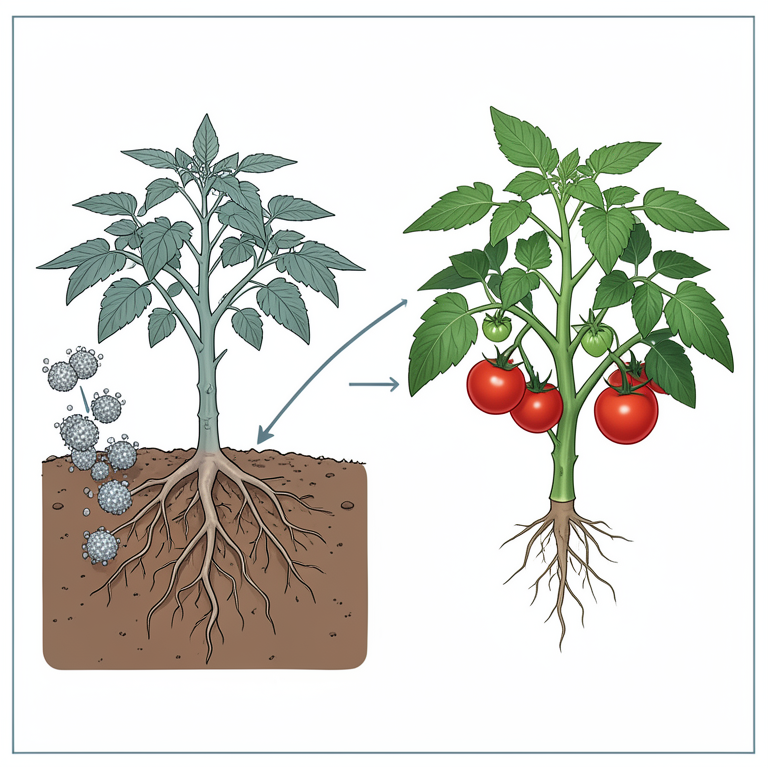
Bioinoculant Mechanism
AI-generated conceptual illustration (tomato plants and Azotobacter bacteria in soil). It explains the idea and does not show study data.
View source evidence ↗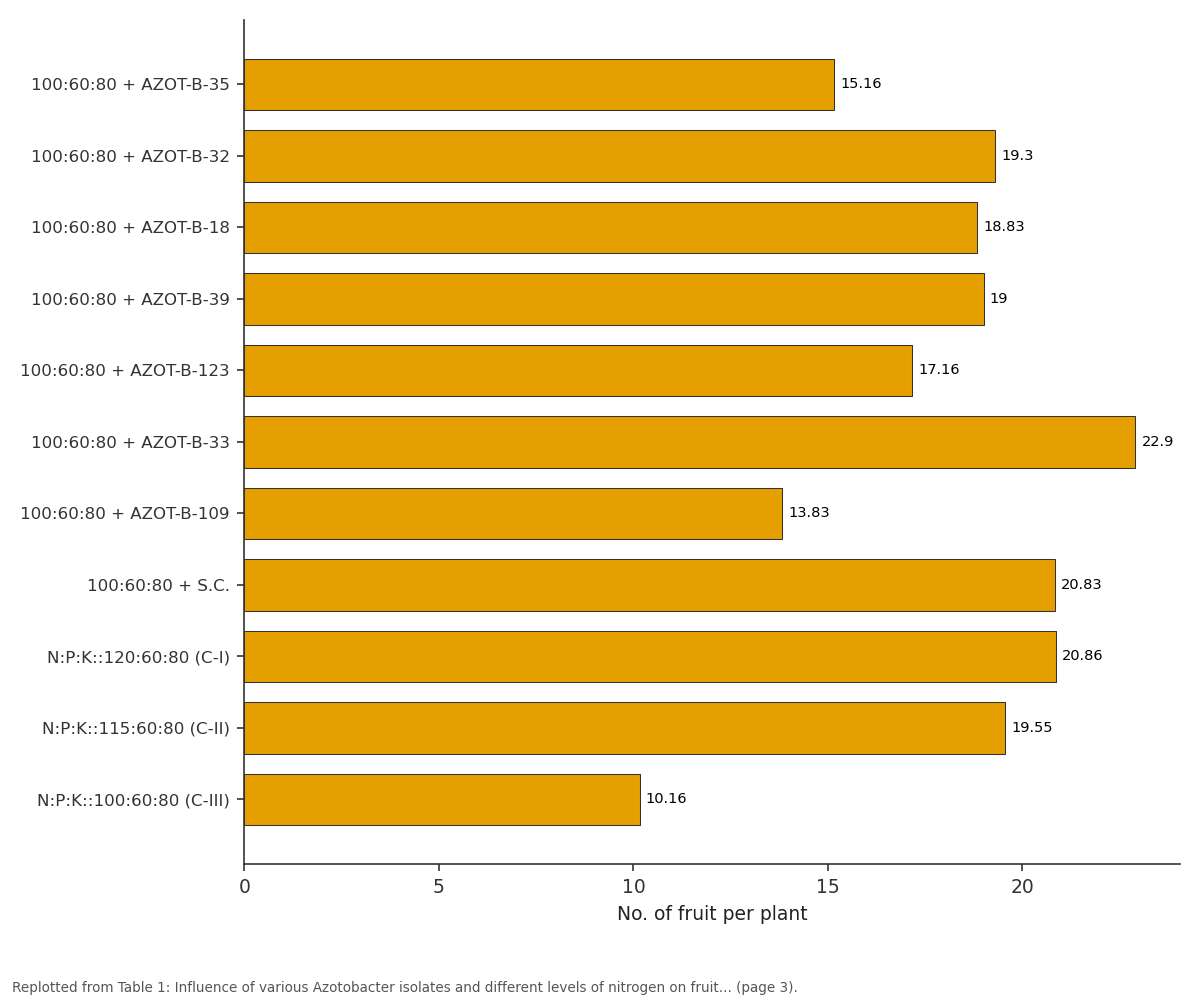
No. of fruit per plant: 100:60:80 + AZOT-B-35 vs 100:60:80 + AZOT-B-32 vs 100:60:80 + AZOT-B-18 vs 100:60:80 + AZOT-B-39 vs 100:60:80 + AZOT-B-123
Replotted from Table 1 (page 3) of the original paper. Every bar is the paper's own table value.
View source evidence ↗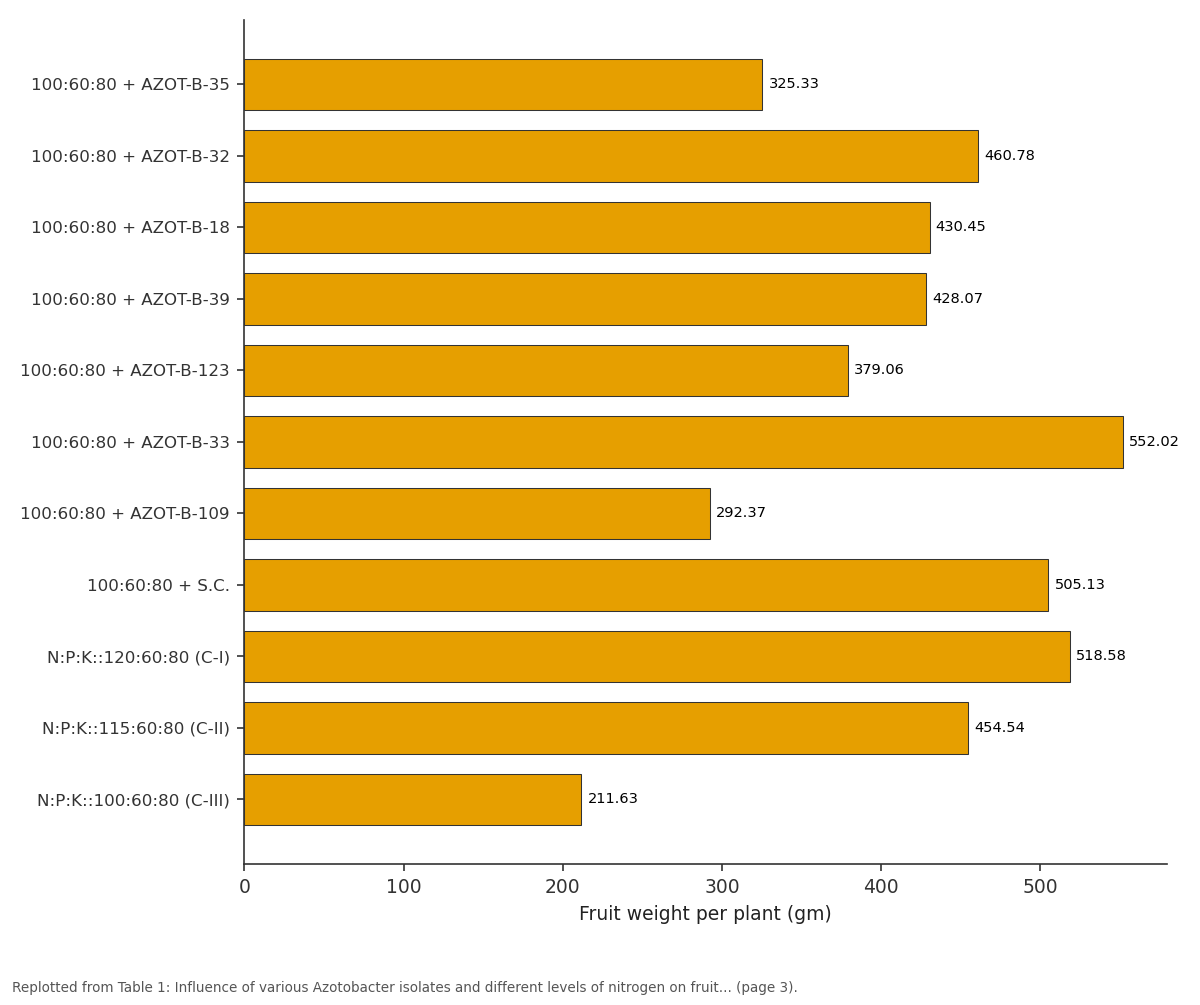
Fruit weight per plant (gm): 100:60:80 + AZOT-B-35 vs 100:60:80 + AZOT-B-32 vs 100:60:80 + AZOT-B-18 vs 100:60:80 + AZOT-B-39 vs 100:60:80 + AZOT-B-123
Replotted from Table 1 (page 3) of the original paper. Every bar is the paper's own table value.
View source evidence ↗Figures & tables
From the original paper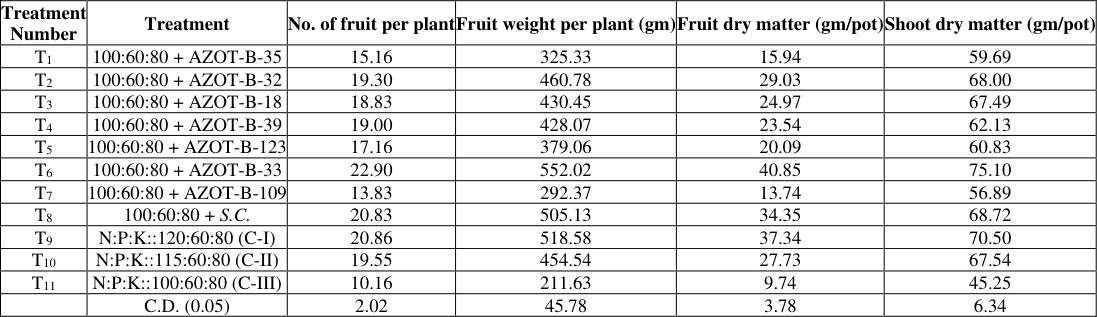 Table 1
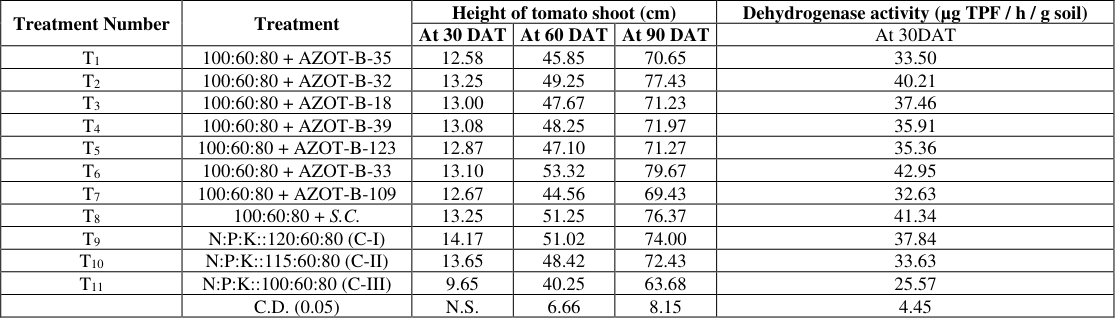 Table 2
Introduction
Tomato (Lycopersicon esculentum Mill.) is one of the most important vegetable crops. It belongs to family solanaceae and is believed to be a native of western South America. This crop is also known as an industrial crop because of its outstanding processing qualities. Tomato (Solanum lycopersicum) is one of the most significant vegetable crops in India, ranking second globally in terms of both production and area. China is the world's greatest producer, accounting for 27.8% of total production, followed by India (11.2%) (Kumar et al., 2016; Harisha et al., 2019; Gupta et al., 2021) [12,9,8] . Tomato It is a good source of B, C, and Fe vitamins. Energy (18 kcal), proteins (0.95 g), fats (0.11 g), carbohydrates (4.01 g), total sugars (2.49 g), calcium (11 mg), iron (0.68 mg), magnesium (9 mg), phosphorus (28 mg), potassium (218 mg), sodium (11 mg), zinc (0, 14 mg), vitamin A (1100 I.U.), vitamin C (22.8 mg), thiamin (0.036 mg), riboflavin (0.022 mg), vitamin B6 (0.079 mg), vitamin E (0.56 mg), lycopene (20 -50 mg), titratable acidity (7.5-10 mg /100 ml), total solids (4-7%), fiber (0.6 g), total saturated fatty acids (0.015 g), and total polyunsaturated fatty acids (0.044 g) are all present in an edible portion of tomatoes.Several epidemiological studies indicated beneficial effects of tomato consumption in the prevention of some major chronic disease, such as cancer and cardiovascular disease (Anon., 2013) [4] . In India, it is mainly grown in Bihar, Karnataka, Uttar Pradesh, Orissa, Andhra Pradesh, Maharashtra, Madhya Pradesh, Assam and Chhattisgarh, accounting for growing on 86.5 million hectares, it yields 210.56 million tons of output with a productivity of 24.34 MT/ha. The main states that produce tomatoes are Tamil Nadu, Odisha, and Madhya Pradesh. Gujarat, Karnataka, Andhra Pradesh, Maharashtra, West Bengal, Bihar, and Chhattisgarh (Anon., 2021) [3] . During last one hundred years, large numbers of aerobic and anaerobic bacteria have been identified as free-living nitrogen fixers. Their N fixing potential ranging from 2mg to 25mg per gram of carbon source utilized. Amongst these potential N-fixer Azotobacter is one that fixes nitrogen in non-legumes. Azotobactor is a heterotrophic free living nitrogen fixing bacteria present in alkaline and neutral soils. Azotobactor chrococcum is the most commonly occurring species in arable soils of India. Apart from its ability to fix atmospheric nitrogen in soils, it can also synthesize growth promoting substances viz., auxins, and gibberellins and also to some extent the vitamins.
Many strains of Azotobactor also exhibit fungicidal properties against certain species of fungus. Response of Azotobactor has been seen in rice, maize, cotton, sugarcane, pearl millet, vegetable and some plantation crops. Its population is very low in uncultivated lands. Presence of organic matter in the soil promotes its multiplication and nitrogen fixing capacity. Area of Chhattisgarh state with is bigger than many states of atmospheric N2 fixing and P mobilizing microbial inoculation, as has a demand for identified by analysis of soil samples of various district of this state. The low population density of above heterotrophs are mainly due to high air temperature up to 48 ºC, soil surface temperature beyond 60 ºC and low humidity up to 3-4% for prolonged period of summer season resulting to loss of organic matter and population of beneficial microbes. Azotobacter spp. is also sensitive to acidic pH, high salts and temperature above 35 ºC, so its population is very poor in soils of Chhattisgarh. The soil of Chhattisgarh is low to medium in available nitrogen thus N is one of the most limiting plant nutrients. In the light of ever increasing prices coupled with increasing demand of chemical fertilizers and depleting soil fertility necessitates developing effective bioinoculant of Azotobacter for tomato crop. In this view of above it may worthwhile to develop the specific location effective Azotobacter isolates for tomato.
Materials and Methods
The Experiments were conducted in soil microbiology laboratory and glass house of department of agricultural microbiology, College of Agriculture, Raipur, during 2022-23. The experimental farm is located at 21 o 16 N latitude and 81 o 36 E longitude with an altitude of 298.56 meters above mean sea level. The climate of the area ranges from dry-sub humid to semi-arid is located at 21 o 16 N latitude and 81 o 36 E longitude with the maximum temperature rising up to 60 o C during summer. The mean annual rainfall of 1200-1300mm, about 85% is received during third week of June to mid-September. The recommended additional rate of fertilizer for tomato is 120:60:80 kg.ha -1 of N, P2O5 and K2O, respectively. The cultivar used in the study was C.V. Pusa Rubi. Eleven treatments, complete in a randomized block design included: T1 (AZOT-B-35+100:60:80 NPK), T2 (AZOT-B-32+100:60:80 NPK), T3 (AZOT-B-18+100:60:80 NPK), T4 (AZOT-B-39+100:60:80 NPK), T5 (AZOT-B-123+100:60:80 NPK), T6 (AZOT-B-33+100:60:80 NPK), T7 (AZOT-B-109+100:60:80 NPK), T8 (IARI, S.C.+100:60:80 NPK), T9 (control-I+120:60:80 NPK), T10 (control-II+115:60:80 NPK) and T11 (control-III+100:60:80 NPK). Forty local Azotobacter isolates and standard Azotobacter IARI isolate (standard check) were collected from Microbial Culture Bank of Department of Agricultural Microbiology, CoA, Raipur and were taken for the study. During this experiment, seven top performing isolates were compared with the same standard check and three uninoculated control contained 100:60:80, 115:60:80 and 120:60:80 kg N, P2O5 and K2O, respectively. The soil was vertisol.
Results and Discussion
In the present study a total of forty local Azotobacter isolates and standard Azotobacter IARI isolate (standard check) were tested as nitrogen fixing efficiency of Azotobacter isolates with respect to plant height, fruit yield and biomass accumulation study of tomato. The results obtained from these studies are as follows
Nitrogen fixing efficiency of Azotobacter isolates
The nitrogen fixing ability of local Azotobacter isolates and standard check was tested for initial screening of the isolates.
The range of nitrogen quantity fixed in the N-free Jensen's liquid medium varied from 2.35 to 13.45 mg N/gm of sucrose (0.0047 to 0.0269% N) after seven days of incubation. Three local Azotobacter isolates i.e. AZOT-B-33, 32 and 18 were found at par with standard check (standard Azotobacter IARI isolate). Among all isolates, isolate number 33 fixed maximum quantity of nitrogen in the medium i.e. 13.45 mg N/gm sucrose (0.0269% N), followed by isolate No.32 which fixed 13.15 mg N/gm sucrose (0.0263% N) after seven days of incubation. The standard check released 13.10 mg N/gm sucrose (0.0262% N) after seven days of incubation. Agrawal and Singh (2002) [2] also conducted similar type of experiment to select effective Azotobacter strains by their nitrogen fixing capacity, growth and survival under stress environment.
Plant height
The data pertaining to plant height study is presented in Table 2. The application of different local isolates and standard check, compared with controls, maximum plant height (53.32 cm) was observed in the plants grown with 100:60:80:: NPK and local isolate AZOT-B-33 which was found at par with treatment CI. Minimum plant height 40.25 cm was recorded in the treatment CIII i.e. 100 kg N. As compared to CIII, significantly highest plant height was observed in AZOT-B-33 with 100:60:80 NPK level, followed by standard check at the same level of nitrogen. All the local Azotobacter isolates and standard check with 100:60:80 NPK level showed at par plant growth with control I (120:60:80 NPK).The inoculations with different Azotobacter isolates were highly effective in increasing the height of plants. Mahato et al. (2009) [13] observed that application of Azotobacter increased the shoot length and more number of leaves per plant. This observation was also in line with that of Martinej et al. (1993) [14] and Umar et al. (2009) [18] who clearly mentioned that application of Azotobacter resulted increase of shoot length and more number of leaves.
| Treatment Number | Treatment | Height of tomato shoot (cm) | — | — | Dehydrogenase activity (µg TPF / h / g soil) |
|---|---|---|---|---|---|
| At 30 DAT | At 60 DAT | At 90 DAT | At 30DAT | ||
| T1 | 100:60:80 + AZOT-B-35 | 12.58 | 45.85 | 70.65 | 33.50 |
| T2 | 100:60:80 + AZOT-B-32 | 13.25 | 49.25 | 77.43 | 40.21 |
| T3 | 100:60:80 + AZOT-B-18 | 13.00 | 47.67 | 71.23 | 37.46 |
| T4 | 100:60:80 + AZOT-B-39 | 13.08 | 48.25 | 71.97 | 35.91 |
| T5 | 100:60:80 + AZOT-B-123 | 12.87 | 47.10 | 71.27 | 35.36 |
| T6 | 100:60:80 + AZOT-B-33 | 13.10 | 53.32 | 79.67 | 42.95 |
| T7 | 100:60:80 + AZOT-B-109 | 12.67 | 44.56 | 69.43 | 32.63 |
| T8 | 100:60:80 + S.C. | 13.25 | 51.25 | 76.37 | 41.34 |
| T9 | N:P:K::120:60:80 (C-I) | 14.17 | 51.02 | 74.00 | 37.84 |
| T10 | N:P:K::115:60:80 (C-II) | 13.65 | 48.42 | 72.43 | 33.63 |
| T11 | N:P:K::100:60:80 (C-III) | 9.65 | 40.25 | 63.68 | 25.57 |
| C.D. (0.05) | N.S. | 6.66 | 8.15 | 4.45 |
Table text extracted from the original PDF; superscript letters are shown inline. The original table image is below.
View original table image
Fruit number
The data on the influence of different local Azotobacter isolates and different levels of nitrogen on fruit number of tomato is presented in Table 1. Maximum number of fruits per plant was recorded due to inoculation of local isolate AZOT-B-33 (22.90) followed by control C-I (120:60:80 NPK) (20.86) and standard check inoculated plants (20.83). The number of fruit increased significantly in plants due to inoculation with local local isolate AZOT-B-33 over standard check at the same level of nitrogen (100kg N) and also over higher nitrogen doses, i.e.115 (C-II) & 120 kg /ha (C-I).
| Treatment Number | Treatment | No. of fruit per plant | Fruit weight per plant (gm) | Fruit dry matter (gm/pot) | Shoot dry matter (gm/pot) |
|---|---|---|---|---|---|
| T1 | 100:60:80 + AZOT-B-35 | 15.16 | 325.33 | 15.94 | 59.69 |
| T2 | 100:60:80 + AZOT-B-32 | 19.30 | 460.78 | 29.03 | 68.00 |
| T3 | 100:60:80 + AZOT-B-18 | 18.83 | 430.45 | 24.97 | 67.49 |
| T4 | 100:60:80 + AZOT-B-39 | 19.00 | 428.07 | 23.54 | 62.13 |
| T5 | 100:60:80 + AZOT-B-123 | 17.16 | 379.06 | 20.09 | 60.83 |
| T6 | 100:60:80 + AZOT-B-33 | 22.90 | 552.02 | 40.85 | 75.10 |
| T7 | 100:60:80 + AZOT-B-109 | 13.83 | 292.37 | 13.74 | 56.89 |
| T8 | 100:60:80 + S.C. | 20.83 | 505.13 | 34.35 | 68.72 |
| T9 | N:P:K::120:60:80 (C-I) | 20.86 | 518.58 | 37.34 | 70.50 |
| T10 | N:P:K::115:60:80 (C-II) | 19.55 | 454.54 | 27.73 | 67.54 |
| T11 | N:P:K::100:60:80 (C-III) | 10.16 | 211.63 | 9.74 | 45.25 |
| C.D. (0.05) | 2.02 | 45.78 | 3.78 | 6.34 |
Table text extracted from the original PDF; superscript letters are shown inline. The original table image is below.
View original table image
Fruit weight
The data on fruit weight of tomato presented in Table 1 and illustrated, which revealed that inoculation with all local Azotobacter isolates significantly increased the fruit weight over control CIII (100:60:80). The highest fruit weight was observed under treatment 100:60:80 NPK + AZOT-B-33 (552.02 gm/plant) followed by treatment C-I (120:60:80NPK) (518.58 gm) and standard check (505.13 gm) with100:60:80 NPK level. Higher fruit yield of tomato in Azotobacter inoculated plants is associated with the efficient fixation of nitrogen as well as metabolic products of Azotobacter like gibberellins, indole acetic acid and cytokinin might have helped in inducing early flowering, fruit setting, fruit picking and also increased number of flowers and fruits per cluster (Bhadoria et al., 2007) [5] . This view was corroborated with the observations of Jackson et al. (1964) [11] and Aeon & Barea (1975) [1] who mentioned that favorable environment, as the roots provide through proper aeration for better bacterial activity resulting in more nitrogen fixation and higher growth attributes with seedling inoculation with Azotobacter as compared to soil inoculation with Azotobacter. Tilak et al. (2005) [17] through their detailed study on soil health supporting bacteria concluded that yield improvement of crops is attributed more to the ability of Azotobacter to produce plants growth promoting substance such as phytoharmonce IAA and siderophore azotobactin, rather than to diazotrophic activity.
Fruit dry matter
The results on the effect of Azotobacter inoculation with local isolates as well as standard Azotobacter check on fruit dry matter yield are presented in Table 1. The results clearly elucidate that inoculation of tomato seedlings with local Azotobacter isolates and standard check with NPK level of 100:60:80 significantly increased the dry matter accumulation by fruit over only application of fertilizer @ 100:60:80 (C-III). Highest dry biomass of fruit was found with isolate No. AZOT-B-33 (40.85 gm/pot), followed by uninoculated control C-I (37.34 gm) with fertilizer dose of 120:60:80 kg NPK. The local Azotobacter isolate AZOT-B-33 significantly accumulated higher fruit dry matter over inoculation of standard check. Simultaneously the same isolate AZOT-B-33 and standard check was found at par with the performance of highest nitrogen dose i.e. 120 kg/ha to increase the fruit dry matter yield.
Shoot dry matter
The effect of inoculation with different local Azotobacter isolates vis-à-vis different levels of nitrogen on shoot dry matter yield was recorded and tabulated in Table 1. Data showed that Highest biomass accumulation (75.10 gm/pot) was recorded in treatment T6 (Plate) which received local Azotobacter isolate AZOT-B-33, followed by control CI (120:60:80) (70.50 gm/pot), standard Azotobacter check (68.72gm) and treatment T2 with local isolate AZOT-B-32(68.00gm/pot). The dry matter yield of shoot increased significantly in plants due to inoculation with local isolate AZOT-B-33 over standard Azotobacter check in presence of same level of nitrogen. This increase in plant biomass might be due to the impact of Azotobacter on tomato plants. Plant growth promoting rhizobacteria use one or more of direct or indirect mechanisms of action to improve plant growth and health. Biological N-fixation, P-solubilisation, improvement of other plant nutrients uptake and phytohormone production like indole-3-acetic acid are some examples of mechanisms that directly influence plant growth (Glick et al., 1995) [7] . Similar findings were also reported by Puertas and Gonzales (1999) [15] who clearly mentioned that the inoculation with Azotobacter alone significantly increased the root depth, shoot height, fresh and dry weights of root and shoots of tomato.
Biological control of plant pathogens and deleterious microbes, through the production of antibiotics, lytic enzymes, hydrogen cyanide and siderophores or through competition for nutrients and space can improve significant plant health and promote growth as evidenced by Increases in seedling emergence, vigor and yield (Hilal et al., 1997) [10] .
Dehydrogenase activity
The analysis data related to biochemical property of soil due to inoculation of local Azotobacter isolates and standard check of Azotobacter are presented in Table 2. It is apparent from the data that inoculation of tomato seedling roots with crop beneficial bacterium Azotobacter significantly increased the activity of dehydrogenase enzyme (DHA) in soil at 30 DAT over uninoculated control C-III. It is clear from the data that highest value of DHA was found due to local Azotobacter isolate AZOT-B-33 (42.95 µg TPF/h/g soil), followed by standard check of Azotobacter (41.34 µg TPF). Lowest DHA was recorded in uninoculated control pot C-III. Significant increase in DHA of soil was noticed which varied from 25.57 µg TPF (C-III) to 42.95, 41.34, 40.21, 37.46, 35.91, 35.36, 33,50 and 32.63 µg TPF /h/g soil due to inoculation of crop with AZOT-B-33, standard check, AZOT-B-32, 18, 39, 123, 35 and 109, respectively. The local Azotobacter isolate AZOT-B-33 was found significantly superior over all the three uninoculated control C-I, II & III but at par with the standard check. The dehydrogenase activity of local Azotobacter isolate AZOT-B-32 was found significantly superior over uninoculated control C-II & C-III but found at par with C-I (120:60:80 NPK).Enzymes in the soil are biologically significant as they participate in various transformations and influence the availability of plant nutrients. The dehydrogenase enzyme systems apparently fulfill a significant role in the oxidation of soil organic matter as they transfer hydrogen from substrates to acceptors. Many different specific dehydrogenase systems are involved in the dehydrogenase activity in soils; these systems are an integral part of the microorganisms. Therefore, the result of the assay of dehydrogenase activity would show the average activity of the active population. also expressed the similar views and mentioned that in soil microorganisms, active roots and dead cells are the principal sources of enzymes. were also of the opinion that the increase in dehydrogenase activity was mainly due to the higher microbial population. The earlier studies revealed that the enzyme activities are often used as indices of microbial growth rather than the microbial number, which further may reflect the microbial respiration and the potential capacity of soil to perform biological transformations of importance to soil fertility.
Acknowledgement
AcknowledgmentI am grateful to the Department of Agril. Microbiology, IGKV. Raipur (C.G.), for providing facilities for this research.
References
16 in the original paper- Aeon R, Barea JM. Synthesis of auxins, gibberellins and cytokinins by Azotobacter vinelandii and Azotobacter beijerinckii related to effects produced on tomato plants. Plant Soil. 1975;43:96-103.
- Agrawal N, Singh HP. Selection of Azotobacter strains for growth and survival under stress condition. Biotechnology of Microbes and Sustainable Utilization. 2000;75-80.
- Anonymous. Director Horticulture and Farm Forestry; 2021.
- Bhadoria SKS, Dwivedi YC, Kushaeah SS. Flowering and fruiting behaviour of tomato as affected by Azotobacter and nitrogen. Indian J. Hortic. 2007;64(3):366-368.
- Giovannucci E. Tomatoes, tomato-based products, lycopene and cancer. Review of the epidemiological literature. J. Natl. Cancer Inst. 1999;91:317-331.
- Glick BR, Karaturovic DM, Newell PC. A novel procedure for rapid isolation of plant growth promoting bacteria. Can. J Microbiol. 1995;41:533-536.
- Gupta BK, Dwivedi SV, Mishra BP, Mishra D, Ojha PK, Verma AP, Kalia A. Adoption gap analysis in tomato cultivation in Banda District of Bundelkhand (U.P.). Indian Journal of Extension Education. 2021;57(4):126-130.
- Harisha N, Tulsiram J, Meti SK, Chandargi DM, Joshi AT. Extent of adoption of tomato cultivation practices among farmers under shade nets in Kolar District of Karnataka. Indian Journal of Extension Education. 2019;55(1):28-33.
- Hilal AS, Elian MI, Matwally AH, Deeb AA. Peanut disease in Egypt. Factor affecting healthy survival plants, pod rots and yield. Annals Agril. Sci. Mashtophar. 1997;28(3):1557-1567.
- Jackson RM, Brown ME, Burlingham SK. Similar effects on tomato plants of Azotobacter inoculation and application of gibberellins. Nature. 1964;203:851-852.
- Kumar P, Chauhan RS, Grover RK. Economics analysis of tomato cultivation under poly house and open field conditions in Haryana, India. Journal of Applied and Natural Science. 2016;8(2):846-848.
- Mahato P, Badoni A, Chauhan JS. Effect of Azotobacter and nitrogen on seed germination and early seedling growth in tomato. Researcher. 2009;1(4):62-66.
- Puertas A, Gonzales LM. Aislamiento de cepas nativas de Azotobacter chroococcum en la provincial gramna y evaluación de su actividad estimuladora en plántulas de tomate. Cell. Mol. Life Sci. 1999;20:4-7.
- Rahhem ADB, Shanshoury EL, Hassan MA, Ghaffer-Abdel BA. Synergistic effect of vesicular-arbuscular mycorrhizas and Azotobacter chroococcum on the growth and the nutrient contents of tomato plants. Phyton (Austria). 1988;29(2):203-212.
- Tilak KVBR, Ranganayaki N, Pal KK, De R, Saxena AK, Shekhar C, Nautiyal S, Mittal S, Tripathi AK, Johri BN. Current Science. 2005;89(1):136-150.
- Umar I, Wali V, Kumar R, Jamwal M. Effect of FYM, urea and Azotobacter on growth, yield and quality of strawberry Cv. Chandler. Notulae Botanicae Horti Agrobotanici ClujNapoca. 2009;37(1):139-134.
Cited by 2
From OpenAlex, OpenCitations and reference lists read by Scinovex
- Role and perspective of Azotobacter in crops production ↗
Reginawanti Hindersah, Nadia Nuraniya Kamaluddin, Suman Samanta, Saon Banerjee, Sarita Sarkar · Sains Tanah - Journal of Soil Science and Agroclimatology · 2020
Low nitrogen content in soil is usually overcome by chemical fertilization. After long application period, high-dose and intensive use of N fertilizers can cause ammonia volatilization and nitrates accumulation in soil. In sustainable agriculture, the use of bacterial inoculant integrated with nutrient management system has a role in soil health and productivity. Azotobacter-based biofertilizer is suggested as a chemical nitrogen…
❝ 34PDF - The nutmeg seedlings growth under pot culture with biofertilizers inoculation ↗
Reginawanti Hindersah, Agustinus Marthin Kalay, Henry Kesaulya, Cucu Suherman · Open Agriculture · 2021
Abstract Nutmeg is important for national and community revenue mainly in Maluku Province where nutmeg seedlings are grown in low-fertility soil without fertilizer. A greenhouse experiment was performed to evaluate the response of nutmeg seedlings following the application of two different biofertilizer concortia. The experimental design was completely randomized block design, which tested the combination treatments of two rates and…
❝ 15PDF